
HMRC's New Sanctionable Conduct Powers Explained
HMRC's new sanctionable conduct powers allow it to investigate, fine, and publicly name tax advisers for deliberate non-compliance.
 Swikriti ThakuriAug 29, 2026Updated Sep 28, 2026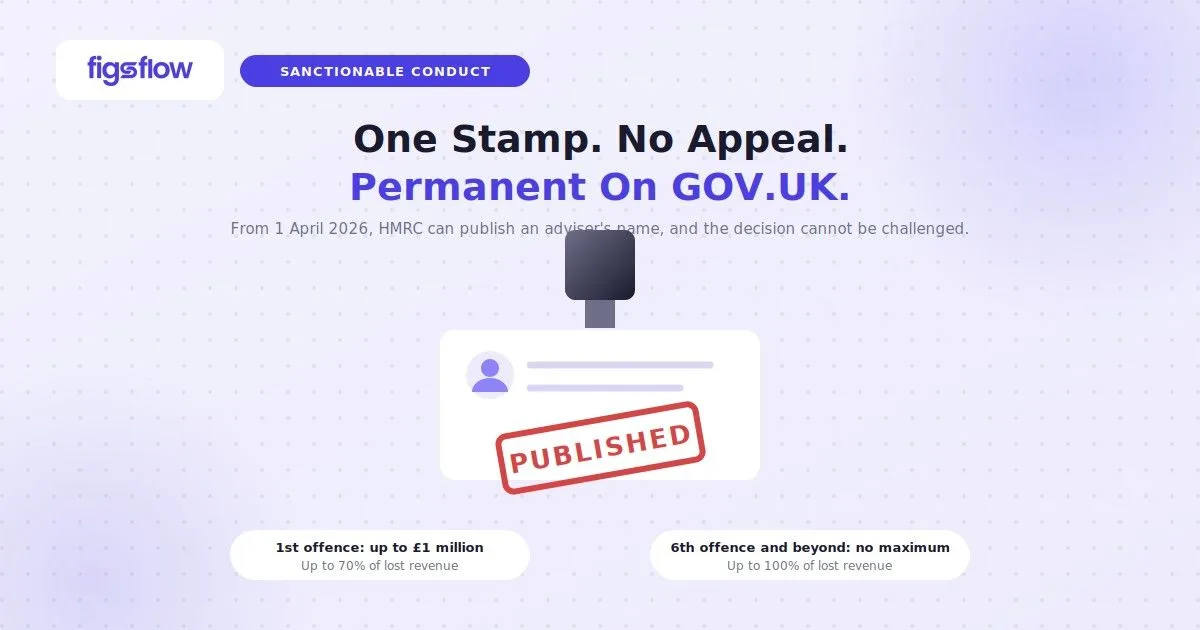
Tax advisers have long understood that their clients’ errors can attract HMRC scrutiny. Since 1 April 2026, that scrutiny has extended to the adviser directly.
Under new enforcement powers, HMRC can investigate, penalise, and publicly name any tax adviser who knowingly contributes to a tax loss. The penalties are substantial. The reputational consequences can be permanent. And unlike most HMRC sanctions, the decision to publish an adviser’s details cannot be appealed.
Who This Sanctionable Conduct Regime Applies To
The rules apply to any individual or organisation that assists others with their tax affairs. That scope is deliberately broad. It covers sole practitioners, partnerships, and advisory firms of any size.
The trigger is sanctionable conduct, which HMRC defines as a knowing action that causes, or intends to cause, a tax loss. The word knowing is doing significant work here. This is not a regime designed to catch honest mistakes. It targets deliberate facilitation.
HMRC’s guidance sets out two examples of conduct that would fall within scope:
- Claiming a tax repayment for a client who is not entitled to it
- Submitting an incorrect tax return to HMRC on behalf of a client
Both examples share the same characteristic. The adviser acted in a way they knew, or should have known, to be wrong.
How An Investigation is Opened
When HMRC suspects sanctionable conduct, it issues a file access notice. The adviser must hand over working papers and audit files, including any documents used to prepare a client’s accounts.
At this stage, the adviser has not been found to have done anything wrong. The notice is an investigative tool. But the obligations attached to it carry their own financial consequences.
If working papers contain inaccuracies, HMRC can charge:
- Up to £3,000 for a single inaccuracy
- Up to £3,000 per inaccuracy where more than one is found
Failing to provide the papers at all triggers a £300 penalty, followed by daily penalties of up to £60. In serious cases, HMRC can apply to a tribunal to increase the daily penalty to £1,000.
Before any formal finding is made, the adviser has an opportunity to provide evidence disputing HMRC’s assessment. That safeguard exists, but it sits within a process that moves on HMRC’s terms.
How Penalties Are Calculated
Where HMRC decides sanctionable conduct has occurred, it issues a conduct notice. The notice sets out its assessment and signals that a financial penalty will follow.
Penalties are calculated as a percentage of the potential lost revenue (PLR) attributable to the adviser’s conduct. The structure escalates with repeat offences:
| Number of Penalties | Percentage of PLR | Maximum Penalty Amount |
|---|---|---|
| 1 | Up to 70% | £1 million |
| 2 to 5 | Up to 85% | £5 million |
| 6 or more | Up to 100% | No maximum amount |
Where PLR cannot be determined, the minimum penalty is £7,500.
When working out the amount, HMRC takes into account how the adviser responded to the file access notice, whether and when they disclosed their conduct, how much they cooperated with the investigation, and their penalty history.
That history matters beyond a single case. Penalties issued within four years of each other can be used to increase the rate applied to future sanctions. All penalties expire 20 years after they are issued.
Advisers have the right to appeal a penalty. That right is important and should not be overlooked in the pressure of an active investigation.
When HMRC Publishes Your Details
A penalty of more than £7,500 triggers mandatory publication on GOV.UK. HMRC will notify the adviser in advance. But the decision to publish cannot be challenged.
The information HMRC may publish includes:
- Name and postcode
- The nature of the adviser’s business
- The periods during which the conduct occurred
- The penalty amount
- Any other details necessary to make the identification clear
If HMRC determines that naming the adviser alone is insufficient to identify them clearly, it may also publish details of the firm they work for or have worked for. The firm will be notified in advance and given the opportunity to respond. That does not mean the publication can be prevented.
For most advisers, a financial penalty is recoverable. A name on a public register is not.
What Tax Advisers Should Do Now
The regime has been in force since 1 April 2026. Preparation at the practice level is not optional. There are four areas that require immediate attention.
- Review working paper standards. Inaccuracies carry penalty exposure before any conduct finding is made
- Clarify the internal threshold. Every practice needs a shared understanding of where legitimate planning ends and knowing facilitation begins
- Document difficult client instructions. If a client requests something an adviser believes to be incorrect, the working paper trail should show how it was handled
- Know your rights. A conduct notice can be disputed. A penalty can be appealed. Both require timely action
The rules are clear. Practices that have not yet reviewed their exposure should treat it as overdue, not upcoming.
Conclusion
Tax practice has always carried professional risk. Since April, the risk has sat with the adviser directly, not just the client.
HMRC’s new powers draw a clear line between advising and enabling. The financial penalties are serious. The public register is permanent. And neither outcome requires a pattern of behaviour. A single knowing act is enough to open the process.
Good practice has always been its own protection. Since April, it has also been the only one available.