
The Future of Accounting: What the Next Decade Holds
The future of accounting is advisory-led and AI-augmented. See how jobs, skills and firms are evolving through 2034, and how to prepare now..

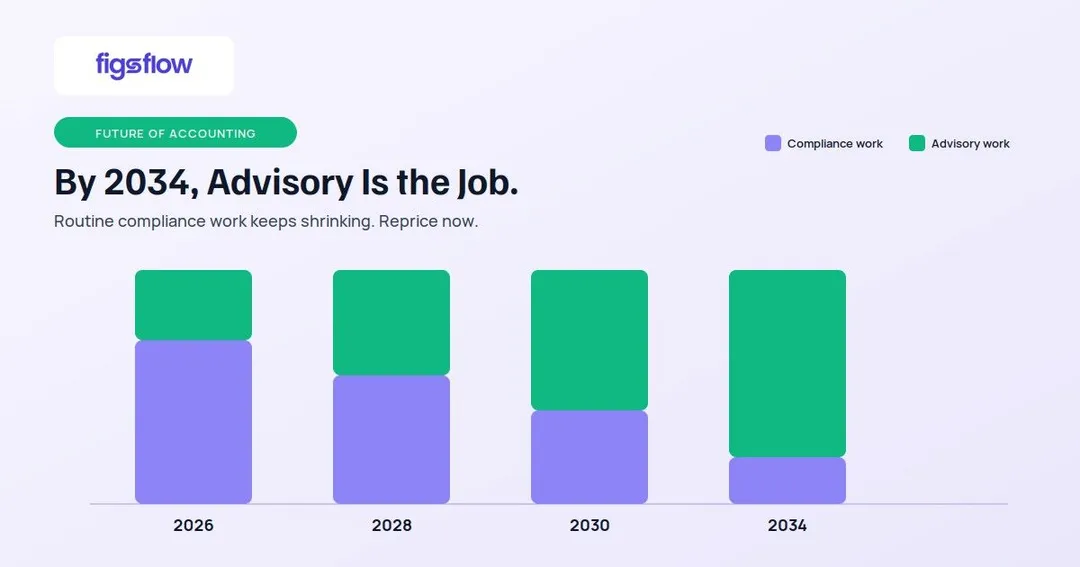
The future of accounting is changing faster than most firms expect. Software now handles a growing share of the routine work, bookkeeping, categorization, first pass review, that used to fill a staff accountant’s day, and that share keeps growing. Over the next decade, routine compliance work keeps shrinking, entry level roles get harder to fill in their old form, and advisory work becomes the main service most firms sell. Firms that plan for this now build an advantage. Firms that wait get forced into the same changes later, on worse terms. This is a decade by decade look at where the work goes, which future of accounting jobs actually grow, and what a firm needs to build now to be worth more in ten years, not less.
What's Already Automated
- Bank feed reconciliation and transaction categorization
- First pass review and exception flagging
- Standard journal entries and month end close routines
- Routine compliance filings built on structured, clean data
What Hasn't Changed Yet
- Judgment calls on ambiguous or incomplete transactions
- Explaining financial statements in the context of a client’s business
- Relationship management, renewals, and scope conversations
- Final sign off and the professional liability that comes with it
Did You Know?The U.S. Bureau of Labor Statistics projects employment for accountants and auditors to grow 5 percent from 2024 to 2034, faster than average, with about 124,200 openings projected each year over the decade. Source, U.S. Bureau of Labor Statistics.
Will AI Replace Accountants by 2030?
No, accountants are not disappearing, but the job will look different by 2030. The tasks going away are the ones that never really needed a person’s judgment in the first place.
That is the honest answer to what the future of accounting with AI looks like. It is not about replacing accountants. It is about a smaller, more focused role built around the parts of the work a computer still cannot do on its own.
Task by Task, What Changes & What Doesn't
| Task | 2026 | 2030 | 2035 |
|---|---|---|---|
| Bank reconciliation | Manual review of exceptions | Automated, exception only | Fully automated |
| Bookkeeping and categorization | Mostly automated | Fully automated | Fully automated |
| Client advisory conversations | Occasional | Core service at growth firms | Primary billable service |
| Tax and compliance filing | Software assisted | Software led, staff signs off | Software led, staff signs off |
| Forecasting and planning | Rare, senior staff only | Standard mid market offering | Standard at most firm sizes |
The Skills That Don't Automate Away
Judgment does not automate. Neither does the ability to sit with a client and explain what a number really means, or to notice when a transaction looks fine but is not. Firms protecting their future teach these skills on purpose. They do not wait and hope staff will just pick them up over time.
For the broader question of whether the profession itself is shrinking, our companion piece covers that directly Read Is Accounting a Dying Field?
The Future of Accounting Jobs: A Compressed Career Ladder
Why There Are Fewer Entry Level Jobs
New accountants used to learn the job by doing repetitive, low level work. Data entry. Basic reconciliation. Routine categorization. Software now handles most of that. This does not mean firms need fewer people in the long run. It means the old way of training new staff no longer works.
What Firms Need to Train for Instead
If you are thinking about future of accounting careers, the starting point is moving up. A new hire used to spend two years just entering data before doing any real judgment work. Now firms need to teach thinking skills and client communication from day one.
Advisory Work Becomes the Main Service Firms Sell
Advisory led firms charge for results, not hours. They build regular forecasting and planning talks into every engagement instead of waiting for the client to ask. Compliance work becomes the starting point of the relationship, not the whole relationship.
Billing by the hour does not work once the hours keep shrinking. A firm still charging by the hour for work that software now does quickly is teaching the client to expect a smaller bill each year, not a better one. Fixed fees and pricing based on value hold up. Hourly billing on work a computer can do does not.
The Real Bottleneck Is Slow Onboarding, Not Skill
Most firms do not have a skill problem right now. They have a speed problem. Onboarding, proposals, and engagement letters take too long, and that slows down everything else, including the shift toward advisory work. A firm trying to bring on new clients while also building an advisory practice cannot do both if one proposal and engagement letter still take hours to put together by hand.
This is exactly what FigsFlow was built to fix. It creates a branded, client ready proposal and engagement letter in minutes instead of hours. That is not just a time saver. It gives a firm the capacity it needs to actually make the advisory shift, not just talk about it. See how FigsFlow handles proposals and engagement letters
Five Moves to Make Before 2030
- Reprice every engagement built on hours that automation has already shortened. If the task takes a third of the time, the invoice cannot stay the same.
- Move analytics and communication training earlier in a new hire’s first year. The old two year runway before judgment work no longer exists.
- Build one advisory offering into every compliance engagement. Even a single forecasting conversation per client changes the revenue mix over time.
- Automate the onboarding and proposal layer before it becomes the bottleneck. Capacity freed here funds everything else on this list.
- Set a firm wide target for advisory revenue as a share of total revenue, and review it annually. What gets measured gets built.
Conclusion
The shift from compliance work to advisory work is not a future possibility. It is the current direction of every metric available, and it moves faster each year software adoption increases. Firms that reprice, retrain, and rebuild their onboarding now spend the next decade compounding an advantage. Firms that wait spend it catching up on worse terms.
Before the next hiring cycle, ask what share of your billable hours a machine could already do, and what you are actually charging for the hours it cannot.