
Digital Signature vs Electronic Signature: What’s the Difference?
Confused about digital signature vs electronic signature? We explain the key differences, which is more secure, and what UK law says.

You’ve probably used “digital signature” and “electronic signature” as if they mean the same thing. For most of your career, that was fine.
However, the distinction now has a compliance consequence. Get it wrong, and your client’s repayment claim doesn’t get processed. But to understand why, you need to know what actually separates the two – and why digital signature vs electronic signature is no longer just a terminology debate.
An electronic signature is the legal umbrella term for any data in electronic form used to sign a document, from a typed name in an email to a cryptographically verified identity certificate. A digital signature is a specific subset of that. It uses Public Key Infrastructure technology to verify the signer’s identity and lock the document so that any change made after signing immediately invalidates it. In short, every digital signature is an electronic signature. However, not every electronic signature is a digital signature.
This guide draws the digital signature vs electronic signature line clearly – where it sits, which documents fall on which side of it, and what HMRC now requires from agents.
Digital Signature vs Electronic Signature: In Plain Terms
Digital signature vs an electronic signature isn’t just a terminology debate. It’s what happens behind it.

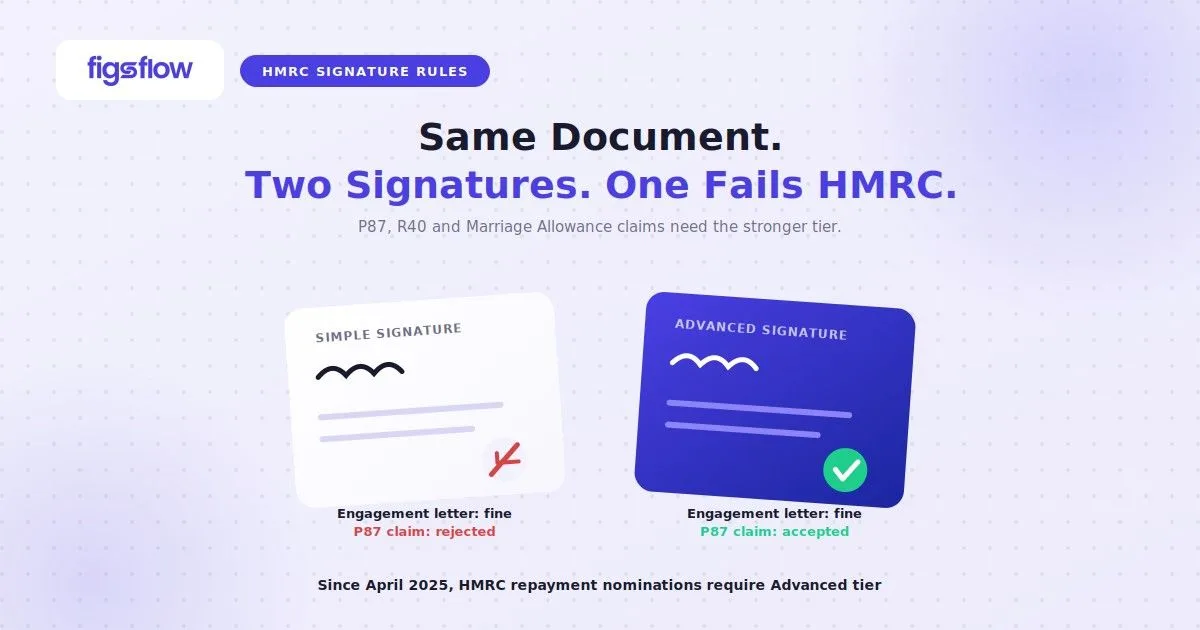
The simplest way to see a digital signature vs an electronic signature is through the same document, signed two different ways.
Your client signs an engagement letter through your platform. They receive a link, open the document on their phone, type their name, and click sign. The platform records their email address, IP address, and the exact time of signing. That’s a simple electronic signature. It’s legally valid for this document.
Now the same client signs a P87 repayment nomination as part of an HMRC submission. They receive a link, open the document, and before they can sign, the platform sends a one-time password to their mobile number. They enter it. That OTP is cryptographically linked to the document at the point of signing. If anything in the document changes after that moment, the signature is flagged as invalid. That’s an advanced electronic signature. It’s also a digital signature.
What Counts as an Electronic Signature Under UK Law?
Under Article 3 of the UK eIDAS Regulation, an electronic signature is:
data in electronic form, which is attached to or logically associated with other data in electronic form, and which is used by the signatory to sign.
The Electronic Communications Act 2000 makes it admissible as evidence in legal proceedings.
UK eIDAS recognises three tiers of an electronic signature.
What Counts as a Digital Signature?
Once you understand the digital signature vs electronic signature distinction, the definition becomes obvious. A digital signature is defined as:
an electronic signature that uses cryptographic technology to verify the signer’s identity and seal the document against tampering.
At the moment of signing, the platform creates a unique fingerprint of the document. That fingerprint is encrypted and locked to the signer’s identity. If anything in the document changes after signing, the fingerprint no longer matches, and the signature is immediately flagged as invalid.
Advanced and Qualified electronic signatures are both digital signatures. A simple electronic signature is not.
Digital Signature vs Electronic Signature: What Each One Actually Proves
Where digital signature vs electronic signature really matters is not validity – both are legally valid. It is what you can prove when a document is challenged.
For engagement letters, proposals, and standard client contracts, the simple tier is sufficient.
The table below matters once you move into HMRC submission territory.
Choosing the Right E-Signature Platform for Your Practice
Now you know which tier each document requires. The next question is which platform delivers it.
Which Signature Type Does Each Document Actually Need?
The digital signature vs electronic signature question has a practical answer for every document type your firm handles.
| Document | Minimum Tier Required | Why |
|---|---|---|
| Engagement letters | Simple Electronic Signature | Legally valid under UK law; no cryptographic verification needed |
| Proposals | Simple Electronic Signature | Same standard as engagement letters |
| Standard client contracts | Simple Electronic Signature | Sufficient unless the contract itself specifies otherwise |
| P87, R40, Marriage Allowance nominations | Advanced Electronic Signature | Required by HMRC from 6 April 2025 for agent repayment nominations |
| Documents requiring tamper-evidence for legal disputes | Advanced or Qualified Electronic Signature | Only AES/QES cryptographically lock the document against post-signing changes |
Conclusion
Digital signature vs electronic signature – the distinction is technical, but the compliance consequence is not. For most documents accounting firms handle, it doesn’t matter. A simple electronic signature on an engagement letter is legally valid.
The distinction starts to matter the moment you move into HMRC submissions territory. Since April 2025, agent repayment nominations on P87, R40, and Marriage Allowance forms require an Advanced Electronic Signature. A simple electronic signature no longer qualifies.
Practices that have this right now have one less compliance gap to worry about when HMRC asks.