
UK Dividend Tax Rates & Calculator 2026/27 | FigsFlow
UK dividend tax rates for 2026/27 are 10.75%, 35.75% and 39.35% with a £500 allowance. Worked examples, reporting rules and a free UK dividend tax calculator.
 Swikriti ThakuriAug 27, 2026Updated Sep 28, 2026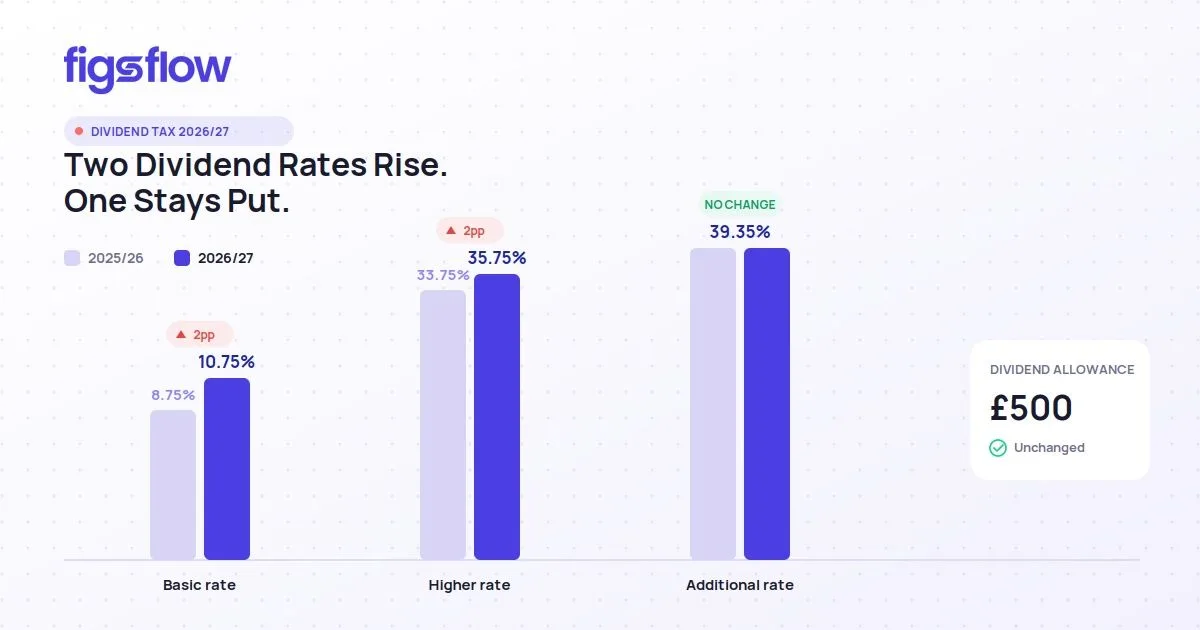
UK Dividend Tax Calculator 2026/27
Use this free UK dividend tax calculator to work out the exact 2026/27 dividend tax position for any client. Enter gross income and the net amounts paid for relief-at-source pension contributions and Gift Aid, plus any qualifying interest payments — the calculator grosses up reliefs, computes adjusted net income and the tapered Personal Allowance, extends the rate bands where the law allows, and stacks income in the statutory order: non-savings first, then savings, then dividends at 10.75%, 35.75% or 39.35%. The default figures reproduce Priya's worked example above, so you can verify the method before running your own numbers.
Work out a client’s 2026/27 dividend tax position
Enter gross annual income figures, and the net amounts actually paid for pension contributions and Gift Aid. The calculator grosses these up, works out adjusted net income and your Personal Allowance, extends the rate bands, then stacks income in the statutory order ‐ non-savings first, then savings, then dividends.
Income (gross)
Reliefs paid net (grossed up at 100/80)
Qualifying interest payments (ITA 2007 s383) — paid gross
| Total income | £52,000.00 |
| Adjusted net income (ANI) | £52,000.00 |
| ANI does not exceed £100,000 | full allowance retained |
| Personal Allowance for 2026/27 | £12,570.00 |
| set against non-savings income of £30,000.00 | − £12,570.00 → £0.00 left |
| Unused Personal Allowance | £0.00 |
| Taxable income after allowance | non-savings £17,430.00 · savings £2,000.00 · dividends £20,000.00 |
| Allowance applied in the beneficial order | ITA 2007 s25(2) |
| Slice | Amount | Rate | Tax |
|---|---|---|---|
| Non-savings, basic rate | £17,430.00 | 20% | £3,486.00 |
| Savings, PSA (£500 — higher-rate taxpayer) | £500.00 | 0% | £0.00 |
| Savings, basic rate | £1,500.00 | 20% | £300.00 |
| Dividends, allowance | £500.00 | 0% | £0.00 |
| Dividends, basic rate | £17,770.00 | 10.75% | £1,910.28 |
| Dividends, higher rate | £1,730.00 | 35.75% | £618.48 |
| Total income tax | £6,314.76 |
From 6 April 2026, the basic and higher dividend tax rates each rose by 2 percentage points. For the 2026/27 tax year, UK dividend tax rates remain an important consideration for tax planning. The rates are 10.75% for basic rate taxpayers, 35.75% for higher rate taxpayers, and 39.35% for additional rate taxpayers, after taking into account the dividend allowance.
This guide provides a quick reference for accountants, including the latest dividend tax rates, allowance details, examples, and practical points to consider when advising clients.
What Changed in the Dividend Tax Rates for 2026/27?
The basic and higher rates each went up 2 percentage points – the statutory labels are the "dividend ordinary rate" and "dividend upper rate" (ITA 2007 s8), which is the wording you'll see in the GOV.UK policy paper. The additional rate and the allowance stayed the same.
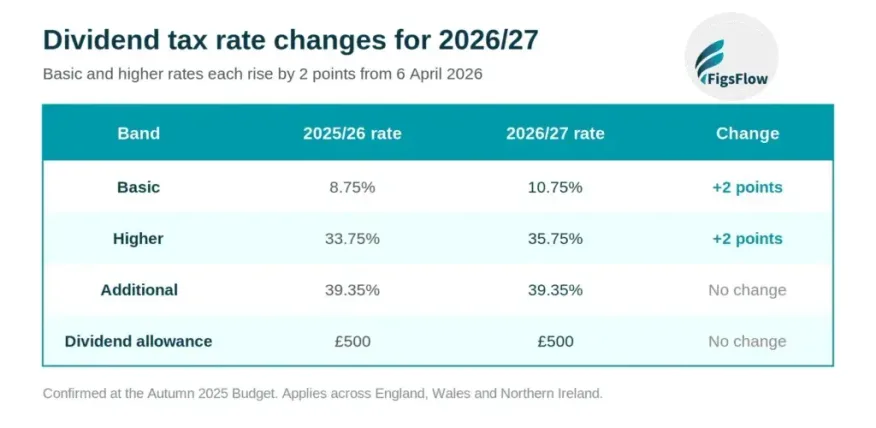
The change was confirmed at the Autumn 2025 Budget and started on 6 April 2026. The same rates apply across England, Wales and Northern Ireland. Scottish taxpayers also pay these UK-wide dividend rates, even though their other income follows Scottish bands.
Source: Changes to tax rates for property, savings and dividend income, GOV.UK.
How Much Is the Dividend Allowance for 2026/27?
The dividend allowance is £500 for 2026/27, the same as the two years before it. While the allowance remains unchanged, the increase in dividend tax rates means clients receiving dividends above this threshold may face a higher tax liability.
The allowance is taxed at 0%, but it still uses up £500 of your band. It does not give you extra basic-rate room. A higher-rate client uses their £500 at the higher-rate point, where their income already sits, not back at the basic rate.
How Do You Apply the Dividend Tax Rates?
Dividends are taxed last, after your other income has filled the bands below.
The order is fixed, salary, pension and rental income first, then savings income, then dividends on top. The band a dividend lands in depends on everything below it, not on how big the dividend is.
Method of Calculating Dividend Tax
- Add the dividends to all other income to find the total and the bands in play
- Use the Personal Allowance against other income first, then against dividends if any is left
- Take off the £500 dividend allowance, taxed at 0%
- Apply the relevant dividend tax rate, 10.75%, 35.75% or 39.35% — to the remaining dividends depending on which tax band they fall into
Worked Example
Priya runs a consultancy through her own company. She pays herself a £30,000 salary, earns £2,000 in interest on a business savings account held personally, and draws £20,000 in dividends across the year. All three sources stack in order to set the rate on her dividends.
| Computation | Non-savings (Salary) | Savings | Dividends | Total |
|---|---|---|---|---|
| £ | £ | £ | £ | |
| Income | 30000 | 2000 | 20000 | 52000 |
| Less: Personal allowance | (12570) | (12570) | ||
| Taxable income | 17430 | 2000 | 20000 | 39430 |
| Taxed at 0% | 500 | 500 | 1000 | |
| Taxed at 20% | 17430 | 1500 | 18930 | |
| Taxed at 10.75% | 17770 | 17770 | ||
| Taxed at 35.75% | 1730 | 1730 |
The grid shows how each income type fills the bands. The working below shows where each tax figure comes from.
| Slice | Amount × rate | Tax |
|---|---|---|
| Salary, basic rate | £17,430 × 20% | £3,486.00 |
| Savings, PSA | £500 × 0% | £0.00 |
| Savings, basic rate | £1,500 × 20% | £300.00 |
| Dividends, allowance | £500 × 0% | £0.00 |
| Dividends, basic rate | £17,770 × 10.75% | £1,910.28 |
| Dividends, higher rate | £1,730 × 35.75% | £618.48 |
| Total income tax | £6,314.76 |
Read the grid left to right in stacking order. Salary fills the basic-rate band first, savings sit on top of it, and the dividends take what basic-rate room is left before the rest crosses into the higher rate. Of the £6,314.76 total, the dividends account for £2,528.76.
Note: The £2,000 of savings interest is not taxed at the dividend rate. Because Priya's total taxable income of £39,430 takes her over the £37,700 basic-rate band, she is a higher-rate taxpayer, so her Personal Savings Allowance is £500, not £1,000 (ITA 2007 s12B). The first £500 of interest is taxed at 0% and the remaining £1,500 at 20% — matching the computation above. The interest still matters for the dividend position, because all £2,000 fills basic-rate band and pushes more of the dividends into the higher rate.
Should Clients Still Take Dividends Over Salary in 2026/27?
Dividends can still be a tax-efficient way for limited company directors to extract profits in 2026/27, but they are no longer an automatic choice. With dividend tax rates rising and the dividend allowance remaining low, clients should review the balance between salary and dividends carefully.
The main advantage of dividends is that they are not subject to National Insurance contributions. Dividend tax rates are also usually lower than income tax rates on salary, which means dividends may still be attractive where the company has sufficient post-tax profits and distributable reserves.
However, salary should not be ignored. Salary is normally deductible for Corporation Tax purposes, can help directors maintain National Insurance credits for State Pension entitlement, and provides a more regular and reliable form of income. Dividends, by contrast, can only be paid from available company profits and may be less flexible where there are multiple shareholders.
In most cases, the best approach for 2026/27 will be a tailored mix of salary and dividends rather than relying on one method alone. Clients should seek advice before deciding, as the most efficient structure will depend on company profits, personal income needs, National Insurance, Corporation Tax and wider tax planning.
Which Dividends Are Tax-Free?
Some dividends can be received tax-free, depending on the client's circumstances. For 2026/27, individuals can receive up to £500 of dividend income within the dividend allowance before dividend tax is due. Dividends received within an ISA are also tax-free and do not need to be declared on a Self Assessment tax return.
Dividend income may also fall within the client's Personal Allowance if they have not used it against salary, pension income or other taxable income. However, once the dividend allowance and any available Personal Allowance have been used, dividend tax will apply based on the client's income tax band.
Clients should still keep records of dividends received, especially where total income is close to a higher tax band or they need to complete a tax return.
When Must You Report Dividends to HMRC?
It depends on how much the client received in dividends, and on whether they already file a tax return.
A client whose dividends are within the £500 allowance has nothing to report. Once dividends go above the allowance, there is tax to pay and HMRC must be told every year it arises.
| Dividend income for the year | Action |
|---|---|
| Within the £500 allowance | Nothing to report. |
| Up to £10,000 | Tell HMRC. If the client already files Self Assessment, report it on the return. If not, ask HMRC to update the tax code so the tax comes from wages or pension, or contact the HMRC helpline. |
| Over £10,000 | Fill in a Self Assessment return. |
A client who already sends a Self Assessment return, for self-employment or any other reason, reports all dividend income on that return. A client who does not usually file and needs to report must tell HMRC by 5 October after the end of the tax year the dividends fell in. For dividends over £10,000, that means registering for Self Assessment by the same 5 October date.
For example, a director who first draws dividends above the allowance in the 2025/26 tax year, which ran from 6 April 2025 to 5 April 2026, must tell HMRC by 5 October 2026, then file and pay by 31 January 2027.
How Do You Pay the Dividend Tax You Owe?
Once the dividend tax rates have been applied and the bill is known, how the client pays depends on whether they file Self Assessment.
Paying Through Your Tax Code
A PAYE client whose whole Self Assessment bill is under £3,000 can have the tax collected through their tax code, taken from salary or pension across the next year. This needs the online return filed by 30 December, not 31 January, and enough PAYE income for HMRC to collect against.
Paying With a Self Assessment Return
Everyone else pays with the return. The options are online or telephone banking, a single Direct Debit, a debit or corporate credit card, or a cheque (the Post Office route has closed). Larger bills also bring payments on account, due 31 January and 31 July, unless last year's bill was under £1,000 or more than 80% of the tax was already collected at source.
Conclusion
The dividend tax rates for 2026/27 – 10.75% basic, 35.75% higher and 39.35% additional, with the allowance held at £500 – apply to dividends received from 6 April 2026. The two-point rise means a materially larger bill for most owner-managed company clients, so the salary-dividend mix, timing of declarations and use of ISAs, pensions and spousal shareholdings all deserve a fresh look. For a client-specific figure, run the numbers through the dividend tax calculator above.
If the rate rise is prompting profit-extraction reviews across your client base, that is chargeable advisory work – scope it properly.
Additional resources
MTD ITSA Guide for Accountants and Tax Agents 2026 How to Grow Your Accounting Practice in 2026 | FigsFlow Tax Advisers Must Register with HMRC: Deadlines & Penalties Ideal Proposal Solution for Tax Counsellors | FigsFlow