
How to Grow Your Accounting Practice in 2026: The Complete Playbook
Learn how to grow your accounting practice from £0 to £1M ARR with a proven 7-stage blueprint. See what to focus on at each stage of growth.


Most guides on how to grow your accounting practice give you a list of tactics. Post on LinkedIn. Ask for referrals. Raise your prices. The advice is not wrong. It just has no sequence.
Without sequence, you apply the wrong strategy at the wrong stage. A sole practitioner at £30K ARR does not have the same bottleneck as a firm at £300K. What works at one stage actively holds you back at another.
This article maps the journey from your first paying client to £1M ARR and beyond. Seven stages. Each one is defined by the specific constraint you need to break, not just the revenue number you want to hit.
From £0 to £1M ARR: Your Blueprint for Growing Your Accounting Practice
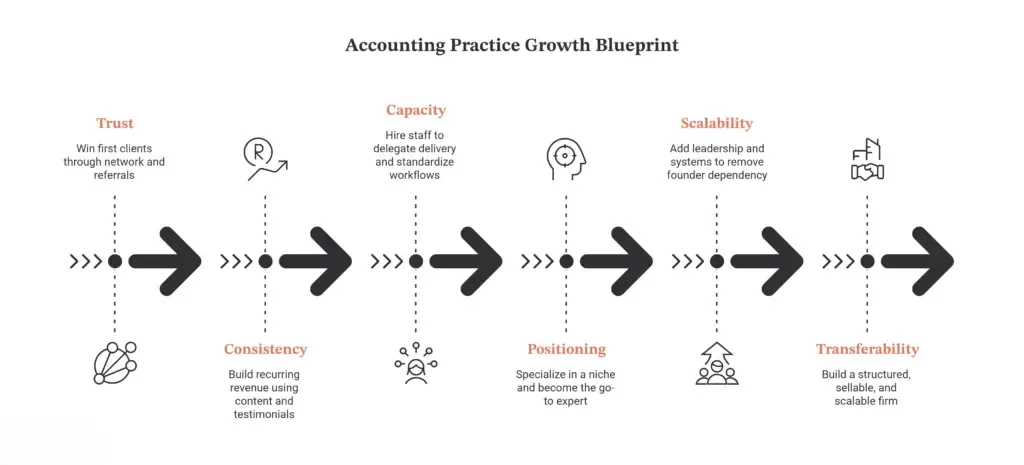
Each stage has one dominant bottleneck: trust, consistency, capacity, delegation, structure, scalability, and finally transferability.
Most firms stall by solving the wrong problem for their stage. This blueprint shows what to focus on, when to shift, and what to ignore so each level unlocks the next.
Stage 1: Get Your First Three Accounting Clients
Your first true clients aren't found in an ad algorithm; they are discovered in your handshake, your close network, and the quiet power of a trusted referral.
Most accountants stall at getting the first three clients because they wait. They wait for the company formation to be perfect, the office space to be ready, or the branding to be flawless. While they endlessly refine the foundations, their client list stays at zero.
To break this bottleneck and grow your accounting practice, look to your immediate network to secure your first three bookkeeping clients:
- Leverage Existing Trust: Former colleagues, old classmates, and family members already know your capability.
- Change the Pitch: Do not sell your services. Ask a simple question: “Do you know anyone who needs help with their accounts?”
- Price for Value: Never underprice your first engagement just to secure the win. It sets a dangerous precedent that is incredibly difficult to correct later. Charge market rates, then over-deliver.
Landing three paying clients is all Stage 1 requires. It validates your pricing, proves your offer works in the real market, and officially sets you on the route to success.
💡 Case Study: From Zero to £2M+ ARR
Raju Gajurel, FCCA CTA, started with zero marketing, zero brand identity, and no physical office. While working full-time as an accountant, he simply solved complex tax problems for friends and family in his evenings.
In 2016, he turned that micro-portfolio into UK Property Accountants in London. Today, that single-client foundation has scaled into a diversified group serving thousands of clients across 50+ countries, spanning specialist tax advisory, an acquired 100-year-old general practice, and specialized software platforms like FigsFlow and RentalBux.
It did not start with a grand strategy. It started with getting those first trusted relationships right.
Further reading: Get Bookkeeping Clients: Unlock Success with 9 Ways
Stage 2: Build a Recurring Client Base (Up to 50K ARR)
Now that you have landed your first three clients, you have officially validated your offer, gained initial experience, and established real-world credibility.
Your next step in growing your accounting practice is to build a predictable, recurring client base.
The strongest client base is built from the inside out: shift your focus from selling a product to delivering undeniable value, and watch buyers turn into partners.
Swikriti further shares a proven three-step framework to grow your accounting practice to a stable client base and hit an ARR of £50K:
Step 1: Maximise Value From Your Immediate Network
Go back to former colleagues, old classmates, and family members who already know your capability. They are your highest-converting asset. Leverage them for three specific things:
- Build Testimonials and Reviews: Turn their satisfaction into social proof. Capture their feedback early to build concrete case studies and online reviews that prove your competence to strangers.
- Fuel Your Organic Content: Use the exact compliance headaches and tax problems you solve for them as the raw material for your videos. Their real-life issues are exactly what other business owners are searching for online.
- Drive Immediate Referrals: Do not wait for them to bring you up in conversation. Actively ask them to introduce you to their own professional networks.
Treating this inner circle as a launchpad creates a solid baseline of recurring revenue while turning your first few clients into your most powerful marketing engine.
Step 2: Document Your Journey on Short-Form Video
Once you are maximizing your network, start recording how you actually serve those clients. Document the raw, day-to-day journey and share it online across platforms like TikTok, YouTube Shorts, and Instagram Reels. Initially, focus entirely on short-form content.
This approach works because it builds immediate familiarity. When a business owner suddenly faces an HMRC penalty or a messy tax issue, you want your face to be their automatic mental default.
Step 3: Build an Active Referral Engine
Every satisfied client you gain from your network or win through content should ideally lead to two or three more. While most accountants wait passively for clients to mention their name, growing practices treat referral generation as a regular habit.
At the end of a year-end review or a successful piece of work, just ask directly: “Is there anyone else in your network who would benefit from this kind of help?” Making this a standard, repeatable question is professional and transparent. Referrals close faster and enter your pipeline with a pre-established baseline of trust.
Stage 3: Stop Being the Bottleneck (£50K to £250K ARR)
Your next step is to transition from a sole operator into a true practice owner. Here is exactly what the difference looks like:
| Feature | The Sole Operator | The True Practice Owner |
|---|---|---|
| Daily Focus | Trapped in client delivery, admin, and daily firefighting. | Focused on strategic growth, team leadership, and systems. |
| Capacity | Capped by your personal time (maxes out around £50K ARR). | Scalable and unconstrained, built on collective team capacity. |
| Client Control | Every client relationship depends entirely on you. | Qualified team members own and manage client accounts end-to-end. |
| Workflows | Manual onboarding, messy spreadsheets, and fragmented tools. | Standardised, automated pipelines that run without your input. |
| The Business | You are the business. If you stop working, the revenue stops. | You own an asset. The practice runs smoothly even when you step away. |
Your First Strategic Hire
The hire that keeps you stuck is the one who assists you: admin, document chasing, draft accounts. That person gives you more time in the same role, not a way out of it.
The hire that changes everything is someone who can own client relationships and manage workflows end to end. When a client calls them instead of you and gets the same quality outcome, you have bought back your most constrained resource: attention.
Don't hire a cheap assistant to handle overflow. Hire someone who can replace you on a client call.
Before making this move, keep these two structural rules in mind:
- Shift the Question: Stop asking, “Can I afford this person?” Start asking, “What becomes possible once they take over the delivery work I am currently doing?”
- Hire Behind Revenue: Wait until your current client volume and cash flow justify the salary. If you hire in anticipation of clients you haven’t won yet, the pressure on your cash reserves will break you before the extra capacity ever pays off.
Standardise Onboarding & Compliance Workflows
If onboarding a single client takes hours of manual work across separate tools, your admin pipeline is broken. You cannot scale to £250K ARR if you are writing proposals from scratch, pulling pricing from spreadsheets, and chasing AML documents manually.
Each manual step adds delay, creates data risk, and hurts the client experience. To fix this, you must consolidate your entire onboarding sequence into a single, automated workflow, starting with a clear client onboarding checklist:
- Unified Sequence: Move proposal generation, value pricing, engagement letters, AML checks, and payment setup into one continuous digital loop.
- The 60-Minute Goal: A modern client should be able to view their quote, sign the contract, set up payments, and clear compliance checks in under an hour.
- Consolidate Your Tech Stack: Use a dedicated platform like FigsFlow to handle this entire sequence in one place. Eliminating five disconnected tools removes errors and slashes onboarding time.
Streamlining your onboarding from a backend chore into a crisp, automated system lets you seamlessly absorb dozens of new clients without adding a single minute of manual admin.
Stage 4: Own Your Niche to Reach £500K ARR
The £250K plateau is where most practices get stuck because they compete on price with every generalist in their postcode. A generalist can be good, but they can never be the only obvious choice for a specific client. Specialists can.
To break this bottleneck and reach £500K ARR, you must shift to deep market positioning:
- Select a High-Value Sector: Target industries with genuine demand, limited specialist competition, and distinct regulatory complexity. Examples include property investors, construction contractors, medical professionals, and non-resident clients.
- Audit Your Existing Client Base: Identify where you already do your best work, where your highest margins sit, and which clients routinely refer others to you.
- Build Inbound Authority: Align all content, services, and referral relationships toward one specific audience so ideal clients, solicitors, and brokers find you automatically.
This focus looks like a restriction from the outside, but it is the ultimate lever for scale. Your pricing must reflect this specialist positioning; clients will gladly pay a premium to buy certainty from an expert who has navigated their exact situation before.
Stage 5: Grow Without Grinding to £1M ARR
The strategy that helped you grow to £500K ARR is usually not the strategy that takes you to £1M and beyond.
Up to 500K ARR, growth is often driven by founder involvement. The owner reviews work, manages clients, solves operational issues, and stays involved across most areas of the practice. That works while the firm is smaller. At the next stage, it becomes the bottleneck.
A practice cannot continue scaling if every important decision, approval, or operational issue still depends on the founder. Growth now requires a shift from founder-led execution to operational structure.
Appointing Operational Leadership
As the team grows, operational responsibility needs to move outward.
Practice managers, operations directors, and senior team leads should begin owning delivery, workflow management, deadlines, and team accountability. The founder’s role shifts away from daily coordination and toward strategic direction, growth, hiring, and leadership.
The goal is not to remove the founder from the business. It is removing the founder from the centre of every process.
Upgrading Your Practice Management Tech Stack
As responsibility spreads across the team, systems become increasingly important.
At this stage, disconnected software, spreadsheet tracking, manual onboarding, and founder-dependent processes start creating operational drag. The systems that worked at smaller scale become inefficient as the practice grows.
Firms moving beyond this stage usually need a more connected operational structure covering onboarding, proposals, engagement letters, AML and KYC, task management, billing, client communication, and internal workflows.
The goal is not simply automation. It is consistency.
When processes are standardised inside connected systems, work becomes easier to delegate, easier to monitor, and less dependent on the founder staying involved in daily operations.
Stage 6: Build an Accounting Practice Worth Acquiring
At some point, growth stops being the focus. The real question becomes: what is this practice worth, and who would buy it?
From here, the focus shifts to building a more saleable business. That includes reducing day-to-day dependence on the owner, standardising processes, increasing market position, strengthening brand presence, and building predictable revenue and client volume.
But before any of that, there is a more important question: what is the purpose of this firm?
Where is this going long term? Is this a lifestyle practice you intend to run indefinitely? Is it something you want to sell to a larger firm? Or is it a business you want to scale and eventually take toward a larger market listing? The direction matters, because it changes how you build everything.
Once that direction is clear, the practice should be shaped around it. Structure, systems, hiring, and growth strategy should all follow the intended end state.
Stage 7: Exit on Your Terms
Growth is only half the story. The real test of the business you’ve built is how you exit it and who is willing to pay for it.
Trade Sale
You can sell your accounting practice to a larger firm. This way, you can expect a valuation of 1–2x recurring revenue, usually tied to an earn-out based on client retention. This is the cleanest route to a full operational handover and fast liquidity.
Private Equity/Consolidator Sale
Another option is to sell to a PE-backed aggregator. You’ll typically take partial cash upfront and roll the remaining equity into the parent group. The ultimate payout depends on scale and margin, offering higher upside but a longer horizon.
Merger with Another Practice
You can also combine your accounting practice with your immediate peer. You pool infrastructure and clients to increase market power, deferring your liquidity event until a larger, collective sale down the line.
Internal Succession
This is a viable option if your priority is continuity and legacy rather than squeezing out the maximum market multiple. It requires years of leadership grooming and a structured, phased buyout.
The Cash Cow
Stepping back from operations entirely to run the practice as a self-sustaining asset that pays you an ongoing dividend.
The Corporate Roll-Up
Building toward your own group structure, centralising operations while retaining majority equity.
The Phased Exit
Gradually reducing your equity stake and billable hours over a fixed period rather than selling in one milestone transaction.
Your exit strategy dictates how you build today. You are either engineering the practice for maximum upfront liquidity, a long-term equity rollover, or a permanent cash yield.
Conclusion
The path to £1M ARR isn’t linear, but the sequence rarely changes.
You land the first client through trust, build predictable retention, and step out of the delivery bottleneck. You commit to a niche, build operational structure before you think you need it, and engineer the practice for acquisition whether you intend to sell or not.
Scaling and growing your accounting practice isn’t about technical skill. It’s about breaking the right constraint at the right time. The firms that stall aren’t failing because of bad strategy; they are simply applying the right strategy at the wrong stage.