
Enhanced Due Diligence on Politically Exposed Persons (PEPs) Explained
What enhanced due diligence for politically exposed persons involves under MLR 2017: who counts as a PEP, family and associate rules, and the three checks required.

Not every client conversation needs a compliance detour. But when someone mentions they used to sit in the House of Lords, or that their brother-in-law is a serving government minister, the conversation changes.
Under the Money Laundering Regulations 2017, that change isn't optional. UK accountants and tax advisers must apply enhanced due diligence to politically exposed persons (PEPs), their family members, and their known close associates. This article explains what that requirement actually means, who it applies to, and why. For the step-by-step process of carrying it out, see our companion guide on how to perform enhanced due diligence on PEPs.
Key Takeaways
- PEP enhanced due diligence is a legal requirement under Regulation 35 of MLR 2017, not a discretionary best practice
- There are three categories of PEP: domestic, foreign, and international organisation
- Family members and known close associates of a PEP are covered by the same rules, even without holding office themselves
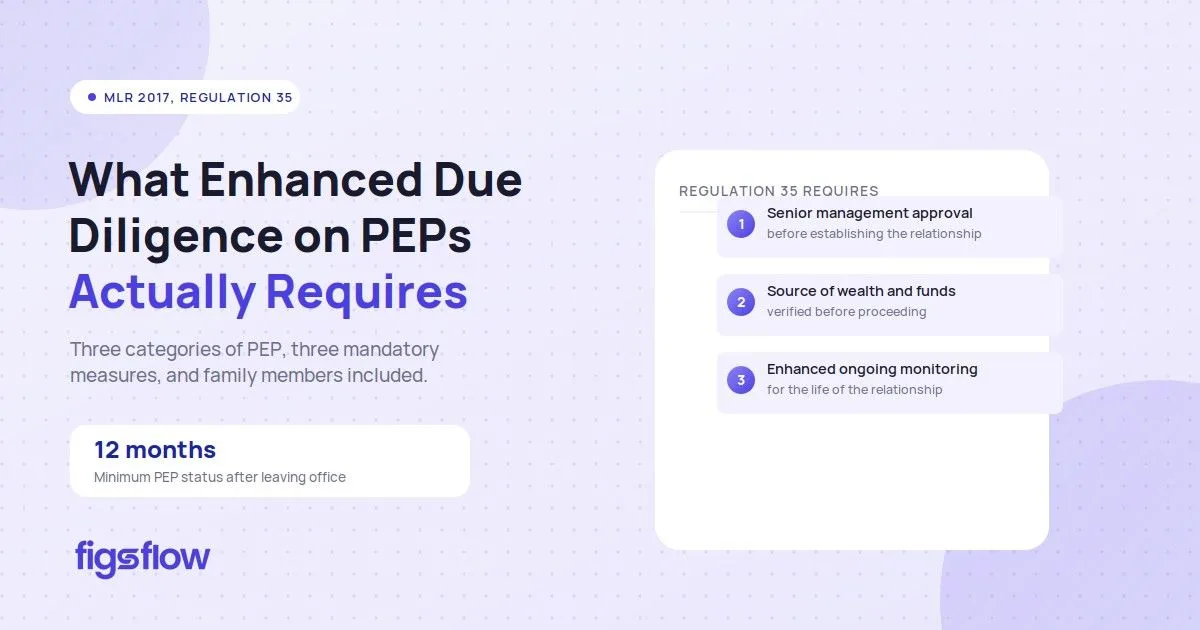
- Three measures are mandatory: senior management approval, verifying source of wealth and source of funds, and enhanced ongoing monitoring
- UK domestic PEPs start as lower risk than foreign PEPs, but still require proportionate enhanced measures, not a free pass
- PEP status isn't permanent. It typically continues for at least 12 months after someone leaves their public function
What Is Enhanced Due Diligence for PEPs?
Enhanced due diligence (EDD) is a deeper level of client checking that goes beyond standard identity verification. Instead of confirming who someone is, you're also establishing where their money comes from, approving the relationship at a senior level, and watching it more closely once it's underway.
PEPs trigger this requirement because of their position, not their conduct. Someone with influence over public contracts, licensing decisions, or state funds sits somewhere the potential for corruption exists, whether or not they've ever acted on it. The regulations treat this as a structural risk to manage, not an accusation to answer.
The Legal Basis: MLR 2017 Regulation 35
The obligation comes from Regulation 35 of the Money Laundering, Terrorist Financing and Transfer of Funds (Information on the Payer) Regulations 2017 (MLR 2017). It sets out who counts as a PEP, and the specific measures firms must apply once someone falls into that category.
Most UK accountancy practices are supervised for AML purposes either directly by HMRC or through a professional body such as ICAEW, ACCA, ATT, CIOT, or ICAS. Whichever applies to your firm, the Regulation 35 obligations are the same. Supervisors expect to see them applied and documented, not just understood.
Who Counts as a PEP? Three Categories
MLR 2017 splits PEPs into three categories. All three trigger the same enhanced due diligence duties, but the risk assessment behind them differs.
Domestic PEPs
These are individuals entrusted with a prominent public function within the UK. In practice, that means roles with genuine authority over public decisions or resources, not junior or administrative posts.
- Members of the UK and devolved parliaments, and government ministers
- Supreme Court justices
- Ambassadors and other senior diplomatic postholders
- Very senior military officers
- Permanent Secretaries and other senior civil service leaders
Foreign PEPs
The same logic applies outside the UK, but prominence is assessed against the individual's own jurisdiction rather than UK standards. A deputy minister in a small state may hold more practical authority than a junior minister in a larger one, so the role itself matters more than the job title.
International Organisation PEPs
The third, often overlooked, category covers directors, deputy directors, and board members of prominent international bodies, such as the United Nations, NATO, the World Bank, or major EU institutions. These individuals hold significant influence over international funds, policy, or appointments, and MLR 2017 treats them as PEPs on the same basis as domestic and foreign officeholders.
Family Members and Close Associates
The regulations don't stop at the PEP themselves. Family members and known close associates carry the same enhanced due diligence requirements, because they can be used to move funds or hold assets on a PEP's behalf without attracting the same scrutiny.
- Family members: spouse or civil partner, children and their spouses or partners, and parents
- Known close associates: a joint beneficial owner of a legal entity or arrangement, or someone known to have close business relations with the PEP
The Three Things MLR 2017 Requires
Once someone is identified as a PEP, family member, or close associate, Regulation 35 requires three specific measures.
- Senior management approval before establishing, or continuing, the business relationship
- Adequate measures to establish source of wealth (the origin of their overall assets) and source of funds (the origin of the specific money in the relationship or transaction)
- Enhanced ongoing monitoring for as long as the relationship continues
Each of these has practical detail behind it, from who qualifies as "senior management" in a small firm to how much documentation is proportionate for a low-risk domestic PEP. Our guide on how to perform enhanced due diligence on PEPs walks through each step, with a matching free enhanced due diligence checklist you can use alongside client files.
Domestic vs Foreign PEPs: Why the Distinction Matters
MLR 2017 explicitly treats UK domestic PEPs as starting from a lower risk position than foreign PEPs. That doesn't remove the obligation to apply enhanced due diligence. It means the intensity of that due diligence should be proportionate: lighter-touch verification for a backbench MP with published expenses and a transparent income, and considerably more scrutiny for a former overseas official from a jurisdiction with weak anti-corruption enforcement.
How Long Does PEP Status Last?
PEP status isn't permanent, but it doesn't end the moment someone leaves office either. Under MLR 2017, firms must continue to treat a former PEP as a PEP for at least 12 months after they stop holding their public function, unless a documented risk assessment justifies treating them as lower risk sooner or continuing enhanced measures for longer. Family members and known close associates typically stop being classified as such as soon as the PEP leaves office, unless other risk factors are present.
What Happens If Your Firm Gets This Wrong?
Failing to identify a PEP, or identifying one but skipping the required measures, is a compliance failure your supervisor can act on. That can mean supervisory sanctions, financial penalties, and reputational damage that outlasts the fine itself. It can also leave your firm exposed if a PEP relationship later turns out to have facilitated financial crime you had the means to catch. Supervisors generally aren't looking for perfection here. They're looking for evidence that your firm identified the risk and applied a proportionate, documented response.
Conclusion
Enhanced due diligence on PEPs comes down to three things: knowing who counts as a PEP (including family and close associates), applying the three required measures in proportion to actual risk, and keeping a clear record of why you made the decisions you did. Once you've got the concepts straight, the practical side is far more manageable. Our companion guide on how to perform enhanced due diligence on PEPs takes you through it step by step.