
Weekly News & Updates for UK Accountants (10-14 August 2026)
If you have clients who are procrastinating with MTD, tell them to be prepared. Because HMRC is going to sign them up automatically in September.

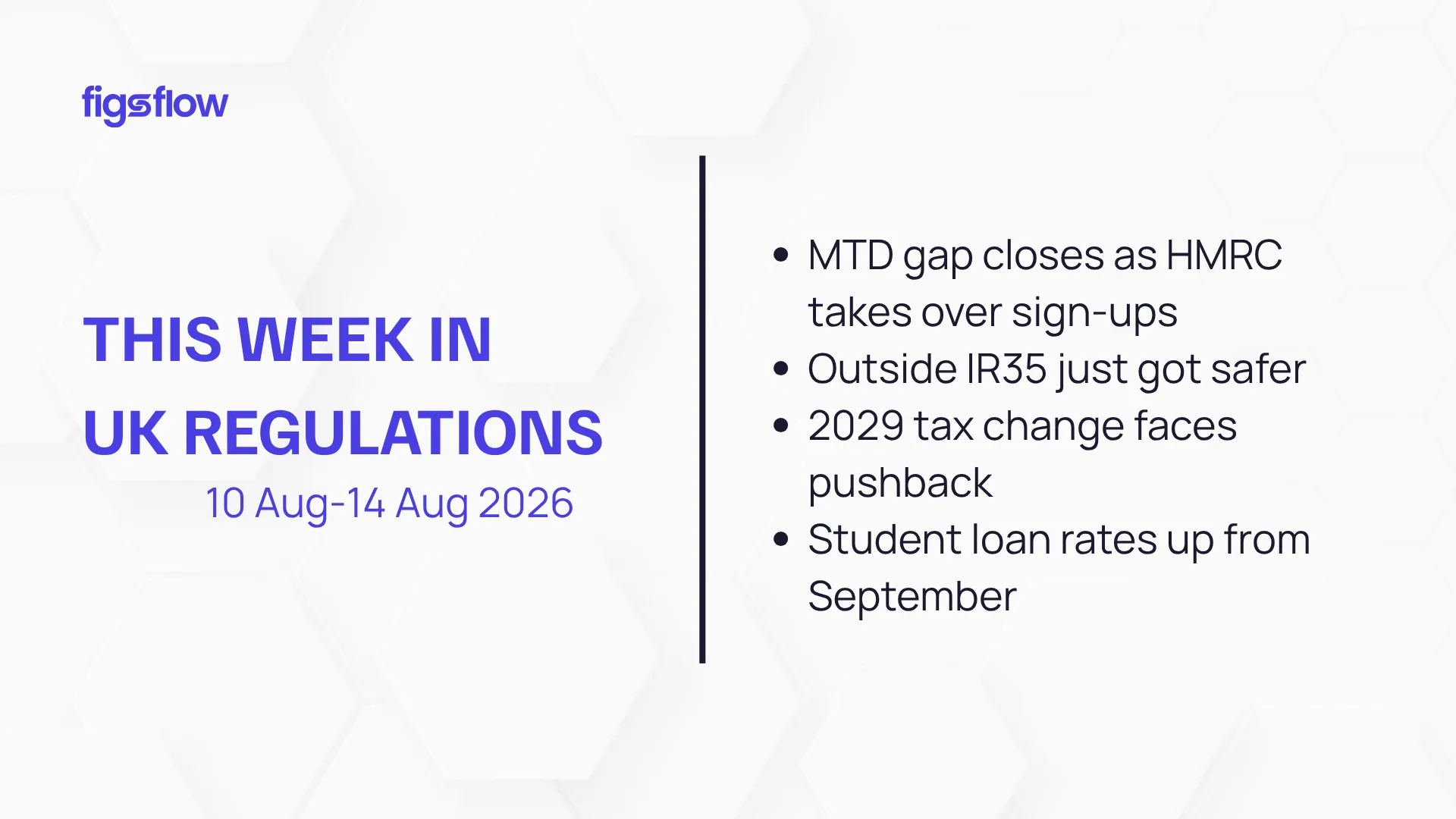
HMRC begins automatically enrolling unregistered MTD taxpayers next month, and any practice still carrying unregistered clients needs to move before September arrives. That is the story to act on first. Close behind it, the April 2026 umbrella legislation has quietly inverted the contractor risk calculus, and the implications for clients running flexible workforces are worth revisiting now that the dust has settled.
The other two are about planning rather than panic. The ICAEW has issued a formal objection to the government’s 2029 proposal for in-year income tax payments through PAYE, and student loan interest rates are rising from 1 September with a cap holding across the most-affected plans.
Here is the detail.
HMRC Begins Auto-Enrolling MTD Stragglers from September as Filing Gap Widens
From September 2026, HMRC will automatically enrol sole traders and landlords required to join MTD for Income Tax who have not yet registered. Around 570,000 are currently signed up against a first-wave cohort of 864,000, leaving roughly 294,000 still outside the system. The August filing data adds weight to the urgency: of those registered, over 436,000 filed their first quarterly update by the 7 August deadline, but around 134,000 did not.
Auto-enrolment does not pause obligations. A client enrolled by HMRC without software in place and without an adviser alongside them starts from a worse position than one who registered late on their own terms.
Key facts:
- Auto-enrolment of unregistered first-wave taxpayers begins September 2026
- 294,000 taxpayers remain unregistered; 134,000 registered taxpayers missed the 7 August deadline
- No penalty points for late quarterly updates in 2026-27; £200 fixed penalty applies from 6 April 2027 once four points are accumulated
Any client in scope who has not registered should be contacted this week. Once HMRC acts, the adviser is playing catch-up rather than leading the process.
IR35 is Now the Lower-Risk Route as Umbrella Liability Falls on Agencies & End-Clients
The April 2026 umbrella legislation changed the risk profile for contractor engagements in a way that has not yet filtered through to every client’s workforce policy. Under the new joint and several liability rules, recruitment agencies and end-clients act as guarantors for unpaid PAYE and National Insurance within their supply chains.
That liability applies regardless of their own due diligence and regardless of what their contracts say. An agency that vetted its umbrella provider thoroughly, documented the process, and included indemnity clauses is still exposed if that provider fails to account for PAYE and NICs correctly. The risk is no longer bounded by the quality of their own processes.
Outside IR35 engagements, by contrast, have become more manageable. Case law has matured, providing clearer grounds for status determinations. The double taxation flaw was corrected in April 2024, meaning firms now pay only the difference in tax (approximately 10% on top of fees) via an offset rather than the full amount. IR35 risk, where it exists, is case-by-case. An umbrella failure is systemic, potentially touching every engagement linked to that provider at once.
Key facts:
- Joint and several liability for unpaid PAYE and NICs applies across the supply chain from April 2026
- Outside IR35 double taxation corrected from April 2024; firms now pay approximately 10% on top of fees via an offset
- IR35 risk is case-by-case; umbrella failure is systemic and can affect all engagements with a single provider simultaneously
For clients running contractor or temporary workforces, the question is whether their current supply chain policy reflects the post-April 2026 landscape. A blanket preference for umbrella arrangements made sense under the old risk structure. It is worth testing whether it still does.
Earlier Income Tax Payments via PAYE Draw Sharp ICAEW Criticism on Three Fronts
From April 2029, the government proposes to require Self Assessment taxpayers with PAYE income to pay estimated income tax liabilities in-year through the PAYE system. The mechanism would use coding notices to collect tax on outside income alongside regular employment deductions. The ICAEW has responded formally, raising concerns on three distinct grounds.
The first is administrative. HMRC’s systems are already under strain, and layering additional coding notice complexity onto employers and payroll providers adds burden to a part of the infrastructure that is not currently coping well.
The second is cash flow. Using stable PAYE income to service fluctuating Self Assessment liabilities could leave taxpayers unable to meet regular financial commitments in months where their outside income has not yet materialised. The third is confidentiality: employers will be able to see, through the coding notice, that an employee has income from outside employment, which carries real risk of workplace bias in smaller businesses.
Key facts:
- Proposal effective date: April 2029
- ICAEW supports more timely payments but advocates quarterly rather than monthly collection
- ICAEW recommends a three-year transitional period and voluntary use of MTD updates for payment purposes
For now this remains a proposal, not a confirmed change. Practitioners with clients who have both PAYE and Self Assessment income should note the direction of travel and watch for the government’s response to the consultation.
Student Loan Rates Rise from September with a 6% Cap Holding Across Plans 2 & 3
From 1 September 2026, updated student loan interest rates take effect for the 2026-27 academic year. The government has maintained a 6% cap on Plan 2 and Plan 3 loans, limiting the rate borrowers face despite underlying inflation figures that would have pushed rates higher. Without the cap, Plan 2 and Plan 3 borrowers would have faced a maximum rate of 7.1%.
Key facts:
- Plan 1 (pre-2012): rate rises to 4.1%, up from 3.2%
- Plan 2 (2012-2023) and Plan 3 (Postgraduate): rates range between 4.1% and 6% based on income, capped at 6%; uncapped rate would have been 7.1%
- Plan 5 (2023 onwards): rate set at 4.1%, up from 3.2%
Payroll teams should confirm that deduction calculations reflect the updated rates from September. For any employee asking why their repayments have changed, the cap is the useful context: rates have risen, but the government has held the ceiling at 6% for the most-affected plans.
Also In News
- Last week’s round-up covering the stories that shaped the week for UK practioners
- What’s Next After MTD: Tax Changes for UK Accountants
- MTD ITSA Guide for Accountants and Tax Agents 2026
- HMRC MTD Letter Explained: Who Must Act & What’s Next
Conclusion
The pattern this week is HMRC moving from announcement to enforcement. Auto-enrolment from September is the clearest example: the registration window has not closed, but HMRC is no longer waiting for taxpayers to use it. The umbrella liability shift tells a similar story, with risk now falling on whoever is left holding the supply chain.
Act this week on MTD registration. Review umbrella supply chains before the next contract renewal. The 2029 payment proposal and the student loan rate changes are both worth filing for the conversations ahead.
We publish these updates every week. Follow us to get next week’s round-up as soon as it lands.