
What Comes After MTD
Stay ahead with the upcoming changes after MTD, including registration requirements and payroll updates.

The final weeks before April 2026 are here. Practices across the UK are onboarding the last of their clients, chasing the stragglers, setting up software and signing new engagement letters. For many accountants and bookkeepers, April has felt like the finish line for two years.
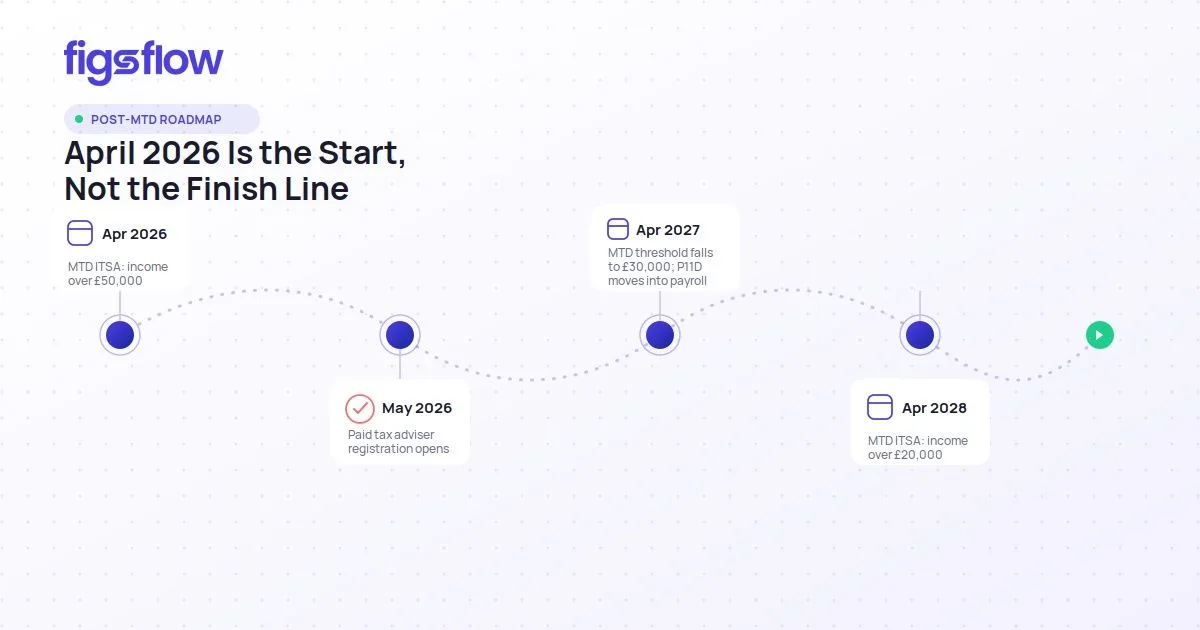
It is not a finish line. It is the first deadline in a sequence that is already confirmed and already running. Two more waves of MTD mandation are legislated. A new registration requirement for every paid tax adviser arrives in May. A fundamental change to how employer clients report benefits lands in April 2027. The pipeline does not pause after April 2026.
Here is what is coming, when it arrives, and what your practice needs to do about it.
MTD Is Not Finished Expanding
The clients joining MTD from April 2026 are those with qualifying income above £50,000. They are, broadly, the easier cohort. Better records. More established software habits. More engaged relationships with their accountant or bookkeeper.
The next two waves are different. From April 2027, the threshold drops to £30,000. From April 2028, it drops again to £20,000. Partnerships have not yet been given a confirmed date but remain in scope. HMRC has also confirmed it will explore extending MTD to the four million businesses and landlords below the £20,000 threshold.
The three confirmed mandation dates are:
- April 2026: Qualifying income above £50,000
- April 2027: Qualifying income above £30,000
- April 2028: Qualifying income above £20,000
What changes as the threshold falls is not just the number of clients. It is the nature of the work. Clients in the £20,000 to £30,000 range are more likely to be sole traders with informal records, limited digital confidence and less margin for error. The handholding required per client goes up as the income goes down. Practices that assume the hard work ends in April 2026 will find themselves underprepared when the second wave arrives.
As each tax year completes, client income will shift. Some clients below the threshold today will cross it. Triage is not a one-time exercise.
A New Requirement for Every Paid Tax Adviser
This is the change that has received the least attention relative to its significance.
From 18 May 2026, HMRC introduces mandatory registration for anyone paid to interact with HMRC on a client's behalf. The definition is broader than many practices have assumed. If you phone HMRC for a client, submit a return, send a message through GOV.UK or the HMRC app on their behalf, and you receive payment for doing so, you are required to register. This applies to sole traders, employees of firms and practices of all sizes. It applies even if tax work is not your primary function and even if you only act for a single client.
The registration dates run in four phased windows, and it is the window that opens on your date, not a single deadline. Those with no existing agent services account, Self Assessment account, or Corporation Tax account had a window from 18 May 2026 to 18 August 2026, and needed to register by 18 August 2026. Those who already hold a Self Assessment or Corporation Tax agent account, but not an agent services account, have a window from 18 August 2026 to 18 November 2026, and must register by 18 November 2026. Agents who solely provide third-party payroll services have a window from 18 November 2026 to 18 February 2027, and must register by 18 February 2027. Those who already hold an agent services account, along with financial services organisations, have until 31 March 2027. In each case, you have three months from the start of your window to apply, and you can continue acting for clients during that window while HMRC considers your registration.
The P11D Era Ends in April 2027
April 2027 brings more than the second MTD wave. It brings a fundamental change to how employer clients report benefits in kind, and most of them do not know it is coming.
Currently, benefits such as company cars, private medical cover and interest-free loans are reported once a year on a P11D form, after the tax year ends. From 6 April 2027, most benefits must be reported and taxed through payroll every month via the Full Payment Submission. The annual P11D cycle ends for most employers. Employees will see taxable benefit values on their payslips each month rather than a coding adjustment arriving later. For clients who have never thought carefully about how their benefits are structured or valued, this will prompt questions they are not yet asking.
P11Ds are still required for 2025-26 and 2026-27. That means many employer clients will be running their final P11D process in summer 2027 at precisely the same moment they are adapting to mandatory real-time payrolling for the first time. Two unfamiliar processes, landing together. Loans and accommodation remain outside mandatory payrolling for now, with a separate timeline from HMRC to follow.
Payroll software needs to be tested and ready well before April 2027. The clients who hear about this change from their adviser first will be far better placed than those who discover it when it arrives.
What Your Practice Should Do Now
April 2026 is a beginning, not an end. The practices that stay ahead of what comes next are the ones clients remember when it matters most. Three things are worth doing before this tax year closes.
Review your client list against 2024-25 income figures.
Once returns are filed, identify every client approaching £30,000. These are your April 2027 cohort and the clock is already running.
Check your registration status now.
If your practice does not hold an agent services account, May 2026 is your deadline. Do not leave it to the final weeks.
Talk to your employer clients about April 2027.
Not in depth yet, but enough to flag that P11D reporting is changing and payroll processes will need reviewing. The clients who hear it from you first will remember it.
MTD Resources for You
- Streamline Your MTD Client Onboarding Journey | FigsFlow
- Last-Minute MTD Resources for Accountants | FigsFlow
- What’s Next After MTD: Tax Changes for UK Accountants
- List of HMRC-approved MTD-compatible software | RentalBux
- Top 10 Free MTD Software for Accountants in 2026 | RentalBux
The next changes are confirmed and dated. Getting ahead of them is what a trusted adviser does.