
Weekly News & Updates for UK Accountants (27-31 July 2026)
This week's weekly news covers HMRC's £12.8bn tax write-off, a 31% rise in winding-up petitions, Class 2 NI record errors, and an under-25 NI proposal.
 Swikriti ThakuriJul 31, 2026Updated Oct 5, 2026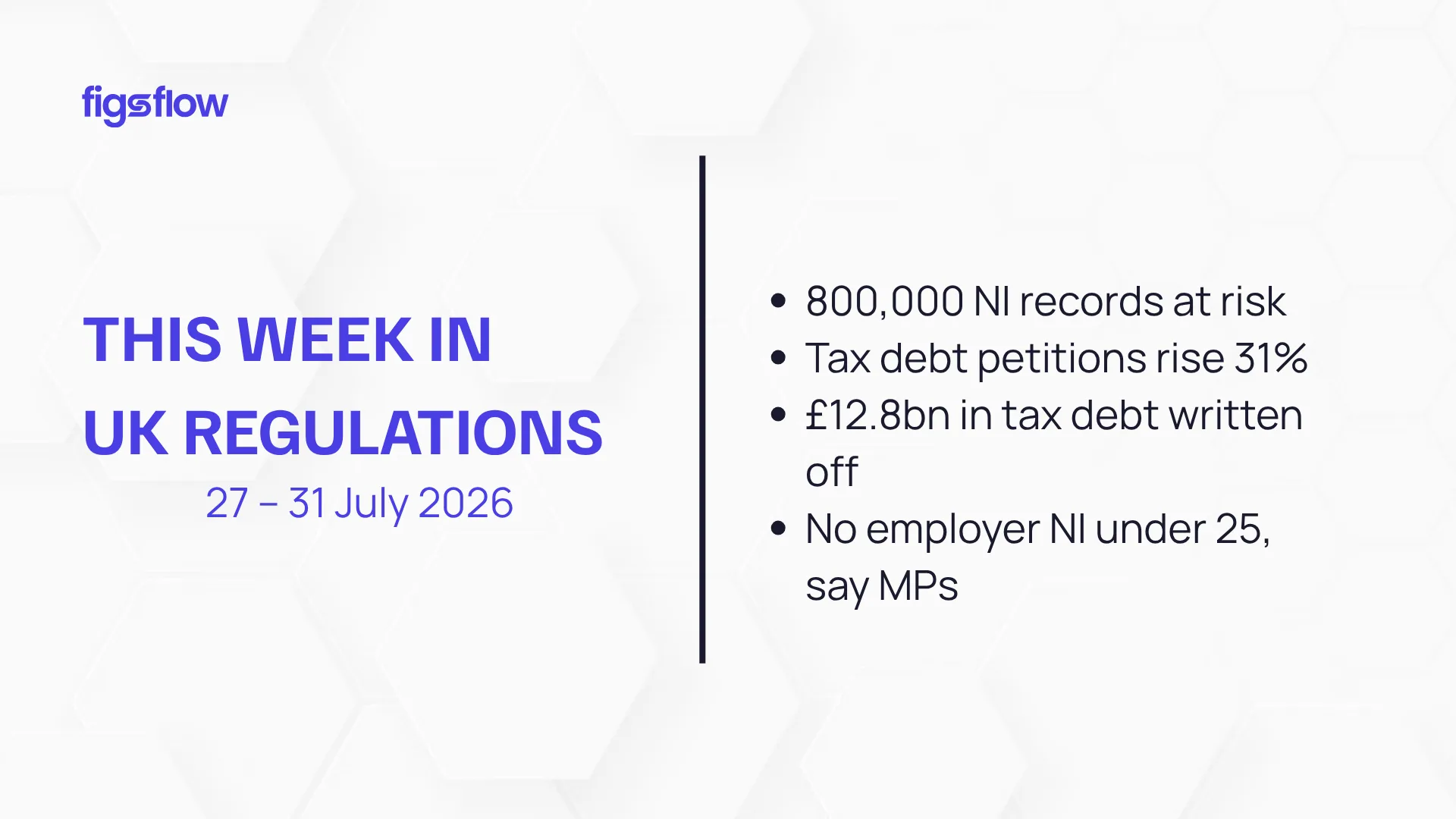
This weekly news and updates for UK accountants opens with a systemic registration failure that has left around 800,000 self-employed taxpayers with gaps in their National Insurance records, and the fix starts with practitioners, not HMRC. That is the story to act on first. Close behind it, winding-up petitions have jumped 31% in a year, and the pattern behind them is telling: silence, not insolvency, is what puts clients in front of a judge.
The thread connecting the week is HMRC’s debt machinery moving in both directions at once: writing off record sums of old debt while chasing current debt harder. The under-25 NI proposal is the one story that looks forward rather than back.
Here is the detail.
800,000 Self-Employed Taxpayers Face NI Record Gaps From CWF1 Registration Failures
Around 800,000 self-employed individuals may have gaps in their National Insurance records that could reduce their future State Pension, and many of them did nothing wrong on their tax returns. The problem sits in the registration process. Anyone who became self-employed between 2015 and early 2024 and did not separately notify HMRC via a CWF1 form may have an incomplete Class 2 record, even where every Self Assessment return was filed correctly and on time.
HMRC’s remedy is phased. Priority cases, those at or near state pension age, will be contacted by summer 2027. Everyone else waits until spring 2027 at the earliest. The concession attached to the fix is significant: affected taxpayers will be allowed to pay voluntary Class 2 contributions at the original historical rates, bypassing the standard six-year limit on backdated payments.
Key facts:
- Affected registration window: 2015 to early 2024
- 160,000 priority individuals contacted first, by summer 2027
- Voluntary Class 2 payable at original historical rates, outside the six-year limit
HMRC’s advice is not to make contact yet. The practical work is at the practice end: screen self-employed clients who registered within the window, and check prior returns and online accounts for Class 2 payments. A client whose record shows gaps should know now, not when a letter arrives next year.
Winding-Up Petitions Rise 31% as HMRC Hardens Its Debt Recovery Stance
HMRC issued 4,761 winding-up petitions in the last year, a 31% increase, and more than half of them ended in court-ordered liquidation. This is not a temporary push. With £42.8bn in tax arrears outstanding, the department plans to recruit a further 2,400 debt management officers by 2029-30, so the capacity to escalate is being built deliberately.
The detail that matters most for client conversations is why petitions happen. Insolvency specialists point out that they are usually the product of a failure to engage rather than an absolute inability to pay. HMRC remains open to payment plans where businesses initiate contact early. Once a petition is filed, the options narrow sharply.
Key facts:
- 4,761 winding-up petitions issued, up 31% year on year
- 2,397 court-ordered liquidations, up 27%
- 2,400 additional debt management officers planned by 2029-30
Any client carrying arrears needs the same message this week: the route to a payment plan runs through early contact, and it closes fast once HMRC moves first.
HMRC Writes Off £12.8bn in Tax Debt as Covid-Era Arrears Unwind
Tax losses surged 77% in 2025-26 to £12.8bn, equivalent to 1.4% of total tax receipts, up from 0.8% the year before. It is a number clients will see in headlines, and the explanation behind it is more useful than the figure itself.
The total splits into two categories. Write-offs, at £9.7bn, cover debts HMRC has concluded there is no practical way to recover, with VAT the largest component at £3.3bn, followed by income tax, National Insurance and corporation tax. Remissions, at £3.1bn, are debts HMRC has actively decided to stop pursuing. VAT leads that category too.
Key facts:
- Total tax losses: £12.8bn, up 77%, or 1.4% of receipts
- Write-offs £9.7bn, remissions £3.1bn, with VAT the largest component in both
- Driver: pandemic-era pauses on debt collection and court action now being formalised as losses
The driver is largely historical. Debt collection and court action were paused through the pandemic, and the backlog of unrecoverable Covid-era debt is only now being formalised as losses. Read alongside the petition figures, the picture is coherent rather than contradictory: HMRC is clearing debt it cannot collect precisely so it can concentrate resource on debt it can.
MPs Propose Employer NI Holiday for All Workers Under 25
The Work and Pensions Committee has urged the Chancellor to introduce an employer National Insurance holiday for all workers under 25, aimed at youth unemployment. This is a recommendation, not policy, and nothing changes until the Chancellor responds.
The proposal targets a gap in the current rules. Employers already pay no NI for under-21s or for apprentices under 25, up to the £50,270 limit. But a non-apprentice aged 21 to 24 attracts the full 15% employer charge on annual earnings above £5,000, which MPs argue makes entry-level hiring more expensive than it needs to be. The committee’s fix is to extend the secondary threshold so no employer Class 1 NICs are due for any worker under 25 earning below £967 per week.
Key facts:
- Current exemptions: no employer NI for under-21s or apprentices under 25, up to £50,270
- Non-apprentices aged 21 to 24: 15% employer charge on annual earnings above £5,000
- Proposed: no employer Class 1 NICs for any worker under 25 earning below £967 per week
There is nothing to implement. But employer clients hiring younger staff will ask about it, and knowing the current age-band rules cold is worth doing regardless. A watching brief.
Also In News
- Last week’s round-up covering the stories that shaped the week for UK practitioner
- What’s Next After MTD: Tax Changes for UK Accountants
- MTD for Income Tax: 783,000 Taxpayers Yet to Register
- How to Onboard MTD Clients Efficiently in 2026 | FigsFlow
Conclusion
The pattern this week is HMRC tidying its books and sharpening its collection tools in the same motion. Record write-offs clear the pandemic backlog while petitions, liquidations and new debt officers point to harder pursuit of what remains collectable. The Class 2 story is the reminder that HMRC’s own systems generate liabilities too, and this time the exposure sits with clients’ pensions.
The immediate work is twofold: screen self-employed clients who registered between 2015 and early 2024 for Class 2 gaps, and get ahead of HMRC with any client in arrears before a petition forecloses the options. The under-25 NI holiday stays on the watching brief.
We publish these updates every week. Follow us to get next week’s round-up as soon as it lands.