
Are Electronic Signatures Legal in the UK? What the Law Requires (2026)
Yes, e-signatures are legal in the UK under the ECA 2000 and UK eIDAS. Learn the 3 validity tests, the 3 signature types and which documents can't be e-signed.

Yes. Electronic signatures are legally binding in the UK. Section 7 of the Electronic Communications Act 2000 makes them admissible as evidence, and Article 25 of UK eIDAS says a signature cannot be denied legal effect just because it is electronic. A signature is valid where the signer intended to authenticate the document and the signature is linked to it. Wills and some formal documents are the exceptions.
There are two kinds of accountants using electronic signatures right now. Those who’ve checked that their setup is legally sound, and those who’ve assumed it is because it seems to work. The difference matters less on a normal day and considerably more on the day a client disputes a signed engagement letter.
This guide covers what the law actually requires, what your platform needs to do, and where e-signatures cannot be used at all. If you’re sending documents for a digital signature, this is the checklist you need.
What Is an Electronic Signature?
Under Article 3 of the UK eIDAS Regulation, an electronic signature is defined as:
“Data in electronic form which is attached to or logically associated with other data in electronic form, and which is used by the signatory to sign.”
In plain terms, that covers a wide range of actions. A typed name at the bottom of an email, a drawn signature on a touchscreen, a click on an “I accept” button, and a signature captured through a dedicated e-signature platform all qualify.
The method matters less than whether the signature is connected to the document and intended as a sign of agreement. If you are unsure how this differs from a cryptographic signature, see digital signature vs electronic signature.
What Are the Three Types of Electronic Signature Under UK Law?
UK eIDAS recognises three tiers of electronic signature, each carrying a different level of identity assurance.
Simple electronic signature is the baseline. It covers anything that demonstrates intent to sign, including a typed name, a scanned signature, or a checkbox confirmation. It carries the least evidential weight but is legally valid for most everyday business documents. For accounting firms, this covers engagement letters, proposals, and standard client contracts.
Advanced electronic signature must meet the four requirements in Article 26 of UK eIDAS. It must be:
- uniquely linked to the signatory;
- capable of identifying the signatory;
- created using signature creation data that the signatory can, with a high level of confidence, use under their sole control; and
- linked to the signed data in such a way that any subsequent change is detectable.
A one-time password sent to the signatory’s mobile number is a common part of an advanced signing process.
Qualified electronic signature is the highest tier. It is an advanced electronic signature created by a qualified signature creation device (Annex II of UK eIDAS) and based on a qualified certificate (Annex I) issued by a qualified trust service provider. Under Article 25(2), a qualified electronic signature has the equivalent legal effect of a handwritten signature. In practice, QES is rarely required for standard English law transactions and is typically reserved for cross-border dealings or situations demanding the strongest possible identity assurance.
For engagement letters and routine client agreements, a Simple electronic signature is sufficient. You do not need QES.
For a fuller breakdown of the three tiers and when each applies, see our guide to simple vs advanced vs qualified electronic signatures.

Are Electronic Signatures Legally Recognised in the UK?
Yes. Electronic signatures are legally recognised in the UK under two overlapping frameworks.
Under section 7 of the Electronic Communications Act 2000, an electronic signature incorporated into or logically associated with an electronic communication is admissible as evidence in legal proceedings. Under Article 25 of the UK eIDAS Regulation, an electronic signature cannot be denied legal effect solely on the grounds that it exists in electronic form.
The Law Commission’s 2019 report on electronic execution of documents confirmed that an electronic signature is capable in law of being used to execute a document, provided the signatory intends to authenticate it and any execution formalities are met. Following the UK’s departure from the EU, eIDAS was retained in domestic law through the Electronic Identification and Trust Services for Electronic Transactions (Amendment etc.) (EU Exit) Regulations 2019. The legal framework remains intact.
What Makes an Electronic Signature Valid?
The tier of your signature does not determine whether it is valid. The Law Commission’s 2019 report on electronic execution of documents is clear on this: what matters is whether an authenticating intention can be demonstrated. Courts in England and Wales have upheld typed names in emails and “I accept” buttons as valid signatures. The method is secondary to the intention.
Three things courts look at when assessing validity:
Intention to sign
The signatory must have applied their mark with the intention of entering into the agreement. Electronic signature platforms typically present language making clear the signatory is signing the document, which supports this. The surrounding email correspondence also contributes to the evidence of intent.
Association with the document
The signature must be incorporated into or logically associated with the specific document being signed. A signature captured through a platform and embedded into the finalised PDF satisfies this condition. A scanned signature image pasted into an email, or a separate signature file sent alongside a document, does not reliably meet it because the connection between the signature and the document cannot be clearly established.
Ability to identify the signatory
There must be sufficient evidence linking the signature to the person who made it. At the Simple tier, this typically means the signatory’s email address and the circumstances of signing. At Advanced tier, additional identity data is built into the signature itself.
The tier of signature determines how easy it is to prove in a dispute. It does not determine whether the signature is valid in the first place.

What Have UK Courts Said About Electronic Signatures?
The courts in England and Wales have taken a practical view. What matters is whether the person intended to authenticate the document, not the technology used.
- Golden Ocean Group Ltd v Salgaocar Mining Industries PVT Ltd [2012] EWCA Civ 265: a name typed at the end of an email in a chain of negotiations was enough to sign a guarantee.
- Neocleous v Rees [2019] EWHC 2462 (Ch): a name in an automatically generated email footer was treated as a signature for a contract for the sale of land, because the sender knew it would be added and intended it to identify them.
- J Pereira Fernandes SA v Mehta [2006] EWHC 813 (Ch): an email address inserted automatically by the email system was not a signature, because there was no intention to authenticate.
The lesson for practices is that intention and evidence decide disputes. A platform that records who signed, when and how gives you that evidence.
What Audit Trail Should an E-Signature Platform Keep?
A weak platform does not automatically void a signed contract. But it leaves you with very little to stand on if a client later says they never agreed to the terms. The platform is not just the delivery mechanism. It is your evidence.
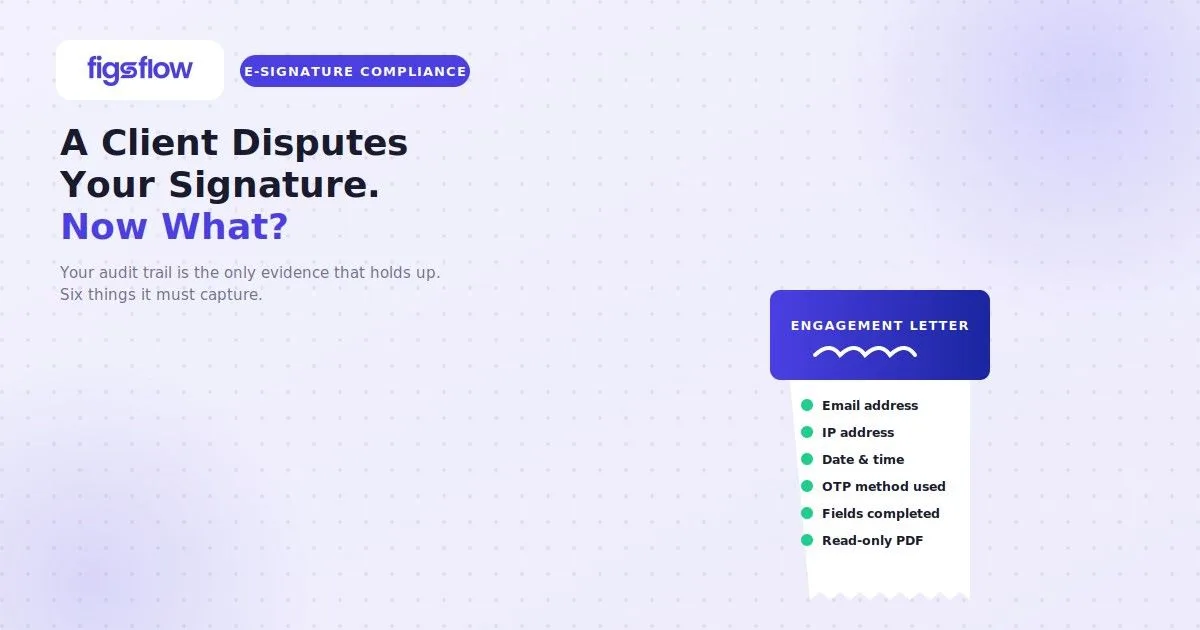
HM Land Registry’s Practice Guide 82 sets out the audit trail it expects for conveyancer-certified electronic signatures. It only formally applies to Land Registry applications, but it is a useful benchmark for any firm. The audit report should show:
- Email addresses: the addresses the document was sent to.
- IP addresses: the addresses of the devices used to sign.
- Date and time of signing: recorded automatically by the platform.
- OTP method used: how the one-time password was sent and entered.
- Fields completed: a record of what each signatory filled in.
We also recommend that the completed document is saved as a locked, final PDF so that any change after signing can be detected.
Check that your platform produces all of these. If it doesn’t, you have a gap. Retain the audit report alongside the signed PDF in the client file. The signed document alone is not enough if a dispute arises.
FigsFlow is a secure platform where clients sign engagement letters electronically in seconds. The signed document, audit trail, and client record sit together from day one. No printing.

Which Documents Can Be Signed Electronically?
Most documents an accounting firm handles day to day can be signed electronically using a Simple electronic signature. Under the ECA 2000 and UK eIDAS, commercial contracts carry no restriction on signature method provided the legal conditions for validity are met.
| Document type | Signature tier required |
|---|---|
| Engagement letters | Simple |
| Client proposals | Simple |
| Service agreements | Simple |
| NDAs | Simple |
| Fee amendments | Simple |
| Corporate resolutions | Simple (subject to the company’s constitutional documents) |
The document should be in its final agreed form before it is sent for signature. Sending a draft and amending the content afterwards creates a validity risk. For the engagement letter position in more detail, see are e-signatures on engagement letters valid in the UK.
Which Documents Cannot Be Signed Electronically?
Some documents have specific formality requirements that a standard e-signature cannot currently satisfy.
Wills must be signed and witnessed in line with section 9 of the Wills Act 1837, with the witnesses physically present. Electronic wills are not currently valid in England and Wales.
Statutory declarations must be made before a person authorised to take them, such as a solicitor or commissioner for oaths, under the Statutory Declarations Act 1835. There is currently no general framework for making them remotely or electronically in England and Wales.
Lasting powers of attorney can be filled in using the Office of the Public Guardian’s online service, but the forms must then be printed and signed on paper. GOV.UK guidance states that everyone must sign the same original document and cannot sign copies or use digital signatures. The Powers of Attorney Act 2023 provides for a more digital process in future.
Certain HMRC submissions are assessed on a case-by-case basis. While HMRC has extended its acceptance of electronic signatures across a number of document types, some specific forms and filings carry restrictions. Check the relevant HMRC guidance for the specific document in question.
Land Registry applications follow HM Land Registry’s own rules in Practice Guide 82. Transfers, charges and other dispositions can be signed using Mercury signing or conveyancer-certified electronic signatures, and HM Land Registry now also accepts qualified electronic signatures for charges, transfers and assents. If a client asks whether their property transfer can be signed electronically, refer them to their conveyancer.

Can a deed be signed electronically?
Yes. The Law Commission’s 2019 report on electronic execution of documents concluded that a deed can be signed electronically. Where a deed must be signed in the presence of a witness, however, the witness must be physically present. Watching by video call is not currently enough. A company executing a deed under section 44 of the Companies Act 2006 without a witness can sign electronically.
Dos and Don’ts with Electronic Signatures
E-signatures are only as reliable as the process behind them. A valid signature on a weak platform, or a good platform used carelessly, can still leave you exposed. These are the habits that separate a defensible setup from one that creates problems later. If you also verify client identity at onboarding, see electronic signatures, KYC and AML for UK accountants.
| Do | Don’t |
|---|---|
| Use a platform that produces a full audit trail with timestamps, IP address, and a finalised PDF | Assume a popular platform is compliant just because it’s widely used |
| Send documents directly through the platform rather than as email attachments | Accept a screenshot or photograph of a signature as a valid e-signature |
| Retain the signed PDF and audit report together in the client file | Use e-signatures for statutory declarations, LPAs, or wills |
| Get the engagement letter countersigned before starting work | Send draft documents for signature |
| Use the same platform consistently across your practice | Begin work on the basis that the client will sign later |
Summary: When Is an Electronic Signature Legally Binding in the UK?
An electronic signature is legally valid in the UK when the intention to authenticate is clear, and the signature is properly associated with the document. That has been the position since the Electronic Communications Act 2000 and was confirmed by the Law Commission’s 2019 report. The tier you use determines how robust your evidence is, not whether the signature holds up at all.
The platform is where most accounting firms have a genuine gap. A compliant platform produces a complete audit trail. A non-compliant one leaves you relying on intent alone if a client disputes a signature, which is a difficult position when an engagement letter is what stands between you and a scope or fee disagreement.
Practices that get this right now have one less compliance gap to worry about when questions arise later.
Not all platforms are built for accounting firms. Our guide breaks down the best e-signature software for UK accountants so you can choose one that’s compliant, practical, and built for the way you work.