Now Live: Practice Management Launched In FigsFlow On 7 October.Free until 28/02/2027
FigsFlow

FigsFlow

FigsFlow is your solution to generating proposals and engagement letters in seconds, managing pricing to keep it reasonable and profitable and handling client onboarding efficiently.

Published entries

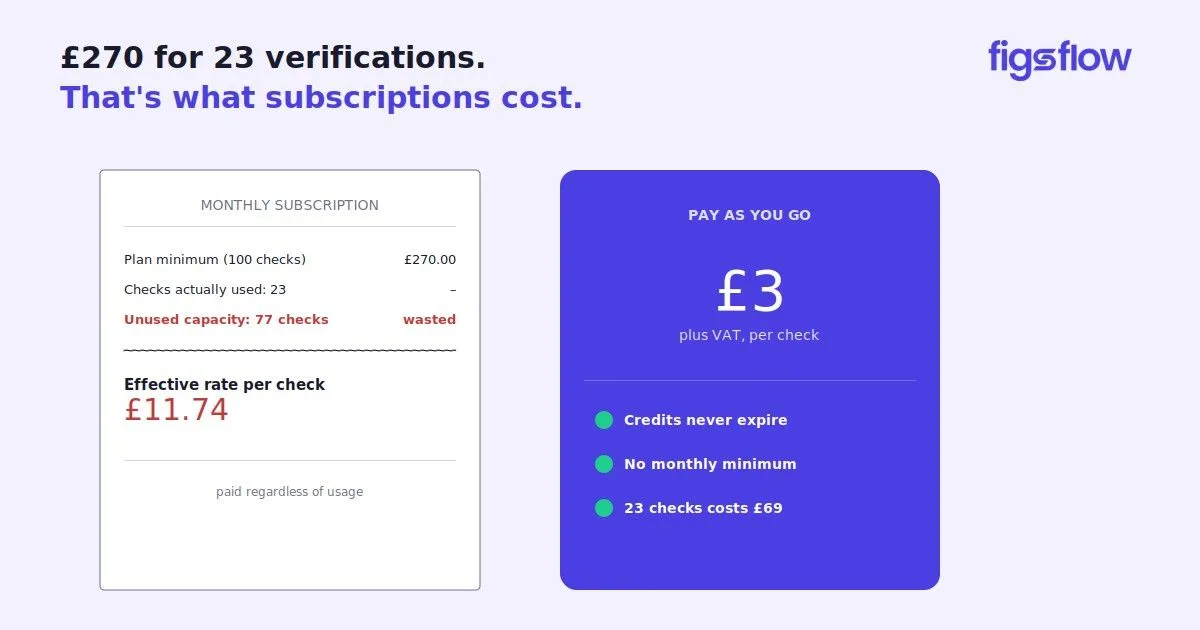
An overview of subscription and pay-as-you-go pricing for verifications.

12/2/2025

The Cost of ID Verification in the UK (2025): Why FigsFlow’s Pay-As-You-Go Model Wins for AML Compliance

The Cost of ID Verification in the UK (2025): Why FigsFlow’s Pay-As-You-Go Model Wins for AML Compliance The Cost of ID Verification in the UK (2025): Why FigsFlow’s Pay-As-You-Go Model Wins for AML Compliance Key Points Summarised for Busy Readers What is ID Verification? Curious about how ID verification actually works? What the Cost of ID Verification Really Looks Like in the UK Standard Price Ranges Per Check What Practices Actually Spend Annually The Gap Between Subscribed Capacity & Actual Usage Bottom line: Most firms overpay for ID verification Beyond Subscriptions: The Hidden Costs of ID Verification Paying for Unused Capacity Staff Time on Manual Processes Compliance Risk Costs Bottom line: Software is your cheapest cost Subscriptions vs Pay-As-You-Go: What the Numbers Show The Subscription Trap The PAYG Advantage Why FigsFlow's Pay-As-You-Go Model Wins The Cost Structure What's Included in Each ID Check Verify Only When You Need To Ideal for Startups, Sole Practitioners &,rowing Firms Start verifying clients without monthly commitments So, What's Next? Ready for your first step? Additional Resources Conclusion Frequently Asked Questions How much does ID verification cost in the UK? What's the difference between subscription and pay-as-you-go pricing? What should be included in an ID verification check? Do ID verification credits expire? How does automated ID verification save time? You budget £90 monthly for ID verification software. You onboarded eight clients in January, three in February, and twelve in March. The subscription doesn’t care. You paid £270 for 23 verifications when you could have paid £69 at £3 per check. That’s £201 wasted on capacity you never used. This is the real cost of id verification for accounting practices: not just the per-check price, but wasted subscriptions, staff time, and compliance risk. For most firms, the cost of id verification is driven by pricing structure rather than the checks themselves. Most UK accounting firms overpay for ID verification because pricing models assume constant client flow. Reality looks different. Client onboarding fluctuates with tax seasons, referral cycles, and market conditions. Fixed subscriptions punish this reality by charging for checks you don’t perform. This guide breaks down what ID verification actually costs in 2025, exposes the hidden expenses nobody mentions, and explains why pay-as-you-go pricing gives you control over compliance costs without sacrificing quality. When assessing the cost of id verification, firms must account for both direct fees and indirect operational costs. When firms talk about the cost of id verification, they often focus only on software pricing. In reality, the true cost includes unused subscription capacity, manual processing time, system inefficiencies, and the financial risk of non-compliance under MLR 2017. The cost of id verification in the UK ranges from £2 to £15 per check, but subscription models often waste 30% to 60% of paid capacity Hidden costs hurt more than software fees. Staff waste 30 to 45 minutes per verification with poor integration, and compliance failures risk HMRC penalties Pay as you go eliminates waste. FigsFlow charges £3 per check with full verification, sanctions screening, PEP checks, and audit trails included Choose based on volume patterns. Subscriptions suit a stable monthly intake, usage-based pricing saves money for seasonal or growing practices Identity verification confirms that clients are who they claim to be by checking their identity documents against authoritative independent sources. This satisfies Customer Due Diligence requirements under the Money Laundering Regulations 2017 . Here’s how ID verification works in practice. Document Scanning & Data Extraction – Electronic verification reads data from passports, driving licences, or identity cards using optical character recognition technology. The system extracts information from the machine-readable zone, the section containing standardised data that border control systems read automatically. Database Verification & Registry Checks – The extracted data gets checked against government databases, credit reference agencies, and official registries simultaneously. For individual clients, this means verifying against DVLA records, passport databases, and electoral registers. Corporate clients require Companies House verification, including PSC register checks to identify beneficial owners. Sanctions & PEP Screening – Sanctions screening runs in parallel with document verification. The system checks if clients appear on PEP lists, financial sanctions lists, or adverse media databases. The entire process generates compliance certificates and timestamped audit trails automatically. These records prove not just that you collected documents but that you verified them against independent sources and screened for sanctions as required by regulation 28 of MLR 2017. ID verification may sound complex, but it follows three clear steps: collecting client documents, verifying authenticity against authoritative sources, and maintaining compliant records Understanding this process helps you spot which providers offer genuine verification versus basic document storage. See the complete guide to ID verification costs and pricing models → Understanding ID verification pricing requires looking beyond the per-check headline rate to examine how different models structure their costs. Basic electronic identity verification typically costs £2 to £5 per check when purchased through subscription models with monthly minimums. This includes document verification against one or two databases but often excludes sanctions screening or Companies House integration. Enhanced identity verification with comprehensive database coverage runs £5 to £10 per check. This adds: credit reference agency checks, electoral register verification, and basic sanctions screening against UK financial sanctions lists Premium ID verification, including biometric matching, liveness detection, and international sanctions screening, costs £10 to £15 per check. Most UK accounting practices don’t need this level for standard Customer Due Diligence. Pay-as-you-go rates without subscriptions generally range from £3 to £8 per check, depending on what’s included. The higher end usually bundles risk assessment tools and ongoing monitoring capabilities. Small practices onboarding 5 to 10 clients monthly spend £600 to £1,200 annually on subscription models requiring minimum monthly fees. Actual verification costs might only be £180 to £360 if charged per use. Medium firms handling 20 to 30 new clients monthly pay £1,500 to £3,000 annually for subscriptions with higher capacity tiers. Usage-based pricing would cost £720 to £1,080 for the same volume. The discrepancy grows during seasonal variations. Tax practices onboarding heavily in January through April, then seeing reduced intake pay for full annual capacity while using 60% of it. These figures show how the cost of id verification escalates when firms pay for fixed capacity instead of actual usage. Most subscription models assume even monthly distribution that doesn’t match accounting practice reality. A firm subscribing to 20 checks monthly uses all 20 during tax season but only 8 in summer months. This creates wasted capacity that firms pay for regardless. Over time, this distortion inflates the cost of id verification far beyond its apparent per-check price. Over a year, practices with seasonal patterns waste 30% to 50% of their subscribed verification capacity. Growing firms face the opposite problem. They outgrow their subscription tier mid-year and must either upgrade to the next expensive tier or purchase additional checks at premium rates. Subscription minimums force you to pay for 100 verifications whether you perform 20 or 80. The price per check represents only the visible portion of ID verification costs. Hidden expenses multiply the total cost significantly. These hidden factors are often the largest drivers of the true cost of id verification. Subscription models charge monthly regardless of verification volume. A practice paying £90 monthly for up to 30 checks performs only 12 verifications in a quiet month, but still pays the full £90. This unused capacity compounds over time. Firms overpaying by £40 to £60 monthly waste £480 to £720 annually on verification capacity they never use. Minimum monthly commitments lock firms into paying even when they onboard zero new clients. Holiday periods, market slowdowns, or practice transitions all create months where verification needs drop to zero but subscription costs continue. Manual verification processes consume 30 to 45 minutes per client when staff must log into separate systems, transfer data manually, chase document uploads, and record results across multiple platforms. At £25 hourly staff cost, manual verification adds £12.50 to £18.75 in labor expense per client. For practices verifying 20 clients monthly, this hidden cost totals £250 to £375 monthly or £3,000 to £4,500 annually. Systems requiring manual audit trail documentation double this time investment. Staff spend additional minutes logging what documents they reviewed, which databases they checked, what results they obtained, and when each action occurred. Integration gaps between verification systems and practice management software create duplicate data entry. Client information entered in your CRM must be manually re-entered into standalone verification platforms. Incomplete audit trails create HMRC supervision risks that dwarf software costs. Recent ICAS reviews found 21% of firms conducting insufficient Customer Due Diligence, which triggers enforcement actions and potential fines. Manual processes inevitably create documentation gaps. Someone forgets to record a verification check, loses track of when sanctions screening occurred, or can’t prove which databases were queried. These gaps don’t just risk penalties. They invalidate your entire compliance defense if money laundering occurs through your client relationship. You can’t prove you performed adequate due diligence when audit trails are incomplete. Missing sanctions screening exposes practices to facilitating sanctioned activity. A single client slipping through without PEP or sanctions checks creates regulatory liability exceeding years of software costs. In regulatory terms, this risk forms a critical part of the overall cost of id verification. In many cases, the regulatory consequences far exceed the visible cost of id verification software itself. Verification fees are nothing compared to the true cost of id verification when systems are inefficient. Manual processes waste £3,000+ annually in staff time, unused subscriptions burn £500+ yearly, and compliance gaps create HMRC penalty risks exceeding years of software spending. Understanding when each makes sense requires examining actual usage scenarios and how they affect the cost of id verification over time. Fixed monthly subscriptions assume consistent client intake that rarely matches accounting practice reality. Seasonal patterns, referral cycles, and market conditions create inevitable variation. When subscriptions fail to match this reality, the cost of id verification increases rapidly without improving compliance outcomes. Practices pay for peak capacity year-round to handle their busiest months. A firm needing 30 verifications in March subscribes at that tier but only uses 12 in July. They’re paying 2.5 times actual usage for half the year. Subscription models with tiered pricing create additional inefficiency. Moving from 20 to 25 clients monthly might jump you from a £60 tier to a £120 tier. That’s £60 extra for five additional verifications or £12 per check. Early termination penalties and annual contracts lock practices into subscriptions even when needs change. A practice reducing focus on new client acquisition still pays monthly minimums throughout the contract term. Usage-based pricing charges only for verifications actually performed, keeping the cost of id verification aligned with real client onboarding volume. Onboarding 12 clients costs £36 at £3 per check. Onboarding 30 clients costs £90. The price scales perfectly with actual usage. Seasonal practices benefit most dramatically. Tax firms performing 40 verifications during tax season and 8 verifications in summer pay £144 annually under PAYG versus £480 to £600 under subscriptions covering peak capacity. Growing practices avoid tier-jumping penalties. Adding clients gradually increases costs proportionally without sudden subscription upgrade jumps. A practice growing from 15 to 25 clients monthly pays £45 to £75 under PAYG versus jumping from a £60 tier to a £120 tier under subscriptions. Every pound spent produces an actual verification, preventing the cost of id verification from being inflated by unused capacity. Did you know? ICAEW found that 19.3% of firms reviewed were non-compliant with AML regulations. FigsFlow structures pricing to reduce the cost of id verification by aligning charges with how accounting practices actually onboard clients. FigsFlow charges £3 plus VAT per ID check with a minimum initial purchase of 10 credits. This £30 minimum gets you started without monthly recurring charges. This approach keeps the cost of id verification predictable and proportional to actual usage. Credits never expire. Purchase 10 credits in January and use them gradually over six months. No penalty. No subscription renewal. No monthly minimum spend beyond initial purchase. The alternative bundle option costs £2.10 plus VAT per check, plus a £8 monthly fixed fee. This includes risk assessment templates and Enhanced Due Diligence workflows alongside standard verification. Practices performing 15 or more verifications monthly save money with this structure. Both options include the same verification capabilities. The pay-as-you-go model suits practices with variable onboarding volume. The bundle suits practices with consistent monthly client intake wanting risk assessment tools. Every FigsFlow ID check provides comprehensive verification that satisfies MLR 2017 requirements without requiring multiple systems or manual processes. Each check includes: Electronic verification against government databases and credit reference agencies, reading machine-readable zones on identity documents to confirm data matches official records Sanctions and PEP screening against financial sanctions lists, PEP databases, and adverse media sources running automatically for every client relationship Companies House integration verifying corporate clients, checking incorporation details, company status, and PSC register to identify beneficial owners holding 25% or more control Address verification confirming proof of address documents against utility databases and electoral registers Face match capability comparing photographs on identity documents to client selfies, preventing the use of stolen or borrowed documents for Enhanced Due Diligence situations Compliance certificates generating automatically with timestamped records showing what was verified, which databases were checked, what results were obtained, and when each action occurred The system handles audit trail documentation automatically. Document uploads, verification checks, risk assessments, and senior management approvals all get timestamped without manual logging, creating the complete compliance record MLR 2017 requires. FigsFlow triggers verification when clients accept engagement letters through the integrated e-signature system. The moment they sign, verification begins. This eliminates the gap between client acceptance and compliance checks that creates risk in manual processes. You’re not relying on someone remembering to log into a separate system and start verification. HubSpot integration imports won deals automatically. Client data flows from your CRM to the compliance dashboard without duplicate data entry. The information is already there when verification triggers. New practices benefit from no monthly commitments draining cash flow during client acquisition phases. Purchase 10 credits to verify your first clients without ongoing subscription overhead. Sole practitioners with limited client intake avoid overpaying for enterprise-level capacity. Onboarding 3 to 5 clients monthly costs £9 to £15 under PAYG versus £40 to £90 under typical subscription minimums. Growing firms scale verification costs proportionally with revenue growth. Adding clients increases compliance costs gradually rather than forcing premature jumps to expensive subscription tiers. Seasonal practices align verification spending with revenue patterns. High-income months with intensive client onboarding see higher verification costs. Quiet months with limited new business see minimal compliance spending. FigsFlow’s AML module starts at £3 per check with no recurring fees. And the best part: it’s free for the first 30 days. Claim your free trial and verify your first clients at no cost. No credit card required, no automatic subscriptions, no monthly minimums after trial ends. At this point, the difference in the cost of id verification between subscription and usage-based models should be clear. Here’s your action plan to switch to smarter ID verification: Step 1: Book a FigsFlow demo See how pay-as-you-go verification integrates with your client onboarding workflow and generates automated compliance records. Step 2: Calculate your actual verification costs Count completed verifications over the past 12 months and compare what you spent to what you’d pay at £3 per check. Step 3: Review your onboarding patterns Identify whether your practice has consistent monthly intake or seasonal variation that makes usage-based pricing more efficient. Step 4: Start your free trial Test FigsFlow with real clients for 30 days at no cost. No credit card required, no commitments. Book a FigsFlow demo and see exactly how much you could save by paying only for verifications you actually perform. Book your demo → ID Verification Checklist for AML: AML ID Verification Checklist: Essential Steps | FigsFlow Digital ID Verification for AML: Digital ID Verification for AML: Why Switch? | FigsFlow ID Verification in AML with FigsFlow: ID Verification & AML: 2025 Guide | FigsFlow Common ID Verification Mistakes in AML: Common ID Verification Mistakes in AML | FigsFlow Verify Identity Through ACSP: Identity Verification Through ACSP Is Now a Business Essential ID verification costs extend beyond the per-check price. Wasted subscription capacity, manual processing time, and compliance gaps from incomplete systems add up fast. FigsFlow’s £3 per check eliminates this waste. Electronic verification, sanctions screening, Companies House integration, and automatic audit trails work together without monthly minimums or tier limits. It’s your call. Either keep paying for capacity you don’t use, or switch to pricing that matches how you actually work. ID verification costs range from £2 to £15 per check, depending on the provider and what’s included. Basic verification with limited database coverage starts around £2 to £5, while comprehensive checks, including sanctions screening and Companies House integration, typically cost £3 to £10 per verification. Subscription models charge monthly fees for a set number of verifications, whether you use them or not. Pay-as-you-go charges only for verifications you actually perform. Practices with seasonal or variable client intake typically waste 30% to 60% of subscription capacity during quiet months. A compliant ID verification check should include electronic document verification against government databases, sanctions, and PEP screening, address verification, and automated audit trail generation. For corporate clients, add Companies House integration to verify incorporation details and identify beneficial owners through PSC register checks. This depends on your provider. FigsFlow credits never expire, so you can purchase them and use them over months without penalty. Many subscription models require a monthly minimum spending, and unused capacity disappears at the end of each billing cycle. Automated systems eliminate 30 to 45 minutes of manual work per client by reading documents electronically, checking multiple databases simultaneously, running sanctions screening automatically, and generating timestamped audit trails without manual logging. Integration with practice management software prevents duplicate data entry. cost-of-id-verification-in-the-uk-2025 cost of id verification in the uk 2025 page Page
An illustration explaining the importance of proof of address for anti-money laundering compliance.

10/8/2025

What is Proof of Address in the UK & Why It’s Crucial for AML Checks

What is Proof of Address in the UK & Why It’s Crucial for AML Checks What is Proof of Address in the UK & Why It’s Crucial for AML Checks What is Proof of Address? Why Proof of Address is Crucial for AML Compliance Common Challenges Faced When Collecting Proof of Address How FigsFlow Simplifies Proof of Address Collection & Verification Conclusion Picture this: you’re onboarding a new property investor client who’s eager to get started with their tax planning. The engagement letter is signed, the ID check is done and then everything grinds to a halt over one small request: proof of address. Weeks later, after polite reminders and multiple email threads, you’re still chasing that one missing document. It’s a familiar frustration for UK accountants . Proof of address feels like a simple box to tick, yet it’s one of the biggest bottlenecks in AML onboarding. In this post, we’ll unpack what actually counts as valid proof of address in the UK, why it’s such an essential part of AML compliance, the common pain points firms face when collecting it, and how digital tools like FigsFlow are finally making the process seamless. Proof of address (POA) is independent documentary evidence confirming that a client resides at the address they’ve declared, issued by a recognised and credible source. In the UK, there are two main categories of acceptable documents: Primary documents must be dated within the last three months and include: Utility bills for gas, electricity or water (but not phones) Bank or credit card statements Council tax bills Mortgage statements HMRC correspondence These documents should clearly display the client’s name and current address, leaving no ambiguity about who they relate to or where the individual lives. When primary documents aren’t available, alternative documents can be used. These include recent tenancy agreements, electoral register confirmations, or government-issued letters (e.g. benefit letters or driving licences). However, these often require additional checks to confirm the address is genuine and up to date. Under the Money Laundering, Terrorist Financing and Transfer of Funds Regulations 2017, accountants and other supervised entities must verify both a client’s identity and address for AML compliance . HMRC and professional bodies such as ICAEW and ACCA make it clear that address verification is a mandatory part of customer due diligence. Proof of address supports AML compliance in three key ways: It Enables Accurate Risk Assessment: Knowing where a client lives helps you assess risk appropriately. A client based in the UK presents different considerations from one connected to a high-risk jurisdiction. Without verified address information, it is impossible to apply the correct level of due diligence. It Enhances Traceability & Accountability: If suspicious activity arises, verified address details create a clear audit trail. They are essential for submitting Suspicious Activity Reports and assisting investigations. Incomplete or unreliable data can make follow-up impossible. It Helps Prevent Fraud: Address verification protects against identity theft, synthetic identities, and phoenix company schemes. Fraudsters often rely on firms that do not check addresses properly, as it allows them to operate under false details. Proof of address works together with identity verification, beneficial ownership checks, and source of funds verification to build a complete client risk profile. Each element strengthens the others to give a clear picture of who your client really is and what level of risk they present. For UK accounting firms, proof of address collection is often one of the slowest and most frustrating parts of AML onboarding . The difficulties usually arise not from non-compliance but from how modern clients live and share information. Shift to Paperless Documentation – Most clients now receive bills and statements online, which reduces the availability of traditional proof of address documents. Electronic PDFs are convenient but harder to verify, and many firms lack tools to confirm whether a document has been altered. This adds time and uncertainty to what should be a simple step. Non-Traditional Client Situations – Some clients do not have documents in their own name or at a fixed address. Those who live with family, rent informally, or move frequently, including students, entrepreneurs, and international clients, often struggle to provide acceptable evidence. Even legitimate clients can be caught out by requirements that assume a traditional paper trail. Delays, Reworks & Manual Verification – Clients may not understand why address evidence is needed, which leads to slow responses or incomplete submissions. Staff then spend valuable hours chasing missing documents, reviewing outdated or unclear files, and manually checking details. This process drains resources and increases the risk of errors that can affect compliance. Inconsistencies in Verification Standards – Different clients require different levels of due diligence. Applying these standards manually is challenging and deciding when enhanced checks are necessary or what evidence is sufficient often relies on individual judgment. This can lead to inconsistency across the firm. These challenges make proof of address collection one of the most resource-intensive parts of AML compliance and highlight why automation can significantly improve the process. FigsFlow makes collecting and verifying proof of address simple, fast and fully compliant. You can assign a risk level to each client using FigsFlow’s pre-built risk assessment templates. This helps your onboarding team select appropriate proof of address documents proportionate to the client’s risk. Clients receive a secure portal link where they can submit their documents at their convenience. This eliminates multiple email exchanges, reduces delays, and ensures documents are never lost. Based on these submissions, you populate the appropriate contact and address information in the system. Everything is stored in one place, making it easy to retrieve when needed. Once the documents are submitted, you can request an AML check. FigsFlow automatically verifies proof of address by searching across vast databases, ensuring accuracy without manual review. This approach ensures that document collection and verification are efficient, accurate, and proportionate to client risk. Proof of address verification consumes hours your team could spend on advisory work. Chasing documents, reviewing submissions, confirming authenticity- it’s necessary for compliance but contributes nothing to client value or practice growth. FigsFlow automates what should never have been manual in the first place. Clients submit documents through secure portals. The system verifies authenticity automatically. Your team maintains complete compliance without administrative overhead. The result? Faster onboarding, happier clients, and compliance that doesn’t drain resources. Your practice meets regulatory requirements while your team focuses on work that actually generates revenue and strengthens client relationships. Simplify proof of address collection and verification while keeping compliance effortless. Try FigsFlow for free with its 30-day trial. How FigsFlow Simplifies Proof of Address Collection & Verification- Initial Risk Assessment How FigsFlow Simplifies Proof of Address Collection & Verification (Client Portal) How FigsFlow Simplifies Proof of Address Collection & Verification- Initial Risk Assessment How FigsFlow Simplifies Proof of Address Collection Verification Automatic POA verification proof-of-address proof of address page Page

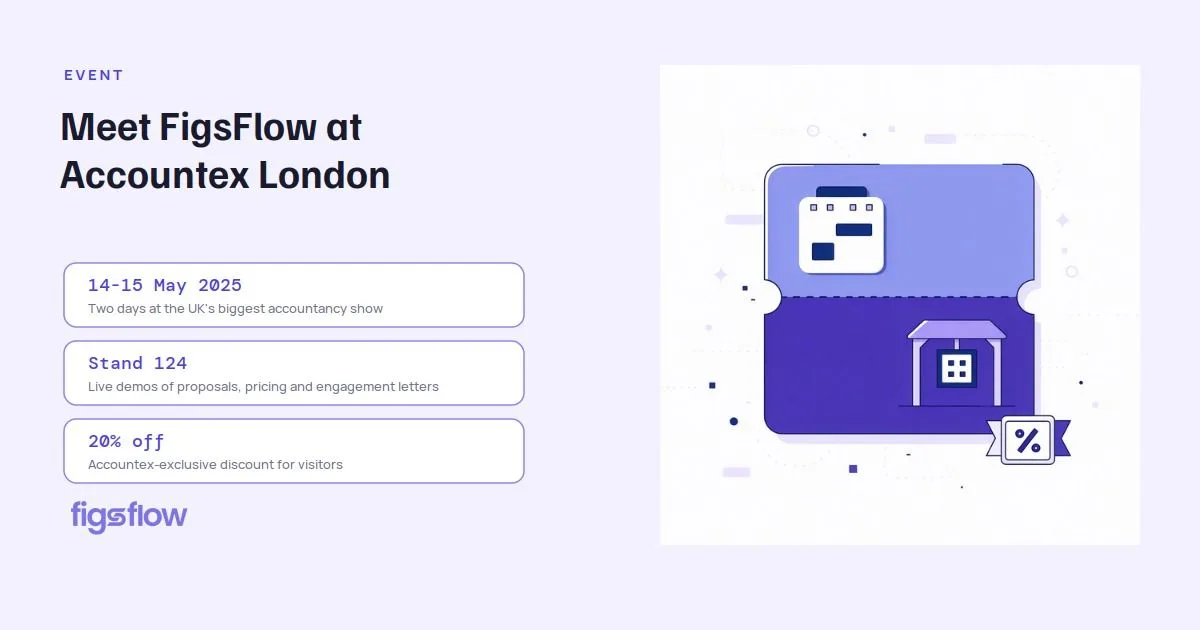
Promotional graphic for FigsFlow at Accountex London, outlining event details and a discount.

5/7/2025

Discover the Future of Proposals, Pricing & Engagement at Accountex London 2025

Discover the Future of Proposals, Pricing & Engagement at Accountex London 2025 Discover the Future of Proposals, Pricing & Engagement at Accountex London 2025 Why FigsFlow? What's Special About the FigsFlow Experience What You Achieve What You'll Be Seeing At Accountex Proposals in Seconds Engagement Letters for All Major Governing Bodies Scope Creep-Proof Pricing Automation That's Not Just A Label Grow with FigsFlow's Integrations We'll Be Expecting You at Stand 124 Mark your calendars for 14 and 15 May 2025, for FigsFlow is coming to Accountex London to exhibit what might just be the most flexible and intelligent proposal, pricing and engagement software accountants, bookkeepers and tax advisers could ever ask for. If you're tired of juggling multiple apps for proposal creation, engagement letters, pricing tools, CRM and signatures, then come meet us here at Stand 124. FigsFlow isn't just another generic tool; it's a fully integrated ecosystem for proposals, engagement letters and pricing, designed by accountants, for accountants . We understand the unique challenges you face — complex regulations, client expectations and pricing ambiguity — and have built a platform that addresses them efficiently. From instantly generated proposals to compliant engagement letters and smart pricing tools, FigsFlow replaces guesswork with clarity and manual admin with smooth automation. Still not convinced? See our features live at Accountex London 2025 and try FigsFlow for free for 30 days (no credit card required) and judge for yourself. Traditional Way With FigsFlow Draft proposals in Word or Google Docs Use beautiful, firm-branded templates Manually edit engagement letters Letters auto-generate based on service, entity type and compliance regulations Separate apps for e-signature, CRM, and pricing All built into one connected workflow Pricing via guesswork or spreadsheets Scientific, rules-based pricing engine that adapts to client scenarios Missed follow-ups or inconsistent tracking Everything tracked in-platform with automated reminders and HubSpot integration The result? A workflow that saves you time and money and converts leads into clients. Let's break it down further. Process How FigsFlow Delivers Proposal Creation Use pre-designed templates covering 100+ accounting & tax services, all styled with your brand, available round-the-clock and signed in one seamless flow. Engagement Letters Auto-generate regulator-compliant engagement letters (ICAEW, ACCA, CIOT, ATT, AAT, CIMA) that change dynamically based on services, client type and jurisdiction. Pricing Engine Configure various pricing options supporting complex models like bundled services and discount options. Signing & Approval Clients view, accept and e-sign proposals in FigsFlow, tracked with a full audit trail. CRM & Pipeline Management Track leads, proposals, sign-offs and renewals in one place — no more lost docs or scattered threads. FigsFlow gives you complete control with none of the back-and-forth. You achieve monumental savings and unparalleled efficiency! *Findings based on user feedback and internal analysis, reflecting the impact of FigsFlow's advanced automation, proposal generation and pricing management features. Why waste time writing and formatting every proposal from scratch? FigsFlow gives you stunning, fully branded proposals, with fonts, colours, sections — everything matched to your needs. You can: Choose from 100+ service templates covering a range accounting, tax and bookkeeping services, with more services and templates continuously added Send a single proposal to multiple directors while maintaining individual engagement letters for compliance Build and send proposals in less than 60 seconds, boosting your response time Better still, proposals come with real-time tracking, so you know exactly when they're opened and accepted. Engagement letters don't need to be a bottleneck. FigsFlow includes pre-built, customisable engagement letters that comply with all major accounting bodies: ACCA, ICAEW, CIOT, ATT, AAT, CIMA and more. Every service — from company accounts to Self Assessment Tax Return and bookkeeping — comes with a pre-built schedule you can tailor without touching the base template. Want just the letter without the full proposal? No problem! Our LOE-only mode is perfect for clients billed hourly or awaiting fee confirmation. And yes, e-signatures are built in. Have your client sign without the hassle of printing and scanning. Quick and easy. Ever quoted a fee, only to realise halfway through that the scope doubled but your price didn't? FigsFlow's advanced pricing calculator puts an end to that headache. Built specifically for accounting and tax practices, it lets you set clear yet flexible pricing models that reflect the actual work involved — no more guesswork, no more underselling. Fixed Pricing Define exactly what's included and what isn't, so scope boundaries are clear from the outset. Variable & Value-Based Pricing Adjust fees based on complexity, size or volume (e.g. number of properties, companies, transactions). Contingent Pricing Tie fees to results (e.g. successful R&D claims), with the flexibility to add minimums or caps. Bundling & Group Discounts Automatically price for group structures or multi-service clients, with transparent tiered logic. Multiple Quote Options Let clients choose between service levels (e.g. basic vs. premium) — clearly priced and explained. Main Points to Understand Every pricing scenario is backed by the parameters you set Every proposal outlines scope limits and terms Every client knows exactly what they're paying for No more ambiguity. No more margin erosion. With FigsFlow, pricing becomes proactive and profit-minded, as it should be. We built the software we always wanted. – FigsFlow Team Let's face it: chasing signatures, copying and pasting service terms and drafting the same emails over and over isn't just boring, it's a productivity killer. FigsFlow takes that manual workload off your shoulders with intelligent automation designed specifically for accountants, bookkeepers and tax advisers. Here's how it helps: Reminders for unsigned documents Auto-selection of service-specific engagement terms Email templates Notifications and alerts You don't need to "adopt" a new system. FigsFlow becomes your system. With FigsFlow, you don't need to overhaul your tech stack or learn yet another tool. Instead, it integrates into your existing system — enhancing what you already use, not replacing it. Integration How It Makes Your Life Easier Gmail & Outlook Send and track proposals, engagement letters, and follow-ups from your inbox without having to log out of FigsFlow. HubSpot Sync your CRM directly. Leads flow in, proposals go out — no manual copy-paste or dual entry. Stripe Clients can now pay directly. Accept payments easily and securely. Xero & QuickBooks Automatically push new client data into your accounting systems. Onboarding takes seconds, not hours. Zapier Unlock custom workflows and connect FigsFlow to thousands of other apps — from Slack to Trello to your internal systems. Companies House No need to manually enter client company details. Instantly pull and auto-fill company data. We're not just showing slides and handing out booklets. We are giving you front-row seats to the future of client onboarding with: Live demos running both days Guidance on using FigsFlow's features One-on-one conversation with the minds behind FigsFlow Visitors to our stall will also be eligible for a huge 20% discount on their first 12-month subscription of FigsFlow. All you'll need to do is scan a QR code and use the coupon code FIGS20. But remember. This is an Accountex exclusive offer. So, to take advantage of it, register here and pay us a visit at Stand 124, Accountex London 2025, 14-15 May 2025. What You Achieve discover-the-future-of-proposals-pricing-engagement-at-accountex-london-2025 discover the future of proposals pricing engagement at accountex london 2025 page Page
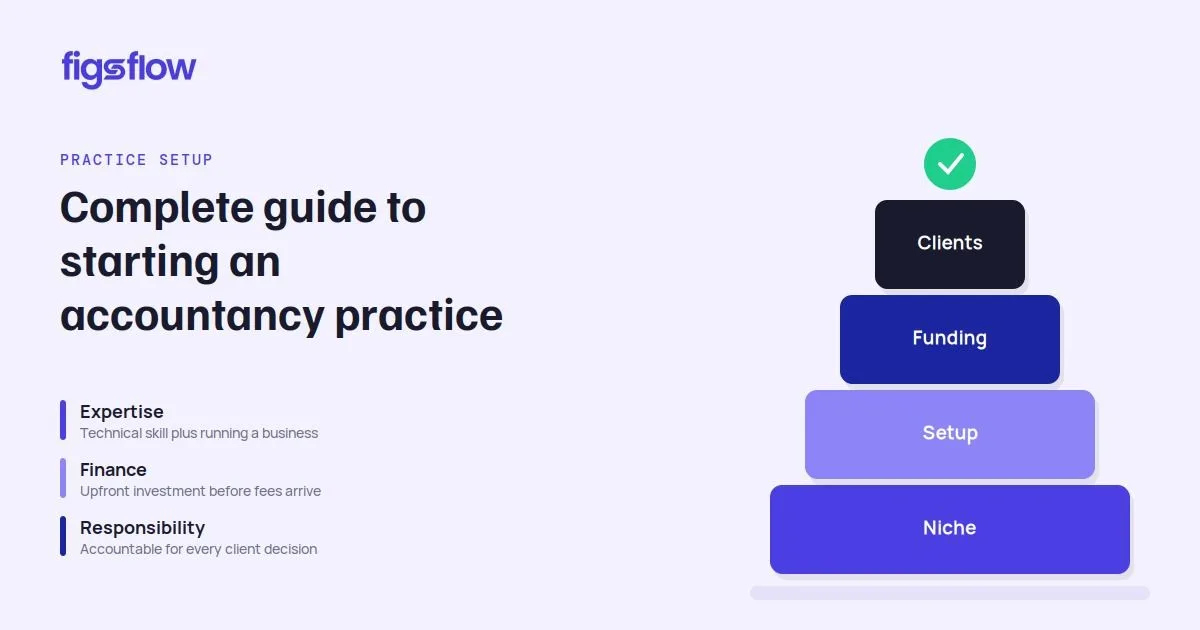
A visual guide outlining the steps to establish an accountancy practice.

2/18/2025

Complete Guide to Starting an Accountancy Practice

Complete Guide to Starting an Accountancy Practice Complete Guide to Starting an Accountancy Practice Lay the Foundation Do I Have the Right Expertise? Am I Financially Prepared? Am I Ready for the Responsibility? Define Niche & Value Proposition for Your Accounting Firm Leverage Your Experience and Passion Accountancy Practice Setup Funding Your Accounting Business Build a Strong Client Acquisition Strategy Deliver Exceptional Client Service Continuous Learning & Adaptation Conclusion: Start Your Accountancy Practice the Right Way Frequently Asked Questions How Profitable Is an Accounting Practice? Is Running an Accounting Firm Difficult? How to Start a Remote Accounting Practice? Starting your own accountancy practice is an exciting and rewarding journey. It offers the freedom to build a business on your terms and serve clients you are passionate about. But it is not without its risks. To succeed, you need, as well as technical accounting skills, a clear strategy and the ability to adapt to a competitive market. This guide is for accountants who want to start their own practice. It cuts through the noise and provides actionable, relevant advice to help you sharpen your knowledge, avoid common mistakes and build a thriving business. Before going all in, take a step back and evaluate whether you are ready to start your own accountancy practice. Because jumping in blind can lead you to jumble up your goals and needlessly lose profits. So, before taking your first steps, ask yourself: While technical accounting knowledge is essential, running an accountancy practice requires additional skills like client management, marketing and business strategy. If you lack experience in those areas, consider upskilling or partnering with someone who complements your strengths. Starting an accountancy practice requires upfront investment in software, office space (if needed), marketing and more. You should have enough savings to cover at least 6-12 months of personal and business expenses. Running an accountancy practice means being accountable for everything, from client satisfaction to compliance with regulations. It is a big shift from being an employee. When starting your own accountancy practice , one of the most critical decisions you will make is defining your niche and value proposition. This isn’t just about “picking a specialty.” Rather it is about carving out a space in the market where you can attract the right clients and build a reputation as the go-to expert. Trying to be everything to everyone is a recipe for burnout and mediocrity. When you niche down, you: Stand out in a crowded market and clients are more likely to choose a specialist over a generalist Charge premium fees as expertise commands higher rates Work with clients you enjoy and focusing on a niche allows you to work in areas you are passionate about Your niche should match your skills, interests and market demand. Think about your past roles and clients. What industries or types of accounting work did you enjoy most? Where did you excel? Which accountancy practices are you familiar with? For Example: Did you work with healthcare providers and understand their unique billing and compliance needs? Did you help startups with fundraising and financial forecasting? Were you involved in forensic accounting or fraud detection? Not every niche is profitable, however. Research the market to identify areas with high demand and low competition. Use tools like Google Trends, industry reports and local business directories to gauge demand. This will help you setup an accountancy firm that fills a real gap in the market. Moreover, if you are passionate about a particular industry or type of work, you will be more motivated to excel and build a reputation. For Example: If you love technology, consider specialising in cloud accounting or helping tech startups If you enjoy solving complex problems, forensic accounting or tax dispute resolution might be your calling Decide how you will operate your accountancy practice. Will you be a sole trader, partnership or limited liability company (LLC)? Each has pros and cons. A sole proprietorship is easy to start but puts your personal assets at risk. An LLC offers protection but comes with more paperwork. Speak to a legal or financial expert to find the best fit for your goals. Once you have chosen your structure, register with the right authorities such as Companies House for limited companies. You will also need to sign up with HMRC for taxes and obtain any necessary licenses. If you are an accountant, joining a professional body like ACCA, ICAEW, or CIMA adds credibility and trust. Next, set up your workspace. Whether working from home or an office, your space should be professional and organised. A clutter-free, well-equipped environment boosts productivity and leaves a good impression on clients. Invest in essentials like a reliable computer, accounting software and secure storage for documents. And choose an accounting platform that fits your clients’ needs. Favourites include QuickBooks, Xero and FreshBooks. For better workflow management, consider tools like Karbon, Practice Ignition or FigsFlow to keep track of proposals and engagement letters, deadlines, client communications and tasks. Another important task is to secure client data. Use encryption, two-factor authentication and regular data backups to protect sensitive information. Clients trust accountants with their finances, do not give them a reason to worry. Needless to say, don’t overlook insurance. Professional indemnity insurance protects your accountancy practice if a client claims you made an error. Public liability and cyber insurance offer extra protection against unexpected risks. The right coverage means your business stays safe from financial shocks. First impressions also matter. Set up a polished website, design a professional logo and use a business email address. These small details help establish trust and make your accounting firm look credible from day one. Once you have planned the structure for your accountancy practice, the next step is securing the funds to get it off the ground. There are several ways to raise capital, each with its own pros and cons. Bank loans are the most common option, but approval requires a solid business plan and good credit. If that is a hurdle, the Small Business Administration (SBA) can act as a guarantor, increasing your chances of getting a loan. Government grants are another possibility; though limited, they can provide financial assistance to entrepreneurs. Venture capital investors may be an option for businesses with high growth potential, but they will take an ownership stake, meaning less control for you. Friends and family can also help, either as investors or lenders, but make sure you handle it professionally; legal advice is a must to comply with regulations. Crowdfunding platforms also allow you to raise money from the public. Finally, if you have personal savings or assets to sell, self-funding keeps you in full control. For an accounting firm, bank loans, SBA-backed loans, or support from friends and family are often the best routes. If your firm grows rapidly, attracting venture capital or angel investors could become an option down the line. Clients are the heart of your accountancy business; without them, even the best accountant will not survive. But finding and keeping clients means having a smart, repeatable strategy. Here is how you can start bringing in clients for your accountancy practice without delay. Start with the People Who Already Know You Before you spend a dime on ads, tap into your existing network. Former colleagues, friends, family and past clients already trust you so let them know you are open for business. ✅ Action Step – Send a friendly message on LinkedIn or WhatsApp. Keep it simple: “Hey [Name], I recently started my own accounting practice, focusing on [your specialty]. If you or anyone you know needs help with [bookkeeping, tax planning, etc.], I’d love to chat.” 👉 Real-life example – If you worked in corporate finance before, reach out to ex-coworkers. Many have side businesses and need accounting help—they just have not thought to ask yet. Build Referral Partnerships (A Win-Win Strategy) You are not the only professional businesses rely on. Lawyers, financial advisers and business consultants all work with clients who need accounting services. Team up with them. ✅ How to do it: Find a business attorney and propose a referral deal: whenever they help set up a new company, they send clients your way for bookkeeping and tax advice. Offer to do the same—when your clients need legal or financial help, you send them to your trusted partners. 💡 Pro tip – Even local real estate agents can be a great source of referrals; business owners buying property often need tax guidance. Make Your Website a Client-Generating Machine A website should bring in leads while you sleep. Here is how to make it work: 📌 Must-have sections: ✅ Clear, simple service descriptions (tax planning, payroll, bookkeeping) ✅ Client testimonials & success stories (trust is everything!) ✅ A booking form so potential clients can schedule a free consultation 🚀 SEO Tip – Make sure your website includes phrases potential clients search for, like “affordable accountant for small businesses” or “best tax adviser in [Your City].” 👉 Example – If you specialise in e-commerce businesses, optimise your site with keywords like “accounting for Shopify sellers” or “Amazon FBA tax accountant.” Be Visible on LinkedIn (Your Next Client is Already There) Business owners scroll LinkedIn every day, looking for solutions. Be the accountant they find. ✅ What to post? Quick, actionable tax-saving tips (“Did you know businesses can deduct home office expenses?”) Common financial mistakes business owners make (and how to avoid them!) Client success stories (with permission) 💡 Engagement Hack – Don’t just post and disappear, comment on discussions, answer questions and message potential clients directly. This builds real connections. 👉 Instead of saying, “Need an accountant?” Try this – “Many businesses overpay taxes because they miss these three deductions. Here is how to avoid it…” Give Away Value for Free People hesitate to hire accountants they don’t know. Earn their trust by sharing useful content. 🔥 Ways to do this: ✅ Host a short webinar on tax deductions for small businesses ✅ Write a blog post about HMRC audit triggers (this gets shared a lot!) ✅ Create a simple guide like “How to Set Up QuickBooks for Your Business.” 📊 Example – If you want to attract freelancers, write a free guide on “Tax Deductions Every Freelancer Should Know.” Share it on LinkedIn and your website. When freelancers need tax help, guess who they will contact first? Your reputation as an accountant depends on the quality of service you provide. That is why, your accountancy practice or firm needs to deliver exceptional customer care to stand out from your competitors. To do this, you can focus on the following: Be Proactive – Don’t just react to client requests. Anticipate their needs and offer solutions before they ask. Communicate Clearly – Avoid jargon and explain complex concepts in simple terms. Regular communication builds trust and keeps clients informed. Meet Deadlines – Timeliness is critical in accounting. Use project management tools to stay on top of deadlines and deliverables. Go the Extra Mile – Small gestures like sending personalised thank-you notes or offering free consultations can leave a lasting impression. The accounting industry is constantly evolving with new regulations, technologies and client expectations. To stay ahead, your accountancy practice must invest in professional development, and you yourself must attend industry conferences, enrol in courses and earn certifications to expand your knowledge and skills. You should also stay updated on regulations: regularly review changes in tax laws, accounting standards and compliance requirements to remain compliant. Be open to adopting new technologies and processes that can boost productivity and service quality. As your practice grows, you’ll need to scale your operations to handle increased demand. Start by outsourcing tasks like bookkeeping or admin work. As your client base grows, consider hiring full-time staff or junior accountants. And expand your offerings, if need be, to include advisory services, financial planning, or business consulting. This boosts revenue and deepens client relationships, too. Starting an accountancy practice is a bold and ambitious step, and with the right preparation and mindset, it can be incredibly fulfilling. Remember, success doesn’t happen overnight. Stay persistent and proactive, and you will be well on your way to creating a practice that is underpinned by your expertise and values. Accounting firms rank among the most profitable small businesses. With hourly rates of up to £150 or more, even a solo practice can generate six-figure annual revenue especially with low overhead costs like a home office. It is not easy. You will need deep technical expertise, strong organisation, time management skills and the ability to handle clients and staff efficiently. Set up a virtual office with cloud-based accounting software, secure file-sharing tools and video conferencing platforms. A well-organised digital workflow is necessary for managing client accounts remotely. Funding Your Accounting Business Continuous Learning & Adaptation complete-guide-to-starting-an-accountancy-practice complete guide to starting an accountancy practice page Page
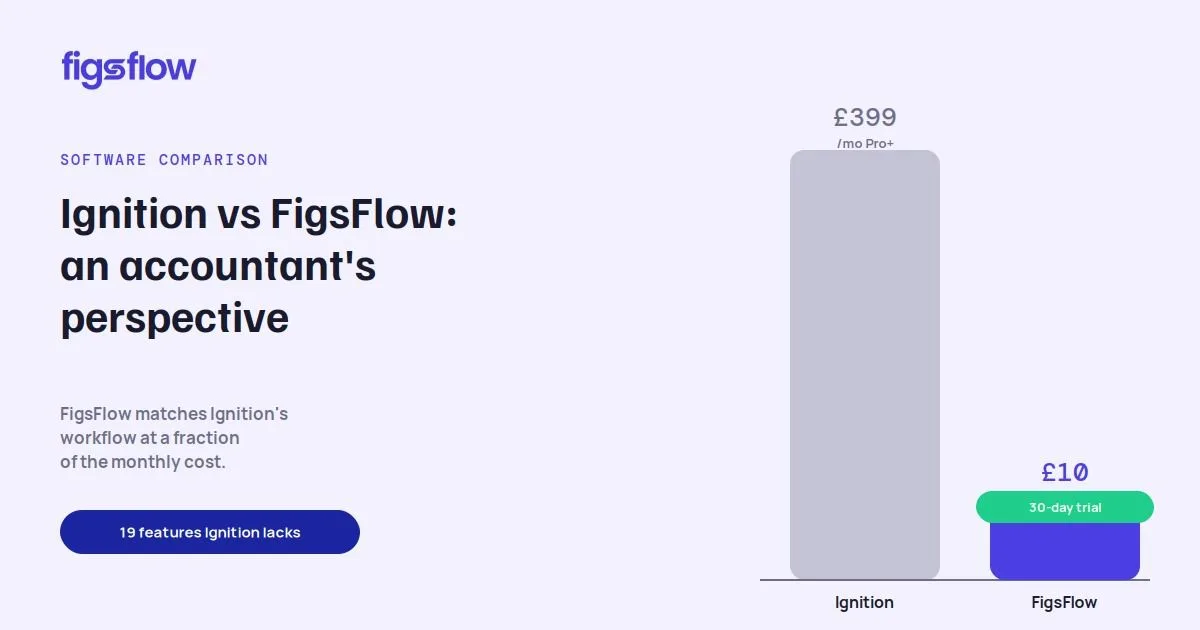
A comparison chart showing the pricing of Ignition and FigsFlow from an accountant's perspective.

2/13/2025

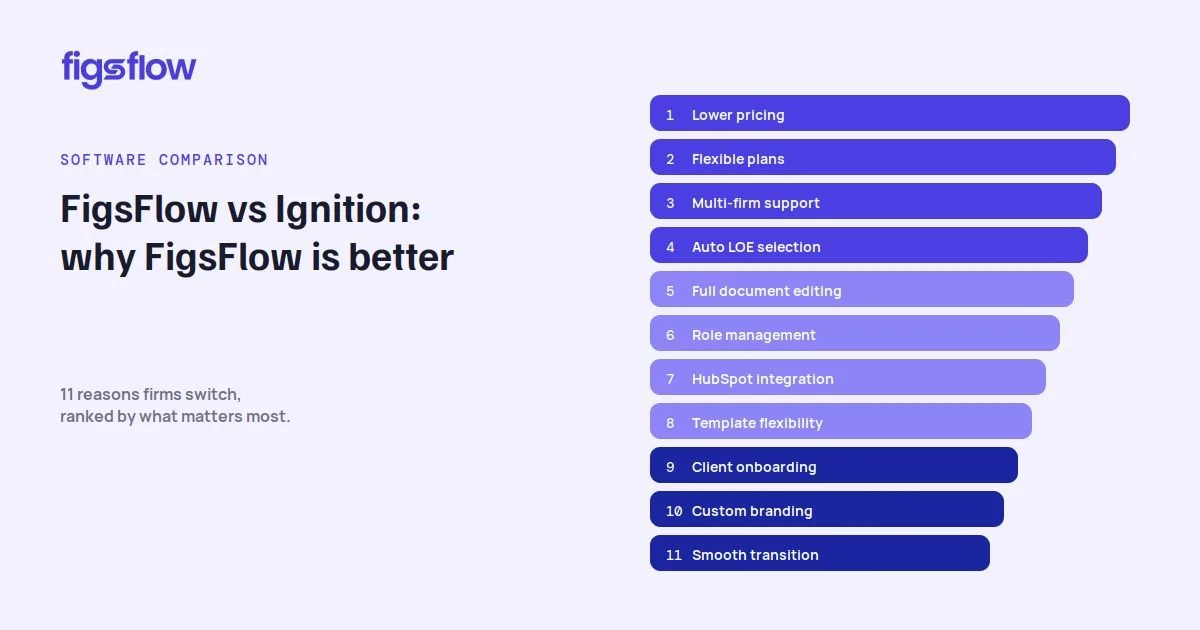
Ignition vs FigsFlow: Comparison Through an Accountants’ Perspective

Ignition vs FigsFlow: Comparison Through an Accountants’ Perspective Ignition vs FigsFlow: Comparison Through an Accountants’ Perspective Can FigsFlow Be an Ignition Alternative? Conclusion: Ignition vs FigsFlow Frequently Asked Questions What is the difference between Ignition and FigsFlow for accounting firms? How affordable is FigsFlow compared to Ignition for accountants? Does FigsFlow offer customisable engagement letters and proposals for accountants? For accounting firms, choosing the right proposal and engagement software can mean having a competitive edge over their counterparts. It saves time and builds stronger client relationships. So when it comes to Ignition vs FigsFlow, the choice could favour FigsFlow, because it is built by accountants for accountants, offers unmatched flexibility and has a library of ready-to-use pre-built templates that fit the needs of every firm. Features FigsFlow Ignition More Affordable Pricing ✓ ✕ Trial Period (30 days) ✓ ✕ Multi-User Support in Lite Plan ✓ ✕ Flexible Plans ✓ ✕ Professional Market Targeting ✓ ✕ Send 10 Documents Per Month ✓ ✕ Multiple Firms/Workspaces ✓ ✕ Automatic LOE Selection ✓ ✕ Extensive Templates Library ✓ ✕ Separate Proposals and LOEs ✓ ✕ Advanced Role Management ✓ ✕ Sub-Services Management ✓ ✕ Customisable Email Templates ✓ ✕ Streamlined Proposal Generation ✓ ✕ Onboarding and Client Service ✓ ✕ Comprehensive Dashboard ✓ ✕ Automated Notifications ✓ ✕ Dynamic Pricing Models ✓ ✕ Companies House Integration ✓ ✕ Export Capabilities ✓ ✕ FigsFlow’s Lite plan starts at just £10 per month, with no hidden costs, making it budget-friendly for firms of all sizes. By contrast, Ignition charges $39 dollars per month for its Solo plan, with costs reaching £399 per month for the Pro+ plan. FigsFlow is built specifically for accountants, tax advisers and bookkeepers, providing deep customisation for engagement letters and proposals . Ignition, however, may appear to a rigid workflow with limited adaptability. FigsFlow offers ready-made templates including automated engagement letters that meet CIOT and ACCA standards. Ignition’s template library, while functional, lacks the same level of accountant-specific customisation, making it less ideal for professional accounting firms. FigsFlow also provides granular user controls, allowing firms to define specific roles and permissions for better security and workflow management. Ignition’s predefined permission settings are far less flexible, limiting access for your team. Moreover, FigsFlow allows firms to manage both main services and sub-services within proposals, keeping pricing and detail accurate. Lastly, FigsFlow lets you add your branding even on its basic plan, helping your business’s identity shine through. Ignition reserves this feature for its higher-tier plans, making it an expensive add-on. FigsFlow is the winner for accounting, tax advisory and professional services firms. It’s more affordable, flexible and packed with features like advanced role management, automated engagement letter selection and easy integrations. If you’re looking for a tool that combines speed and customisation, FigsFlow is a smart choice. It’s designed to grow with your firm, helping you deliver exceptional client service while keeping costs in check. Choose FigsFlow and take your practice management to the next level. FigsFlow is more affordable, flexible and tailored specifically for accountants. It offers features like custom engagement letters, an extensive template library, and granular user controls. FigsFlow starts at just £10 per month, making it a budget-friendly option for firms. Ignition’s pricing starts at $39 per month, with higher-tier plans costing up to £399 per month. Yes, FigsFlow provides fully customisable engagement letters and proposals with ready-made templates that meet professional standards, tailored specifically for accountants and tax advisers. Ignition vs FigsFlow ignition-vs-figsflow-comparison-accountants-perspective ignition vs figsflow comparison accountants perspective page Page
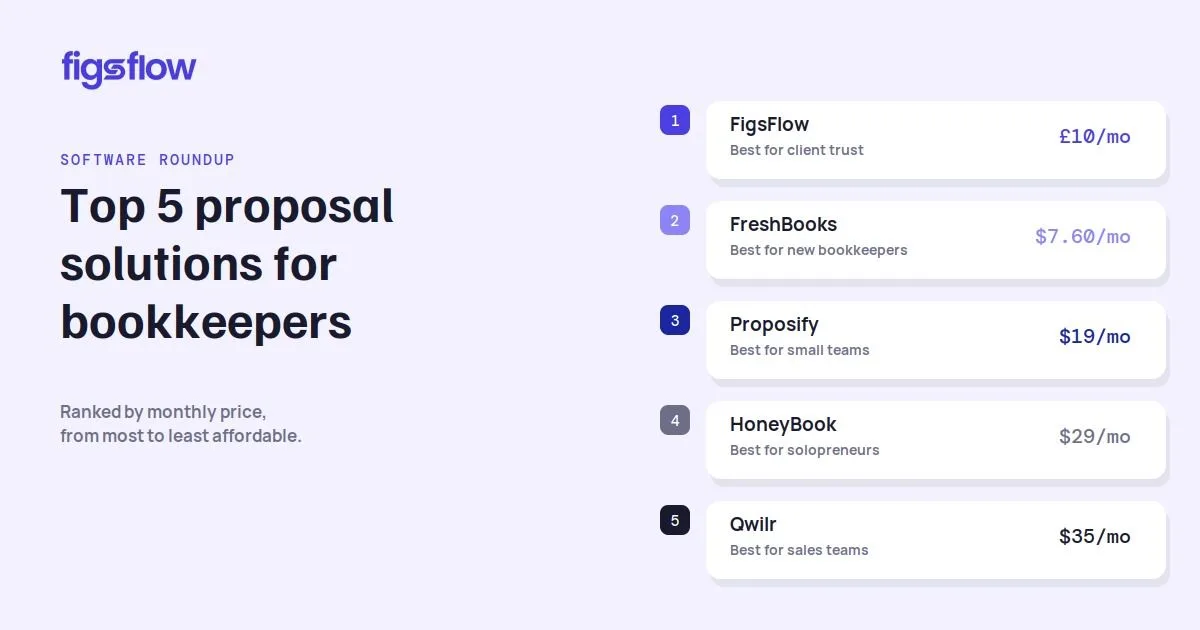
A list of the top 5 proposal software solutions for bookkeepers, ranked by price.

2/11/2025

Top 5 Proposal Solutions for Bookkeepers

Top 5 Proposal Solutions for Bookkeepers Top 5 Proposal Solutions for Bookkeepers Proposal Solutions at a Glance FigsFlow: Best for Strengthening Client Trust Qwilr: Best for Firms with Sales Teams Proposify: Best for Small Teams FreshBooks: Best for New Bookkeepers HoneyBook: Best for Independent Bookkeepers Conclusion Frequently Asked Questions What is the best proposal solution for bookkeepers? How do I create proposals for bookkeeping services? Which proposal software offers eSignatures for bookkeepers? As a bookkeeper, your job is all about keeping your clients’ finances organised. But wasting hours on old-school ways to write up proposals and list out what you will do for them isn’t exactly why you love this work. You would rather be knee-deep in spreadsheets, sorting out numbers and helping your clients stay on track. So, it is time to ditch the hassle and find a better way to handle the boring stuff. We have compiled a list of the top five proposal solutions for bookkeepers in 2025. We have broken down the features, pricing, and pros and cons of each so you can find the best fit without wasting time testing them out. Proposal Software Standout Feature Integrations Starting Price per Month (as of Feb 2025) FigsFlow Automates engagement letters, multiple workspaces, allows e-signatures HubSpot, advanced role management and detailed client data capture £10 (~approx. $12.50) with a 30-day free trial Qwilr Interactive proposals with tracking and analytics CRM tools, payment processors, and team collaboration tools $35/user (Business plan) with a 14-day free trial Proposify Editable proposals with PDF downloads, e-signatures Integrates with sales automation tools and CRMs $19 (Basic for 2 users), $41 (Team plan), $65 (Business plan) FreshBooks Invoice conversion with e-signatures and collaboration tools CRM tools, invoicing and payment processors $7.60 (Lite), $13.20 (Plus), $24 (Premium) HoneyBook Project management with scheduling and invoicing Zoom, QuickBooks, Zapier, email and calendar integrations $29 (Starter), $49 (Essentials for 2 users), $109 (Premium for teams) FigsFlow is a powerful proposal software tool for bookkeepers that boosts client engagement and proposal creation. It offers a wide range of customisable templates , flexible pricing and the ability to manage multiple firms or workspaces. The platform also includes advanced role management, integration with HubSpot and detailed client data capture, making workflows smoother. It allows digital signatures on documents for faster transactions. With an easy-to-use dashboard and step-by-step onboarding, FigsFlow is simple and efficient. Pricing starts at just £10 a month and a 30-day free trial is available. Users can try it out before committing. Qwilr is a great tool for sales teams in bookkeeping, built to make collaboration and tracking proposals easier. It offers web-based proposals that replace old PDFs and lets you add interactive elements like spreadsheets, videos and calculators. You can also use templates to keep things consistent across the team. Qwilr makes it easy to share agreements, track how proposals are performing with real-time analytics and handle eSignatures and payments for smoother transactions. The Business plan starts at $35 per user per month with a 14-day free trial, while the Enterprise plan, with extra features, costs $59 per user per month. Proposify is ideal for small bookkeeping teams without dedicated sales reps, offering visually appealing, on-brand proposals that can be signed electronically or downloaded as PDFs for traditional clients. Key features are embedding images and videos, easy PDF downloads and customisable templates to speed up proposal creation. Its pricing includes a Basic plan at $19/month for up to two users, a Team plan at $41 per month and a Business plan at $65 per month for larger teams with advanced integrations and workflows. FreshBooks is an ideal proposal solution for bookkeepers new to the field. It offers proposal features perfect for individuals or small teams. Its standout features are customisable proposals with images and attachments, in-app commenting for better collaboration, approval and eSignature for faster deal closures and the ability to convert proposals into invoices. Pricing starts at $7.60 per month for the Lite plan with options for additional features and users in the Plus ($13.20 per month) and Premium ($24 per month) plans, while enterprise solutions are available through custom pricing. HoneyBook is an all-in-one platform built for solopreneurs, providing a cost-effective solution for independent bookkeepers. It consolidates scheduling, invoicing and meeting bookings into one tool, saving time and money. Key features are automated project management, integrations with Zoom, Zapier, QuickBooks and email, helping independents stay organised and productive. Pricing starts at $29 per month for the Starter plan, with the Essentials plan at $49 per month for two users and the Premium plan at $109 per month for teams, all with annual billing options and a free trial. When it comes to choosing proposal software, the right fit for you will depend on factors like the services you offer, the size of your team and your budget. Each software tool comes with its own set of features, and while some may offer extensive functionality, you might find that many of these features are not necessary for your particular needs. For instance, a small firm might not need the advanced features of a larger organisation, and using an overly complex tool could just add unnecessary costs. The best proposal software for bookkeepers depends on your needs. For streamlining client engagement, FigsFlow is a top choice with customisable templates and client data management. Creating proposals for bookkeeping services is easy with proposal solutions like FigsFlow, Qwilr or Proposify. These platforms offer templates to make the process faster and more professional. Many proposal solutions for bookkeepers offer eSignature features, including FigsFlow, Qwilr, Proposify and FreshBooks. These platforms allow you to easily send proposals for signing. Proposal Solutions for Bookkeepers top-5-proposal-solutions-for-bookkeepers top 5 proposal solutions for bookkeepers page Page
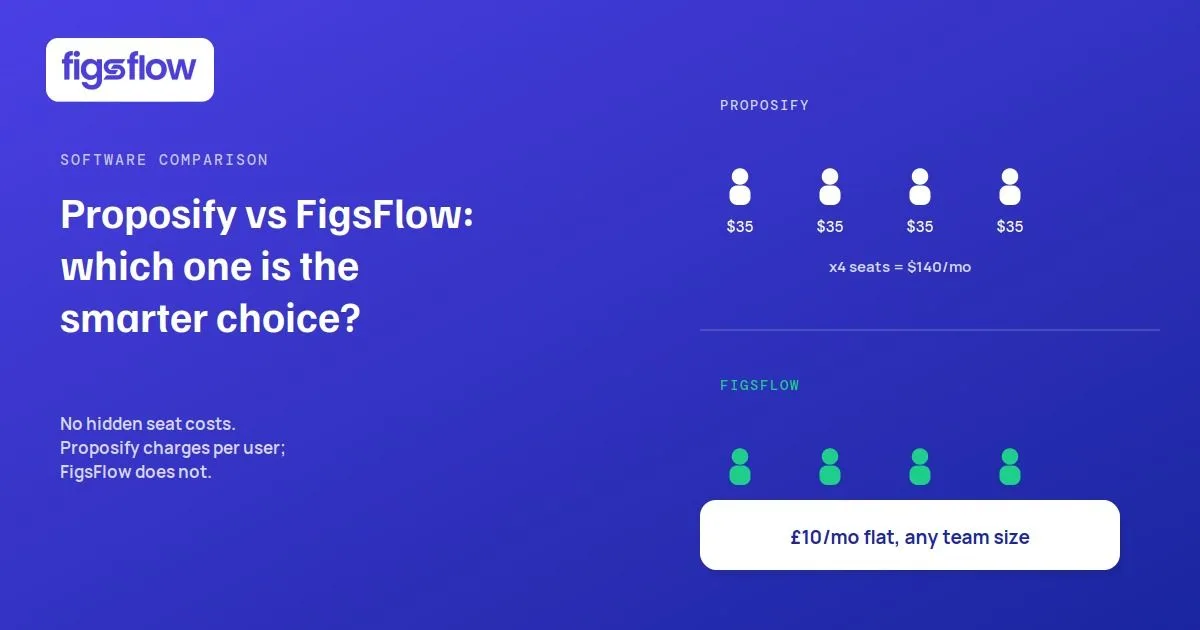
A comparison of pricing between Proposify and FigsFlow software.

2/10/2025

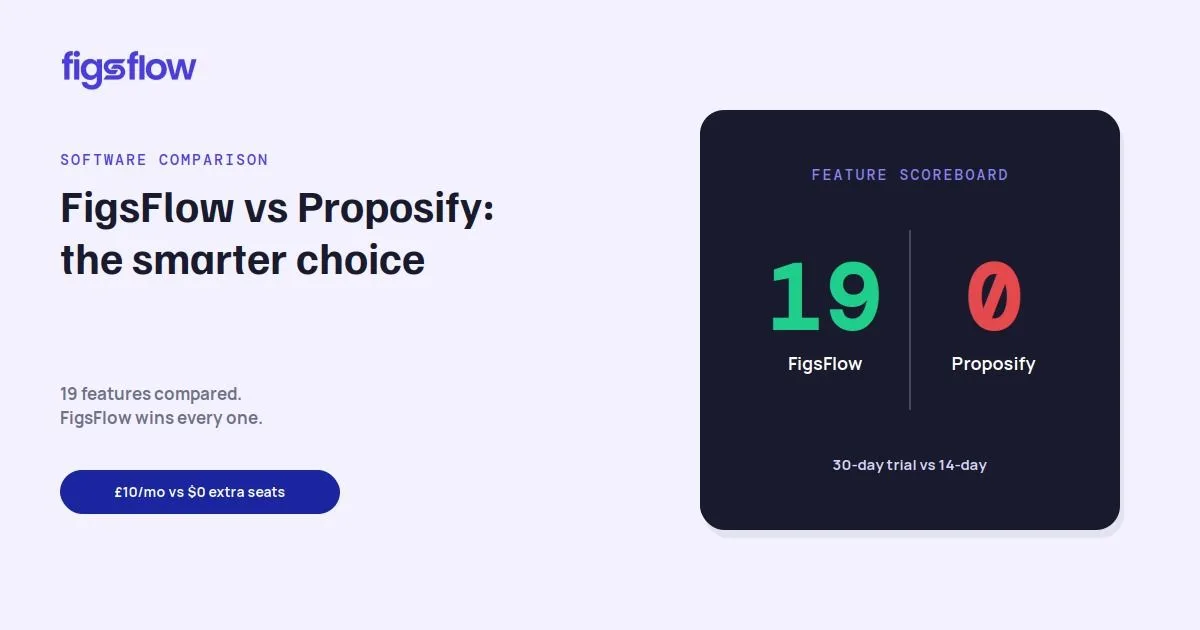
Proposify vs FigsFlow: Which One is the Smarter Choice?

Proposify vs FigsFlow: Which One is the Smarter Choice? Proposify vs FigsFlow: Which One is the Smarter Choice? Can FigsFlow Be Proposify Alternative? Conclusion: Proposify vs FigsFlow Frequently Asked Questions What’s the difference between FigsFlow and Proposify for accountants? Is FigsFlow more affordable than Proposify? What are the key features of FigsFlow for accounting firms? For accounting and professional services firms, choosing the right proposal and engagement software can mean having a competitive edge over their counterparts. It saves time, helps stay compliant with laws and builds stronger client relationships. So, when it comes to Proposify vs FigsFlow, the choice is clear: FigsFlow is built for accountants, offering unmatched flexibility, smooth integrations and customisation that fits the distinct needs of your firm. Here’s why it stands out. Features FigsFlow Proposify More Affordable Pricing ✓ ✕ Trial Period (30 days vs. 14) ✓ ✕ Multi-User Support in Lite Plan ✓ ✕ Flexible Plans ✓ ✕ Professional Market Targeting ✓ ✕ Send 10 Documents Per Month ✓ ✕ Multiple Firms/Workspaces ✓ ✕ Automatic LOE Selection ✓ ✕ Extensive Templates Library ✓ ✕ Separate Proposals and LOEs ✓ ✕ Advanced Role Management ✓ ✕ Sub-Services Management ✓ ✕ Customisable Email Templates ✓ ✕ Streamlined Proposal Generation ✓ ✕ Onboarding and Client Service ✓ ✕ Comprehensive Dashboard ✓ ✕ Automated Notifications ✓ ✕ Dynamic Pricing Models ✓ ✕ Companies House Integration ✓ ✕ Export Capabilities ✓ ✕ FigsFlow starts at just £10/month, with no hidden seat costs, making it budget-friendly for firms of all sizes. By contrast, Proposify charges $35 per user per month—costs that can skyrocket for larger teams. FigsFlow is built for accountants, tax consultants and bookkeepers, providing deep customisation for engagement letters & proposals. Proposify, however, sticks to a rigid workflow with limited adaptability. FigsFlow offers ready-made templates, including automated engagement letters tailored to CIOT and ACCA standards. Proposify has a smaller accountant-specific template library, making it less ideal for professional accounting firms. FigsFlow also provides granular user controls, letting firms define specific roles and permissions for better security and workflow management. Proposify’s predefined permission settings are far less flexible. Moreover, FigsFlow allows firms to manage both main services and sub-services within proposals, keeping pricing and detail accurate. Proposify’s rigid structure forces users into a one-size-fits-all format. When it comes to Proposify vs FigsFlow, FigsFlow is the clear winner for accounting, tax advisory and professional services firms. It’s more affordable, flexible and packed with features like advanced role management, automated engagement letter selection and easy integrations. If you’re looking for a tool that combines speed, customisation and efficiency, FigsFlow is the smarter choice. It’s designed to grow with your firm, helping you deliver exceptional client service while keeping costs in check. Choose FigsFlow and take your practice management to the next level. FigsFlow is tailored for accountants with custom templates, role management and Companies House integration. Proposify is a general tool with limited customisation. Yes, FigsFlow starts at £10/month, while Proposify costs $35 per user per month, making FigsFlow much more affordable. FigsFlow offers automated engagement letter selection, flexible pricing plans, accounting-specific templates and advanced role management for efficient workflow. proposify-vs-figsflow-which-one-is-the-smarter-choice proposify vs figsflow which one is the smarter choice page Page
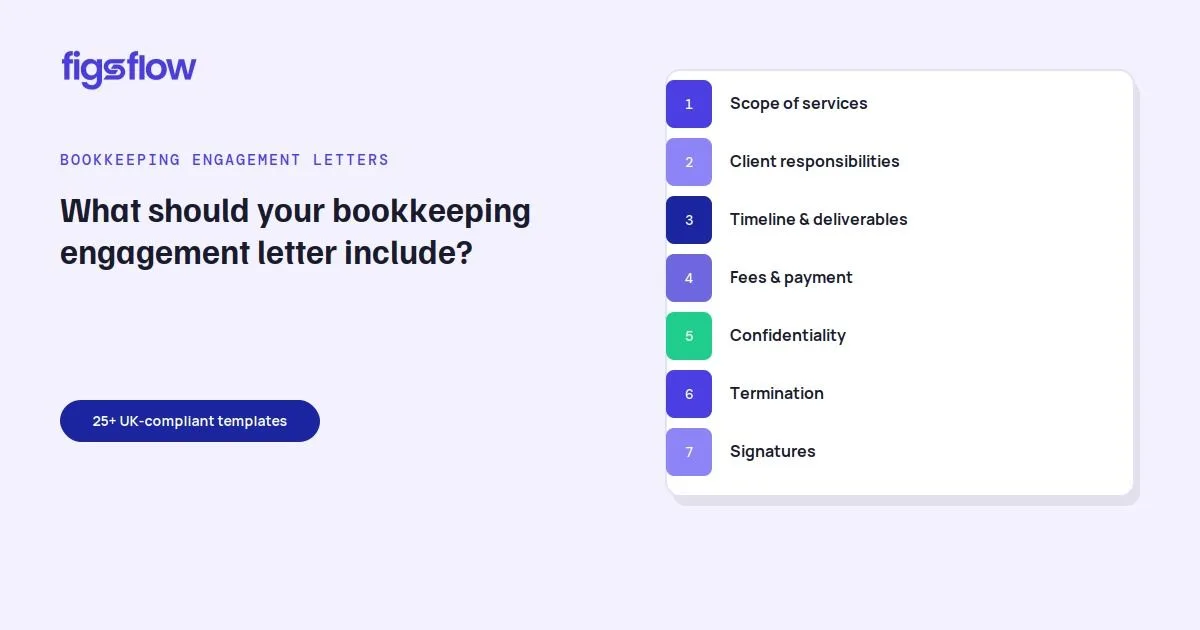
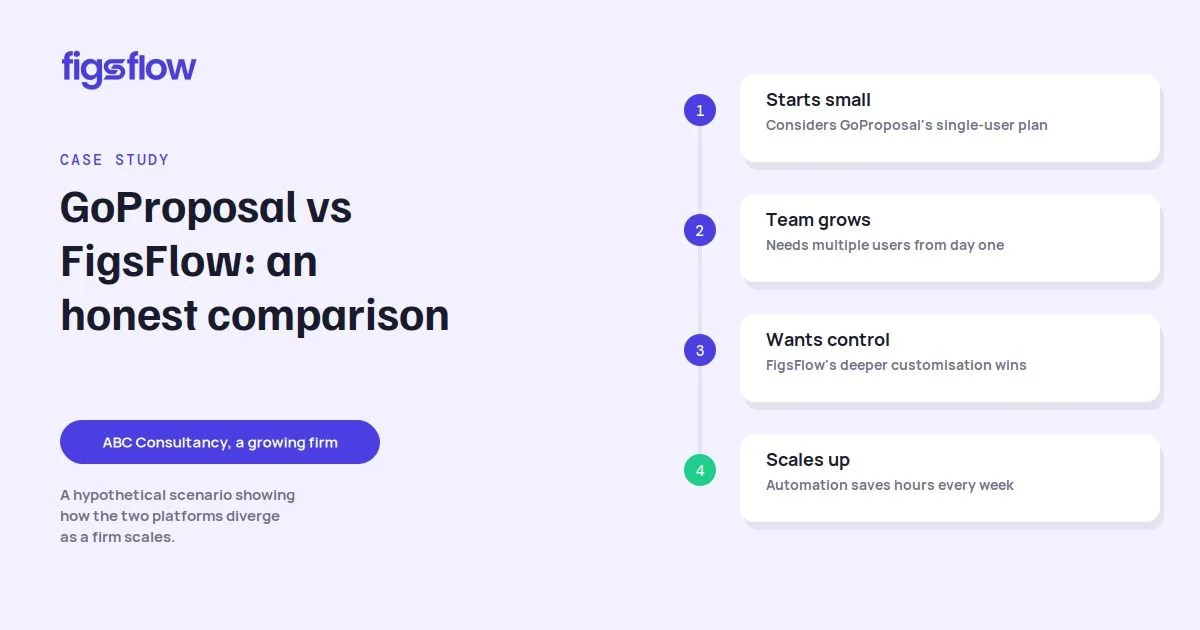
A case study comparing two platforms, GoProposal and FigsFlow, for a growing consultancy firm.

2/4/2025

GoProposal vs FigsFlow: An Honest Comparison

GoProposal vs FigsFlow: An Honest Comparison GoProposal vs FigsFlow: An Honest Comparison The Business Dilemma Value for Money: How the Two Stack Up Conclusion Frequently Asked Questions 1. Which is a better option for small accountants: GoProposal vs FigsFlow? 2. How does FigsFlow’s automation differ from other software? 3. Is FigsFlow scalable? Choosing the right platform, GoProposal vs FigsFlow, for managing your business operations means laying the groundwork for success. You need a system that is packed with powerful features, flexible and cost-effective. FigsFlow shines as a top choice for businesses looking to boost productivity without breaking the bank. Let us look at how GoProposal vs FigsFlow compare in key areas to show why it is the better option for practice management. Feature FigsFlow GoProposal Pricing Starts at £10, with flexible plans Starts at £65 Plan Customisation Highly customisable upon request Fixed plans, limited flexibility User Capacity 2 users on the Lite plan 1 user on the Basic plan Document Capacity 10 LOEs on the Lite plan 5 LOEs on the Basic plan Multiple Workspaces/Firms Supports multiple firms/workspaces Does not support multiple firms Automated LOE Selection Yes, based on entity type Manual selection required Template Library Comprehensive, included in base plan Limited, requires additional payment Role Management Advanced, customisable roles Predefined roles only CRM Integration HubSpot integration available No CRM integration Client Database Detailed client data capture Basic client details only Document Signing Multiple signatures at once Requires individual signing Onboarding Step-by-step guided process No guided onboarding Dashboard Intuitive and user-friendly Limited functionality When businesses search for the right platform to manage their burdensome practice, they often confront a tough decision: balancing cost with scalability. To illustrate that, let us imagine a hypothetical scenario involving ABC Consultancy, a small firm with big plans for expansion. ABC Consultancy initially considers GoProposal, hoping it would meet its needs. But it quickly realises that the £65 per month price tag is more than its tight budget could handle. After more research, it comes across FigsFlow. With a starting price of just £10, plus a range of flexible pricing plans, it seems like the perfect fit. As the firm grows, so does its need for a platform that could scale with them. GoProposal would only allow one user on its basic plan, meaning they would have to upgrade as their team expanded. FigsFlow, on the other hand, offers multiple users from the start, making collaboration easier without the need for costly upgrades. Customisation also plays a big role in its decision. While GoProposal requires it to manually select engagement letters, FigsFlow provides a customisable template library, enabling the firm to quickly adjust documents to fit each client’s needs. What really makes a difference is FigsFlow’s automation tools. The platform automatically selects the right engagement letter based on the client’s entity type, saving time and trimming the chance for errors. GoProposal does not offer that feature, which means more manual work for the firm. In the end, ABC Consultancy realises FigsFlow not only saves the company money but also provides it with the scalability and flexibility needed to grow. Though this scenario is hypothetical, it reflects a broader trend: more businesses are choosing platforms that are affordable, adaptable and packed with features to support growth without breaking the bank. FigsFlow is a more affordable and flexible option than GoProposal, particularly for small businesses. With prices starting at just £10, it is much more budget-friendly than GoProposal’s £65 starting price, making it easier for businesses with limited funds to get started. FigsFlow offers customisable plans to fit various business needs, while GoProposal sticks to fixed pricing, which can be restrictive. FigsFlow allows multiple users even at the entry level, making collaboration easier without extra costs. GoProposal, on the other hand, limits its Basic plan to one user, meaning businesses need to upgrade as their team grows. FigsFlow provides more flexibility with documents, too—its Lite plan allows 10 engagement letters (LOEs), while GoProposal only allows five. FigsFlow shines when it comes to scalability. It lets businesses manage multiple workspaces and companies under a single account, unlike GoProposal, which does not offer the feature. Its automation tools, like automatically selecting the correct LOE based on entity type, save businesses time and reduce mistakes, while GoProposal requires manual input. What is more, FigsFlow gives businesses access to a large library of engagement letter templates as part of the base plan with no added costs. By contrast, GoProposal charges £40 per month for extra templates. FigsFlow also lets businesses send extra documents for just £1 each, while GoProposal forces firms to upgrade their plans. FigsFlow also excels in ease of use with features like customisable role management, seamless CRM integration with HubSpot and a simple onboarding process. Its user-friendly dashboard and automated client communications set it apart from GoProposal, which has a more limited interface and requires manual client communication. FigsFlow stands out as the versatile choice for businesses aiming to simplify practice management. It equips businesses with everything they need to run smoothly and engage clients efficiently. On the other hand, GoProposal falls short in key areas needed for scalability. For businesses wanting to optimise their practice management without costing an arm and a leg, FigsFlow is clearly the better option. FigsFlow is more affordable and flexible, with prices starting at just £10, compared to GoProposal’s £65 starting price. FigsFlow offers customisable plans, allows multiple users even at the entry level and provides scalability without extra costs. FigsFlow offers automation features that save businesses time and reduce errors, such as automatically selecting the correct engagement letter based on the client’s entity type. Others may require manual selection of engagement letters, which increases the potential for mistakes and adds to the workload. Yes, FigsFlow is highly scalable. It allows businesses to manage multiple workspaces and companies under a single account. FigsFlow offers multiple users from the start, making it easier for businesses to expand without incurring additional costs. Value for Money How the Two Stack Up - GoProposal vs FigsFlow goproposal-vs-figsflow-an-honest-comparison goproposal vs figsflow an honest comparison page Page
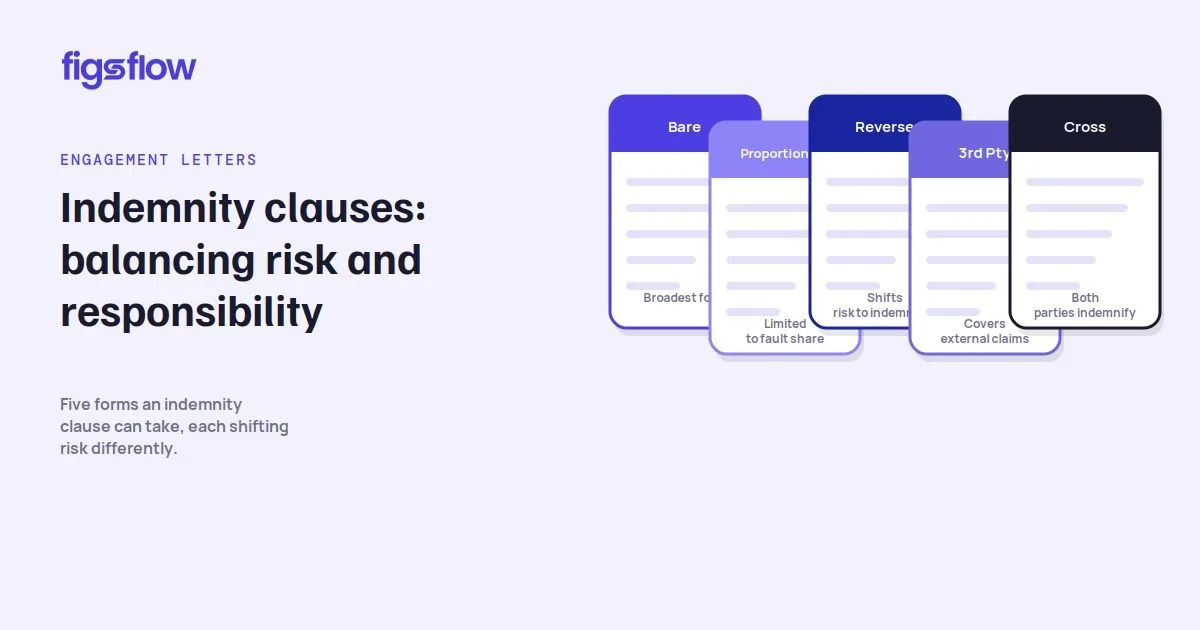
An overview of different types of indemnity clauses used in contracts.

1/31/2025

Indemnity Clauses in Engagement Letters: Balancing Risk and Responsibility

Indemnity Clauses in Engagement Letters: Balancing Risk and Responsibility Indemnity Clauses in Engagement Letters: Balancing Risk and Responsibility What Is an Indemnity Clause? How Indemnity Clauses Help Accountants Minimise Risks How Indemnity Clauses Work Indemnity Clauses vs Limitation and Exclusion Clauses Types of Indemnity Clauses Common Cons and Pitfalls of Indemnity Clauses Best Practices for Drafting Indemnity Clauses Legal Considerations for Indemnity Clauses Conclusion Frequently Asked Questions What is the purpose of an indemnity clause? How does an indemnity clause differ from a limitation clause? What are the different types of indemnity clauses? In any business deal, it’s important to clearly define who is responsible for what risks so that obligations and liabilities are shared fairly. For accountants, engagement letters help with this by setting out the services provided, any limits on liability and how indemnification works to prevent disputes. Knowing how indemnity clauses work, how they differ from other risk management tools like limitation or exclusion clauses and how well-written terms can ensure fairness, transparency and trust is key to protecting both accountants and their clients. An indemnity clause is a part of engagement letters where one party (the indemnifier) agrees to pay the other party (the indemnified) for certain losses, damages, or liabilities. These losses can happen due to situations like negligence, breaking the contract, or claims from third parties. The indemnity clauses define the scope of the claims covered under the contract, outline the procedures for submitting claims for compensation and set any limits to liability that the indemnifying party is responsible for. The main goal of an indemnity clause is to allocate the risk and provide financial protection to one party against specific loss or damages. Indemnity clauses help accountants decide who is responsible for covering financial losses if something goes wrong. Clearly defining these responsibilities reduces confusion and minimises disputes, making engagement letters more predictable and fair for both parties. Without clear indemnity terms, businesses risk unexpected liabilities that could trigger financial strain or legal battles. One of the biggest benefits of indemnity clauses is their flexibility. They can be customised to fit different industries and types of agreements. For example, in accounting engagements , indemnity clauses may protect firms from client misrepresentations like providing inaccurate financial data that leads to tax penalties or legal issues. In audit agreements, they can address liabilities arising from a client’s noncompliance with financial regulations. This adaptability makes indemnity clauses great for accountants to manage professional risks and safeguard their practice. The coverage provided by an indemnity clause can vary depending on the engagement letter. Some clauses are narrowly focused, covering only specific risks like third-party claims resulting from negligence. Others are broader, protecting against a wide range of liabilities, including legal fees and indirect damages. The right level of coverage depends on the company’s risk tolerance and business needs. These clauses also outline how compensation is handled. The indemnifier—the party taking on the risk—may compensate the indemnified party with direct payments or by handling the issue themselves, such as covering legal costs or fixing damages. This setup means financial losses are managed efficiently, preventing unnecessary disruptions to business operations. To keep things fair and coverable, indemnity clauses can also include limits on liability. These limits might be monetary caps, time restrictions or exclusions for certain types of damages, such as lost profits or indirect costs. To understand how indemnity clauses operate, consider this example. Scenario A mid-sized accounting firm engages a freelance tax consultant to handle corporate tax filings for its clients. The contract includes an indemnity clause stating that the consultant will compensate the firm for any financial losses or legal claims arising from errors in their work. Implications If the consultant makes a critical filing error (e.g., miscalculates tax liabilities, leading to penalties for the client), they must cover the accounting firm’s financial losses, including penalties, legal fees and potential reputational damage. If the issue originates from inaccurate client-provided data or last-minute changes imposed by the firm, the consultant is not liable under the indemnity clause. Limitation of Liability To protect the consultant from unlimited financial exposure, the contract may include caps or exclusions , such as: Monetary Cap – Limiting the indemnity to the total engagement fee or a fixed amount (e.g., £50,000). Exclusions for Indirect Losses – Stating that the consultant is not responsible for lost client business or reputational harm. Time Limits – Requiring that claims be made within a specified period (e.g., 12 months after tax filing). Although indemnity clauses, limitation clauses and exclusion clauses share the goal of curbing risk, they operate differently. Indemnity Clauses Limitation Clauses Exclusion Clauses Transfer responsibility for certain risks to one party Set a maximum limit on the liability a party can face. Exclude liability for certain types of damages altogether. For example, a clause may state that a party is not responsible for indirect or consequential damages like lost profits. Focus on covering losses or damages Reduce financial risk without completely removing it. For instance, a supplier might limit their liability to the value of the goods they delivered. Exclude liability for certain types of damages altogether. For example, a clause may state that a party is not responsible for indirect or consequential damages like lost profits. Example Comparison An indemnity clause may require Party A to pay for all damages caused by their actions. A limitation clause might cap Party A’s liability at $50,000. An exclusion clause might state Party A is not liable for damages caused by delays Indemnity clauses in engagement letters can take different forms, each serving a specific purpose in managing risk and financial exposure. For accountants, understanding these variations is essential when advising clients or structuring agreements to protect against liabilities. Here’s an explanation of the most common types of indemnity clauses. Bare Indemnity – This is the broadest form of indemnity, where one party (the indemnifier) assumes full responsibility for covering all losses related to specified events, regardless of fault or negligence. In an accounting context, this could mean a firm agreeing to indemnify a client for any financial loss arising from tax filings, even if the client provided incorrect data. Proportionate Indemnity – Unlike bare indemnity, this type limits the indemnifier’s liability to losses that directly result from their actions or negligence. For instance, if an accountant makes an error in financial reporting that leads to penalties, they may be required to indemnify the client only for the portion of the loss attributable to their mistake, not for unrelated factors. Reverse Indemnity – This shifts the responsibility to the indemnified party, requiring them to compensate the indemnifier for losses caused by their own actions. A practical example would be an accounting firm requiring clients to indemnify them if the client’s misrepresentation of financial data leads to legal claims or penalties against the firm. Third-Party Indemnity – This covers claims made by external parties against the indemnified party. In accounting, this might involve an accountant being indemnified against lawsuits or fines imposed due to a client’s regulatory noncompliance, ensuring that the firm does not bear the financial burden of the client’s mistakes. Cross Indemnity – This occurs when both parties agree to indemnify each other for specific risks. In an accounting engagement, for example, a firm may agree to indemnify a client for errors in professional advice, while the client indemnifies the firm against any claims resulting from their misuse of financial reports. Each type of indemnity clause serves a different purpose, and their application depends on the level of risk involved, the contractual relationship and industry-specific concerns. Accountants should carefully assess which indemnity structure best meet their clients’ needs while making sure liabilities remain clearly defined and fairly distributed. For accountants, indemnity clauses should be carefully written to protect against unreasonable liability while maintaining professional integrity and legal compliance. Regularly reviewing engagement letters with legal counsel means they remain enforceable and fair. Here are a few key points to keep in mind while writing them. Overly Broad Language Vague or excessively broad indemnity clauses can create unintended risks. For example, a clause stating that “Client shall indemnify Accountant for all claims and liabilities” could be interpreted to include disputes beyond the accountant’s control, such as regulatory penalties caused by the client’s misconduct. Clarity is key as narrowly defining indemnification terms can prevent costly legal battles. Unfair Burdens on One Party Imposing excessive indemnity obligations can deter prospective clients or create risks for your firm. If an engagement letter forces a small business client to indemnify an accountant against all tax authority claims-even those resulting from the accountant’s own negligence—it could be considered unfair and unenforceable. Balanced, reasonable indemnity terms foster trust and long-term client relationships. Failure to Comply with Legal Limits In many jurisdictions, restrictions apply to indemnity clauses in regulated professions such as accounting, legal, and construction services. Some states prohibit accountants from limiting liability for fraud or gross negligence, even if an engagement letter includes such terms. Failing to meet indemnity clauses with local legal standards can render them void or expose your firm to legal penalties. Undefined or Perpetual Liability Neglecting to specify a time frame for indemnity obligations can cause indefinite liability. If an engagement letter states that a client must indemnify an accountant for any future claims related to the engagement but lacks a clear expiration date, the accountant could face legal exposure long after the client relationship ends. Best practice: define a reasonable indemnity period aligned with relevant record-keeping and statute of limitations requirements. Since indemnity clauses protect accountants and clients from financial risks, poorly drafted clauses can create legal disputes and unintended liabilities. For fairness and clarity, accountants should follow these key best practices when including indemnity provisions in engagement letters templates , client contracts and service agreements. 1. Be Specific About Coverage Clearly define what losses are covered under the indemnity clause. Broad, vague language can spark disputes and unintended liability. Specify whether indemnification applies to: Legal fees (e.g., costs of defending lawsuits related to accounting work) Direct damages (e.g., penalties due to tax return errors caused by client misinformation) Third-party claims (e.g., lawsuits from investors relying on financial statements) Example: “Client agrees to indemnify and hold harmless Accountant for direct financial losses, including reasonable legal fees, arising from the Client’s failure to provide accurate financial records.” 2. Use Clear, Precise Language Avoid legal jargon and ambiguous terms that could be open to multiple interpretations. Define key terms like “losses,” “claims” and “damages” so both parties fully understand their obligations. 3. Limit Scope Where Appropriate Not all losses should be covered. Indemnity clauses should exclude: Indirect or consequential damages (e.g., lost profits due to a delayed audit) Punitive damages (unless legally required) Liabilities resulting from the accountant’s own negligence This prevents accountants from being unfairly burdened with excessive risk. 4. Cap Liability to Manage Exposure Unlimited indemnity obligations can expose accountants to disproportionate risks. A liability cap limits potential financial burdens to reasonable levels. Example: “The Client’s indemnity obligation shall not exceed the total fees paid for services rendered under this contract, with a maximum cap of £50,000.” Setting a cap aligned with engagement fees or a reasonable multiple of those fees prevents small engagements from leading to disproportionately large claims. 5. Address the Duration of Indemnity Neglecting to specify a time limit can result in indefinite liability exposure. Align the indemnity period with relevant record-keeping requirements, statute of limitations, or industry norms. Example: “The indemnity obligations in this agreement shall remain in effect for a period of three (3) years following the completion of services.” 6. Require the Indemnified Party to Mitigate Losses The party receiving indemnity should take reasonable steps to minimise damages rather than relying entirely on the indemnifying party. A mitigation clause prevents excessive or unnecessary claims. Example: “The indemnified party must take commercially reasonable steps to mitigate any losses before seeking indemnification.” 7. Comply with Laws and Industry Standards Indemnity clauses must meet applicable accounting regulations and professional standards. Many jurisdictions limit accountants’ ability to shift liability for professional misconduct, and some regulatory bodies prohibit indemnity clauses that seek to protect accountants from gross negligence or fraud. To meet compliance, check local and industry-specific legal restrictions and avoid clauses that limit liability in areas where such limitations are prohibited. Moreover, consult legal counsel when drafting indemnity provisions for high-risk engagements. Indemnity clauses are often closely examined in legal disputes, and their enforceability depends on several factors. Accountants must draft these clauses carefully to meet legal standards while protecting their interests. A well-written indemnity clause strikes a balance between fairness, legal compliance and professional ethics. Keep the following points in mind when creating indemnity clauses in engagement letters. Reasonableness Courts may strike down indemnity clauses that are overly broad, unfair, or place an excessive burden on one party. For example, an engagement letter stating that a client must indemnify an accountant for all claims, even those arising from the accountant’s negligence, may be deemed unreasonable. To improve enforceability, indemnity clauses should be specific, proportional, and not overly one-sided. Statutory Limits Many jurisdictions have laws restricting indemnification, particularly for professional services. Some states prohibit accountants from limiting liability for negligence, fraud, or willful misconduct. Moreover, in certain industries regulatory bodies may impose strict guidelines on liability waivers. Accountants should note their indemnity clauses comply with relevant professional and statutory restrictions to avoid legal headaches. Public Policy Considerations Indemnity clauses that attempt to protect a party from liability for illegal acts or violations of public policy will generally be unenforceable. For example, an accountant cannot require a client to indemnify them for penalties resulting from fraudulent financial reporting. Courts may also refuse to enforce clauses that could encourage unethical behaviour by shielding professionals from accountability. Indemnity clauses in engagement letters help share risks and responsibilities between the parties involved, and make sure that the party best suited to handle a risk takes care of it, providing clarity and financial protection. However, write these clauses clearly and specifically to avoid confusion and unfair responsibility. Knowing how indemnity clauses work, the different types and how they differ from other contract clauses like limitation and exclusion clauses can help create fair contracts. And getting legal advice when writing these clauses means they are fair, enforceable and follow the law. In the end, well-written indemnity clauses build trust, transparency and smooth business relations. An indemnity clause is a clause designed to transfer financial responsibility for specific risks from one party (the indemnifier) to another (the indemnified). It ensures that the indemnified party is compensated for losses, damages, or liabilities arising from certain events, such as negligence, breach of contract or third-party claims. Indemnity clauses and limitation clauses both address risk in contracts but in different ways. While indemnity clauses transfer the financial responsibility for defined risks to one party, limitation clauses set the maximum amount that a party can be liable for. Indemnity clauses come in various forms, each tailored to different risk scenarios. The most common types include bare indemnity, which holds the indemnifier responsible for all losses related to certain events, regardless of fault; proportionate indemnity, where responsibility is limited to the indemnifier’s actions or negligence; and reverse indemnity, which requires the indemnified party to compensate the indemnifier for losses caused by the indemnified’s (generally third parties) actions. Indemnity Clauses 1 indemnity-clauses-in-engagement-letters-balancing-risk-and-responsibility indemnity clauses in engagement letters balancing risk and responsibility page Page
A graphic discussing reasonable exclusions in liability clauses.

1/28/2025

What Could Be Fair & Reasonable Exclusions When Defining Limitation of Liability?

What Could Be Fair & Reasonable Exclusions When Defining Limitation of Liability? What Could Be Fair & Reasonable Exclusions When Defining Limitation of Liability? Understanding Limitation of Liability Clauses Role of Fairness & Reasonableness in Exclusions Common Types of Exclusions in Limitation of Liability Clauses Legal Framework & Judicial Scrutiny of Exclusion Clauses Drafting Fair and Reasonable Exclusion Clauses Enforceable vs. Unenforceable Clauses Conclusion Frequently Asked Questions What is a limitation of liability clause, and why is it important? What factors make an exclusion clause enforceable in court? What are examples of enforceable and unenforceable exclusion clauses? In the context of contractual agreements, parties seek to limit their liability in the event of a breach. One of the common ways to achieve that is through the inclusion of limitation of liability clauses, which define the maximum extent to which a party can be held liable for damages arising out of the contract. Those clauses are widely used across a range of industries and serve to provide certainty and mitigate risk. However, while limitation of liability clauses can provide much-needed protection, they must also be fair and reasonable to be enforceable. Exclusions in limitation clauses are certain types of damages or liabilities that are excluded from the scope of the limitation. The fairness and reasonableness of these exclusions are crucial as overly broad or unjust exclusions may render a clause unenforceable or void. Understanding what constitutes a fair and reasonable exclusion when defining limitation of liability is important for both parties in ensuring the contractual terms are legally enforceable. This article will explore what constitutes fair and reasonable exclusions in limitation of liability clauses, examining the key principles, common types of exclusions and relevant legal frameworks. It will also explain the factors to consider when drafting such clauses and how to ensure they comply with industry standards and legal requirements. Limitation of liability clauses are provisions in engagement letters and proposals that specify the maximum amount a party may be liable for in the event of a breach. These clauses set boundaries on possible financial exposure and can help both parties understand the limits of their responsibilities. Typically, limitation clauses take one of the following forms: Cap on Liability – This sets a maximum financial limit on damages a party can be held liable for. Exclusion of Certain Types of Liability – These clauses may exclude liability for certain damages such as consequential, punitive, or indirect damages, or may exclude liability entirely for certain risks. While limitation clauses are common, exclusion clauses—which attempt to limit or eliminate liability for certain types of damages—are more contentious. Exclusion clauses have to meet higher standards of fairness and reasonableness when one party is attempting to exclude liability for heavy types of damages. Exclusion clauses are inherently problematic because they seek to avoid or limit liability for specific damages, which could unfairly benefit the party seeking to exclude liability. As such, these clauses must meet the standard of fairness and reasonableness so they are enforceable. In many jurisdictions including the United Kingdom and the United States, the fairness of exclusion clauses is a matter of public policy. Courts typically look at the circumstances under which the contract was made including whether the exclusion was negotiated or imposed unilaterally. In jurisdictions like the UK, the Unfair Contract Terms Act 1977 (UCTA) provides a legislative framework for determining whether an exclusion clause is reasonable. According to UCTA, exclusion clauses that limit or exclude liability for negligence must be reasonable, and the party seeking to rely on the clause has the burden of proving reasonableness. Some factors that courts and regulatory bodies may consider in determining fairness include: Bargaining Power – Whether the parties had equal bargaining power or if the clause was imposed by one party. Clarity of Language – Whether the exclusion was clearly communicated and understood by both parties. Commercial Context – Whether the exclusion reflects common practices in the relevant industry or sector. The key principle here is that the exclusion must not unduly disadvantage one party while benefiting the other. This is to prevent situations where a party is unfairly released from liability for damages that it could reasonably foresee and should be held accountable for When drafting limitation of liability clauses , certain exclusions are commonly considered and accepted as fair and reasonable in many contracts. These exclusions seek to protect both parties so the risk distribution remains proportional to the parties’ roles and responsibilities in the agreement. Below are some common types of exclusions often seen in limitation of liability clauses. 1. Consequential & Indirect Damages Excluding consequential damages or indirect damages is one of the most common types of exclusions in limitation clauses. These types of damages are losses that do not directly result from the breach but are a consequence of it. For example, if a contractor fails to complete a project on time, the direct damage may be the cost of the unfinished work but the indirect damage might be the loss of business or revenue due to the delay. Consequential damages are typically excluded from liability because they can be highly speculative and unpredictable. For instance, in many contracts, a party will exclude liability for any loss of profits or business interruption resulting from a breach. These exclusions are generally considered reasonable when the party seeking to limit liability could not have reasonably foreseen the exact nature or extent of the indirect damage at the time the contract was formed. 2. Punitive or Exemplary Damages Punitive damages are intended to punish the wrongdoer and deter others from engaging in similar conduct. They are usually awarded in cases of gross negligence or willful misconduct. Excluding punitive damages is seen as reasonable because these damages go beyond mere compensation for losses suffered and punish the breaching party. In many contracts, exclusion of punitive or exemplary damages is a standard provision. This is considered fair because punitive damages are not compensatory in nature and may exceed the actual harm caused by the breach. However, in cases of serious misconduct or fraud, some jurisdictions may limit the enforceability of such exclusions. 3. Loss of Data In the modern digital age, data loss has become a serious concern. Excluding liability for loss of data is common in contracts involving technology, software, or data storage. Because data loss can be a foreseeable risk in those industries and the damage caused by such loss may be difficult to quantify. Excluding liability for loss of data is generally considered reasonable when the contract includes provisions for data backup and disaster recovery and when the party seeking to exclude liability is taking steps to mitigate the risks of data loss. 4. Third-Party Claims Exclusion clauses include provisions excluding liability for third-party claims. This means claims brought against the contracting parties by third parties like customers or competitors. These exclusions are enforceable when they are specifically stated in the contract. Excluding third-party claims is considered fair when the parties have no direct control over the third-party interactions and could not reasonably foresee or prevent such claims. This exclusion helps to protect parties from liability that may erupt from unforeseen external factors. The enforceability of exclusion clauses is subject to legal scrutiny in most jurisdictions. In many cases, a court of law will assess the fairness of an exclusion clause based on the specific facts of the case, including the bargaining position of the parties and the clarity of the clause. 1. The Contra Proferentem Rule One of the fundamental legal principles that apply to exclusion clauses is the contra proferentem rule. This rule dictates when there is ambiguity in the terms of a contract, the interpretation that is least favourable to the party that drafted the contract will be adopted. This means exclusion clauses are not used to exploit the other party or to avoid liability through unclear or convoluted language. 2. The Unfair Contract Terms Act 1977 (UCTA) Under UCTA, exclusion clauses that limit or exclude liability for negligence must meet the test of reasonableness. Section 2 of UCTA requires any exclusion clause attempting to limit liability for negligence must be reasonable in the circumstances The test for reasonableness is based on a number of factors like the relative bargaining power of the parties, the availability of alternative remedies and the knowledge and expertise of the parties at the time the contract was entered into 3. Consumer Protection Laws In addition to commercial contracts, consumer contracts are subject to additional scrutiny. Exclusion clauses in contracts with consumers must comply with the Consumer Rights Act 2015 in the UK. This means exclusion clauses in consumer contracts are transparent, fair and not misleading. Similar laws exist in other jurisdictions to prevent consumers from being unfairly deprived of remedies or protections due to exclusion clauses. When drafting exclusion clauses in limitation of liability agreements, several best practices should be followed for fairness and reasonableness. These are: Clarity – The exclusion clauses should be clear, unambiguous and easily understood by both parties. Complex legal jargon or unclear terms could render the clause unenforceable. Negotiation – Ideally, both parties should have the opportunity to negotiate the terms of the limitation of liability clause. A clause that is imposed without negotiation may be deemed unfair. Proportionality – The exclusion should be proportionate to the risks involved. Overly broad exclusions that attempt to cover all possible damages are more likely to be viewed as unreasonable. Industry Standards – The exclusion clauses should follow standard practices in the relevant industry. If the exclusion is out of line with what is commonly accepted in the industry, it may be considered unreasonable. Transparency – The implications of the exclusion should be clearly communicated to both parties so each understands the scope of the limitation and what liabilities are excluded. Compliance with Legal Requirements – Finally, exclusion clauses must comply with applicable laws like the Unfair Contract Terms Act 1977 (UK), the Consumer Rights Act 2015 and other consumer protection laws. Enforceable Clauses Unenforceable Clauses Exclusion of indirect damages with clear wording. Vague exclusion of “all possible liabilities.” Exclusion of punitive damages in a business contract. Attempt to exclude liability for gross negligence. Limiting liability for data loss with a backup policy in place. Broad exclusion of all liabilities related to data loss. Exclusion of third-party claims with specific terms. Ambiguous exclusion of liabilities for “third parties.” Limitation of liability clauses are used to mitigate risk and make contracts clear. However, any exceptions in these clauses must be fair, reasonable and easy to understand to be valid. It’s important to write these clauses carefully, following legal rules , so they are legal and fair for everyone. As laws change, businesses and legal professionals need to stay informed and adjust accordingly. A limitation of liability clause restricts the amount or types of damages one party can claim from another in case of a contract breach. It is important because it helps manage risks, ensures liabilities are proportionate to the agreement, and provides clarity, reducing uncertainty for both parties. An exclusion clause is enforceable if it is clear, reasonable, complies with legal standards, and is properly incorporated into the contract. If it is ambiguous, unfair, or introduced after the contract is signed, it may be deemed unenforceable by the court. Enforceable clauses are specific, such as those excluding liability for indirect damages, while unenforceable ones are overly broad or attempt to waive liability for gross negligence or fraud, which are often prohibited by law. Checklist 2 what-could-be-fair-reasonable-exclusions-when-defining-limitation-of-liability what could be fair reasonable exclusions when defining limitation of liability page Page
A graphical representation illustrating the limitation of liability for accountants.

1/22/2025

Complete Guide to Limitation of Liability Clause for Accountants

Complete Guide to Limitation of Liability Clause for Accountants Complete Guide to Limitation of Liability Clause for Accountants Caps on Liability: A Common Approach Fair and Reasonable Exclusions Key Recommendations for Limitation of Liability Clause Conclusion Accountancy firms often add clauses to their engagement letters to limit their liability, which is a smart way to manage risks and protect themselves. But this limitation of liability clause needs to be reasonable. They might be ruled invalid if they are too extreme, leaving the firm open to unlimited liability. Here’s how firms can strike the right balance and shield themselves against risks. One common way accountancy firms mitigate legal risks is by setting a cap—a fixed limit on how much they can be held financially responsible for. These caps can either be negotiated with clients or follow standard terms. They might apply to all claims combined or be set for each claim. For example, if a firm sets a cap, it becomes the maximum amount they will pay, no matter how big the claim is. Another approach is to exclude certain types of losses entirely like: Indirect losses like lost profits. Losses caused by incomplete or incorrect information from the client. Joint liabilities, where responsibility is split proportionally. Errors or omissions made by third-party advisers. These exclusions are often aligned with the firm’s professional indemnity (PI) insurance, so everything stays within their contractual obligations. Liability limits are only useful if they hold up in court. If a clause is deemed unfair or unreasonable—like one that drastically limits liability—it could be dismissed, exposing the firm to claims. Here is what influences fairness: Client Type – Are you dealing with a large corporation, a small business, or an individual? Scope of Work – Is it a routine task or a project with major financial stakes? Risk Assessment – What’s the chance for losses in this engagement? The Consumer Rights Act prevents firms from limitation of liability clause below the value of their fees. A good rule of thumb is to set caps that align with the work’s scale and possible risks. For higher-stakes projects, a larger cap is more likely to hold up and better protect the firm. To strike a balance between risk mitigation and client trust, accountants should adopt these best practices: 1. Draft with Precision Write liability clauses that cover all possible claims, like breach of contract or negligence. Make sure formulas for calculating liability limits are clear and easy to understand, avoiding confusing or vague methods. 2. Stay Within Legal Bounds Do not attempt to exclude liability for losses that are legally non-excludable, such as fraud or regulated activities under the Financial Conduct Authority (FCA). 3. Use Clear Terms Specify whether caps are aggregate (covering all claims) or apply separately to individual breaches. Provide clients with sufficient time to review the terms and consult legal advisers. 4. Structure Engagement Letters Thoughtfully Separate the limitations or exclusions into their own sections within the engagement letter. This way, if one clause is found unenforceable, the rest of the letter still stands. For engagement letters with standard terms and a cover letter, highlight the key limitations in the cover letter. 5. Document Negotiations Keep a detailed record of any discussions or negotiations about engagement terms. This documentation can serve as evidence of fair dealing if a dispute arises Limitation of liability clause is an important part of an accountancy firm’s risk management, but it needs to be done carefully. If the clauses are too strict, they could backfire and leave the firm open to unlimited claims. To protect the firm and keep clients’ trust, focus on being clear, fair and legally compliant. Always get legal advice when drafting or updating engagement letters to make sure they strike the right balance between protecting the firm and meeting client needs. complete-guide-to-limitation-of-liability-clause-for-accountants complete guide to limitation of liability clause for accountants page Page
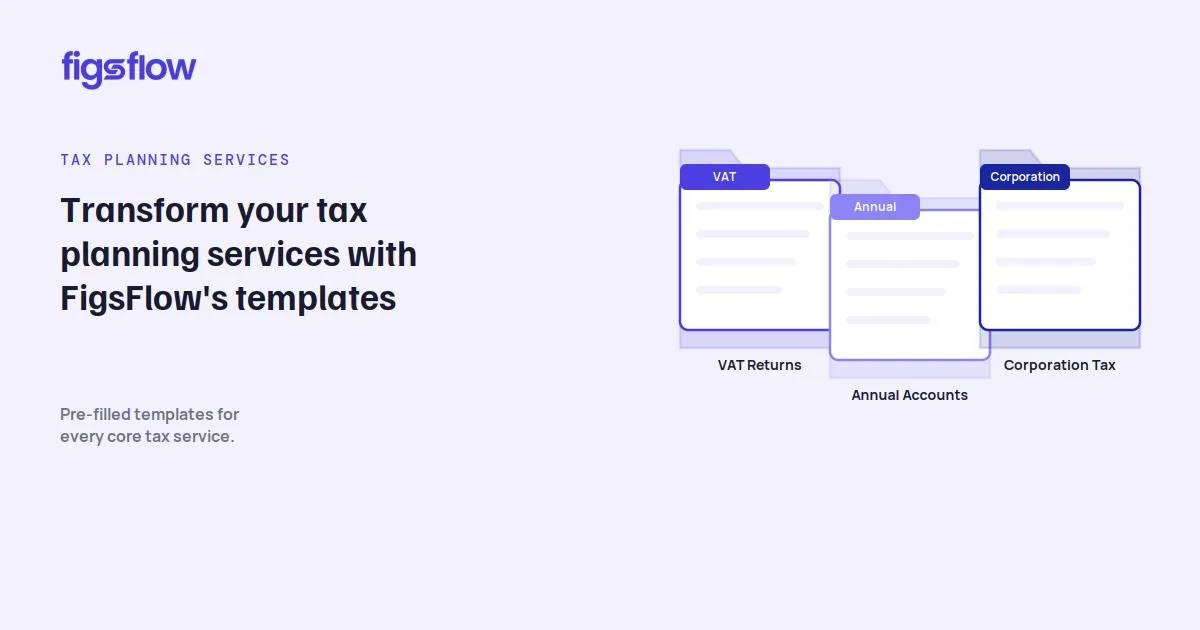
An infographic discussing how tax advisers use engagement letters to build client trust.

1/17/2025

How Tax Advisers Can Use Engagement Letters to Boost Client Trust

How Tax Advisers Can Use Engagement Letters to Boost Client Trust How Tax Advisers Can Use Engagement Letters to Boost Client Trust What Are Engagement Letters? Why Are Engagement Letters Important? How Engagement Letters Boost Client Trust How to Draft a Great Engagement Letter Common Mistakes to Avoid Enter FigsFlow: Simplifying Engagement Letters What Makes FigsFlow Special? How FigsFlow Boosts Client Trust Conclusion For tax advisers, success stems from the trust clients place in them. Managing clients’ financial matters requires clarity and professionalism, making it essential to uphold that trust. A powerful tool for achieving that is the engagement letter. An engagement letter is a document that explains the working relationship between an adviser and their client. It spells out details like what services will be provided, who will be responsible for what, the fees and other important terms. This helps avoid confusion and builds a strong foundation for working together. But how can tax advisers get the most out of engagement letters? And how can tools like FigsFlow make this easier? Let us find out. Engagement letters are written agreements that lay out the details of the services a tax adviser will provide to their client. Think of them as a roadmap for the advisory relationship. They cover: Scope of Work – What specific tasks the adviser will handle such as preparing tax returns or providing audit support. Terms & Conditions – Deadlines, timelines and expectations for both parties. Fees & Payment Schedules – How much the client will pay, when and for what services. Responsibilities – Clearly stating what the client must provide (e.g., documents) and what the adviser will deliver. Confidentiality – How sensitive client information will be protected. When done right, an engagement letter reduces misunderstandings, protects both the adviser and the client and builds a strong foundation of trust. In tax advisory things can get complex and even contentious if expectations are not clear from the start. Here’s why engagement letters are essential: Clarity for All – Clients know exactly what services they are paying for, and advisers clearly understand what they need to deliver. Legal Protection – If a dispute erupts, the engagement letter serves as a legally binding document to resolve issues. Professional Image – A well-written engagement letter shows the adviser is organised, transparent and committed to professionalism. Fostering Trust – Clients are more likely to trust advisers who are upfront about terms, fees and responsibilities. 1. They Set Clear Expectations Imagine a client assumes their adviser will handle all correspondence with tax authorities but the adviser sees that as outside their scope. Misaligned expectations can lead to frustration. With an engagement letter, both parties know what to expect. 2. They Avoid Misunderstandings Money matters can be sensitive. Clearly stating fees and payment terms upfront in the engagement letter prevents awkward conversations later. 3. They Reflect Professionalism Clients appreciate advisers who take their work seriously. An engagement letter shows that you have thought about every detail of the relationship. 4. They Provide Reassurance Clients who see a confidentiality clause feel confident their personal and financial data will be handled responsibly. To get the most out of your engagement letters, follow these best practices: Be Specific – Vague terms like “assist with taxes” can cause confusion. Clearly outline what tasks you will handle. Use Simple Language – Avoid legal jargon. Your clients should be able to understand the terms without needing a lawyer. Update Regularly – If the scope of work changes, revise the engagement letter accordingly. Get Client Input – Encourage your clients to review the letter and ask questions before signing. Even a small oversight in an engagement letter can create big problems. Watch out for these common pitfalls: Being Too Generic – Using a one-size-fits-all template without tweaking it to the client’s needs. Omitting Key Details – Failing to specify fees, deadlines, or scope of work. Skipping Updates – Forgetting to revise engagement letters when changes occur. Overcomplicating the Language – Making the letter so dense that clients do not read or understand it. Drafting engagement letters does not have to be time-consuming or tedious. That is where FigsFlow steps in—a software designed specifically for tax advisers, accountants and bookkeepers. FigsFlow takes the hassle out of creating engagement letters, making the process faster and more efficient. 1. Customisable Templates With FigsFlow, you can access pre-built customisable templates . Whether you are drafting a letter for a small business client or an individual, you can edit the template to meet their needs. 2. Automation Say goodbye to repetitive tasks. FigsFlow automates much of the engagement letter process, saving you time and reducing errors. 3. Professional Design FigsFlow’s templates are sleek and professional, helping you make a strong impression on your clients. 4. Integration-Friendly FigsFlow works with your existing tools, allowing a smooth workflow. 5. Compliance Assurance Every engagement letter drafted with FigsFlow is designed to meet industry standards and legal requirements, so you can rest easy knowing you are covered. Using a tool like FigsFlow does not just make your life easier. It boosts your clients’ confidence in your services, too. Here is how: Fast Turnaround – Clients appreciate getting documents quickly, and FigsFlow helps you deliver engagement letters promptly. Consistency – Every letter looks polished and professional, leaving a lasting impression. Error Reduction – Automation minimises mistakes, ensuring your clients receive accurate documents. Transparency – FigsFlow makes it easy to clearly outline terms and expectations, reinforcing your commitment to openness. Engagement letters help tax advisers establish clear expectations and build trust with clients. It protects both parties legally, clarifies services and fosters trust by demonstrating transparency and commitment. Best practices include being specific, using simple language and updating letters as needed. Tools like FigsFlow simplify the process by offering customisable templates, automation and compliance features, boosting client confidence. how-tax-advisers-can-use-engagement-letters-to-boost-client-trust how tax advisers can use engagement letters to boost client trust page Page

A calendar for January highlighting the 31st as a deadline for accountants.

1/7/2025

Engagement Letter Creation for Accountants this Self Assessment Tax Season

Engagement Letter Creation for Accountants this Self Assessment Tax Season Engagement Letter Creation for Accountants this Self Assessment Tax Season Challenges Accountants Face Without Automation How FigsFlow Quickens Engagement Letter Creation Why FigsFlow Stands Out How to Get Started with FigsFlow Conclusion Tax season is crunch time for accountants. With the deadline for Self Assessment closing in, clients count on you to file accurate returns on time. It's a whirlwind of data, deadlines and double-checking. But there is one task that often gets overlooked and adds unnecessary stress: drafting engagement letters. Creating them manually during such a busy period can feel like juggling one more thing you don't have time for. That is when online tools, such as FigsFlow , can be handy for engagement letter generation, which take the hassle out of managing engagement letters, giving you more time to focus on other important tasks. Creating engagement letters by hand during the Self Assessment tax season can create several problems: Time Pressure – Writing each letter from scratch takes time away from the important task of tax preparation. Inconsistent Formatting – Manual drafting often results in letters lacking consistency, confusing clients or looking unprofessional. Compliance Risks – Missing key legal or regulatory details could leave you vulnerable to liability. Burnout – Repetitive tasks like creating engagement letters add to the stress and fatigue of an already demanding season. FigsFlow simplifies engagement letter management for accountants with a smart, automated approach. Here is how it transforms the process: 1. Pre-Built Templates FigsFlow offers ready-made templates designed specifically for accountants. These templates include standard language ensuring you stay compliant. You can easily customise them to suit individual client needs, saving you time and effort. 2. Time-Saving Automation Rather than spending hours drafting and editing letters, FigsFlow lets you generate professional engagement letters in just minutes. This automation frees you up to focus on more important tasks like tax strategy and client consultations. 3. Consistency Across Clients With FigsFlow, every engagement letter follows a consistent format, enhancing your professional image. This builds trust with clients and strengthens your brand's credibility. 4. Compliance Made Easy FigsFlow stays up-to-date with the latest regulations, automatically including all the necessary legal clauses. You will not have to worry about missing important details. 5. Quick Customisation While automation handles the core elements, FigsFlow allows for quick customisation. Whether it is writing terms for a high-net-worth client or adjusting language for a small business, the software makes it simple and quick to personalise each letter. Unlike generic software, FigsFlow is purpose-built for accountants and has features designed to meet your specific needs: User-Friendly Interface – Even if you are not tech-savvy, FigsFlow is easy to use. Integration Capabilities – FigsFlow integrates easily with other accounting tools, creating a unified workflow. Real-Time Updates – As regulations evolve, so does FigsFlow: your templates are always compliant. Cost-Effectiveness – By saving time and reducing errors, FigsFlow offers a significant return on investment. Getting started with FigsFlow is simple: Sign Up – Create an account and explore the platform's features. Choose a Template – Select from a range of templates for different services. Customise and Send – Adjust the template to fit your client's needs, then send it directly from the platform. With FigsFlow, you can eliminate the stress of creating an engagement letter and devote more time to delivering exceptional service to your clients. Self Assessment Tax Return season doesn't have to be overwhelming. Make this tax season your most efficient by exploring FigsFlow today and seeing the difference it can make for your practice. engagement-letter-creation-for-accountants-this-self-assessment-tax-season engagement letter creation for accountants this self assessment tax season page Page

Image detailing common mistakes in proposal writing and how to avoid them.

12/31/2024

5 Proposal Mistakes to Avoid and How FigsFlow Can Help

5 Proposal Mistakes to Avoid and How FigsFlow Can Help 5 Proposal Mistakes to Avoid and How FigsFlow Can Help Mistake 1: Rushing Through the Process Mistake 2: Failing to Customise Proposals Mistake 3: Overloading Proposals with Jargon Mistake 4: Ignoring Compliance Requirements Mistake 5: Lacking a Clear Call to Action Why FigsFlow Is the Right Choice Conclusion Proposals are the building blocks of any successful relationship between accountants, bookkeepers, tax advisors and their clients. Done well, they convey professionalism, inspire trust and set clear expectations. But if done poorly, they can confuse clients, tarnish your reputation, and even cost you business. To help you avoid those pitfalls, we'll explore five common proposal mistakes professionals make when crafting proposals. We'll also show you how FigsFlow can help you create flawless documents every time. When you're busy managing multiple clients, it's tempting to slap together a quick proposal and move on. But rushing could mean overlooked details, unclear terms, or formatting inconsistencies. These errors not only confuse clients but also make you look unprofessional. For accountants, bookkeepers and tax advisers, that can be particularly damaging. Your clients trust you with their finances, and sloppy proposals might make them second-guess your reliability. How FigsFlow Helps FigsFlow automates the proposal creation process with proposal software and ready-made templates. You can produce detailed, professional proposals in minutes with accuracy and consistency every time. Using proposal management for accountants and tax advisers not only saves you time but also shows your clients that you care about their business and pay attention to details. A generic, cookie-cutter proposal can make your client feel like just another number. Clients want to see that you understand their unique needs and challenges. If your proposals don't address those specifics, they might hesitate to move forward. For example, a small business client might have different priorities than a large corporation. Using the same language and approach for both could leave one (or both) feeling misunderstood. How FigsFlow Helps FigsFlow offers customisable templates for proposal software for accountants and other professionals. This allows you to tailor each proposal to your client's specific needs while keeping a professional format. Although it's important to sound knowledgeable, proposals filled with technical jargon can alienate clients. Not everyone is familiar with accounting or tax terminology, and overly complex language may confuse them. A client who doesn't fully understand what they're agreeing to is less likely to trust you. Worse still, they might sign the proposal and later dispute terms they didn't understand. How FigsFlow Helps FigsFlow's proposal software includes user-friendly templates that strike the perfect balance between professionalism and clarity. It helps you avoid overwhelming clients while still presenting the necessary details. Compliance is non-negotiable in professions like accounting, bookkeeping and tax advising. Yet one of the biggest mistakes professionals make is failing to include legally required information in their proposals. This oversight can cause disputes, penalties or even legal action. Yet staying on top of compliance requirements manually can feel overwhelming, especially as regulations change. How FigsFlow Helps FigsFlow takes compliance seriously. Its proposal software for accountants and proposal software for tax advisers means your proposals meet industry standards. With features designed for proposal management, the platform automatically updates templates to reflect the latest regulations. This means you can focus on your work, confident that your proposals are always compliant. A proposal is more than a document: it's a tool to win business. But without a clear call to action (CTA), clients might be left wondering what to do next. Whether it's signing an agreement, scheduling a follow-up meeting or providing additional information, your proposal should guide the client toward the next step. A weak or missing CTA can result in delays or even lost opportunities. How FigsFlow Helps FigsFlow makes it easy to include strong, actionable CTAs in every proposal. The platform's proposal generation software means your documents are professional and strategically designed to close deals. FigsFlow isn't just another proposal software. It's a comprehensive tool designed to meet the unique needs of accountants, bookkeepers and tax advisers. Here's what sets it apart: Time Efficiency -Create proposals in minutes using prebuilt templates. Customisation – Create your documents for each client without starting from scratch. Compliance Assurance -Stay ahead of regulatory changes with automatic updates. Professional Design – Impress clients with polished, consistent proposals every time. User-Friendly Interface – Navigate the software easily even if you're not tech-savvy. Sign up with FigsFlow today and see these benefits for yourself. Build trust, save time, grow your business with confidence and, most importantly, avoid making mistakes that ruin your proposal and lose you deals!. Avoiding proposal mistakes is crucial to growing your business. Addressing common pitfalls and using a reliable tool like FigsFlow can save time, boost your professionalism and build stronger client relationships. Don't let outdated methods hold you back: let FigsFlow help you easily scale your business. 5-proposal-mistakes-to-avoid-and-how-figsflow-can-help 5 proposal mistakes to avoid and how figsflow can help page Page

A list of ten clauses every accounting proposal should cover.

12/24/2024

Understanding Proposals for Accountants: Legal & Professional Insights

Understanding Proposals for Accountants: Legal & Professional Insights Understanding Proposals for Accountants: Legal & Professional Insights What is an Accounting Proposal? What Are the Key Elements of an Accounting Proposal? 1. Clear Scope of Work 2. Compliance with Regulations 3. Confidentiality & Data Security 4. Pricing & Terms 5. Limitations of Liability 6. Dispute Resolution 7. Client Obligations 8. Intellectual Property 9. Duration & Termination 10. Ethical Considerations How to Draft an Effective Accounting Proposal: Best Practices to Follow Conclusion Get Your Free Accounting Proposal Templates Frequently Asked Questions (FAQs) What is an accounting proposal? How to write a proposal for accounting services? What is a proposal and example? Can ChatGPT write a proposal? Proposals in accounting are far more than just formalities. They are the foundation of a strong professional relationship. A well-crafted proposal clearly defines the scope of work, sets mutual expectations and provides legal protection for the accountant and the client. Creating a proposal demands careful attention in an industry where legal obligations and ethical standards play a big role. This article will examine the key legal considerations accountants must consider when drafting proposals for accountants. By mastering those elements, accountants can elevate their proposals and ensure they comply with legal and ethical requirements. An accounting proposal is a formal document that outlines the terms, scope, and pricing for accounting services that a firm offers to a prospective client. It serves as the starting point for a professional relationship between the accountant and the client, providing a clear understanding of what will be delivered, the expected costs, and the legal boundaries that govern the agreement. At its core, an accounting proposal is more than just a financial offer. It's a tool for establishing mutual trust, defining the scope of work, and ensuring both parties are on the same page. Whether it's for a one-off audit, ongoing bookkeeping, tax planning, or advisory services, the proposal outlines the specifics of what the accountant will deliver, when, and for how much. To ensure that an accounting proposal is effective and legally sound, there are several key elements that must be addressed. These elements not only protect both parties but also help establish transparency and trust. Let's take a closer look at the key components every accounting proposal should include. The scope of work is one of the most important parts of any proposal management . It clearly outlines the services the accountant will provide and sets expectations for the accountant and the client. If this section is unclear, it can lead to misunderstandings and disputes down the line. Define Deliverables – A well-defined scope of work should specify the exact services to be provided, such as tax planning, audits, bookkeeping, or consulting on regulations. Being specific helps prevent confusion and ensures both parties are on the same page. Avoid Ambiguity – It's also important to state what is not included in the proposal. For example, if the accountant is not responsible for tax filing, this should be made clear. If not, clients may assume more responsibilities, leading to legal issues or unmet expectations. Legal Precedents – Make sure the scope of work meets local regulatory requirements. Accounting services can vary depending on the jurisdiction, with different tax codes, auditing standards and regulations in place. By referencing relevant legal precedents in the proposal, accountants show their awareness of these regulations and commitment to compliance. The accounting profession is subject to a range of national and international regulations, and proposals must reflect compliance with these laws and standards. Failure to do so can lead to legal liabilities and claims of professional misconduct. Accounting Standards – Whether following IFRS, GAAP, or a national standard, proposals for accountants should clearly show adherence to the relevant accounting guidelines. For example, if the proposal involves an audit, the accountant must follow specific auditing standards that outline how financial statements should be reviewed and reported. Licensing and Certifications – It's important to highlight the firm's compliance with professional bodies like the ACCA (Association of Chartered Certified Accountants) or CPA (Certified Public Accountant). Including those certifications in the proposal helps establish the accountant's qualifications and boosts credibility. Data Protection Laws – If the proposal involves handling sensitive client data, compliance with data protection laws such as GDPR (General Data Protection Regulation) or HIPAA (Health Insurance Portability and Accountability Act) is vital. The proposal should detail how client data will be stored, managed and protected to ensure full compliance with these laws. Accountants often have access to confidential and sensitive financial information, making confidentiality clauses essential to any proposal. Confidentiality Clauses – Including a non-disclosure agreement (NDA) or a confidentiality clause protects the client's sensitive information. This clause means neither the accountant nor any third parties can disclose confidential details without the client's consent. Confidentiality is crucial when dealing with tax planning, audits and financial forecasting, where client trust is paramount. Data Handling – Proposals for accountants should outline how client data will be securely stored, accessed and managed. This includes detailing any encryption methods used, data access permissions and protocols for data disposal. Such transparency fosters client trust and ensures legal compliance. The pricing section of a proposal is not just a financial statement; it's a legally binding document that must be clear and fair to prevent disputes over compensation. Transparency in Fees – Proposals for accountants should offer a detailed breakdown of fees, including hourly rates, fixed costs, and any additional charges (e.g., for urgent requests or special services). This transparency avoids confusion about billing practices and ensures clients know all costs before agreeing to the proposal. Payment Terms – Clearly defining payment due dates, late payment penalties, and refund policies is crucial. The proposal should set out the timeline for payment and the consequences of missed payments, such as interest charges or service suspension. Legal Boundaries – Accountants must ensure that the pricing structure complies with fair competition laws. Overcharging or setting fees that could be seen as anticompetitive may result in legal issues and damage the firm's reputation. In the accounting world, even the most diligent professionals can make mistakes. Limiting liability through clear terms in the proposal is essential for protecting the accountant from excessive legal claims. Cap on Liability – Proposals should include a cap on the amount for which the accountant can be held liable. This helps manage risks and protects the accountant from potentially ruinous financial claims. Professional Indemnity Insurance – It is advisable for accountants to mention any professional indemnity insurance coverage in their proposals. This reassures clients that, in the event of an error or oversight, the accountant has the financial resources to address the issue without burdening the client. Disputes are unfortunate in any professional relationship, but an accountant can minimize the potential for litigation by specifying a dispute resolution process in the proposal. Resolution Mechanism – Proposals for accountants should outline a clear procedure for resolving disputes. This may involve mediation, arbitration, or using a specific legal forum within a designated jurisdiction. Such clauses can prevent protracted litigation and provide an efficient means for resolving conflicts. Governing Law – It is important to specify the jurisdiction whose laws will govern the proposal. This can be particularly relevant if the accountant and the client are in different locations or countries. Understanding which laws apply in case of disputes can significantly impact the resolution process. A proposal should define the services the accountant will provide and clarify the client's obligations. Roles and Responsibilities – Accountants should clearly outline what the client is expected to provide—documents, access to certain data, or timely cooperation in providing requested information. Consequences of Breach – The proposal should detail the repercussions for failure on the client's part to meet their obligations. This can include delays in service delivery or termination of the contract. Accountants may develop unique tools, templates, or reports in some engagements. Clear terms regarding intellectual property (IP) are essential to avoid disputes over ownership. Ownership of Work – Accountants should clearly specify who owns the work produced during the engagement. This could include reports, templates, or proprietary methods developed as part of the service delivery. Permission for Use – If the client intends to use proprietary methods or tools beyond the engagement, the proposal should state the terms under which such use is permissible. A proposal must define the duration of the engagement and the conditions under which it can be terminated. Term of Engagement – Proposals for accountants should state the expected duration of the services to be provided and outline any renewal processes if applicable. Termination Conditions – Proposals for accountants should clearly define the grounds for termination, whether by mutual agreement, for cause, or due to non-performance by either party. Finally, ethical considerations must form the backbone of any proposal, ensuring the accountant maintains professional standards. Conflict of Interest – Accountants must declare any potential conflicts of interest that could affect their objectivity. Addressing this upfront ensures transparency and reduces the risk of ethical issues arising later. Professional Standards – The proposal should commit to following the ethical codes and standards set by the relevant professional bodies, such as the ICAEW's Code of Ethics or the AICPA's Code of Professional Conduct. Creating an effective accounting proposal is more than just a formality; it's a crucial step in building a successful, professional relationship with your client. By following a few best practices, you can create proposals that are comprehensive, transparent, and legally sound. Here are some best practices to keep in mind when drafting your accounting proposals: Clearly Define the Scope of Work – The scope of work should specify exactly what services you will provide, such as tax planning, audits, or bookkeeping. Be clear about what is included and, just as importantly, what is not. This helps prevent misunderstandings and sets proper expectations. Ensure Compliance with Legal and Regulatory Standards – Your proposal should reflect adherence to relevant accounting standards, such as IFRS or GAAP, as well as any industry-specific regulations. Including this information helps build credibility and ensures that your services align with professional requirements. Set Transparent Pricing and Payment Terms – Provide a detailed breakdown of your fees, whether hourly or fixed, and any additional charges. Clearly define payment schedules, late fees, and refund policies to avoid disputes and ensure transparency throughout the engagement. Include Confidentiality and Data Security Provisions – Given the sensitive nature of financial information, it's important to include confidentiality clauses and specify how client data will be securely handled and protected. This not only builds trust but also ensures compliance with data protection laws. Outline Dispute Resolution Mechanisms – Including a clause for dispute resolution, such as mediation or arbitration, can help resolve potential conflicts without resorting to litigation. Specify the legal jurisdiction that will govern any disputes to avoid confusion down the line. By following these best practices, you can ensure that your accounting proposal not only meets professional standards but also fosters a positive and transparent working relationship with your clients. In accounting, proposals for accountants are vital in building trust and ensuring a clear understanding between the accountant and the client. They should clearly outline the services provided , follow legal and regulatory requirements and protect sensitive information. The pricing structure needs to be transparent, with clear terms for payment and legal boundaries. The proposal should also limit the accountant's liability and outline how disputes will be resolved. It should specify what the client is responsible for, clarify ownership of any work produced and define the duration and termination conditions of the engagement. Access a wide range of customizable accounting, bookkeeping, and tax advisory engagement letter and proposal templates for free. Save time and create professional documents in no time! Access it for Free → An accounting proposal is a formal document outlining the services you will provide to a client, the fees involved, and the terms of the engagement. It sets expectations and helps establish a professional relationship, ensuring both parties are clear on deliverables and responsibilities. To write an accounting proposal, introduce your firm's background, list the services offered, and explain why you are the best fit. Include your qualifications and experience with notable clients. Personalize the proposal by adding a photo or team details to build trust and connection. A proposal is a document aimed at persuading someone to accept a specific offer or idea. For accounting services, it details the services provided, the value of those services, pricing, and engagement terms. An example could be a tax advisory proposal outlining services and fees. Yes, ChatGPT can assist in drafting proposals for accounting services by providing structure, content ideas, and professional language. It can help you create a solid first draft, which you can then customize with specific details for each client. 2 Understanding Proposals for Accountants understanding-proposals-for-accountants-legal-and-professional-insights understanding proposals for accountants legal and professional insights page Page

Infographic detailing different pricing models for bookkeepers.

12/19/2024

How to Define Pricing Strategy for Bookkeepers

How to Define Pricing Strategy for Bookkeepers How to Define Pricing Strategy for Bookkeepers Understanding the Bookkeeping Service Market Pricing Models: Hourly vs. Fixed Rates How to Use FigsFlow for Pricing Strategy for Bookkeepers Key Considerations for Setting Prices Conclusion Pricing is one of the most challenging parts of running a bookkeeping business. Getting it right can make the difference between steady income and financial stress. Although many bookkeepers charge by the hour, there are other factors to think about when setting prices. This article looks at how to define pricing strategy for bookkeepers that reflect the value of your services, attract clients and keep your business profitable. We'll also discuss how FigsFlow, a software for accounting professionals, can make the pricing process easier and more efficient. The first step in defining pricing is understanding the market you're operating in. The scope of bookkeeping services can range from simple data entry to complex financial reporting, tax preparation and advisory services. Each service comes with a different level of expertise, time commitment, and value, all of which need to be factored into pricing. Key factors influencing pricing include: Complexity of the service – Basic bookkeeping tasks like reconciling bank statements usually cost less than more complex jobs like preparing tax filings or handling payroll. Client's business size – Larger businesses usually need more detailed financial management, which costs more. Geographical location – Bookkeeping fees can vary depending on the local economy and cost of living. Bookkeepers use two main pricing models: hourly and fixed-rate. Each has pros and cons, and the choice depends on the services offered and what the bookkeeper and client prefer. 1. Hourly Rate – With this model, you charge clients based on the time spent on their work. It works well for clients who need occasional help or tasks that aren't predictable, like a one-time project. Pros – It's flexible because you only charge for the time you actually spend working. Cons – It's hard to predict costs upfront, and clients might not like the uncertainty of the final bill. 2. Fixed Rate – This model charges a set price for certain services like monthly bookkeeping or payroll management. It works well for regular services where the workload is predictable. Pros – The bookkeeper and client know the cost in advance, making budgeting easier. Cons – The bookkeeper takes the risk, especially if the work ends up taking more time than expected. 3. Value-Based Pricing – This pricing is based on the value the services bring to the client's business. The price can reflect those benefits if the bookkeeper helps the client save money or grow their business. For example, a bookkeeper who helps minimise taxes or maximise cash flow may charge based on the money saved. Pros – It can mean higher earnings if the services greatly impact the client's business. Cons – It requires a strong understanding of the client's business and the ability to measure the value of the services provided. Bookkeeping pricing strategies should reflect the services offered and match industry standards and client expectations. This is where tools like FigsFlow can be of real help to bookkeepers. FigsFlow provides a variety of pre-built templates that simplify managing pricing, contracts and proposals while making sure everything stays in line with industry norms. Here's how FigsFlow can help bookkeepers set their prices: Customisable Pricing Schedules – FigsFlow allows bookkeepers to create pricing schedules that fit their services. Whether you charge hourly, by project, or based on value, FigsFlow helps you set clear rates that are easy to share with clients. Engagement Letters and Proposals – The software also has templates for engagement letters and proposals. This makes it easy to quickly create professional documents that outline your pricing, scope of work and payment terms, helping clients know exactly what to expect before the work starts. Transparency with Clients – FigsFlow's pre-built templates make pricing details clear and upfront. This reduces confusion and helps build trust with clients from the beginning. By clearly outlining the services and fees, you can avoid any misunderstandings down the line. Efficiency and Time-Saving – FigsFlow automates repetitive tasks like creating pricing schedules and proposals, saving bookkeepers valuable time. This allows them to focus on growing their business or offering more valuable services to clients. Tracking and Reporting – FigsFlow also helps bookkeepers track time and monitor how much time is spent on each task. This data can help fine-tune pricing strategies over time, adjusting based on actual work hours and client needs. Competitive Analysis – Bookkeepers need to understand the local market and how competitors price their services to stay ahead. But just matching prices isn't enough. Bookkeepers should aim to provide more value. Client Retention – When setting prices, think about keeping clients for the long haul. Offering flexible pricing that scales with the growth of your clients' businesses can help build lasting relationships. Cost of Doing Business – Remember to account for the costs of running your bookkeeping business, such as software subscriptions, employee salaries, insurance, and marketing. Your pricing should cover those expenses to keep your business profitable. Pricing strategy for bookkeepers is key to staying profitable and fostering good client relationships. Whether using hourly, fixed, or value-based pricing, it's important to consider the services' complexity, what the client needs and the local market. Tools like FigsFlow can simplify pricing, allowing bookkeepers to create clear, professional proposals and monitor pricing effectiveness. how-to-define-pricing-strategy-for-bookkeepers how to define pricing strategy for bookkeepers page Page

An informative graphic about engagement letters for accountants.

12/16/2024

Engagement Letters: Everything Accountants Needs to Know

Engagement Letters: Everything Accountants Needs to Know Engagement Letters: Everything Accountants Needs to Know What Is An Engagement Letter? Why Engagement Letters Matter More Than Most Firms Realise How Does an Engagement Letter Work? What to Include in an Accounting Engagement Letter Engagement Letter Checklist 7 Tips for Writing an Accounting Firm Engagement Letter How FigsFlow Automates Your Engagement Letters Conclusion Further Reading FAQs Who prepares a letter of engagement? Is an engagement letter the same as a contract? When should an engagement letter be sent? How often should engagement letters be updated? What is the main purpose of an engagement letter? Most accounting firms don't lose clients over bad work. They lose them over unclear expectations, disputed fees, and scope disagreements that a single document, signed before work began, could have prevented. An engagement letter is that document. It defines what you will do, what you will charge, and what happens if things change. Done well, it protects your firm, sets client expectations from day one, and removes the ambiguity that most disputes grow from. This guide covers everything solo and small firm accountants need to know: what an engagement letter is, what it must include, how to write one that actually holds up, and how to make the whole process take less than a minute. An engagement letter is a formal written agreement between an accounting firm and a client that defines the terms of their working relationship before any work begins. It sets out who is responsible for what, what services are being provided, how much those services cost, and what happens if things change. Think of it as the rulebook for the engagement. Not because you expect things to go wrong, but because having everything agreed in writing from the start means there is no ambiguity if they do. For accountants, engagement letters carry particular weight. You are dealing with sensitive financial information, strict regulatory obligations, and clients who may not fully understand the scope of what they are asking for. A well-written engagement letter manages all of that before it becomes a problem. Most accounting firms know they should be sending engagement letters. Fewer treat them as the strategic tool they actually are. When a client relationship goes wrong, the engagement letter is the first thing that gets examined. If it is vague, incomplete, or missing entirely, your firm has very little to stand on. Scope creep, fee disputes, and malpractice claims are significantly harder to defend without a clear written record of what was agreed. Beyond protection, engagement letters are also a trust signal. A firm that sends a clear, professional engagement letter before work begins communicates competence and confidence. For solo and small firm accountants, that first impression can be the difference between a client who stays long-term and one who shops around. There is also a regulatory dimension. Depending on your jurisdiction, engagement letters may be required for certain services. Professional conduct rules in the UK, for example, treat written client agreements as a fundamental part of practice. Sending them consistently is not just good practice. It is the standard your firm should be held to. An engagement letter works in the same way as a contract between two parties, but without the formality or legal language of a traditional contract. It is written to be clearly understood by the client, not to impress a courtroom. At its core, the letter does four things. It describes the services being delivered. It sets out the terms and conditions of the engagement. It confirms any deadlines or timelines. And it establishes how the firm will be compensated. One of the most important functions of an engagement letter is limiting the scope of the work. This protects both sides. If a client engages your firm for self-assessment tax returns, that engagement does not automatically extend to payroll queries or business advisory work they raise six months later. The engagement letter makes that boundary explicit, so there is no expectation mismatch later. An engagement letter becomes legally binding once it has been reviewed and signed by all parties. Until that point, it is simply a document. This is why chasing signatures matters, and why using a platform with built-in e-signature and automated reminders makes a practical difference to how quickly engagements actually get started. For ongoing clients, engagement letters should be reviewed and reissued when the scope of services changes or annually at a minimum, whichever comes first. The elements below are not a wishlist. Every point should be present in every engagement letter your firm sends. Parties and engagement details Identify your firm and the client clearly. If the client is part of a larger organisation, specify who you are formally engaged with and who the point of contact is for day-to-day communication. Scope of services Define exactly what your firm will and will not do. Be specific about deliverables, practice areas, and any tasks that fall outside the agreed scope. Vague scope is the most common source of fee disputes. Client responsibilities List what you need from the client to do your job, including documents, information, and any deadlines they are responsible for meeting. If a client fails to provide what is needed, your firm should not be held accountable for delays. Fees and payment terms Set out your fee structure clearly, whether fixed, hourly, or value-based. Include billing frequency, payment methods, due dates, and your policy on late payments. If there are circumstances that would change the fee, such as additional work or catch-up work, state how those will be handled. Communication and confidentiality Explain how and how often you will update the client, and through what channels. Include your confidentiality obligations, what information can and cannot be shared, and which channels should be used when handling sensitive data. Dates and termination State the start date of the engagement and any end date if applicable. Include the conditions under which either party can terminate the agreement, and what happens to work in progress and files if they do. Conflict of interest and liability Disclose any potential conflicts of interest before the engagement begins. Include a limitation of liability clause appropriate to the size and nature of the engagement, and outline how disputes will be resolved if they arise. Signatures The engagement letter is not valid until it has been signed by an authorised representative of both the firm and the client. Make this clear in the letter itself, and set a deadline for the signature to be returned. Before sending any engagement letter, run through every point below. If any item gets a no, fix it before it goes out. Write for the client, not the profession Your client is not an accountant. Write the engagement letter in plain language they can actually understand. If they have to ask what something means, the letter has already created more confusion than it resolved. Clear language is not unprofessional. It is what separates a good engagement letter from a legal document nobody reads. Define scope like your fees depend on it Because they do. Vague scope descriptions are the single biggest driver of fee disputes and unpaid extras. Instead of "bookkeeping services," specify what that includes: bank reconciliation, VAT returns, management accounts, frequency of reporting. The more specific the scope, the less room there is for a client to assume something was included when it was not. State exclusions explicitly Do not assume the client knows what falls outside the engagement. If you are handling self-assessment returns but not tax planning advice, say so. If payroll is a separate service, say so. Exclusions protect you, and they also help clients understand when they need to come back to you for something additional. Match the letter to the client, not the template Templates are a starting point, not a finished product. A sole trader and a limited company with multiple directors need different engagement letters, even if the services are similar. The parties, responsibilities, and risk profile are different. A firm that sends identical boilerplate to every client is not using engagement letters strategically. Treat fees and payment terms as non-negotiable inclusions Every engagement letter should include your fee structure, billing frequency, payment method, and what happens when invoices are not paid on time. Do not assume this is understood. Clients who have not seen a late payment policy in writing are the most likely to push back when you enforce one. Set a signature deadline An unsigned engagement letter is not an engagement letter. It is a document sitting in someone's inbox. When you send a letter, include a clear deadline for the signature to be returned before work begins. Automated reminders through your engagement software take this off your plate entirely. Review and reissue when scope changes An engagement letter that was accurate at the start of the relationship may not reflect what you are actually doing twelve months later. Any material change to the scope of services should trigger a new or amended engagement letter. Waiting until something goes wrong to discover the letter no longer covers the work puts your firm in an avoidable position. Sending a professional, regulatory-compliant engagement letter should not take an hour of your day. With FigsFlow , it takes less than a minute. The process starts when you click Generate Proposal. From there, you select the services for that client from a library of 150+ accounting, bookkeeping, and tax advisory services, or add your own. You add the client's point of contact and entity details. For companies or partnerships, the point of contact is the person you deal with directly, while the engagement letter itself is addressed to the entity. FigsFlow's advanced pricing calculator then generates a fee quotation based on the pricing engine you have already configured. You can choose monthly, quarterly, or annual billing, include catch-up fees, add associated services, and overwrite the price if needed. No manual calculations. No separate spreadsheet. Once the pricing is set, you preview the full engagement letter in a live window, make any edits, attach supporting documents, and set a custom reminder that stops automatically the moment the client signs. Then you send it. The whole process, from selecting services to a ready-to-sign letter in the client's inbox, takes less than a minute. For existing clients, the same workflow handles scope changes without starting from scratch. For new clients, it replaces a process that most small firms still do manually. Engagement letters are not a formality. They are one of the most practical tools an accounting firm has for protecting its revenue, managing client expectations, and building relationships that last. For solo and small firm accountants, the risk of getting this wrong is higher than it is for larger practices. There is less margin for fee disputes, scope creep, and client misunderstandings. A clear, consistent engagement letter process addresses all of that before it becomes a problem. The firms that treat engagement letters as a standard part of onboarding, not an afterthought, are the ones that rarely end up in disputes. The firms that automate that process are the ones that get letters signed faster, start work sooner, and spend less time on administration. FigsFlow handles the entire engagement letter workflow, from generating a compliant letter to collecting the signature, in under a minute. Start your 30-day free trial and see how quickly it fits into the way your firm already works. Complete Guide to Drafting Engagement Letters – How to draft engagement letters that protect your firm, define scope, and hold up when it matters. Understanding the Basics of Engagement Letters – Key elements, common mistakes, and what makes an engagement letter legally sound and compliant. The engagement letter is prepared by the service provider, in this case the accounting firm. It should be drafted before any work begins and reviewed by both parties before being signed. While the client does not write the letter, they are equally bound by it once they sign, so firms should always give clients enough time to read it properly before chasing for a signature. An engagement letter serves the same legal purpose as a contract but is less formal in structure and language. It is still a legally binding document and can be relied upon in a dispute or legal proceeding. The key difference is that it is written to be understood by a client rather than interpreted by a lawyer. For most standard accounting engagements, an engagement letter provides sufficient legal protection without the complexity of a formal contract. An engagement letter should be sent before any work begins. This applies to new clients and to existing clients whenever the scope of services changes. Sending it after work has started weakens your position significantly if a dispute arises, because it becomes harder to prove what was agreed at the outset. Most firms send the letter as part of their onboarding process, immediately after an initial consultation or proposal. Engagement letters should be reviewed at least once a year for ongoing client relationships. Beyond annual reviews, any material change to the services being provided, the fee structure, or the client's circumstances should trigger a new or amended letter. A letter that accurately reflected the engagement when it was signed may not reflect what your firm is actually doing twelve months later, and that gap creates risk. The main purpose of an engagement letter is to make sure both the accounting firm and the client have a shared, written understanding of what has been agreed before work begins. It protects the firm by defining the scope and limiting liability. It protects the client by setting clear expectations on fees, timelines, and responsibilities. And it protects the relationship by removing the ambiguity that most disputes grow from. How FigsFlow Automates Your Engagement Letter engagement-letters-everything-accountants-needs-to-know engagement letters everything accountants needs to know page Page

Infographic explaining the significance of proposals and engagement letters in professional settings.

12/11/2024

Why Are Proposals & Engagement Letters Essential for Accountants & Bookkeepers?

Why Are Proposals & Engagement Letters Essential for Accountants & Bookkeepers? Why Are Proposals & Engagement Letters Essential for Accountants & Bookkeepers? What Are Proposals & Engagement Letters? Why Are Proposals & Engagement Letters So Important? How FigsFlow Makes Crafting Proposals & Engagement Letters Easier Conclusion Clear communication and professionalism are essential for building good client relationships and running things smoothly in accounting and bookkeeping. And proposals and engagement letters play a big part in that. These two essential documents set clear expectations, outline the tasks to be completed and protect the service provider and the client. So today, let us get a better understanding of what proposals & engagement letters are and why they are important for accountants and bookkeepers. Proposals are documents accountants and bookkeepers can send to potential clients outlining the services they provide. It includes details about the work, timelines, pricing and terms. Meanwhile, an engagement letter is a document that is signed after a proposal is accepted. It formally defines the terms of the agreement and sets clear roles and responsibilities for the accountant/bookkeeper and the client. 1. Clarifying Expectations One of the main benefits of proposals and engagement letters is that they help both sides understand what is expected of them. Accountants and bookkeepers can outline their services, timeframes and costs. For clients, they provide clarity on what to expect. When clients feel well-informed and confident about what to expect, they are more likely to proceed with the services. 2. Setting Boundaries Engagement letters also function as contracts, defining the scope of work. This is important in accounting and bookkeeping, where services can range from simple tasks to complex financial reporting. With an engagement letter, accountants and bookkeepers can avoid "scope creep," where clients ask for extra services beyond the original agreement. These letters help prevent miscommunication and unexpected issues for both parties by clearly stating what is included and what is not. 3. Legal Protection Moreover, engagement letters are more than just paperwork. They are legal documents, too. If a disagreement happens about the services, the terms in the engagement letter can be used as proof in court. For example, if a client says the accountant or bookkeeper did not fulfil their promises, the engagement letter can show what was agreed upon. Likewise, if the accountant or bookkeeper needs to clarify what they are not responsible for, the engagement letter makes that clear. This protects both sides and helps prevent expensive legal problems. 4. Establishing Professionalism Sending a well-crafted proposal and engagement letter demonstrates professionalism. It shows clients that you take their business seriously and are committed to providing clear, structured and reliable services. For accountants and bookkeepers, this is an opportunity to reinforce their expertise and build trust with their clients. Moreover, a formal proposal and engagement letter system can enhance the business's reputation, creating a sense of reliability and trustworthiness. 5. Streamlining Communication Proposal and engagement letters formalise the agreement in writing, reducing the chances of miscommunication. Clients know exactly what they are getting, and accountants or bookkeepers can be assured that their services are being understood and agreed upon. When all terms are in writing, it is easier to refer back to the document in case of confusion, making it simpler to resolve any misunderstandings quickly. Creating proposals and engagement letters can be time-consuming. FigsFlow simplifies the process with pre-loaded templates tailored for the accounting industry. Accountants and bookkeepers can access a range of templates for various services and customise them as per their need. Additionally, they can sign up to FigsFlow and get additional services like dynamic previewing, centralised dashboard, integrated digital signatures , easy tracking, version control and access management. FigsFlow eliminates the need for accountants and bookkeepers to design proposals and engagement letters from scratch for every client every time. Proposals & engagement letters are key for accountants and bookkeepers. They clarify expectations, protect both parties legally and maintain professionalism. Using tools like FigsFlow helps save time, improve services and create legally sound documents In a competitive market, having tools to simplify tasks like creating these letters can strengthen client relationships and ensure business success. FigsFlow provides an easy, efficient solution, allowing professionals to focus on delivering excellent service. 2 accountants and bookkeepers why-are-proposals-engagement-letters-essential-for-accountants-bookkeepers why are proposals engagement letters essential for accountants bookkeepers page Page

A visual representation of the top 5 features of proposal software for accountants.

11/25/2024

Top 5 Features of Best Proposal Software for Accountants

Top 5 Features of Best Proposal Software for Accountants Top 5 Features of Best Proposal Software for Accountants Key Features of the Best Proposal Software for Accountants 1. Pre-built & Customisable Templates 2. User-Friendly Interface: Simplicity is Key 3. Team Collaboration: Streamline Proposal Reviews 4. Compliance with Industry Standards 5. HubSpot Integration: Sync Client Data Seamlessly Conclusion: Choosing the Best Proposal Software for Accountants If we are being completely honest, developing complete and comprehensive proposals can be quite a hassle. Accountants have to spend a lot of time to draft the perfect document. This, in itself, is not a bad thing but this can be a huge drain on productivity and takes up time that could otherwise be spent with clients. This is why accountants need to choose the right proposal software. Such software can immensely boost efficiency and precision and streamline and automate the process of reaching out to clients. But what makes proposal software right for accountants? What should accountants look for when choosing proposal software? This article covers the basic features that will hopefully help them all over select the features of best proposal software for accountants. Creating detailed and accurate proposals is a fundamental part of an accountant's job. However, the process can often be time-consuming and complex, taking precious time away from client work and other important tasks. That's where the right proposal software comes in. Choosing the best proposal software for accountants is crucial to streamline your workflow, boost efficiency, and automate repetitive tasks. The right software can drastically reduce the time spent on creating proposals, allowing you to focus more on serving your clients and growing your practice. Proposal writing is an art. But that does not mean it should take up all your time. The best proposal software for accountants should come with pre-built templates designed for the accounting industry. These templates would give professionals a solid foundation and make it easier to create detailed and consistent proposals without starting from scratch. The best software should allow accountants to focus on the finer details while taking care of the broader structure and outline. FigsFlow fulfils this exact need by offering a wide variety of templates that are ready to use as soon as you download. Further, these templates are designed by accountants for accountants to meet the standards of the accounting industry. The best proposal software should be intuitive and easy to use. Accountants cannot be expected to be tech experts, so they need tools they can use without investing much time in learning. The ideal proposal software should also have a user-friendly interface. It should allow anyone, regardless of their technical ability, to quickly put together high-quality proposals. This is why drag-and-drop features, clear navigation menus and accessible instructions are a must. FigsFlow is built with this simplicity in mind, enabling accountants to create documents effortlessly even if they are not familiar with complex software. Proposal software becomes even more powerful when it allows accountants to collaborate within their teams. The ability to easily share proposals and receive feedback from their colleagues and superiors within the platform adds tremendous value. Team members can comment, make revisions or approve sections of the proposal in real-time, saving everyone time and reducing the risk of errors. A feature that facilitates easy communication and adjustments between parties is essential for smooth proposal development and approval. FigsFlow provides this. Accountants must adhere to strict standards and regulations, and the proposals they create must reflect that. The best proposal software means all templates are compliant with industry rules and regulations, providing peace of mind to accountants and their clients. These templates integrate best practices and legal considerations, helping accountants create accurate proposals that follow all necessary compliance guidelines. FigsFlow ensures its templates are customisable as well as compliant with accounting industry standards, saving professionals from having to worry about missed regulations or guidelines. An important aspect of any proposal software is its ability to integrate with other tools accountants use daily – tools like HubSpot . Accountants don't have time to manually transfer data between programmes. That is why the ideal software should be able to incorporate HubSpot and other required tools and make the workflow as smooth as possible. Accountants should be easily able to import client information, tax data and financial details. FigsFlow offers this integration and thus the proposals it helps develop become greatly accurate. Professionals need tools that boost productivity, accuracy and client communication. The features of best proposal software for accountants designed specifically for accountants should prioritise ease of use, customisation, compliance, collaboration and integration with other industry tools. By incorporating those five characteristics, FigsFlow allows accountants to create professional proposals in less time, leaving more room for client service and company growth. Best Proposal Software for Accountants top-5-features-of-best-proposal-software-for-accountants top 5 features of best proposal software for accountants page Page

A promotional image for FigsFlow highlighting features for small business accountants.

11/21/2024

FigsFlow’s Features to Benefit Small Business Accountants

FigsFlow’s Features to Benefit Small Business Accountants FigsFlow’s Features to Benefit Small Business Accountants How FigsFlow Helps Accountants Why is FigsFlow Perfect for Small Business Accountants? Conclusion Running a small business accounting practice is no easy feat. Small business accountants are constantly juggling tasks, keeping clients happy, staying on top of deadlines and making sure everything complies with the latest rules. But what if there was a tool that could simplify a key task in accounting – preparing proposals and engagement letters? It would save you time and help you stay on track with industry standards, right? Well, we have got just the tool for you – FigsFlow. It is a smart software that provides ready-to-use templates for all the essential documents you need, be it engagement letters, pricing schedules or proposals. FigsFlow makes your work more efficient and professional, reducing stress and giving you more time to focus on what matters. Ready-Made Templates for Key Documents FigsFlow offers pre-built templates for documents you use regularly such as: Engagement Letters – These set clear expectations with your clients about what services you will provide. With FigsFlow, you can generate these quickly. Pricing Schedules – FigsFlow gives you customisable templates to help you set up clear and fair pricing for your services. Proposals – Writing proposals can take a lot of time. FigsFlow provides templates that allow you to create them in minutes. With these templates, you can spend less time writing documents and more time providing great services to your clients. Customisable to Fit Your Needs Every client is different and FigsFlow understands that. Its templates are fully customisable , so you can adjust them to meet your client’s specific needs. Whether it is tweaking a pricing plan or changing the terms in a letter, FigsFlow lets you personalise each document while keeping everything professional. Stay Compliant Easily As an accountant, you have to follow strict industry rules and regulations. FigsFlow’s templates are designed to meet compliance standards, so you don’t have to worry about missing important details or making costly mistakes. It ensures your documents are always in line with legal requirements. Save Time and Work Efficiently Time is money and FigsFlow helps you save both. Instead of spending hours drafting letters and proposals from scratch, you can quickly use the ready-made templates. This saves you time and lets you focus on other important tasks, like helping clients or analysing financial data. Boost Your Professional Image FigsFlow helps you create polished and professional documents with every client. Using consistent, high-quality templates builds trust and shows your clients you are serious about delivering top-notch services. The more professional you appear, the more likely your clients will return and refer others to you. Works with Your Current Systems FigsFlow easily fits into your existing accounting systems, so you don’t have to make big changes. It also works in the cloud, meaning you can access your documents and templates from anywhere, whether you are at the office or working remotely. For small business accountants, FigsFlow offers a combination of time-saving features, professional quality and easy compliance. The templates make it easy to create important documents quickly while customisable options let you tailor everything to each client. By using FigsFlow, you can increase your efficiency, avoid mistakes and elevate your professional reputation. The software saves you valuable time and helps you get back to helping your clients succeed. If you want to take your accounting practice to the next level, FigsFlow is the tool for you. It helps you work faster, stay compliant and deliver quality service that keeps clients coming back. Small business accountants need every edge they can get. With customisable templates, built-in compliance features and easy integration with your existing accounting systems, FigsFlow is a must-have for accountants looking to simplify their work, look more professional and grow their practice. Try FigsFlow today and see how it can make a difference in your business. SMALL BUSINESS ACCOUTANTS figsflows-features-to-benefit-small-business-accountants figsflows features to benefit small business accountants page Page

An infographic explaining how accounting templates assist accountancy firms.

11/19/2024

How Accounting Templates Simplify Work for Accountancy Firms

How Accounting Templates Simplify Work for Accountancy Firms How Accounting Templates Simplify Work for Accountancy Firms What Are Accounting Templates, and Why Should You Care? Why Templates Make a Big Difference How FigsFlow Revolutionises Templates for Accountancy Firms Why Choose FigsFlow? Real-World Benefits Conclusion Accountancy is all about precision, consistency and efficiency. But many firms still get bogged down by repetitive tasks that could be made much easier. If you are an accountant, bookkeeper, or tax adviser, you’ve likely lost hours creating engagement letters, pricing schedules, or client proposals. Imagine what you could achieve if that time went into advising clients or growing your business instead. That is where accounting templates come in, which make life easier and work faster. Templates are ready-made, customisable documents designed to fit your needs. Think of them as the foundation of your work—structured but flexible enough to suit different clients and situations. For accountants, accounting templates can include things like engagement letters , pricing structures, proposals, or client onboarding forms. The best part about templates is how they streamline your work. They help keep things consistent and professional while saving you tons of time. It is not about cutting corners but about cutting out extra effort. 1. Time Is Money—Save It! Creating documents from scratch every time can feel like reinventing the wheel. Templates save you from repetitive work, letting you focus on what matters. With a good template, you can easily customise documents for each client without starting from zero. For example, if you are drafting an engagement letter for a new client, you don’t need to write a new one every time. Just open your template, adjust a few details and send it out in minutes. 2. Consistency Matters Imagine running a marathon in mismatched shoes. It would not be a good idea. Consistency is important in every part of life, more so in professional services. By using templates, your documents will have a consistent style, tone and format, which helps build your firm’s trustworthiness. Consistency also helps with compliance. Templates created with industry standards lower the chance of mistakes and make sure you are always meeting the necessary rules and regulations. 3. Professionalism at Its Best Nothing screams “amateur” like a hastily drafted, poorly formatted document. With templates, your firm can maintain a clean, professional look. A well-crafted engagement letter or proposal shows your commitment to quality and attention to detail, making a strong, positive impression on clients. 4. Streamlined Workflows Templates make more than just one task easier. They help smooth out your whole workflow. When you are bringing on new clients or handling ongoing projects, having ready-to-use documents saves time and keeps things moving faster. FigsFlow takes templates to a whole new level. Built specifically for accountants, bookkeepers, and tax advisers, it has ready-made, customisable templates for: Engagement letters Pricing schedules Proposals These templates follow industry standards and are easy to personalise. By using prebuilt documents, you can: Save hours on creating paperwork Impress clients with professional, polished materials Stay compliant with industry regulations Unlike generic templates, FigsFlow is made specifically for accountants. It is tailored to your unique needs, so you don’t waste time fixing templates that don’t fit your work. Imagine this: you are onboarding a high-profile client who needs a detailed proposal outlining your services and pricing. Instead of starting from scratch, you use a FigsFlow template. In minutes, you have a polished, professional proposal ready to impress your client with your efficiency. Or think about the time you save preparing recurring engagement letters. With a template, you don’t have to rewrite the same document for each client. Those saved hours can go toward growing your business or simply enjoying more personal time. Templates save time, boost professionalism and strengthen client relationships. FigsFlow gives you a system that streamlines your workflow and elevates your practice. If you are done with repetitive tasks eating up your time, let FigsFlow take over the paperwork. Ready to simplify your workflow? Explore FigsFlow today and see the difference templates can make for your firm. Accountancy Firms how-accounting-templates-simplify-work-for-accountancy-firms how accounting templates simplify work for accountancy firms page Page

Image showcasing HubSpot integration for accountants with FigsFlow.

11/13/2024

HubSpot Integration for Accountants: Boost CRM with FigsFlow

HubSpot Integration for Accountants: Boost CRM with FigsFlow HubSpot Integration for Accountants: Boost CRM with FigsFlow Why CRM Matters for Accountants Key Benefits of FigsFlow’s HubSpot Integration for Accountants How FigsFlow Transforms HubSpot for Accountants How to Get Started with FigsFlow’s HubSpot Integration Conclusion Today, accountants need more than spreadsheets and manual work to keep up with clients. Modern firms rely on tools that simplify client management, handle routine tasks automatically and allow more time for valuable services. That is where FigsFlow’s integration with HubSpot makes a big difference, offering a major upgrade for accounting teams. Together, they give accounting professionals a better way to manage clients, work more efficiently and keep clients happy. For accountants, Customer Relationship Management (CRM) means more than just storing client details. It is about creating a strategy to keep clients happy and loyal. A good CRM system helps accountants: Track Client Information – Keep records of all interactions, requests and communications in one place. Automate Communication – Set up automatic reminders, follow-ups and document requests. Understand Client Needs – Use data to offer the right services or suggest upgrades based on what clients need. Simplify Workflow – Manage onboarding , scheduling and tasks more easily. Traditional CRM systems often don’t have the tools accountants need. That is where the FigsFlow-HubSpot integration comes in. Saves Time – Accountants can save a lot of time on administrative tasks, allowing them to focus on revenue-generating work. Fewer Mistakes – Automating tasks like document management reduces errors and ensures everything is compliant. Better Client Experience – Timely updates, professional documents and regular communication make clients feel valued, boosting loyalty and referrals. Easy Growth – By automating CRM tasks, FigsFlow helps accounting firms grow without making operations more complicated. More Revenue – With better client insights, accountants can spot opportunities to offer additional services, boosting the value of each client. 1. Ready-to-Use Templates for Client Interactions One of FigsFlow’s best features is its prebuilt templates for engagement letters, pricing schedules, proposals and more. When integrated with HubSpot, these templates are easily accessible at every stage of the client journey. Here is how it helps: Automate Engagement Letters – FigsFlow enables you to send professional engagement letters to your clients. Quick Proposal Creation – Generate proposals customised to each client’s needs in minutes. Customisable Pricing Schedules – Show clients clear, transparent pricing , while allowing for customisation based on their needs or your firm’s policies. 2. Automation for Accounting Workflows FigsFlow helps you make maximum use of HubSpot’s features to create accounting-specific workflows such as: Automated Onboarding and Offboarding – Guide clients smoothly through onboarding with welcome emails and initial meetings. Task Reminders and Follow-Ups – Stay on top of filing deadlines and client follow-ups with reminders set at key moments. Billing and Payment – FigsFlow’s pricing templates ensure payment details are sent professionally without the need for uncomfortable payment discussions. 3. Personalised Client Communication HubSpot is well-known for its communication tools, and FigsFlow makes it even better by adding ready-to-use templates for accountants. Here is how it helps your CRM: Personalised Emails – Use FigsFlow’s email templates to send emails that feel personal and specific to each client without adding extra work. Clear Reports – Share clear and professional proposals, engagement letters and pricing documents with clients using FigsFlow’s templates. Set Up Your HubSpot Account – If you are new to HubSpot, choose a plan that fits your firm’s size and needs. Integrate FigsFlow with HubSpot – FigsFlow can be integrated with HubSpot without much hassle. Customise Your Templates – Adjust the FigsFlow templates to match your firm’s style. Train Your Team – FigsFlow is easy to use, but a brief training session will help your team understand how to make the most of its features. The FigsFlow-HubSpot integration helps accounting firms work more efficiently and focus on their clients. It streamlines everyday tasks, boosts communication and makes managing data easier. With FigsFlow, your firm can operate more smoothly, improve client satisfaction and increase profitability. HubSpot Integration for Accountants: Boost CRM with FigsFlow hubspot-integration-for-accountants-boost-crm-with-figsflow hubspot integration for accountants boost crm with figsflow page Page

An advertisement for FigsFlow's proposal automation service.

11/11/2024

Automate Proposals with FigsFlow and Win Clients

Automate Proposals with FigsFlow and Win Clients Automate Proposals with FigsFlow and Win Clients The Challenge of Proposal Creation Why Is It Important To Automate Proposals How FigsFlow Works: Simple Yet Powerful Automation Conclusion: Automate Proposals with FigsFlow for a Competitive Edge Accountants, bookkeepers and tax advisers often get bogged down by repetitive tasks like crafting proposals. That keeps them from delivering effective and efficient service and fulfilling the needs of their clients. There is no denying that while proposals are crucial for winning clients, creating them from scratch for every client and service consumes valuable time and energy. That is where FigsFlow steps in. With its powerful proposal automation features, FigsFlow helps businesses save time, streamline their workflows and, most importantly, win more clients to automate proposals. Creating a proposal is an important step in winning new clients. However, the traditional way of making proposals can be slow and tedious. Customising, formatting and ensuring the document meets industry standards can take hours. This eats into the time you could be spending on more valuable tasks like building client relationships or driving business growth. But what if you could automate the process? Automating proposals doesn’t just save time. It also makes your workflow more consistent, minimises errors and helps your team present a polished and professional brand image. Proposal automation changes the way your firm handles business development. FigsFlow offers several reasons why automating proposals should be a top priority: 1. Simplify Your Team’s Workflow FigsFlow eliminates the need for your team to manually draft proposals. Instead of spending hours on formatting, adjusting terms and checking for compliance, your team can quickly create professional, customised proposals in minutes. This gives you more time to focus on important tasks like building client relationships and delivering services. 2. Attract More Clients with Consistency and Professionalism A proposal is often a potential client’s first impression of your firm, and it can be the deciding factor in securing the deal. FigsFlow’s automated templates help your team create consistent, polished proposals that reflect your firm’s branding. Proposals made with FigsFlow exude professionalism, showing your firm as organised and efficient. A well-crafted, customised proposal can make all the difference, helping you stand out in a competitive market. 3. Customise Proposals Easily for Each Client While automation handles most of the work, FigsFlow makes it easy to customise each proposal to fit the client’s specific needs. You can quickly adjust pricing, terms and services to make sure the proposal is perfectly suited to the client’s situation. This flexibility makes sure each proposal is personal and professional with the option to tweak details as needed without starting over. 4. Speed Up Client Onboarding Proposal automation makes the client onboarding process faster. By eliminating manual and error-prone tasks, your team can quickly generate and send out proposals. This speeds up the sales process and helps you close deals more efficiently. Clients are more likely to respond quickly to a professional, automated proposal, giving you an edge over the competition. 5. Stay Compliant with Industry Standards In industries like accounting, bookkeeping, and tax advisory, compliance is paramount. FigsFlow’s templates to automate proposals are designed to follow industry best practices and legal requirements. You don’t have to worry about missing important compliance details. This ensures your proposals are accurate and legally sound, protecting your firm from possible legal issues 6. Increase Team Efficiency and Productivity The biggest benefit of automating proposals with FigsFlow is the significant increase in team efficiency. Your staff no longer has to spend time drafting and editing proposals from scratch. Instead they can focus on more important tasks like meeting clients or analysing their needs. This boost in productivity allows your firm to handle more clients and grow without needing to hire more staff. FigsFlow’s proposal automation platform is designed to be easy to use and efficient. Here’s how it works: Prebuilt Templates – FigsFlow includes a library of templates tailored for accountants, bookkeepers and tax advisers. These templates cover a wide range of services, from tax advisory to financial planning, so you can quickly find and use the right one for each client. Customisable Fields – While the templates offer a strong starting point, they are fully customisable. You can easily adjust pricing, terms of engagement and service offerings to match the specific needs of each client. Effortless Branding – Consistent branding across all documents is key to maintaining a professional image. FigsFlow ensures all your proposals align with your firm’s brand, making them look polished and uniform, no matter who creates them. Compliance Assurance – All templates are designed with regulatory compliance in mind, reducing the risk of legal issues or mistakes that could harm client relationships or your firm’s reputation. Real-Time Collaboration – FigsFlow allows team members to collaborate on proposals in real time, making it easier to share ideas, give feedback, and make adjustments before finalising and sending the proposal to the client. In a fast-paced industry where time equals money, FigsFlow helps you automate proposals and gives firms a real edge. It allows you to create high-quality, tailored proposals in a fraction of the time. With smoother workflows, a more professional appearance and the ability to win more clients, automating proposals is a boost for accountants, bookkeepers and tax advisers looking to grow their business while still delivering excellent service. By bringing FigsFlow into your firm, your team can focus on what truly matters: providing outstanding service and driving growth. Save time, boost client satisfaction and elevate your firm’s credibility with FigsFlow’s easy-to-use proposal automation platform. Start to automate proposals today and see the difference for yourself! automate-proposals-with-figsflow-and-win-clients automate proposals with figsflow and win clients page Page

Comparison of features between FigsFlow and Proposify

11/5/2024

FigsFlow vs Proposify: Smarter Choice for Modern Service Firms

FigsFlow vs Proposify: Smarter Choice for Modern Service Firms FigsFlow vs Proposify: Smarter Choice for Modern Service Firms Quick Comparison Table: FigsFlow vs Proposify In-Depth Comparison Pricing and Plans Customisation and Flexibility Template Library and Document Generation Roles, Permissions, and User Management Proposal and Sub-Service Generation Integration and Export Options Conclusion For accounting and professional services firms, selecting the proper proposal and engagement management software helps drive process efficiencies, ensures compliance, and reinforces client relationships. FigsFlow vs Proposify represent very different capabilities, but FigsFlow is more agile, open to integrations, and customisable for professionals in accounting and advisory practices. In this detailed breakdown, here are some key reasons why FigsFlow comes up better. Features FigsFlow Proposify More Affordable Pricing ✓ ✕ Trial Period (30 days vs. 14) ✓ ✕ Multi-User Support in Lite Plan ✓ ✕ Flexible Plans ✓ ✕ Professional Market Targeting ✓ ✕ Send 10 Documents Per Month ✓ ✕ Multiple Firms/Workspaces ✓ ✕ Automatic LOE Selection ✓ ✕ Extensive Templates Library ✓ ✕ Separate Proposals and LOEs ✓ ✕ Advanced Role Management ✓ ✕ Sub-Services Management ✓ ✕ Customisable Email Templates ✓ ✕ Streamlined Proposal Generation ✓ ✕ Onboarding and Client Service ✓ ✕ Comprehensive Dashboard ✓ ✕ Automated Notifications ✓ ✕ Dynamic Pricing Models ✓ ✕ Companies House Integration ✓ ✕ Export Capabilities ✓ ✕ FigsFlow costs £10 a month for the Lite plan, with other plans at £24, £48, and £90 a month, therefore fitting into most business needs without additional seat costs. Proposify prices start at $35 a month per seat, scaling up or down depending on the size of your team, making it more costly with bigger teams or companies that may require more than one user. FigsFlow provides advanced customisation, with up to four plans, targeted specifically at accountants, tax consultants, and bookkeepers. It does allow flexibility in personalising engagement letters, proposals, and templates for specific needs within the professional services firms. Proposify has a predefined workflow structure and doesn’t offer flexibility in workflow adjustments or client-specific documentation for the mentioned services. FigsFlow provides over 120 pre-designed, professionally developed templates for engagement letters and proposals at no extra cost, so your users can have what they need without having to pay more. Proposify has a limited library of templates, with no particular LOE templates set up and ready to go for professional firms. FigsFlow further streamlines this with automated LOE selection, which caters to many different types of clients based on their regulatory standards, such as CIOT and ACCA. FigsFlow is equipped with an advanced role management system whereby firms can define specific user roles, granular permissions, and access control that will be perfect for firms with complex internal structures. In Proposify, user management is highly limited. Its predefined permission templates are not allowing the same level of customisation supported by FigsFlow, hence potential security and workflow issues. With FigsFlow, users can establish and manage the main services and all the sub-services of each within proposals, hence enabling users to detail their services and price accordingly as they see fit for clients. This is not possible in Proposify, where the user is forced into an inflexible format for a proposal, probably not representative of the range of services that professional firms might provide. This ensures that all data captured about clients comes directly from official records, as well as providing seamless onboarding and accuracy. FigsFlow allows setting export options tailored to user preference, allowing users to choose what columns of data appear on exports to improve the reporting and analysis that happens. This is in contrast to Proposify, which requires additional integrations beyond itself-such as Pandadoc-to unlock much of this export functionality natively, while also not supporting native Companies House data capture. Between FigsFlow VS Proposify, FigsFlow outsmarts Proposify at providing a solution tailored to the needs of accounting, tax advisory, and professional services firms. This makes FigsFlow more affordable with flexible pricing, deeper document generation, role management, and integrations that make it much stronger for firms looking for speed and customisation in a proposal and engagement management tool. figsflow-vs-proposify-figsflow-is-the-smarter-choice figsflow vs proposify figsflow is the smarter choice page Page

A comparison chart highlighting reasons why FigsFlow is preferred over Ignition.

11/4/2024

FigsFlow VS Ignition: Why FigsFlow is the Better Choice

FigsFlow VS Ignition: Why FigsFlow is the Better Choice FigsFlow VS Ignition: Why FigsFlow is the Better Choice Feature Comparison Table Why FigsFlow Outshines Ignition 1. Pricing and Plans 2. Customisable and Flexible Plans 3. Multiple Firm/Workspace Support 4. Automatic LOE Selection 5. Full Document Editing 6. Advanced Role Management 7. Seamless HubSpot Integration 8. Flexibility in Template Structure 9. Enhanced Client Onboarding 10. Branding and Personalisation 11. Smooth Transition from Other Systems Conclusion When it comes to automating proposals, documentation, and onboarding of clients for any business, the choice of the platform becomes everything. The following article explains three major reasons why, between FigsFlow VS Ignition, FigsFlow stands far above Ignition. Features FigsFlow Ignition Affordable Pricing ✓ ✕ Customisable Plans ✓ ✕ Free 30-Day Trial ✓ ✕ Multiple Firms/Workspaces ✓ ✕ Automatic LOE Selection ✓ ✕ Full Document Editing ✓ ✕ Role Management ✓ ✕ HubSpot Integration ✓ ✕ Flexible Templates ✓ ✕ Detailed Client Onboarding ✓ ✕ Custom Branding Options ✓ ✕ Smooth Transition Support ✓ ✕ Where FigsFlow has started at an incomparably lower rate of £10 for its Lite plan, Ignition starts off at £79 for the Core Plan and goes all the way up to £299 in the Pro+ Plan. This in itself makes FigsFlow a great deal more economical , mainly for the smaller firms that cannot afford to invest such a heavy amount in software solutions. FigsFlow offers completely customisable plans for different types of firms. Ignition does not have this flexibility. Its customers are limited to predefined pricing tiers that will most likely not suit the unique needs of any given firm. Multi-entities or team handling are allowed in FigsFlow, which allows different workspaces with one account for convenience and cost efficiency. On the other hand, multi-firm handling without buying separate accounts is not supported in Ignition, which can get costly, along with complicated management. FigsFlow enables LOE type-based automation of entity selection, saving a great deal of time in document management. Ignition does not have such automation; users of Ignition have to choose LOEs themselves, which may be inefficient. FigsFlow allows full editing of all document sections during the preparation stage to fully customise it in every engagement. Ignition has limited editing; hence, only some parts of the documents can really be changed, which, in turn, limits flexibility. Advanced role management is available in FigsFlow, which means the ability for extensive access control and the granting of custom roles within firms with certain permissions. Ignition has basic role management; out-of-the-box roles may not work for every team structure. It has a native, out-of-the-box integration with FigsFlow and HubSpot, through which the client data may flow to and from both systems where success in customer relationship management can be achieved. Ignition itself does not support the integration with HubSpot; hence, firms that are looking to centralise their data workflows may find the feature rather limiting. FigsFlow’s template structure is more flexible, allowing adding and moving sections around and deleting them, whereas Ignition templates are somewhat stiff in their setup and cannot be fully customised. That means there is a limitation of adaptability. FigsFlow has an onboarding process that is quite comprehensive and assists firms to ease new clients into the system. Ignition does not have any in-depth onboarding process which, therefore, may make the transition process much more complex than it should be, primarily in instances where a firm is migrating from some other software. FigsFlow allows custom branding even on its basic plan, hence letting businesses continue with the brand experience consistently. This is offered by Ignition in higher-tier plans, making it a little bit pricey for those wanting to access this feature. FigsFlow operates an in-house transition program designed to move companies easily from other software. Shifting data and workflow will therefore be smooth. On the other hand, there is not any formalised transition program for Ignition, and switching would be lots more cumbersome and disruptive. With FigsFlow, the response is a much richer, more flexible solution for firms desiring maximum availability, ease of use, and advanced customisation from their proposal generation software. Rich in features, intuitive in functionality, it stands at that ideal point any business in need of scalability with the tool base, whereas Ignition is cemented into place by limitations and higher entry costs. Among all, FigsFlow is unparalleled in upgrading client interaction and smoothing operations for businesses. figsflow-vs-ignition-why-figsflow-is-better figsflow vs ignition why figsflow is better page Page

Comparison chart of document solutions FigsFlow and PandaDoc.

10/30/2024

FigsFlow vs PandaDoc: Choosing the Best Document Solution for Your Business

FigsFlow vs PandaDoc: Choosing the Best Document Solution for Your Business FigsFlow vs PandaDoc: Choosing the Best Document Solution for Your Business 1. Pricing That Fits Your Budget 2. Document Management and User Experience 3. Streamlined Proposal and Template Generation 4. Advanced Features and Integrations 5. Customisation and User Control 6. User Onboarding and Support 7. Dashboard and Notifications: Keeping Everything in Sight 8. Transition and Long-Term Compatibility FigsFlow vs PandaDoc: Why FigsFlow is the Best Choice When it comes to managing client documents, engagement letters and proposals, professionals need more than basic templates to get the job done. That’s where FigsFlow and PandaDoc come in—two strong platforms designed to make creating documents and onboarding clients easier. But how do you choose the right one between FigsFlow vs PandaDoc? Let’s look at the features, pros and cons to help you decide. When comparing between FigsFlow vs PandaDoc, FigsFlow stands out for its flexible pricing , which starts at just £10 for the Lite plan and going up to £90 for the Professional plan, making it accessible for small and large businesses alike. Plus, it provides a generous 30-day free trial, so you can take your time exploring the service. Whereas PandaDoc’s entry-level pricing starts at £19, but accessing advanced features requires moving to higher-tier plans, which can be less budget-friendly. FigsFlow simplifies managing client documents with tools designed specifically for accounting and tax professionals. It provides automated Letter of Engagement (LOE) selection, smooth integration options and onboarding tailored to each client. FigsFlow is an excellent choice in this field with a complete set of features. Though PandaDoc is great for general business proposals, FigsFlow goes further as it has specialise options and adaptable pricing. If creating smooth, professional proposals quickly is a priority, FigsFlow could be your new go-to. It has seamless proposal generation and allows you to draft from start to finish in one smooth process. By comparison, PandaDoc’s setup can feel more cumbersome with multiple steps that make the process seem longer and less ideal for those seeking efficiency. In the case of flexibility with templates , FigsFlow stands out. It allows you to freely add, move and edit sections that make customisation easy. PandaDoc, by contrast, feels more like a word processor, familiar but without FigsFlow’s streamlined flexibility. Taking a look between FigsFlow vs PandaDoc, FigsFlow also shows easy integrations. While PandaDoc connects with Hubspot, it doesn’t fully integrate with Companies House. FigsFlow, however, works seamlessly with both, making it simple to pull client data right into your documents—a big time-saver PandaDoc lacks. Client information can auto-fill and update automatically, which is a huge advantage for those managing lots of clients or important data. FigsFlow also automates pricing based on different service options, hourly rates or contingent fees. In PandaDoc, those have to be entered manually, which takes more time, and therefore error-prone. Professionals know that small details matter. That is why, between FigsFlow vs PandaDoc, FigsFlow allows you to add inline notes, adjust specific terminology and privacy statements, use tailored email templates with complex triggers. These features make it easy to personalise customer interactions. PandaDoc, lacking some of those options, can feel less efficient for niche industries. Let’s face it: no one likes dealing with complicated onboarding. FigsFlow makes the process easy with step-by-step questionnaires that automatically set up all your settings and templates, so you can start quickly. By contrast, PandaDoc has a more hands-off onboarding experience, often leaving users to figure things out on their own, which can be daunting. In fact, between FigsFlow vs PandaDoc, FigsFlow also provides a seamless onboarding experience for your clients right from the subscription stage to completion. PandaDoc lacks that level of targeted support as it concentrates more on general features than on client onboarding. Between FigsFlow vs PandaDoc, FigsFlow’s dashboard is simpler to use and provides detailed summaries and insights for quick updates. It also sends automatic notifications to keep clients informed about delays or status changes—a feature PandaDoc only partly supports. For professionals with many clients, this adds transparency and reassurance for clients. Choosing a document management tool is about future growth, not just immediate needs. FigsFlow is built to scale and designed to develop into a full ERP solution, making it ideal for businesses with growth plans. Whereas PandaDoc is more fixed in its current setup and mainly designed for proposal creation, making it difficult for scaling or switching. For managing client documents, FigsFlow is built with accounting and tax advisors in mind. It offers a personalised approach like automated selection of LOEs, easy integration options and client-specific onboarding. Lets compare between FigsFlow vs PandaDoc and see exactly why FigsFlow is the more preferred option: Features FigsFlow Pandadoc More Affordable Pricing ✓ ✕ Multiple Workspaces/Firms ✓ ✓ Access to All Templates Without Extra Cost ✓ ✕ Generate Multiple LOEs per Proposal ✓ ✕ Full Document Editing ✓ ✕ Engagement Letter Plans ✓ ✕ Advanced Role Management ✓ ✕ Create and Add Sub-Services ✓ ✕ Assign Email Templates to Steps and Triggers ✓ ✕ Automatic LOE Selection by Entity Type ✓ ✕ Seamless HubSpot Integration ✓ Limited Flexible Template Structure ✓ ✕ Guided Onboarding ✓ ✕ Automated Notifications ✓ Limited Automated Pricing ✓ ✕ Companies House Integration ✓ ✕ Easy Document Branding ✓ ✕ Client-Focused Onboarding ✓ ✕ Intuitive Dashboard ✓ ✕ Enhanced Export Capabilities ✓ ✕ Future-Proofing for ERP Integration ✓ ✕ Smooth Transition from Other Systems ✓ ✕ Between FigsFlow vs PandaDoc , FigsFlow has everything you need, which should make it a top choice, though PandaDoc also works well for standard business proposals. Ready to upgrade your document management? With FigsFlow you’re getting more than just software: you’re choosing a partner that grows with your business needs. figsflow-vs-pandadocthe-best-solution-for-business figsflow vs pandadocthe best solution for business page Page

A comparison of FigsFlow and GoProposal across 28 categories.

10/29/2024

FigsFlow vs GoProposal: Why FigsFlow is Better

FigsFlow vs GoProposal: Why FigsFlow is Better FigsFlow vs GoProposal: Why FigsFlow is Better Pricing Plans Customisable User Capacity Market Type Document Capacity Multiple Firms and Workspaces Automatic LOE Selection Service and Library of Templates LOE and Proposals Editing Flexibility Document Creation Beyond Limits Roles Creation and Assignment Sub-Services Email Templates HubSpot Integration Flexibility in Template Structure Onboarding Dashboard Automatic Notifications Automated Pricing Terms and Privacy Policy Ability to Add Item wise Notes Companies House Integration Client Database Signatures Email CC Assignment Smooth Transition from Other Systems Conclusion When choosing a platform to manage practice, one should consider choosing a system that is feature-rich, flexible and offers value-added services. However, with so many options available like FigsFlow and GoProposal, one has to question, between FigsFlow vs GoProposal, which is better? FigsFlow excels in all these aspects and, hence, is meant to become an ideal solution for all kinds of businesses willing to have productivity and results without paying over the odds. Here is a close view of how FigsFlow outperforms the competitor, GoProposal, and is the ideal choice when deciding which is better between FigsFlow vs GoProposal. Features FigsFlow GoProposal More Affordable Pricing ✓ ✖ Multiple Workspace/Firms ✓ ✖ Access to All Templates Without Extra Cost ✓ ✖ Generate Multiple LOEs per Proposal ✓ ✖ Full Document Editing ✓ ✖ Engagement Letter Plans ✓ ✖ Advanced Role Management ✓ ✖ Create and Add Sub-Services ✓ ✖ Assign Email Templates to Steps and Triggers ✓ ✖ Automatic LOE Selection by Entity Type ✓ ✖ Seamless HubSpot Integration ✓ ✖ Flexible Template Structure ✓ ✖ Guided Onboarding ✓ ✖ FigsFlow offers competitive pricing starting from £10, apart from having flexible plans for different needs: the lite plan is £10, basic is £24, standard costs £48, and professional is £90. In comparison, GoProposal will start at £65, making FigsFlow more affordable right from the very beginning. FigsFlow’s plans come with templates for engagement letters, allowing users to actually make contracts without facing any pricing constraints. In GoProposal, this is not possible; hence, it is not flexible with the different business needs. Between FigsFlow vs GoProposal, FigsFlow offers customisable plans that are tailor-made to suit different types of firms created by the sales team upon request. GoProposal has none of these customisations, making limited choices for businesses. Where FigsFlow’s base plan includes two users even on the lite plan, GoProposal only offers one user on its basic plan, meaning an upgrade for additional users. With FigsFlow pricing, it fits for any firm size starting from small to large firms with cost being a factor. GoProposal, on the other hand, does relatively attract larger firms with its higher pricing. Even when it comes to the document capacity between FigsFlow vs GoProposal, FigsFlow will let you send up to 10 LOEs-even on the lite plan-while GoProposal limits this to just five documents in its basic plan, and thus restricts firms in engaging clients. Between FigsFlow vs GoProposal, FigsFlow supports several workspaces and firms within one account, which makes it great for businesses managing multiple entities. GoProposal doesn’t, therefore, reducing its scalability. This makes the LOE auto-selection by entity type in FigsFlow efficient and less cumbersome, hence less manual involvement. In GoProposal, this has to be done manually, adding steps and a chance for errors. When it comes to the pricing between FigsFlow vs GoProposal, FigsFlow, in its base price, contains a comprehensive service and LOE template library . GoProposal, however, limits template access in their base price and charges an additional £40 per month. FigsFlow allows multiple LOEs per proposal, giving the user more flexibility and customisation. GoProposal allows only one LOE per proposal and limits adaptability. Even when it comes to flexibility between FigsFlow vs GoProposal, FigsFlow gives users the ability to edit all sections of proposals and LOEs at the point of creation for complete customisation. GoProposal allows edits on only certain sections, affecting user control. Once document limits are exceeded, with FigsFlow, it will enable the sending of additional documents at just £1 per document, an incredibly low cost. On GoProposal, the user is forced to upgrade, and this can get very expensive. FigsFlow boasts advanced role management. Such as that firms are able to create bespoke roles that may give access to certain materials or tools within the platform. With GoProposal, only a few pre-defined roles are available; this really restricts team efficiency and collaboration. With FigsFlow, users can assign sub-services to every main service, hence further structuring the services. This GoProposal cannot do; that reduces flexibility. Between FigsFlow vs GoProposal, FigsFlow allows attaching email templates to steps and triggers for smarter communication. GoProposal has only basic LOE email templates with no automation. FigsFlow is perfectly integrated with HubSpot to make most of the CRM data in driving intelligent proposals and client engagement. GoProposal cannot do that, and transitions for clients are more manual. FigsFlow allows users to enjoy flexible templates, allowing them to add, move, and edit sections in engagement letter templates. GoProposal requires one to stick with fixed templates, thereby limiting customisation. FigsFlow provides step-by-step onboarding questionnaires to make sure all the templates and settings are preloaded as required. GoProposal does not have guided onboarding; one has to find their way around. Even when comparing the dashboard between FigsFlow vs GoProposal, FigsFlow has an intuitive dashboard that greatly enhances usability. GoProposal has limited functionality on its dashboard, hence limiting users’ experience. FigsFlow provides the possibility to customise notifications in case these proposals take more time than expected; this way, it will notify the customer. This is very good for customer management. GoProposal does not have this option. FigsFlow allows pricing to be Hourly, Contingent, and Customised, which automatically convert into Monthly, Annual, or Quarterly rates. GoProposal has less flexibility; its pricing comes from pre-set models. Between FigsFlow vs GoProposal, FigsFlow proves to be quite flexible. It offers custom terms and privacy policies according to each service being provided. GoProposal has universal rules and thus it limits customisation. FigsFlow will allow for item-specific notes, and hence no detail gets left behind. GoProposal allows taking up notes only on the whole proposals, thereby minimising the specificity of the notes. Because of FigsFlow’s integration with Companies House, all details of the client auto populate; this improves accuracy. GoProposal requires the data to be entered manually. In FigsFlow, everything starting from revenues, proposals, timeline, and even audit trails get captured in the client database. GoProposal captures only very basic client details, making it too limited in terms of insight generation. Meanwhile, between FigsFlow vs GoProposal, FigsFlow supports several documents and LOE signatures in one go, which saves the time of the users. In GoProposal, it is necessary to sign documents individually. In FigsFlow, every email template can be assigned to a person or department, enabling the user to decide more precisely who gets what emails. In GoProposal, only universal email CC assignments are supported. This in-house program at FigsFlow has made the transition from any previous system much easier, while GoProposal is a bit more difficult regarding transitions. This adds complexity. With all of the above being stated, it becomes evident that when choosing between what software is best between FigsFlow vs GoProposal , FigsFlow is better. It represents an all-in-one, budget-friendly solution for solving different needs that businesses may have while managing engagement letters and proposals. Offering them flexible pricing, greater scope for customisation, and seamless integrations, FigsFlow doesn’t just create more efficiency for professionals, but it also carves unparalleled value against GoProposal. From multi-user access and granular role management to automating document handling and integrating with HubSpot, FigsFlow gives firms all the tools needed to manage a streamlined operation and create better client relationships, making it a clear winner between FigsFlow vs GoProposal. figsflow-vs-goproposal-why-figsflow-is-better figsflow vs goproposal why figsflow is better page Page

Graphic showcasing an engagement letter template with pricing options.

10/24/2024

Save Time with FigsFlow’s Prebuilt Pricing & Engagement Letter Template

Save Time with FigsFlow’s Prebuilt Pricing & Engagement Letter Template Save Time with FigsFlow’s Prebuilt Pricing & Engagement Letter Template Why Are Engagement Letters Important for Accountants, Bookkeepers and Tax Advisers? Streamlined Proposal Templates to Win More Clients Why to Choose FigsFlow’s Ready-to-Use Engagement Letter Template Make the Smart Choice: Choose FigsFlow Today In a profession where accuracy matters and time is scarce, accountants, bookkeepers and tax advisers can easily get stuck dealing with mundane paperwork. Creating engagement letters, pricing schedules and proposals takes up time that could be better spent on more important work. Enter FigsFlow. It offers prebuilt, ready-to-use engagement letter templates tailored for the accounting industry, simplifying those tasks and saving you time. FigsFlow streamlines your workflows, allowing you to prioritise what truly matters which is delivering value to your clients. An engagement letter is sort of a contract between a professional and their client. It sets clear expectations, defines the scope of work and protects both parties from misunderstandings. Every client has different needs and tailoring the legal terms for each one can slow down the onboarding process. And skipping this step is not an option as vague terms can lead to disputes later on. FigsFlow offers more than one prebuilt engagement letter template that are designed to save you time. They are also fully customisable, so you can easily adjust them for your clients. They come with standard legal language, so you don’t have to start from scratch. Whether for tax advisory, accounting or bookkeeping, our ready-to-use templates make the process quicker and smoother, cutting down on time spent on admin tasks. Winning new clients takes more than just expertise. You need to make a strong first impression too. And a professional proposal template helps you do that. A well-written, clear proposal can be the difference between landing a new client or losing them to a competitor. But creating customised proposals for every potential client takes time when you have to work on formatting, pricing and showcasing your services. FigsFlow’s prebuilt proposal templates are made for the accounting industry, allowing you to create polished, professional proposals in minutes. These templates are tailored to what accounting clients need, highlighting key services, pricing and the unique value your firm offers Here’s why FigsFlow’s prebuilt template is a game-changer for your firm: 1. Saves Time Creating proposals, engagement letters and pricing documents from scratch takes up valuable time. With FigsFlow, you can generate professional documents quickly, freeing up more time to focus on clients and growing your business. 2. Easily Customisable FigsFlow comes prebuilt with all the templates that you need, but they are fully customisable. You can easily adjust the wording, terms and conditions to suit each client. 3. Compliant with Industry Standards In accounting, tax advisory and bookkeeping, compliance is crucial. FigsFlow templates are designed with industry standards in mind so that your engagement letters and proposals meet legal and regulatory requirements. 4. Uniformity Across Your Firm Using FigsFlow’s professionally designed templates for all your documents means uniform branding and boosts your firm’s credibility. Whether it is a proposal or an engagement letter, every document looks polished and leaves a strong impression on clients. 5. Customisable Pricing Templates Pricing can be tricky for firms offering services like tax advisory, auditing and bookkeeping. FigsFlow’s pricing templates make it easier by providing clear, standard formats. You can customise them for each client. Time spent drafting proposals, engagement letters and pricing documents could be used more for advising clients or growing your business. With FigsFlow’s prebuilt engagement letter templates, your firm can create high-quality, compliant and professional documents quickly. From engagement letters that set clear terms, to proposal templates that help you win clients, FigsFlow gives you the tools to work smarter. Save time, minimise error and elevate your firm’s professionalism. Start using FigsFlow today and see the benefits of templates designed specifically for accounting professionals. figsflows-prebuilt-pricing-engagement-letter-template figsflows prebuilt pricing engagement letter template page Page

A list of ten essential elements for writing a sales proposal.

10/17/2024

Crafting the Perfect Sales Proposal: 10 Must-Have Elements for Closing the Deal

Crafting the Perfect Sales Proposal: 10 Must-Have Elements for Closing the Deal Crafting the Perfect Sales Proposal: 10 Must-Have Elements for Closing the Deal 1. A Strong Executive Summary 2. Understanding the Client’s Problem 3. Clear and Detailed Solution 4. Measurable Outcomes 5. Competitive Analysis 6. Pricing and Payment Structure 7. Timeline and Milestones 8. Social Proof and Testimonials 9. Terms and Conditions 10. Call to Action Conclusion A sales proposal can make or break a business deal. Whether you are trying to win a new client or retain an existing one, your proposal needs to stand out and capture attention. It should clearly outline why your product or service is the best choice. A well-crafted proposal should state benefits — such as cost savings and scalability — that come with your product, alongside addressing the specific needs of the prospect. This helps build trust, thereby boosting the chances of closing the deal. This article will walk you through ten must-haves that will make your sales proposal successful. If you are looking for a sales proposal template, keep reading to discover what to include for a persuasive pitch. The executive summary is usually the first section of your sales proposal, and it is the most important. In this section, provide a brief overview of your proposal. Address the client’s needs and explain how your product or service will solve their problems. Highlight the value you offer and what it will mean for their business. Though it is a small section, a well-written executive summary sets the tone for the entire proposal. When done right, it grabs the reader’s attention and makes them eager to learn more about your product. Every business proposal should start with a clear identification of the client’s problems or pain points. Show your potential client that you truly understand their challenges and have the expertise to solve them. The more they feel you “get” their situation, the more likely they are to trust that your solution will work. Focus on issues specific to their industry and explain how your product or service can help. Once you have identified the problem, it is time to present your solution. This section of your sales proposal should clearly outline how your product or service will alleviate the client’s pain points. Be direct and provide a step-by-step explanation of your approach. Include details about implementation, timelines and the tools or resources your company will use. A well-structured sales proposal template will have sections dedicated to explaining your solution in clear language that the client can easily understand. Clients want to see how your solution will benefit their business. Focus on measurable outcomes like cost savings, increased revenue, or improved efficiency. Include specific figures or key performance indicators (KPIs) where possible. This section adds credibility and helps clients understand the value you offer. Proposals that present clear, quantifiable results tend to be more successful. Your prospect may have several options, so your proposal must be exceptional. Conduct a competitive analysis and clearly explain why your solution is the best choice. Highlight factors like cost-effectiveness, quicker implementation, or better customer support. Addressing the competition strengthens your argument and shows that your proposal is the best option available. Be transparent about your pricing. Clearly break down the costs and explain the value of each component. If you offer different tiers or packages, make it easy for the client to compare them so they can choose what fits their needs best. Remember, it is not just about offering the lowest price. Your sales proposal should justify your pricing by highlighting the value of your service. Setting clear expectations is another important element, and that starts with a timeline. Outline the major milestones, deadlines and deliverables in your proposal so the client knows what to expect and when. Using a project proposal template can help you structure this section effectively. This clarity will help the client visualise the flow of the project and build trust in your organisation and planning skills. Use social proof, like client testimonials, case studies, or reviews, to establish credibility. When prospects see that you have successfully worked with other businesses and solved similar issues, they will feel more confident in choosing you. Share success stories from relevant industries or related challenges to demonstrate your skills and reliability. Include a clear and detailed terms and conditions section in your proposal. This should cover legal aspects like the scope of work, payment terms, cancellation policies and any guarantees. A well-structured terms and conditions section helps prevent misunderstandings and provides clarity for both parties as you move forward. The final key ingredient of a successful sales proposal is a strong call to action (CTA). After presenting all the information, guide the client on what to do next. Be clear about whether you want them to sign the contract, arrange another meeting, or schedule a call with you. Ensure the client knows exactly what steps to take to move forward, making it easy for them to take action and close the deal. A winning sales proposal is not just about promoting your product; it shows you understand your client’s needs and have the best solution for them. You can also use proposal templates that are available like FigsFlow to elevate your proposal to the next level. To make your proposal attractive and encourage the client to choose you, include those ten important elements to help you close deals. the-perfect-sales-proposal-10-must-have-elements the perfect sales proposal 10 must have elements page Page

An infographic on the steps to create a project proposal.

10/16/2024

How to Write a Winning Project Proposal

How to Write a Winning Project Proposal How to Write a Winning Project Proposal What Is a Project Proposal? Why Is a Project Proposal Important? How to Write a Proposal for a Project Conclusion Writing a project proposal may prove to be the game-changing thing for any project. A well-structured proposal not only describes the scope of your work but also helps establish a foundation of trust and understanding with your client or team. Whether you use a project proposal template or create one from scratch, you must learn how to develop a solid project proposal that stands out. So, let us go into detail on how to write a winning proposal. A project proposal is a written form that describes an outline of objectives, timelines, resources, and methodologies concerning the project. It forms an outline of what your work will entail and helps the others appreciate what they will be getting from you. In this way, writing a project proposal boosts one’s chances of getting approval because one gets an opportunity to present a clear plan. Depending on the nature of a given project, project proposals may vary in form from an informal one-page document to a detailed multi-page document. The structure often remains the same, though, so your ideas can logically and professionally flow across. A good project proposal denotes that one has understood the scope and objectives of the project. The project proposal helps in gaining credibility and showcases the fact that one has thought through the details of the proposal. It will ensure that all parties involved with the project understand what is expected from them. Any good project proposal example should effectively outline all the critical elements of goals, deliverables, deadlines, and resources required for execution. Besides, a good proposal can save you from a number of misunderstandings afterward. Therefore, when everything is spelled out right from the get-go, there are fewer chances for any kind of confusion after that, saving a lot of time and effort for all those concerned. Now that we have understood the importance of project proposals, let us break down the steps in writing an award-winning one. 1. Understand Your Audience It is very important to know what an audience wants. The tone and depth differ whether one is proposing to clients, investors, or internal teams. You should have a proper understanding of who the audience will be before you start to write. You should make your project proposal template more relevant by populating information that meets your audience’s expectation. 2. Clearly Define the Problem or Need The problem that the project is supposed to solve or a need that the proposed venture should meet should first be indicated in your proposal. This lays a basis on which the project is required. Ensure that your project proposal makes it firm as to why it is urgent or important for this problem to be solved. 3. Propose a Solution After highlighting the problem, it was time to give your proposed solution. You have got to be specific and show how your approach is different or superior to other alternatives. Whether you detail a service, product, or strategy, make certain that your solution responds to the goals and needs identified earlier. You can also present a project proposal example in this section to give a better idea of your approach and methodology to the audience. 4. Outline the Project Scope and Deliverables A good project proposal example will enumerate what tasks or milestones comprise the project and how they are going to be delivered. Be sure to state what the deliverables are and set expectations of what the end result will look like. This all falls into place with the help of a project proposal template. Defining the scope clearly also avoids scope creep and keeps the project on track. 5. Set a Timeline The proposal should contain a realistic estimation of the time needed to complete the project. Divide it into phases or milestones to ensure that this timeline is realistic. Leave some buffer time for unforeseen delays; this would be professional and perceptive with foresight regarding the planning of projects. 6. Define Roles and Responsibilities Of all the elements that may go into any given project proposal, roles and responsibilities are among the most overlooked. This is very crucial because describing who is responsible for what helps in avoiding any discrepancy when the implementation process begins. It will help the group to keep accountability and ensure that someone knows his role in making the project work. 7. Include a Budget No project proposal can be complete without giving the budget. Give a resource breakdown, including costs regarding resources, labour, materials, and any other expenses that may arise. This will give transparency to show all stakeholders the monetary requirements for the success of the project. 8. Proof and Edit Before sending out the proposal, review it again for mistakes one last time. A mistake-free proposal is a professional thing that shows you can pay attention to detail. Take your project proposal template and use it to double-check that you have included all relevant sections, with the most appropriate placement of each. Writing a project proposal does not have to be such a daunting task. By utilising a project proposal template , key items to consider, and tailoring the document to your audience, you can construct a much better proposition that all but guarantees the approval of the project in question. Every project is born from a thoughtful and well-structured proposal. how-to-write-a-winning-project-proposal how to write a winning project proposal page Page

A graphic interface for drafting professional letters of engagement.

10/15/2024

Draft and Send Professional Letter of Engagement to Clients with FigsFlow

Draft and Send Professional Letter of Engagement to Clients with FigsFlow Draft and Send Professional Letter of Engagement to Clients with FigsFlow Why the Letter of Engagement is Essential for Client Relationships How FigsFlow Simplifies Letter of Engagement Creation Advanced Features for Sending and Managing Engagement Letters Customisation and Flexibility for Different Client Needs Automate Your Letter of Engagement with FigsFlow Conclusion While setting the right expectations for your services, nothing works better than a clearly written, professional Letter of Engagement. A good Letter of Engagement not only explains your services but can also be used as a binding contract between you and the client. With FigsFlow , creating and sending Letters of Engagement becomes seamless, assuring effectiveness to let you focus on delivering the results while keeping a clear understanding with your clients. The Letter of Engagement is a very important document in terms of setting the terms and conditions within your relationship. Whether a bookkeeper, an accountant, or some sort of consultant, it provides appropriate grounds for what was agreed upon between the parties: scope, expectations, and fees. This could minimise misunderstandings and disputes in the future by laying out all the essential details upfront. With FigsFlow’s proposal generation software, it is easy to draft and customise each Letter of Engagement. The tool auto-selects templates depending on the client type, making it easy to tailor your engagements without having to start from scratch. In only a few short clicks, professional and compliant documents are created that will protect both your business and your clients. FigsFlow provides the smoothest avenue to create Letters of Engagement within minutes efficiently. You shall have a plethora of service templates at your fingertips, together with industry-recognised standard templates for Letters of Engagement. All this ensures your documents look not only professionally crafted but also tailored to your specific industry regulations. Moreover, FigsFlow will allow you to fully brand your Letter of Engagement in every respect: terms, timelines, and pricing structure. Whether adding disclaimers, breaking down services or describing confidentiality clauses, FigsFlow makes the change to your liking with absolute freedom. This is an intuitive process that is designed to save one’s time so much that one may focus on the bigger picture: client service and satisfaction. Once you have a draft of your Letter of Engagement, FigsFlow can make the sending and managing of the documents easier. You can have the documents sent directly to your client from the platform, where they can be assured of receiving clean and professional copies of each. Each Letter of Engagement can also be signed electronically; thus, no need for printing, scanning, or mailing. This speeds up the onboarding and opens your services to clients anywhere in the world. What is more, FigsFlow keeps track of the status of an engagement letter. You will be instantly notified the moment a document is opened or signed. You will never lose your agreements because it archives all letters for easy lookup and audit trails. This means that at any point in time, you will be able to go back and find that important document to ensure compliance and transparency across the client relationship. The real power of FigsFlow, however, is the flexibility within. Whether this means developing a Letter of Engagement for either a small business or a larger corporation, FigsFlow’s templates can be tailored to the size and complexity of the client. The potential to develop child services for each service can drastically reduce a project scope into granules, therefore giving your clients complete clarity over what they are paying for. You can also attach email templates to every step in the engagement letter process so that at every touchpoint with your client, communication is professional. The integration with HubSpot will enable automated follow-ups, so you can be comfortable that no engagement letter falls through the cracks. If you want to upscale your client onboarding and smooth operations, automation of your Letters of Engagement is the key. FigsFlow suggests some engagement letter templates based on the client’s entity type and the scope of the services you are offering. This, in turn, automates the creation of your letters to minimise manual work and ensures your letters are compliant with all the necessary regulations for your industry. Automation does not stop at generating Letters of Engagement. FigsFlow will automatically create notices that will notify you and your client regarding any major milestones, such as opening, viewing, or signing of the letter. This real-time tracking ensures that no necessary step is skipped, and everything is smooth for you and your client. The creation and management of Letters of Engagement are a keystone to any professional service business. FigsFlow makes it not only smooth and straightforward but very customisable, too, so you can meet the particular needs of each client. You will save time, reduce errors, and build a better relationship with clients as you take advantage of FigsFlow’s rich templates and automation tools. Simplify your engagement letter process today with FigsFlow and see the future of professional client management. draft-and-send-professional-letter-of-engagement-to-clients draft and send professional letter of engagement to clients page Page

Image showing various FigsFlow templates for different proposal types.

10/9/2024

FigsFlow Templates Simplify Proposal Generation

FigsFlow Templates Simplify Proposal Generation FigsFlow Templates Simplify Proposal Generation The Importance of Proposal Generation Software Features of FigsFlow Templates Conclusion Efficiency is considered paramount in today’s fast-moving business arena, and that relates even to the administration of proposals. FigsFlow templates offer an innovative approach for proposal generation with templates aimed at streamlining the entire process. The features are user-friendly, ensuring that through FigsFlow templates, professionals can pay more attention to their core tasks rather than being bogged down by administrative details. This is not just about saving time but enhancing the quality and consistency of the proposals themselves. Proposal generation software becomes key for any business that respects efficiency and professionalism. FigsFlow automates the entire process of creating a proposal , saving one from common pitfalls one could go through while manually creating one. This saves a lot of time and reduces the chance of an error, hence making your proposals polished and error-free. It streamlines workflows and ensures seamless collaboration by a team, keeping everything organised in one central platform. Most importantly, being able to create proposals in a jiffy can be the competitive edge for companies. In an environment where speed is expected from clients, it really makes all the difference to have the right tools. Assisted by proposal generation software provided by FigsFlow, businesses are able to answer requests more speedily and with heightened accuracy. It enhances customer satisfaction and gives a boost to business relationships. FigsFlow templates are loaded with features that would make the process of creating proposals easy and less tiresome. The most appreciated feature includes the creation of different proposal types, each suited for a particular client or project. In addition, such relevance in each proposal makes it directly head to the client’s needs. Many of them are pretty easy to use, even by those nontechnical people who will create remarkable proposals. What is more, with FigsFlow, one can connect his or her templates with other business tools. In such a way, the experience of using the facility is enhanced: the generation of proposals becomes interrelated with other important business processes. Whether this involves linking to a CRM system or project management software, this ability to use FigsFlow templates across platforms can enhance operations and efficiencies in many ways. In conclusion, FigsFlow templates are the ultimate solution for any company ready to enhance the process of generating proposals. This software tool focuses on usability, personalisation, and integration in enabling users to generate professional-looking proposals rapidly with high quality. Today, many businesses seek to optimise their corporate operations; therefore, it is going to be extremely useful to make full use of tools like FigsFlow. Accordingly, this will allow the company to spend less time preparing the proposal and investing more time in really important things: establishing relationships and providing quality services for their clients. figsflow-templates-simplify-proposal-generation figsflow templates simplify proposal generation page Page

A document outlining pricing strategies for accountants and bookkeepers.

9/30/2024

Pricing Strategy for Accountants and Bookkeepers

Pricing Strategy for Accountants and Bookkeepers Pricing Strategy for Accountants and Bookkeepers What is a Pricing Strategy? Common Pricing Strategy for Accountants and Bookkeepers Hourly vs Fixed Fees: Choosing the Right Model Importance of pricing strategy for accountants Conclusion: Finding the Right Pricing Strategy Setting the appropriate price for your accounting and bookkeeping services involves a painstaking pricing strategy. Indeed, a good pricing strategy for accountants will attract clients and ensure the business remains profitable. This guide seeks to emphasise some of the key pricing strategies-competitive pricing, cost-plus pricing and value-based models to help you decide which will best fit your accounting or bookkeeping practice. A pricing strategy is usually regarded as the course of action businesses pursue to find the optimal price for a particular product or service. Pricing strategies are simply about finding the balance that gives clients the highest possible revenue while accountants and bookkeepers charge affordable rates. There are several pricing models to choose from, each with its own pros and considerations. The proper pricing strategy makes all the difference in positioning your services and how clients will perceive your value. 1. Competitive Pricing Strategy Competitive pricing bases your service rates on the prices that competitors charge for services similar to yours. The problem is that it usually works in highly competitive markets with several options for the clients. On the other hand, charging within the same range as other accountants or bookkeepers will make you attract those price-sensitive clients, enabling you to get a good market value from your work. One thing to consider when pricing competitively is the need to differentiate your services. When your price is not very different from others, emphasising what is unique about your offering -specialised skills or faster turnaround times can provide a differentiation that sets your service apart from others. 2. Cost-Plus Pricing Strategy for Accountants Cost-plus pricing involves calculating the cost of providing your services and adding a margin. It’s simple and guarantees that the project’s base costs will be covered, leaving room to negotiate profit margins. However, regularly reviewing and updating your costs is required, allowing this pricing method to remain effective in growing your business. 3. Value-based Pricing Strategy Value-based pricing is based upon the perceived value of your services to the client and does not look back to costs or competitive rates. If you can help clients reduce costs or increase their profits through either high-level expertise or providing a service that enables them to do one or both of those things, you have reason to charge premium prices based on that value. This works especially well when your clients understand exactly what benefits they get from you. For example, if your tax planning saves them thousands of pounds, then higher rates can be considered justified. When deciding on the method of implementation for your pricing strategy, you also have to choose between hourly and fixed fees. Hourly Pricing : When you charge a client for the time you work for them. It is transparent because it means you get paid for each service hour. Your clients do not know what their total cost may be upfront, and they could feel concerned. Fixed Fees : With fixed fees, you charge a fixed amount of money for your services, regardless of the time you spend on them. Fixed fees are predictable and, therefore, attractive to clients. You will want to ensure that the scope of work is reasonably well defined to prevent unexpected project changes. To the bookkeeper, pricing strategy impacts profitability directly and client retention. Selecting an appropriate model will enable one to remain competitive and ensure that value for the hard work is appropriately compensated. The industry is getting automated, and clients look forward to receiving added value from their bookkeepers. Value-based or competitive pricing helps create that worth, while cost-plus pricing ensures that no engagement results in losses. Obviously, choosing a pricing strategy for accountants involves great deliberation of your costs, competitors, and value added to clients. Whether you choose a competitive model, cost-plus model, or value-based model, what matters is that pricing should match business goals and client expectations. Doing so ensures increased profits, improved relations with clients, and long-term business success. pricing-strategy-for-accountants-and-bookkeepers pricing strategy for accountants and bookkeepers page Page

A visual guide outlining components of bookkeeping engagement letters.

9/26/2024

What Should Your Bookkeeping Engagement Letter Include?

What Should Your Bookkeeping Engagement Letter Include? What Should Your Bookkeeping Engagement Letter Include? KEY TAKEAWAYS What is a Bookkeeping Engagement Letter? Key Components of a Bookkeeping Engagement Letter Introduction and Scope of Services Responsibilities of the Client Timeline and Deliverables Fee Structure and Payment Terms Confidentiality and Data Security Termination and Dispute Resolution Agreement and Signature Common Mistakes in Bookkeeping Engagement Letters Bookkeeping Engagement Letter Sample Free Bookkeeping Engagement Letter Templates Get Professional Engagement Letter Templatesow Best Software to Create Bookkeeping Engagement Letters Automate Your Engagement Letters with FigsFlow Helpful Resources Conclusion Frequently Asked Questions (FAQs) How to write an engagement letter for bookkeeping? How to write a bookkeeping proposal? Who prepares an engagement letter? What is the difference between a proposal and an engagement letter? What is the engagement letter software for bookkeepers? How to start an engagement letter? Who will issue an engagement letter? Bookkeeping engagement letters are written documents that provide an explicit understanding of the expectations of bookkeepers for their clients. A well-constructed engagement letter outlines the services of the bookkeeper, the responsibilities of the bookkeeper and the client, and the terms on which the bookkeeping engagement shall be carried out. An engagement letter can protect you from any potential misunderstandings or disputes that could arise and help guarantee a smooth working relationship. What should you then, therefore, include in your bookkeeping engagement letter? Let us break down and take a look at all the essentials. Bookkeeping engagement letters establish clear expectations between bookkeepers and clients, preventing disputes and protecting both parties legally. Essential components include scope of services, client responsibilities, fee structures, data security provisions, and termination clauses. Common mistakes like vague scope language and missing data security provisions can expose practices to significant risk. Professional templates and software streamline creation while ensuring regulatory compliance and consistency across client engagements. FigsFlow offers comprehensive engagement letter templates specifically designed for UK accounting and bookkeeping practices. Well-drafted engagement letters reduce liability exposure while strengthening client relationships through transparency and professionalism. Defining Bookkeeping Engagement Letter A bookkeeping engagement letter is a formal contract between a bookkeeper and their client that defines the professional relationship. This legally binding document outlines what services will be provided, how much they’ll cost, when they’ll be delivered, and what each party is responsible for throughout the engagement. Think of it as your professional safety net. Without a properly drafted engagement letter, you’re operating on assumptions rather than agreements. Clients may expect unlimited phone support or monthly financial reports that you never intended to provide. Meanwhile, you’re left without legal protection if disputes arise over scope, fees, or deliverables. The engagement letter serves three critical functions. Protection against scope creep and fee disputes. Clarification of exactly what you will and won’t do. Professionalism that positions you as a serious accounting professional rather than a casual bookkeeper. For UK bookkeepers, engagement letters also help demonstrate compliance with professional standards from bodies like ACCA, ICAEW, and AAT. Under MLR 2017, you must conduct client due diligence, and the engagement letter formalizes this relationship while documenting your AML obligations. It is usually suggested that the first section of your engagement letter for bookkeeping properly define the scope of your services. What bookkeeping work will you be doing for the client? Will you be handling payroll, accounts, or monthly financial reports? This is also a place where you can indicate what services are not included unless specifically requested. The introduction usually includes: A description of the services you will perform, such as general ledger maintenance and bank reconciliation What is not included in these services unless mentioned, such as tax filing and financial audits Any specialist services provided at an additional fee Clearly note the services you provide so you and your client know the totality of your liability. This brings us back to the need to outline the client’s role. Good bookkeeping engagement letters explain what you will do and what the client will have to do so that you can provide them with effective service. This section explains: Client-supplied material, such as bank statements and invoices Any deadlines for when the client must provide information Client’s responsibilities regarding accuracy and timeliness This will help you do your work effectively and on time while ensuring the client knows their obligations. This section outlines when and how the deliverables will be performed. Clients must be informed when they can expect their financial reports, reconciliations, or whatever other services the engagement may call for. It is suggested to include: Frequency of service, whether it is weekly, monthly, quarterly or even yearly Milestones and key deadlines for deliverables How the deliverables are to be submitted, whether by email in PDF or via an online portal This also gives insight into the timeline, which could help manage client expectations, especially if the services rendered are time-sensitive. Having well-defined bookkeeping engagement letters helps in reducing the likelihood of awkward billing conversations later on. You must clearly outline your fee and payment terms so that the client understands what they will be paying for from the beginning. You must include the following: Total service costs, whether hourly or flat-rate Payment schedules, such as monthly or upon completion Any late payment penalties that may be applied Transparency in this section helps show professionalism and also helps avoid any dispute that could arise over billing. Two important factors that a bookkeeper must consider are confidentiality and data security. The profession requires you to deal with the client’s sensitive financial information, which helps make clients feel more at ease about how their information is protected and used properly. You can include the following in this section: A statement with respect to the handling and protection of client data Reference to any third-party service providers who may gain access to data Specific confidentiality clauses for client information protection Indeed, addressing these upfront can instill much confidence in your clients and make them comfortable sharing all financial data with you. This may be one of the most important sections of your bookkeeper engagement letters. It states the situations where the agreement might be considered null and void on either party’s end, stating what happens in the case of disputes. Include the following: How and when either party can terminate the engagement Procedure for resolving disputes or differences Any fees or obligations that are outstanding in the event of early termination of the engagement Having these terms mentioned can help prevent misunderstandings and make the end of the working relationship cleaner if it does come to that. Lastly, you will want to include a section where both parties can sign and agree to the terms of the bookkeeping engagement letter. This section solidifies the agreement between you and your client and should include the following: Names of both parties Signature lines for you and the client The date of the agreement Both parties must sign the bookkeeping engagement letter and have a signed copy for each party to keep records. A poorly drafted engagement letter creates more problems than it solves. Many bookkeepers rush through this crucial document, only to face disputes, scope creep, and liability issues later. These five mistakes appear repeatedly in engagement letters that fail to protect both parties. Vague Scope Language Nothing creates disputes faster than ambiguous service descriptions. “General bookkeeping services” means different things to different people. Be ruthlessly specific about deliverables, timelines, and what’s included versus excluded. Missing Termination Clauses You need an exit strategy before problems arise. Without clear termination terms, clients can abandon engagements mid-month leaving you unpaid for work completed. Include notice periods, outstanding payment obligations, handover procedures, and what happens to client records upon termination. No Data Security Provisions Under GDPR and UK data protection law, you’re processing sensitive personal and financial data. Failing to address how you’ll protect this information isn’t just unprofessional; it’s potentially illegal. Your engagement letter should specify storage methods, encryption standards, software platforms, retention policies, and client rights under data protection regulations. Inadequate Limitation of Liability Many bookkeepers omit liability clauses entirely or include vague language that provides no actual protection. Professional engagement letters cap liability at a reasonable multiple of fees charged and explicitly exclude consequential damages. They also clarify that you’re not providing assurance services or conducting audits. Unclear Fee Adjustment Mechanisms Fixed monthly fees work until scope expands. The client who initially had 50 transactions monthly now processes 300, and you’re doing triple the work for the same fee. Build in escalation clauses tied to transaction volume, complexity increases, or additional services requested outside the original scope. A well-drafted engagement letter protects your practice while setting clear expectations for clients. Address these five areas comprehensively, and you’ll prevent most disputes before they arise. Understanding the components is helpful, but seeing how they work together in practice makes everything clearer. Below is an annotated sample from an actual bookkeeping engagement letter that demonstrates best practices in action. The full sample engagement letter is displayed in the uploaded PDF document. Key sections worth noting include clear service scope definitions listing specific deliverables, client responsibility clauses that create accountability, transparent fee structures with adjustment mechanisms, GDPR-compliant data protection provisions, and termination procedures that protect both parties. Creating professional engagement letters from scratch is time-consuming and risky. You might miss critical clauses, use outdated regulatory language, or create documents that don’t actually protect you legally. FigsFlow provides 25+ professionally drafted engagement letter templates specifically designed for UK accounting and bookkeeping practices. These templates are fully compliant with current UK regulations including Companies Act 2006, MLR 2017, GDPR, and professional body standards from ACCA, ICAEW, and CIOT. The template library covers standard monthly bookkeeping, payroll administration, VAT returns, management accounts, year-end accounts preparation, self-assessment services, cloud accounting setup, and both fixed-fee and hourly-rate structures. Each template comes with guidance notes explaining what to customize and how to adapt the document for specific client circumstances. Access 25+ UK-compliant templates designed specifically for bookkeeping practices Get Free Templates → Manual document creation works until you have multiple clients with similar but not identical engagements. You’re copying last month’s engagement letter, find-and-replacing client names, manually updating fee structures, and hoping you didn’t miss anything critical. Then compliance requirements change. MLR 2017 gets updated. GDPR guidance evolves. Now you need to update 30+ engagement letters across all active clients while maintaining accurate records of who’s signed which version. Here’s why FigsFlow is the perfect choice. Automated Template Library Access 25+ professionally drafted templates that automatically update when compliance requirements change. No manual tracking needed. Client-Specific Customization elect your template, customize service scope and fees, and generate professional PDFs in minutes while maintaining legal frameworks. Built-In E-Signatures Send engagement letters directly to clients with automatic tracking, reminders, and complete audit trails for compliance. Integrated Workflow Convert proposals to engagements automatically with pricing and services already populated. One seamless process from prospect to client. Create compliant, professional engagement letters in minutes with built-in e-signatures and automatic compliance updates Start Your Free 30-Day Trial → Here’s How You Can Automate Bookkeeping Engagement Letters with FigsFlow: Stop Wasting Hours: Automate Engagement Letters with FigsFlow Grab ICAEW Compliant Engagement Letter Templates for Accountants, Bookkeepers, & Tax Advisers (It’s Free for Now!): Your Short Guide to Using ICAEW Engagement Letter Templates Here’s the Must-Have Features Every Engagement Letter Software for Bookkeepers Must Have: Features of Engagement Letter Software for Bookkeepers | FigsFlow We Tested 42 Proposal Software for Accountants & Bookkeepers. Here’s the Best Ones: Top 10 Proposal Software for Accountants in 2026 | FigsFlow If You’re on the Hunt for AML Software for Bookkeepers, We Present FigsFlow – the Best AML Compliance Solution: Best AML Software for Bookkeepers | FigsFlow Writing thorough engagement letters for bookkeeping is a critical first step in developing client expectations, protection, and trust. You will be able to make one clear and professional with all the information that the engagement will need to cover, from the scope of services to confidentiality agreements, which will assist in the success of the business relationship. If done well, however, bookkeeping engagement letters are much more than a mere formality; they are one of the most powerful tools for managing your clients and determining how smoothly your bookkeeping service will operate. A bookkeeping engagement letter should clearly define the services you’ll provide, client responsibilities, and payment terms. Include essential sections covering timeline and deliverables, confidentiality and data security provisions, and termination procedures. Both parties must sign the document to make it legally binding. This formal contract protects both bookkeeper and client from disputes while establishing professional expectations. A bookkeeping proposal should begin with a cover page and introduction that addresses the client’s specific needs. Detail the services you’ll offer, your qualifications and relevant experience, along with transparent pricing and payment terms. Include general terms and conditions, a clear implementation timeline, and provisions for confidentiality and data security. The proposal aims to win new business by demonstrating your value and professionalism. The bookkeeper or accounting firm providing the services prepares the engagement letter. They draft the document outlining all terms, responsibilities, and conditions of the professional relationship. Once prepared, the engagement letter is presented to the client for review and signature. Both parties must sign to create a legally binding agreement. A proposal is a marketing document designed to win new clients by showcasing your services and value. An engagement letter is the formal contract that follows, establishing the legal terms once the client agrees to work with you. Proposals aim to secure business, while engagement letters formalize the professional relationship with binding terms. Both serve distinct purposes in the client acquisition and onboarding process. FigsFlow provides specialized software for creating professional bookkeeping engagement letters with 25+ UK-compliant templates. The platform includes built-in e-signatures, automated template libraries that update with regulatory changes, and integrated workflows from proposal to signed engagement. It streamlines document creation while ensuring compliance with GDPR, MLR 2017, and professional body standards. Begin your engagement letter with the names of both parties involved in the professional relationship. Follow with a comprehensive introduction defining the scope of services you’ll provide and what’s specifically excluded. Include both your responsibilities as the bookkeeper and the client’s obligations for providing information. These opening sections establish the foundation for all subsequent terms and conditions. Bookkeepers and accounting professionals issue engagement letters to their clients before commencing work. The service provider creates the document to clarify expectations, deliverables, and professional obligations. This applies to bookkeeping practices, accounting firms, tax advisors, and financial consultants. Issuing a formal engagement letter demonstrates professionalism and prevents scope creep throughout the working relationship. Free Engagement Letter Templates for Bookkeepers FigsFlow Best LOE Software for Tax Consultants​ what-should-bookkeeping-engagement-letters-include what should bookkeeping engagement letters include page Page

An infographic promoting engagement letter templates for bookkeepers.

9/25/2024

Smart Bookkeepers Use Engagement Letter Templates

Smart Bookkeepers Use Engagement Letter Templates Smart Bookkeepers Use Engagement Letter Templates Why Use Engagement Letter Templates? Key Benefits of Using Engagement Letter Templates Conclusion When it comes to bookkeeping, it is more than important to have a clear and professional engagement letter. These documents mention the terms of service and help set expectations that can further strengthen working relationships with clients. Smart bookkeepers understand just how important this can be and place great value on a good Engagement letter. The right engagement letter template can help save time and resources and allow bookkeepers to focus on more important tasks at hand like managing finances. Engagement letters are important tools that state the entire scope of work and outline the legal responsibilities that exist between a bookkeeper and their clients. Drafting these letters from scratch, however, can be a time-consuming task. This is exactly why bookkeepers should explore the possibility of using engagement letter templates. These templates provide you with a pre-structured format, to ensure that none of the important details are left out, while also allowing for easy customisation to suit the specific needs of a client. Saves time – Smart bookkeepers know that time translates to money. Rather than creating individual letters for hours, templates can be customised in no time. With time-saving engagement letters for bookkeepers, professionals could save valuable time to apply to more intensive tasks like working out financial data and relations with clients. Improved Client Relationships – Professional engagement letters used in bookkeeping services indicate to the clients that one is serious about clear communication regarding the said business relationship. Such letters will help establish trust from the very beginning since they contain details on what one offers, costs and other time limits. Legal Protection – An engagement letter is an agreement with legal effect. The duties of the parties are defined therein. Engagement letters between bookkeepers and clients help bookkeepers protect themselves from potential disputes arising over unmet and mistaken expectations. The letter clearly says what services will be offered and which will not be offered thereby steering both the bookkeeper and the client from later misunderstandings. Smoothen the process – The use of effective bookkeeping engagement letter templates is one of the easiest ways to enhance efficiency, especially for a fresher or to smoothen one’s practice. This is because, besides removing the hassle of repetitive drafting, it allows you to pay more attention to building your clientele and managing the accounts more successfully. Engagement letter templates are a no-brainer in the working-smart-not-hard bookkeeper’s toolkit. Set up correctly, consistency is achieved, and time is saved, with relationships with your clients intact. If you want to rise above the mediocrity of an average bookkeeping practice, then engagement letters for bookkeepers are your first step toward efficiency and ultimately success. smart-bookkeepers-use-engagement-letter-templates smart bookkeepers use engagement letter templates page Page

An advertisement for pricing software with benefits highlighted.

9/20/2024

Simplify Pricing and Boost Profits with Pricing Software

Simplify Pricing and Boost Profits with Pricing Software Simplify Pricing and Boost Profits with Pricing Software Simplify Your Pricing and Save Time with Pricing Software Boost Profits with Optimised Pricing Strategies Streamline Your Pricing Workflow How Pricing Software Can Help Boost Your Profits Conclusion As a tax adviser, managing pricing can be a quite a daunting task. However, with the improvements in technology, using a pricing software that is designed especially for tax advisers can help streamline this process and significantly help in boosting your profits. Let’s take a look at how you can simplify your pricing strategy while also increasing your bottom line . Manual pricing processes can, at times, prove to be quite overwhelming, especially for smaller tax firms or solo consultants. Instead of adjusting the fees manually or negotiating the rates based on guesses, a pricing software provides you accurate data to work with, ensuring fair and consistent pricing across all services. This pricing software allow you to manage large numbers of clients, services, and pricing tiers with ease and without the possibility of confusion. In fact, the implementation of such systems will mean that tax advisers are able to set up templates in minutes for regularly used services and apply standard or bespoke rates. The fact that charges update automatically when new regulations or changes in the tax code take effect saves so much time-you can free it up and put it to use on high-value activities like building client relationships and growing your business. Your pricing strategy is one of the most important elements in defining your profitability. Pricing optimisation for tax advisers is a crucial element that can either drive or throttle your income. With appropriate pricing software for tax firms, you will be equipped with tools designed to provide data-driven insights into how you could optimise your pricing model. Such portals analyse customer behaviour in relation to demand for the service and profitability margins to suggest the right pricing strategy for the tax adviser that better meets the specific needs of your firm. You would be better able to fine-tune your rates to maximise revenue without sacrificing client satisfaction. As a tax professional, the goal is ultimately to create value for your clients and not get bogged down by complicated price management processes. Applied to tax services, price management will manage your billing cycles, invoicing, due dates of payment with ease. A lot of the software can also provide real-time profit tracking, automatic invoicing, and reminders that keep your cash flow smooth and well-managed. Smoothening the prices for the tax consultants was never this easy. Be it the setup of pricing structures for new clients or rate adjustments with regards to demand in services, at each step, the software simplifies the process, so you don’t waste any of your time or money in it. Increased profitability is one of the major benefits that you will realise from using profitability enhancement software as a tax adviser. Done right, with tools automating lower-level tasks and providing insightful analytics, you should take a data-driven approach to your pricing model. The best part is that the software does most of the heavy lifting for you, giving you real-time insights into the financial health of your advisory services. By adopting pricing automation for tax consultants, you minimise the time used in making pricing decisions and enhance the accuracy of your rates; therefore, you will not undercharge for your services. Moreover, you will have your pricing meet the industry’s requirements while keeping your clients happy. When precision and accuracy mean everything, pricing software has explicit advantages. From saving manual labour through automation tools to data-driven strategies for maximising profit, investment in tax advisory software solutions revolutionises the way you go about pricing, enabling you to focus on what truly matters: the delivery of the best possible tax services to your client. boost-profits-with-pricing-software boost profits with pricing software page Page

Graphic illustrating engagement letters for bookkeepers.

9/18/2024

Engagement Letters for Bookkeepers: Crafting Engagement Letters That Close Deals

Engagement Letters for Bookkeepers: Crafting Engagement Letters That Close Deals Engagement Letters for Bookkeepers: Crafting Engagement Letters That Close Deals Why Engagement Letters for Bookkeepers Matter How Engagement Letters Help Bookkeepers Close More Deals Tips for Bookkeepers to Close Deals with Engagement Letters The Future of Bookkeeping and Engagement Letters As a bookkeeper, not only do you keep track of their money, but you also tend to develop relationships with your clients. Perhaps one of the best ways to seal the deal and ensure that all parties are off on the right foot is through an engagement letters for bookkeepers. These Letters describe what is expected from both parties, define boundaries, and describe the scope of services. Engagement letters are not just formalities, but the very foundation of your client agreements. They outline your responsibilities, the obligations of the client, and any terms surrounding your services. This document is key to setting the professional tone such that there will not be any misunderstandings down the line. The engagement letters for the bookkeepers, when tailored for today’s competitive market to be more informative and yet persuasive, can increase client retention and acquisition manifold. The correct engagement letter would make all the difference between a potential client wavering and signing on your dotted line. Engagement letters for bookkeepers is much more than just a formality; it could become the way to seal a deal. By presenting a well-articulated, professional engagement letter to a potential client, you are showing how professional and attentive you are to every detail, and that you are transparent in your business approach. Those would certainly be qualities that build confidence in clients and give one an edge over any other competitor who might not be willing to take the time to follow this very important step. When everything is laid out at the start, clients can also more appreciate your services since possible conflicts or miscommunication can be minimised. In other words, effective engagement letters for bookkeepers can be your roadmap to smoother client relationships and increased trust, which eventually leads to more closed deals. Writing engagement letters may sound daunting, but the process is effortless provided that one observes a few key strategies. Make it Personal – Make every letter you write tailored to the client’s needs. Some personalisation may go a long way. Highlight Benefits – Indicate how your services will meet the client’s needs precisely. A good engagement letter does not just state what services you will offer but shows the value of your bookkeeping services to the client. Be Open to Questions – Let them know that they can ask any questions or clarify the points before signing. This line of openness will go further to gain trust and make the clients feel at ease as they proceed. With the ever-changing bookkeeping industry, the expectations of clients also continue to change. The more competition that arises and the desire for better service from clients, the more engagement letters become the key differentiator in making a deal with the client. As would be expected, there is an increased trend towards clients reaching out for a bookkeeper who possesses professionalism and clarity, features that are perfectly communicated through engagement letters. If you follow the best practices in the engagement letters for bookkeepers and continually improve, then you will not only be protecting yourself from a dispute but also come across as a partner: trustworthy in your customer’s journey to success. engagement-letters-for-bookkeepers engagement letters for bookkeepers page Page

9/12/2024

Future of Bookkeeping with This Essential Proposal Management Software

Future of Bookkeeping with This Essential Proposal Management Software Future of Bookkeeping with This Essential Proposal Management Software Revolutionising Bookkeeping Through Proposal Management Essential Tools for Bookkeepers The Impact of Proposal Management on Bookkeeping Services Conclusion Bookkeeping, like every sector of tax and finance, is an ever-evolving sector driven by new advancements in technology and automation. However, a downside of this evolution is that bookkeeping tasks become more and more complicated and conveying those tasks to clients becomes difficult. That’s why bookkeepers need advanced proposal management software to develop proposals and engagement letters and keep themselves updated with the times. Proposal management software has transformed the way bookkeepers handle proposals and letters of engagement. In the past, proposal management used to be a manual and time-consuming task that was prone to mistakes and inefficiencies. However today, with new and advanced proposal management tools, bookkeepers can easily automate and simplify these tasks, freeing up the time to focus on the more strategic parts of their work. One of the main benefits of proposal management software is its ability to improve the proposal creation and tracking process. Many modern tools like FigsFlow offer features like customisable templates, automated workflows and real-time collaboration, which improve the efficiency of proposal management. For bookkeepers, this also means reduced administrative burden and more accurate proposals that align with clients’ needs. As bookkeeping services continue to evolve, using the right proposal management software can greatly enhance the overall efficiency of your work. Essential tools for bookkeepers include: Customisable Templates: Proposal management software usually comes with quite a few customisable templates that allow bookkeepers to easily create professional and consistent proposals quickly. Automated Workflows: The automation features help streamline many repetitive tasks like proposal approvals and client communications, reducing the risk of any errors or delays. Real-Time Collaboration: Tools that facilitate real-time collaboration allow bookkeepers to work easily with clients and team members, ensuring that the proposals are accurate and well-defined. By utilising these features, bookkeepers can greatly improve their workflow, enhance client relationships, and even position themselves as leaders in the industry. Proposal management software is now not just a trend; it is a necessary shift in how bookkeeping services are being delivered. As automation becomes more common, bookkeepers will need to adapt to these changes if they want to stay competitive. The ability to manage proposals efficiently will quickly become increasingly more important as firms seek to make their operations more efficient and to improve client service. Furthermore, proposal management tools not only help bookkeepers to stay organised but also maintain a high standard of professionalism. With features that support tracking, analytics, and document management, bookkeepers can rest easy knowing that every proposal is well-documented as well as easily accessible. In conclusion, the future of bookkeeping is looking bright with the integration of proposal management software. By adopting these tools, bookkeepers can easily streamline their workflow, enhance their service offerings, and stay ahead of the constantly increasing competition. bookkeeping-with-proposal-management-software bookkeeping with proposal management software page Page

An advertisement for tax planning services with templates.

9/11/2024

Transform Your Tax Planning Services with FigsFlow’s Easy-to-Use Templates

Transform Your Tax Planning Services with FigsFlow’s Easy-to-Use Templates Transform Your Tax Planning Services with FigsFlow’s Easy-to-Use Templates Simplifying Tax Planning Services with Customisable Templates FigsFlow Streamlines Your Workflow Why FigsFlow Templates are a Must-Have for Tax Professionals FAQs on FigsFlow’s Templates for Tax Advisers How can FigsFlow’s tax service templates be used effectively? Can FigsFlow templates streamline tax advisory services? What are the benefits of using FigsFlow for tax engagement letters? How does FigsFlow simplify tax advisory services with templates? Whether it is VAT Returns, Annual Accounts, Corporation Tax or any other tax planning services, developing a comprehensive proposal or engagement letter from scratch takes time and effort. However, tax advisers and accountants working in the fast-paced world of finance often lack time and are required to focus their efforts on delivering results to their clients. That puts them in a difficult situation of having to either compromise on the quality of their client engagement documents or divide their time between service delivery and document development. FigsFlow solves this problem by providing easy-to-use pre-filled templates. Let us discuss more on this. FigsFlow offers a range of customisable templates that make it super easy for accountants, bookkeepers and tax professionals to draft and send engagement letters and proposals to clients. These templates are sufficiently comprehensive and include vital components like legal compliance but are also customisable enough to allow you to tailor your services and pricing options for individual clients. Whether you are providing tax planning services, tax advisory or any other specialised offering, FigsFlow’s tax service templates help in maintaining consistency without the headache of having to write every section manually. What’s more is that you do not have to start from zero every time you approach a new client. Instead, you can just modify the pre-built templates to suit your services, ensuring that your engagement letters are clear, precise, and aligned with the industry standards. FigsFlow’s templates are designed to enhance the efficiency of your work by reducing the amount of manual effort required to create and manage client documents. This allows professionals to focus on what truly matters — providing expert tax planning services to clients. By taking advantage of FigsFlow’s templates, tax advisers, accountants and bookkeepers can: Reduce administrative workload – There is no longer any need to spend hours drafting the letters. Use the ready-made templates that are easy to edit for any type of service. Ensure compliance and professionalism – Each template is built specifically with the professional standards for tax advisory in mind, ensuring that your engagement letters are always up to the required standards. Enhance client communication – Clear and structured engagement letters help to ensure that your clients understand the services that you provide as well as the terms of the agreement. When it comes to tax planning services , having professional templates for tax services not only helps improve efficiency but also helps raise the standards of your client engagements. FigsFlow’s user-friendly interface allows you to easily make changes to the templates to fit your specific needs, whether you are dealing with some complex tax matters or just a simple routine service. The platform also provides client engagement templates for tax professionals, which can easily be customised with your firm’s branding. This helps add a layer of professionalism to all communications, helping you make a great first impression while also ensuring that all legal and procedural aspects are properly covered. FigsFlow’s templates can easily be customised to suit the specific needs of the client, offering both efficiency and personalisation. They help streamline the process of creating engagement letters and any other essential documents, freeing up more time to focus on the core services. Definitely! By providing you with ready-made templates, FigsFlow helps reduce the time required to draft documents, allowing tax professionals to focus on delivering great advice and solutions to their clients. FigsFlow provides its users with customisable, professional templates that help ensure consistency, save time, and even improve client relationships through clear communication. FigsFlow offers its users a selection of pre-designed templates that cover a variety of tax services, making it easier to quickly generate engagement letters and any other essential document. tax-planning-services-with-figsflows-templates tax planning services with figsflows templates page Page

Image promoting automation for tax adviser engagement letters

8/29/2024

Automate Engagement Letters And Focus on Providing Tax Advice

Automate Engagement Letters And Focus on Providing Tax Advice Automate Engagement Letters And Focus on Providing Tax Advice Why Use Software to Automate Engagement Letters Automated Engagement Letters Are the Future of Tax Services Conclusion Tax advisers are juggling between several tasks at any given time. From analysing complex financial data to ensuring client compliance with ever-changing regulations, they have very little free time on their hands. That is why FigsFlow provides them with a quick and easy way to automate engagement letters. After all, engagement letters are crucial documents that set client expectations, outline services to be provided and establish lines of communication between tax advisers and clients. However, seeking to craft them manually consumes a lot of valuable time that tax advisers could better spend on providing top-notch tax advice and services. That is why they should relieve themselves of the hassle and choose FigsFlow . Using advanced engagement letter software , tax professionals can produce professional letters in less than half the time it would take them to do so manually. Additionally, they can maintain consistency in all their letters presented to all their clients. Furthermore, using integrated features offered by tools like FigsFlow, tax advisers can incorporate the software into their existing working systems with minimal hassle and learning time. More still, advisers can set up templates to automate engagement letters that can then be customised to meet the specific needs of each client. Once all the templates are in place, generating an engagement letter is as simple as entering the client details and choosing the relevant services. As the tax industry continues to evolve, automating engagement letters for efficiency will soon become the norm. Tax advisers who have adopted these trends will find themselves better equipped to handle the increasing demands of their profession. The industry is heading towards what FigsFlow already provides. So, smart tax advisers should not hesitate to sign up to our platform and start utilising our services. In conclusion, tax advisers can automate engagement letters as a strategic move to focus on what they do best—providing exceptional tax advice. With the right engagement letter automation tools, you can enhance your efficiency, improve client satisfaction, and stay ahead of the competition. automate-engagement-letters-and-focus-on-tax-advice automate engagement letters and focus on tax advice page Page

An advertisement for a proposal drafting service with various tools listed.

8/28/2024

The Secret Weapon for Bookkeepers to Draft Best Proposals

The Secret Weapon for Bookkeepers to Draft Best Proposals The Secret Weapon for Bookkeepers to Draft Best Proposals Why Bookkeepers Need Specialised Proposal Software Tools to Help Bookkeepers Create the Best Proposals Conclusion Proposals are very important for bookkeepers. After all, they are the backbone of the business. But they can be hard to draft, time-consuming to update and difficult to customise. They can also take your time and resources away from your core task of financial management. Well, what if we told you that there was a way to simplify the process of crafting exceptional and the best proposals? Introducing FigsFlow, the best proposal software every bookkeeper must have in their arsenal. As mentioned, strong proposals are the backbone of bookkeeping businesses. However, creating a proposal from scratch for every single client can be quite tedious. Furthermore, manually writing content increases the chances of mistakes and errors. This is where FigsFlow comes into play. It is a software specially designed to meet the needs of bookkeepers and offers tools that make the process of drafting winning proposals efficient and effective. FigsFlow offers numerous templates for bookkeepers to use. These templates have many pre-filled sections, meaning bookkeepers don’t have to spend time researching and writing repetitive and general content. It also relieves them of the burden of having to develop the right structure for their proposals. At the same time, FigsFlow’s templates are plenty customisable and leave amble room for bookkeepers to include specific services and USPs. They can also easily brand their documents. Plus, with FigsFlow’s built-in tools for feedback and collaboration, users can collaborate with their team to refine the proposals before they are sent out. In addition, FigsFlow also offers proposal management tools that enable bookkeepers to track the progress of each of their proposals. Efficiency is key when it comes to drafting the best proposals, and FigsFlow delivers on this front too. By using the software to streamline the process, bookkeepers can focus more on their clients and less on administrative tasks. With FigsFlow, every proposal is an opportunity to showcase your expertise. FigsFlow is the secret weapon that bookkeepers need to draft the best proposals and win over clients. By automating the proposal creation process and offering tools tailored to the needs of bookkeepers, FigsFlow ensures that every proposal is professional, delivered on time, and accurate. secret-weapon-to-draft-best-proposals secret weapon to draft best proposals page Page

An advertisement for pricing solutions aimed at accountants.

8/21/2024

The Ultimate Pricing Solutions For Accountants You Shouldn’t Miss!

The Ultimate Pricing Solutions For Accountants You Shouldn’t Miss! The Ultimate Pricing Solutions For Accountants You Shouldn’t Miss! Why Accountants Need the Best Pricing Solutions Key Features of the Ultimate Pricing Solutions for Accountants How to Choose the Best Pricing Software Boost Your Practice with the Right Tools Conclusion Pricing Solutions are quickly becoming a need for everyone, but why is it so? Pricing is a keyword in the field of accounting. It is crucial to make the right calculations, be transparent about hours charged, forward detailed bills and invoices and more. But doing all these things manually can get really overwhelming really fast; not to mention the chances of errors. This is where pricing software becomes indispensable for accountants. The right pricing software for accountants can help streamline processes, reduce errors, and ultimately, double your efficiency. The best pricing software for accountants is designed to simplify the complex and time-consuming task of managing client fees. It provides efficient pricing tools for accountants that automate calculations and save countless hours of work. This not only enhances accuracy but also boosts your overall productivity. Efficient pricing software for accountants is more than just a tool. It is a holistic platform that allows you to focus on what matters most— serving your clients and growing your business. By automating repetitive tasks and ensuring precision, the right software can truly double efficiency with pricing software. When choosing the best pricing software for accountants, it’s important to consider the features that will best support your practice. Look for software that offers: Pricing automation for accountants – Automation is key to enhancing efficiency. The software should automate the billing processes, track the time spent on client projects, and adjust the pricing based on predefined criteria. Comprehensive reporting tools – Effective software provides detailed reports that give you insights into your pricing strategies, helping you to refine and optimise them for better profitability. User-friendly interface – A tool that’s easy to use ensures that you and your team can quickly adapt and start benefiting from its features right away. Selecting the right software involves considering your firm’s specific needs. Ask yourself: How can pricing software double efficiency for accountants? The software should automate the time-consuming parts of your pricing tasks, allowing you to focus on client relationships and business development. What is the ultimate pricing software for accountants? The best software is one that not only meets your current needs but also scales with your business as it grows. Top pricing software features accountants need: Ensure the software includes features like integration with accounting tools, customisable pricing models, and robust reporting capabilities. In today’s competitive market, leveraging technology is crucial. Accountants’ must-have pricing tools are those that not only streamline your processes but also enhance your service delivery. By adopting pricing software to boost accountant productivity, you can offer more accurate pricing, reduce overheads, and improve client satisfaction. The accounting pricing management tools available today are sophisticated and designed to meet the evolving demands of the industry. Whether you’re a small firm or a large practice, the right software will make a significant difference in how efficiently you operate. If you’re still using outdated methods for managing your pricing, it’s time to make a change. The ultimate pricing software for accountants is out there, waiting to transform your practice. By adopting pricing automation for accountants, you can streamline your workflow, enhance accuracy, and double your efficiency—leaving you more time to focus on growing your business. the-ultimate-pricing-solutions-for-accountants the ultimate pricing solutions for accountants page Page

An advertisement for engagement letter software for bookkeepers.

8/20/2024

Bookkeepers: The Engagement Letter Software You Need to Try

Bookkeepers: The Engagement Letter Software You Need to Try Bookkeepers: The Engagement Letter Software You Need to Try Why Bookkeepers Need Specialised Engagement Letter Software Top Features in Engagement Letter Software for Bookkeepers Bookkeeping Engagement Letter Software Solutions Top Engagement Letter Software for Bookkeepers Conclusion In the world of bookkeeping, managing client expectations and ensuring clarity is crucial. One of the best ways to achieve this is through well-crafted engagement letters. But with the growing number of clients and the need for efficiency, relying on manual methods is no longer viable. This is where engagement letter software like FigsFlow for bookkeepers comes into play. Bookkeepers often juggle multiple clients, each with unique requirements. Drafting and managing engagement letters for each client can be time-consuming. Engagement letter software for bookkeepers simplifies this process by providing tailored templates, automated features, and easy-to-use tools. This software is designed to address the specific needs of bookkeeping professionals, ensuring that every engagement letter is accurate, professional, and compliant with industry standards. When choosing the best engagement letter software for bookkeepers, there are several features to look for: Customisable Templates – The software should offer templates that can be easily customised to fit the specific needs of your clients. Automated Processes – Automation is key to saving time. Look for software that automates the drafting, sending, and tracking of engagement letters. Compliance Tools – Ensure that the software includes features that help you stay compliant with legal and regulatory requirements. User-Friendly Interface – The software should be easy to navigate, even for those who are not tech-savvy. Integration with Other Tools – Look for software that integrates seamlessly with other bookkeeping tools you use, such as accounting software. With the right bookkeeping engagement letter software solutions like FigsFlow, bookkeepers can streamline their workflows, reduce errors, and improve client communication. Software solutions like these offer bookkeepers the ability to manage engagement letters efficiently, keeping everything organised in one place. This not only saves time but also ensures that every client receives a professional and personalised engagement letter. Some of the best engagement letter software for bookkeepers includes tools that are specifically designed for the bookkeeping industry. Figsflow is a tool that features easy template creation, automated follow-ups, and secure storage of signed documents. By using specialised software, bookkeepers can ensure that their engagement letters are not only professional but also tailored to the needs of their clients. Implementing engagement letter software in your bookkeeping practice can significantly improve your workflows. The software reduces the time spent on administrative tasks, allowing you to focus more on your core responsibilities. Additionally, with features like automated reminders and secure document storage, you can ensure that no detail is overlooked, leading to better client relationships and more efficient operations. For bookkeepers, having the right tools is essential to maintaining professionalism and efficiency. Engagement letter software like FigsFlow for bookkeepers is a game-changer, offering a range of features that simplify the process of creating and managing engagement letters. By choosing the right software, bookkeepers can save time, improve client communication, and ensure that their business remains compliant with industry standards. Don’t miss the benefits of this essential tool—explore the options available and find the best engagement letter software for your bookkeeping practice today. the-engagement-letter-software-you-need-to-try the engagement letter software you need to try page Page

An infographic outlining criteria for selecting pricing solutions for tax preparers.

8/13/2024

Stay Ahead By Choosing the Best Pricing Management Solution for Tax Preparers

Stay Ahead By Choosing the Best Pricing Management Solution for Tax Preparers Stay Ahead By Choosing the Best Pricing Management Solution for Tax Preparers The Importance of Pricing Managment Solution Key Features to Look For in Pricing Managment Solution Comparing the Top Pricing Management Solution for Tax Professionals Why Tax Advisors Need Specialised Pricing Software Conclusion In the fast-paced world of tax advisory, staying competitive means embracing the best tools available. One of the most critical tools is using the best pricing software for tax advisors out there. With the right pricing management solution, you can streamline your processes, improve accuracy, and ultimately provide better services to your clients. But with so many options on the market, how do you choose the best one? This guide will help you navigate the landscape of the best pricing software for tax advisors and make an informed decision. Pricing software has become indispensable for tax professionals. It not only simplifies the process of calculating fees but also ensures consistency and transparency in pricing. For tax advisors, having the best pricing software means being able to offer competitive pricing strategies that align with the needs of clients while maximising profitability. When choosing the best pricing software for tax advisors, it is essential to look for tools that offer flexibility and customisation. Different tax services require different pricing models, and the software should be able to accommodate this. The right tax advisor pricing software will allow you to tailor your pricing to suit the unique needs of your clients, whether you are dealing with complex tax situations or straightforward filings. When selecting the best pricing software for tax advisors, there are several features that you should consider: Customisation – The software should allow you to customise pricing models according to the specific needs of your clients and services. This flexibility is crucial in offering tailored solutions that meet client expectations. Automation – Look for tax pricing automation tools that can streamline the process of setting and updating prices. Automation reduces manual errors and saves time, allowing you to focus on providing value to your clients. Integration – The best pricing software for tax advisors should easily integrate with your existing tax software for accountants. This ensures that your pricing strategies are seamlessly incorporated into your overall service delivery. User-Friendly Interface – A user-friendly interface is essential for efficient use of the software. It should be easy to navigate, even for those who are not tech-savvy. Analytics and Reporting – Comprehensive analytics and reporting features help you track the effectiveness of your pricing strategies and make data-driven decisions. This is especially important for tax advisors who need to justify their fees to clients. With so many options available, comparing the options for the best pricing software for tax advisors can be overwhelming. Here are some factors to consider when making your decision: Cost – Consider the cost of the software in relation to the features it offers. While it is important to stay within budget, remember that investing in high-quality pricing software for tax services can pay off in the long run. Support – Check if the software provider offers reliable customer support. This is crucial, especially when you encounter issues that need immediate resolution. Reputation – Look for software that has a strong reputation among tax professionals. Reading reviews and seeking recommendations from colleagues can help you identify the best pricing tools for tax services professionals. Tax advisors have unique needs when it comes to pricing their services. Unlike other professionals, tax advisors deal with complex regulations and varying client needs. The best pricing software for tax advisors are designed to handle these complexities, providing tools that are specifically tailored to the tax industry. Using generalised pricing tools might lead to inaccuracies and inefficiencies. In contrast, tax advisor software for pricing is built with the nuances of tax services in mind. This specialised approach ensures that your pricing strategies are not only accurate but also compliant with tax regulations. Choosing the best pricing management solution is a crucial decision that can significantly impact your business’s success. By investing in the right tools, you can streamline your pricing process, enhance client satisfaction, and stay ahead in the competitive world of tax advisory. Consider the features, cost, and support options available, and do not hesitate to invest in software that offers the best solutions for your needs. In the end, the right pricing software will not only save you time but also help you maximise your revenue, allowing you to focus on what you do best — advising your clients. choosing-the-best-pricing-solution-for-tax-preparers choosing the best pricing solution for tax preparers page Page

Visual presentation for Figsflow's engagement letters aimed at tax advisors.

8/8/2024

Revolutionising Engagement Letters for Tax Advisors with FigsFlow

Revolutionising Engagement Letters for Tax Advisors with FigsFlow Revolutionising Engagement Letters for Tax Advisors with FigsFlow Streamlined and Accurate Creation Process Improved Client Communication Data Security and Seamless Integration Conclusion In the dynamic world of tax advisory, efficiency, accuracy, and professionalism are paramount. One area where these elements converge is in the creation of engagement letters. Traditionally, drafting engagement letters has been a tedious and time-consuming task. However, with the advent of specialised software like FigsFlow, the process has been revolutionised, offering significant benefits to tax advisors. Here’s how this software is transforming the landscape of Engagement letters for tax advisors. One of the most significant advantages of using a software to make engagement letters for tax advisors is the streamlined creation process. Traditional methods often involve manually drafting and formatting each letter, which can be incredibly time-consuming. FigsFlow simplifies this by providing pre-built templates that can be easily customised to fit the specific needs of tax advisors. These templates not only save time but also ensure consistency and professionalism in every document. Accuracy is crucial in engagement letters for tax advisors to ensure that all parties are clear on the terms of the engagement. FigsFlow helps enhance accuracy by offering features that ensure all necessary details are included and properly formatted. By ensuring all regulatory requirements are met, this software reduces the risk of errors and omissions, thus maintaining a high standard across all documents. Engagement letters for tax advisors are a critical touchpoint in the client relationship. They set the tone for the engagement and outline expectations. FigsFlow enhances client communication by making the process more efficient and professional. High-quality, well-formatted documents improve client satisfaction and trust, as they provide clear and concise terms of engagement. Using FigsFlow can also be a cost-effective solution for good engagement letters for tax advisors. By reducing the time and effort required to create engagement letters, advisors can focus more on value-added activities, ultimately improving their bottom line. This efficiency translates to savings in administrative costs and allows advisors to focus on core activities, providing a high return on investment. In the world of tax advisory, data security and confidentiality are of utmost importance. FigsFlow is designed with robust security features to protect sensitive client information. The software uses encryption to protect data during transmission and storage and implements access controls to ensure only authorised personnel can access client data. Furthermore, it meets industry standards for data protection, providing peace of mind to both advisors and their clients. Another significant benefit of FigsFlow is its ability to integrate seamlessly with existing systems used by tax advisors. This integration ensures a smooth workflow and reduces the need for manual data entry. The software works with existing accounting software, automatically populating client data, which streamlines the workflow and reduces the administrative burden. FigsFlow is revolutionising the way tax advisors create and manage engagement letters. By streamlining the creation process, enhancing accuracy and compliance, improving client communication, integrating with existing systems, ensuring data security, and offering a cost-effective solution, FigsFlow is an indispensable tool in creating Engagement letters for tax advisors. Embrace the future of engagement letters with FigsFlow and experience the transformation firsthand. revolutionising-engagement-letters-for-tax-advisors revolutionising engagement letters for tax advisors page Page

An infographic outlining the essentials of drafting strong proposals.

8/7/2024

The Secrets to Drafting the Best Proposals for Accountants

The Secrets to Drafting the Best Proposals for Accountants The Secrets to Drafting the Best Proposals for Accountants The Role of Proposals in Accounting Advantages of Proposal Software Essential Elements of a High-Quality Proposal Enhancing Proposals with Personalisation How FigsFlow Can Transform Your Proposal Process Conclusion In the accounting profession, creating a compelling proposal is crucial for attracting clients and securing contracts. Whether you are an accountant, tax advisor, bookkeeper, or part of an accountancy firm, to understand drafting the best proposals can significantly impact your success. This article will reveal the secrets to crafting the best proposals for accountants, highlighting how FigsFlow’s proposal software can streamline and enhance the process. Proposals are more than just formal documents; they are essential tools for communicating the value of your services to potential clients. A well-crafted proposal: Clearly outlines the services offered Sets expectations for both parties Builds credibility and trust with clients Can influence the decision-making process in your favour Crafting proposals that are both professional and client-focused is key to establishing a strong first impression and setting the stage for a successful working relationship. Traditional methods of drafting proposals, such as using Word documents, can be time-consuming and prone to inconsistencies. Proposal software offers several advantages, making the process more efficient and effective: Efficiency – With proposal software, creating proposals is quicker and more streamlined. Features like automated templates and content libraries reduce the time spent on formatting and drafting. Professionalism – Software solutions often include customisable templates that ensure your proposals are visually appealing and consistent in tone. Customisation – Tailor each proposal to address the specific needs and goals of each client, which helps in presenting a personalised and relevant proposal. Tracking and Analytics – Advanced proposal software allows you to track engagement metrics such as views, comments, and e-signatures. This insight helps in understanding client interest and improving follow-up strategies. For drafting the best proposals, it is important to include key elements that clearly communicate your offer and address client needs. Start with a concise summary that highlights the main benefits of your proposal. Follow this with a detailed scope of services, outlining what you will provide and how it will meet the client’s needs. Clearly outline your pricing structure using transparent terms to avoid misunderstandings. Include a timeline with key milestones and deadlines to set clear expectations. Additionally, provide terms and conditions to protect both parties and formalise the agreement. Personalisation can make a significant difference in drafting the best proposals. Customise each proposal by incorporating specific details about the client’s business and the challenges they face. Present tailored solutions that address their unique needs and include relevant engagement letters for accountants or tax advisors as part of your proposal package. FigsFlow offers an array of features designed to simplify and enhance the proposal drafting process. By using FigsFlow, you can: Access Professional Templates – Choose from a variety of templates tailored for accountants, tax advisors, bookkeepers, and accountancy firms. Automate Proposal Creation – Leverage automation tools to streamline the creation process, allowing you to focus on customisation and client-specific details. Ensure Compliance – Utilise engagement letters for tax advisors, bookkeepers, and accountancy firms to maintain industry compliance and formalise agreements. Track Client Engagement – Monitor proposal activity to gain insights into client engagement, which can help in refining follow-up strategies and improving client interactions. Crafting high-quality proposals is essential for accountants looking to win new business and build strong client relationships. By incorporating the right elements and leveraging modern proposal software like FigsFlow, you can streamline your proposal process, enhance professionalism, and increase your chances of success. Embrace these strategies to transform your proposals into powerful tools for client engagement and business growth. secrets-to-drafting-the-best-proposals secrets to drafting the best proposals page Page

An overview of features for pricing software aimed at accountants.

8/5/2024

Accountants, Boost Your Bottom Line! Choose the Best Pricing Software

Accountants, Boost Your Bottom Line! Choose the Best Pricing Software Accountants, Boost Your Bottom Line! Choose the Best Pricing Software The Importance of Pricing Software for Accountants What Makes The Best Pricing Software? Conclusion In the competitive world of accounting, efficiency and accuracy are paramount. One of the most crucial yet often overlooked aspects of running a successful accounting practice is pricing. Setting the right price for your services ensures profitability and enhances client satisfaction and loyalty. This is where pricing software can make a significant difference. Here is why accountants should consider investing in the best pricing software and how to choose the best one for your practice. Accuracy – Traditional pricing methods, such as spreadsheets or manual calculations, are prone to errors. Pricing software automates these calculations, ensuring that all variables are considered, and reducing the risk of mistakes. Efficiency – Automating the pricing process saves valuable time that can be better spent on client service and business development. With the best pricing software, you can quickly generate quotes and proposals, speeding up your workflow. Consistency – Pricing software helps maintain consistency in your pricing structure. This is particularly useful when dealing with multiple clients or services, ensuring that all your clients are charged fairly and appropriately. Data-Driven Decisions – The best pricing software provides insights and analytics that help you make informed decisions. By analysing historical data and market trends, you can set competitive prices that maximise your profitability. Improved Client Relationships – Transparent and accurate pricing builds client trust. They appreciate the clarity and can see the value they are getting for their money, leading to stronger, long-term relationships. Customisation Options – The best pricing software should allow you to tailor prices based on various factors such as client needs, project scope and service type. This flexibility ensures that your pricing strategy aligns with your business model. Integration Capabilities – The best pricing software integrates seamlessly with your existing accounting and proposal management tools . This integration ensures a smooth workflow and reduces the need for manual data entry. User-Friendly Interface – Choose software that is easy to use and navigate. A user-friendly interface minimises the learning curve and allows your team to quickly adapt and utilise the software effectively. Scalability – As your practice grows, your software should be able to scale with you. Look for solutions that can handle an increasing number of clients and services without compromising on performance. Analytics – Analytical tools are essential for monitoring and adjusting your pricing strategies. Ensure the software provides comprehensive reports and insights into your pricing performance and profitability. Security Features – Since pricing involves sensitive financial data, it is crucial to choose software with robust security measures to protect your information from unauthorised access and breaches. Choosing the best pricing software is a strategic move that can significantly boost your bottom line. By enhancing accuracy, efficiency, and client relationships, the right software will help you stay competitive in the accounting industry. Evaluate your needs, explore the features of different options, and invest in a solution that aligns with your business goals. With the best pricing software, you can streamline your operations, increase profitability, and focus on what you do best – providing exceptional accounting services to your clients. choose-the-best-pricing-software choose the best pricing software page Page

A visual guide outlining steps for selecting an engagement letter tool.

8/2/2024

The Ultimate Guide to Selecting the Best Engagement Letter Tool

The Ultimate Guide to Selecting the Best Engagement Letter Tool The Ultimate Guide to Selecting the Best Engagement Letter Tool Identify Your Firm’s Needs Key Features to Look For Pricing and ROI Scalability Get Feedback from Your Team Conclusion In the accounting and tax advisory world, engagement letters are essential. They define the scope of work, set client expectations, and protect your firm from potential disputes. However, managing engagement letters manually can be time-consuming and prone to errors. This is where engagement letter tools comes in. In this guide, we will walk you through the key considerations to help you choose the best engagement letter software for your firm. Before you start evaluating different software options, it is crucial to identify your firm’s specific needs. Consider the following questions: How many engagement letters do you generate each month? Do you require integration with your existing accounting or practice management software? What level of customisation do you need for your engagement letters? Are you looking for cloud-based solutions for remote accessibility? The right engagement letter tool should offer a robust set of features to streamline your workflow. Here are some key features to look for: Customisable Templates – Choose software that offers a variety of customisable templates. This allows you to create professional-looking engagement letters quickly and ensures consistency across all documents. E-Signature Integration – E-signature capability is a must-have feature. It simplifies the signing process, reduces turnaround time, and provides a secure way for clients to sign documents electronically. Compliance and Security – Ensure the engagement letter tool complies with industry standards and regulations. It should also have strong security measures in place to protect sensitive client information. Integration Capabilities – Look for software that integrates seamlessly with your existing systems, such as your practice management software, CRM, and accounting software. This integration will help you maintain a cohesive workflow. Automation and Workflow Management – Automation features can save you a lot of time. The software should be able to automate routine tasks like sending reminders for unsigned letters and tracking the status of engagement letters. User-Friendly Interface – A user-friendly interface is essential for quick adoption by your team. The software should be intuitive and easy to navigate. Evaluate the Vendor The software vendor plays a crucial role in your experience. Here are some factors to consider when evaluating vendors: Customer Support – Ensure the vendor offers reliable customer support. Check if they provide support through multiple channels such as phone, email, and live chat. Training and Resources – Look for vendors that offer comprehensive training and resources. This can include webinars, tutorials, and a detailed knowledge base. Reputation and Reviews – Research the vendor’s reputation in the industry. Read reviews and testimonials from other accounting firms to gauge their satisfaction with the software. While cost should not be the only factor, it is important to choose an engagement letter tool that offers excellent value for money. Compare pricing plans and consider the following: Does the software offer a free trial or demo? Are there any hidden costs? What is the ROI? Will the software save you enough time and reduce errors to justify the cost? Your firm’s needs will evolve over time. Choose an engagement letter tool that can scale with your business. Whether you plan to grow your client base or expand your services, the software should be able to accommodate your future needs. Finally, involve your team in the decision-making process. They will be the ones using the engagement letter tool daily, so their feedback is invaluable. Allow them to test the software and provide input on its functionality and ease of use. Selecting the best engagement letter tool is a critical decision that can significantly impact your firm’s efficiency and client satisfaction. By identifying your needs, evaluating key features, considering the vendor’s reputation, and ensuring scalability, you can make an informed choice that will benefit your firm in the long run. Ready to streamline your engagement letter process? Explore how FigsFlow can help you create, manage and track engagement letters with ease. Our customisable templates, seamless integrations and user-friendly interface make FigsFlow the ideal solution for accounting and tax professionals. selecting-the-best-engagement-letter-tool selecting the best engagement letter tool page Page

An infographic outlining tips for choosing proposal software.

8/1/2024

Top 5 Tips for Choosing the Best Proposal Software

Top 5 Tips for Choosing the Best Proposal Software Top 5 Tips for Choosing the Best Proposal Software What is Proposal Software? Why You Need Proposal Software Top 5 Tips for Choosing the Best Proposal Software Identify Your Needs and Objectives Look for Key Features Consider Integration Capabilities Evaluate User Experience and Support Assess Pricing and Value Common Mistakes When Choosing Proposal Software Conclusion Ready to Find Your Perfect Proposal Software? Frequently Asked Questions (FAQs) What is the best proposal software? Can ChatGPT write a proposal? What is the best AI to help with proposals? What is proposal software? What is the best free proposal software? Ever wonder why every proposal software you try turns out to be completely useless? It’s frustrating, isn’t it? You sign up with high hopes, only to find yourself wrestling with overcomplicated features you’ll never use. Here’s the truth: you’re probably choosing it wrong. Most people fall for the shiny stuff. The fancy brand names. The impressive feature lists that read like a novel. The add-ons that promise to revolutionize your workflow. But here’s what nobody tells you: more features don’t mean better software. They just mean more clutter between you and getting actual work done. The right proposal software isn’t about having everything. It’s about having what you actually need, presented in a way that makes sense for your practice. This guide cuts through the marketing nonsense. No fluff. No jargon. Just five straightforward tips that’ll help you identify proposal software that actually works for your accounting practice, not against it. By the end, you’ll know exactly what to look for and what to ignore when making your decision. Proposal software is a specialized digital tool designed to help businesses create, manage, and track professional proposals efficiently. Think of it as your automated proposal assistant that transforms hours of manual work into minutes of streamlined productivity. Unlike traditional methods where you spend time formatting Word documents or manually creating PDFs, proposal software automates the entire process. You get professional templates, smart customization options, and powerful automation features that generate polished proposals faster than ever before. For accountants, tax advisors, and bookkeepers, this means creating engagement letters, Letters of Engagement (LOEs), service proposals, and pricing quotes without starting from scratch each time. The software handles the heavy lifting while you focus on customizing the details that matter to your clients. Creating proposals manually might work when you’re sending one or two per week. But as your practice grows, the time drain becomes impossible to ignore. Here’s what proposal software actually delivers: Time Savings A manual proposal takes 30 minutes to several hours. With software, it's 5 to 10 minutes. For firms sending multiple proposals weekly, that's hours saved each month for billable work. Professional Consistency Every proposal maintains consistent formatting, branding, and messaging. No more worrying about missing clauses or unprofessional formatting. Your proposals always look polished. Faster Client Response Modern clients expect quick responses. Proposal software lets you send customized, professional proposals within hours instead of days. Built-in e-signatures eliminate printing and scanning hassles. Client Engagement Insights See exactly when clients open your proposal, how long they review it, and which sections get attention. Follow up at the perfect moment with actual data. Built-in Compliance Software designed for accountants includes MLR 2017 compliant templates, proper AML clauses, and regulatory disclosures. Every engagement letter meets current requirements automatically. Higher Conversion Rates Proposals sent within 24 hours have significantly higher acceptance rates. Software enables rapid response without sacrificing quality, directly impacting your ability to win business. Effortless Scaling Manual processes break down as you grow. Proposal software handles 5 or 50 proposals per month equally well, with team collaboration and approval workflows built in. The question isn’t whether you need proposal software. It’s how much longer you can afford manual processes when better solutions exist. Here are the five essential factors to consider: Before diving into the features of various proposal software options, it’s important to understand your specific needs and objectives. Consider the following: Type of Business: Are you an accountant, tax advisor, bookkeeper, or part of an accountancy firm? Different software may cater to specific industries better. Volume of Proposals: How many proposals do you need to create and manage on a regular basis? Complexity: Do your proposals require complex calculations, customisations, or integrations with other software? By clearly defining your needs, you can narrow down your options and choose the best proposal software that aligns with your business goals. When evaluating proposal software, consider the features that are most important for your business. Some essential features to look for include: Templates: Pre-designed templates can save time and ensure consistency across proposals. Customisation: The ability to customise proposals to match your branding and specific client needs. Collaboration Tools: Real-time collaboration features that allow multiple team members to work on a proposal simultaneously. E-signatures: Integrated e-signature functionality to streamline the approval process. Analytics and Tracking: Tools to track proposal views, client interactions, and conversions. Your proposal software should integrate seamlessly with the other tools and systems you use. Look for software that offers integrations with: CRM Systems: To manage client information and track proposal status. Accounting Software: To ensure financial data is accurately reflected in your proposals. Email Platforms: To send and track proposals directly from your email account. Integrations can significantly enhance your workflow and improve overall efficiency. A user-friendly interface and robust customer support are critical factors in choosing the best proposal software. Consider the following: Ease of Use: Is the software intuitive and easy to navigate? Can new users quickly get up to speed? Training and Resources: Does the software provider offer training materials, tutorials, and support resources? Customer Support: What level of customer support is available? Look for software with responsive support teams that can assist with any issues that arise. Finally, consider the cost of the proposal software and the value it provides. Look for software that offers transparent pricing and aligns with your budget. Keep in mind: Subscription Plans: Many proposal software options offer subscription-based pricing with different tiers based on features and usage. Free Trials: Take advantage of free trials to test the software and see if it meets your needs before committing. Return on Investment: Consider the time and resources saved by using proposal software compared to manual processes. Even with the best intentions, businesses make critical errors when selecting proposal software. These mistakes waste time, money, and create frustration down the line. Here are the five most common pitfalls to avoid: Focusing Only on Price The cheapest option rarely delivers the best value. You'll end up with missing features, poor support, or expensive add-ons. A slightly pricier solution that saves 10 hours monthly quickly pays for itself through actual productivity gains. Ignoring Your Existing Tools Software that doesn't integrate with your CRM, accounting system, or practice management tools forces manual data entry and duplicated work. Map out your current tech stack first and ensure proper integrations exist before committing. Skipping the Trial Period Many businesses choose software based on slick demos without testing it themselves. Free trials reveal the reality of daily use, including usability issues and workflow problems sales presentations never mention. Always test with your actual use cases. Forgetting About Growth Software perfect for a solo practitioner might collapse under a growing firm's needs. Consider where your business is heading. Will it support multiple users and increased volume? Switching software later disrupts your entire workflow. Choosing Generic Over Specialized General-purpose software seems versatile but lacks crucial industry features. For accounting firms, specialized solutions include engagement letter templates, MLR 2017 compliance, and accounting-specific workflows that generic tools simply cannot provide. These mistakes are entirely preventable. Take time to evaluate properly, test thoroughly, and choose strategically. Your future self will thank you. Choosing the right proposal software doesn’t need to be complicated. Strip away the marketing hype. Ignore the fancy features you’ll never use. Focus on what actually matters for your practice: does it save you time, does it work with your existing tools, and will your team actually use it? The best proposal software isn’t the one with the longest feature list or the flashiest brand name. It’s the one that fits seamlessly into your workflow, maintains professionalism, and includes the compliance features you need without creating new headaches. Take your time with the decision. Test properly. Involve your team. And choose software that solves real problems rather than creating new ones. We've reviewed the top 10 proposal software options specifically designed for accounting firms See the Top 10 Software→ FigsFlow is the best proposal software. It generates professional, fully customisable proposals with automated service pricing in under a minute, making it faster and smarter than alternatives. Yes, ChatGPT can help write proposals but should be used as a supporting tool rather than a complete solution. For accounting firms, specialised tools like FigsFlow deliver far better results with built-in templates and automated pricing. FigsFlow AI is the best for accounting proposals. It writes service schedules and descriptions in one go, integrates directly with engagement letters, and produces a complete, professional proposal in under a minute. Proposal software streamlines and automates the proposal creation process, allowing you to quickly generate professional documents, customise pricing, and share them with clients while tracking engagement and approvals efficiently. FigsFlow offers a 30 day free trial, making it the best option to try risk free. You get full access to professional proposal generation, automated pricing, and AI powered service descriptions before committing to a paid plan. top-5-tips-for-choosing-the-best-proposal-software top 5 tips for choosing the best proposal software page Page

An advertisement for FigsFlow's proposal template designed for accountants.

7/24/2024

Accountants! Save Hours and Use FigsFlow’s Proposal Template

Accountants! Save Hours and Use FigsFlow’s Proposal Template Accountants! Save Hours and Use FigsFlow’s Proposal Template The Challenge of Manually Drafting Proposals Why Use Proposal Templates? Consistency and Professionalism Efficiency and Timesaving Key Features of FigsFlow’s Proposal Templates Customisable Templates Automated Data Integration Easy Collaboration and Approval Enhancing Client Engagement Clear and Transparent Proposals Tracking and Analytics Real-World Benefits Increased Productivity Improved Accuracy Enhanced Professional Image Conclusion In the fast-paced world of accounting, time is of the essence. Every minute that you spend drafting proposals manually is a minute not spent on client work or business development. Fortunately, there is a solution that can save accountants hours: FigsFlow’s proposal templates. By leveraging this innovative software, accountants can streamline their proposal creation process, enhance client engagement, and significantly boost efficiency. Creating proposals manually can be a daunting and time-consuming task. Accountants often find themselves juggling multiple clients, tight deadlines, and complex financial data. All of these can make the proposal creation process feel overwhelming. Manually drafted proposals are prone to errors, inconsistencies, and can lack the professional polish needed to make a strong impression. FigsFlow’s proposal templates ensure that every proposal you send out is consistent and professional. These templates are designed to include all the necessary elements of a comprehensive proposal, from detailed service descriptions to transparent pricing. This consistency not only helps in maintaining a professional image but also ensures that no critical information is overlooked. By using FigsFlow’s proposal templates, accountants can save significant amounts of time. Instead of starting from scratch for each proposal, you can simply customise a pre-existing template to fit the client’s needs. This cuts down the proposal creation time from hours to just minutes, allowing you to focus on more critical tasks. FigsFlow offers a range of customisable templates designed to meet the diverse needs of accountants. Whether you are preparing an engagement letter for a new client or a detailed proposal for tax advisory services, FigsFlow has a template that is tailored to fit your requirements. One of the standout features of FigsFlow is its ability to integrate data automatically. This means that key information from your client database can be included in your proposals, reducing the risk of errors and ensuring accuracy. FigsFlow makes it easy for multiple team members to collaborate on a proposal. You can easily share drafts, gather feedback, and make revisions in real-time. Once the team finalises the proposal, they then send it for approval with just a few clicks, streamlining the entire process. Using FigsFlow’s templates helps in creating proposals that are clear, transparent, and easy for clients to understand. This transparency can enhance client trust and engagement, as clients are more likely to appreciate the clarity and professionalism of your proposals. FigsFlow provides tools to track the status of your proposals. You can see when a client has viewed your proposal, which sections they spent the most time on, and whether they have any questions. This insight can help you follow up more effectively and close deals faster. Accountants who use FigsFlow’s proposal templates report significant increases in productivity. By automating the proposal creation process, they are able to take on more clients and complete more projects without sacrificing quality. Automated data integration and standardised templates reduce the likelihood of errors and omissions, ensuring that every proposal is accurate and comprehensive. Consistently professional and well-structured proposals help in building a strong professional image. This can lead to increased client satisfaction and higher rates of client retention. For accountants, tax advisors, bookkeepers, and accountancy firms looking to save time and enhance the quality of their proposals, FigsFlow’s proposal templates offer an ideal solution. By leveraging the power of FigsFlow, you can create professional, accurate, and engaging proposals in a fraction of the time it would take to do so manually. Do not miss the opportunity to streamline your proposal process and boost your business efficiency with FigsFlow. accountants-save-hours-with-figsflows-proposal-template accountants save hours with figsflows proposal template page Page

User interface displaying features of engagement letter software

7/23/2024

Unlock the Benefits of Engagement Letter Software Now!

Unlock the Benefits of Engagement Letter Software Now! Unlock the Benefits of Engagement Letter Software Now! Enhancing Professionalism and Efficiency with Engagement Letter Software Why Tax Advisors Need Engagement Letter Software Why Choose Figsflow for Your Engagement Letters Conclusion In the fast-paced world of accounting, efficiency and professionalism are very important. Crafting engagement letters manually can be a tedious and time-consuming task. That is where using an engagement letter software comes into play. FigsFlow is one such software designed to streamline the process, allowing tax advisors and other accounting professionals to create professional, customisable engagement letters quickly and efficiently. Let us explore the numerous benefits of engagement letter software and how it can revolutionise the way you handle client engagements. Using engagement letter software ensures that all your communication with clients is consistent and professional. Figsflow provides templates that can be easily customised to meet the specific needs of your clients, ensuring clarity and compliance with industry standards. Gone are the days of spending hours drafting engagement letters from scratch. With engagement letter software like Figsflow, you can generate letters in seconds. This not only saves time but also reduces the chances of errors that can occur with manual drafting. One of the standout features of this software is the ability to customise engagement letters. Whether you are a tax advisor, bookkeeper, or part of an accountancy firm, the software allows you to tailor each letter to the unique needs of your clients, enhancing client engagement and satisfaction. Additionally, Figsflow also provides a centralised platform where you can store, manage, and track all your engagement letters. This makes it easy to retrieve and review documents, ensuring nothing falls through the cracks. For tax advisors, accurate and comprehensive documentation is crucial. Figsflow helps in maintaining thorough records, which is essential for both compliance and client trust. The software’s automation features also ensure that all necessary details are included in each letter. In today’s digital age, offering clients the convenience of digital engagement letters is a significant advantage. Figsflow allows you to send, receive, and store engagement letters electronically, streamlining the entire process and reducing paper waste. Using software for engagement letters dramatically improves the efficiency of your client engagement process. Automated features and templates mean you can focus more on your clients and less on administrative tasks. Automation is a game-changer in the accounting industry. With Figsflow, you can automate repetitive tasks such as sending reminders and follow-ups. This ensures timely communication and helps in building strong client relationships. Moreover, it also ensures that all your documents meet regulatory standards and reflect a high level of professionalism. This is particularly important for tax advisors, where compliance is non-negotiable. When it comes to engagement letter software, Figsflow stands out as a top choice for tax advisors and other accounting professionals. Figsflow offers a comprehensive solution that combines efficiency, customisation, and automation. Figsflow is highly rated for its user-friendly interface and robust features that cater specifically to the needs of tax advisors. The software’s intuitive design makes it easy to create and manage engagement letters, even for those who are not tech-savvy. Figsflow provides detailed guides and customer support to help you get the most out of their software. Whether you are new to using an engagement letter software or if you are looking to optimise your current processes, Figsflow has the resources that you need. Cost-effectiveness is another significant advantage of using Figsflow. The software offers affordable pricing plans that provide excellent value for money, making it accessible for firms of all sizes. The benefits of engagement letter software , particularly Figsflow, for tax advisors are undeniable. From increased efficiency and professionalism to enhanced client engagement and compliance, the advantages are numerous. Embrace the future of client engagement and take your accounting practice to the next level with Figsflow. unlock-the-benefits-of-engagement-letter-software-now unlock the benefits of engagement letter software now page Page

An overview of client engagement strategies through automated letters.

7/16/2024

Revealed: The Secret to Engaging Clients Instantly

Revealed: The Secret to Engaging Clients Instantly Revealed: The Secret to Engaging Clients Instantly Why Do We Even Need Engagement Letters? The Power of FigsFlow’s Engagement Letter Software Key Features of FigsFlow’s Engagement Letter Software Client Engagement Tools Benefits of Using FigsFlow’s Engagement Letter Software Conclusion In today’s fast-paced business environment, engaging clients from the get-go is crucial. An efficient client engagement strategy can set the tone for a long-lasting and productive relationship. One of the most effective tools in achieving this is the engagement letter. By leveraging advanced engagement letter software like FigsFlow, businesses can craft professional, quick engagement letters, engaging clients instantly. Engagement letters play an important role in client onboarding. They outline the scope of services, responsibilities, and expectations, providing a clear understanding between the client and the service provider. A well-drafted engagement letter is not only a professional necessity but also an important part of a solid client engagement strategy. Traditionally, creating engagement letters has been a time-consuming task. The process involves drafting, reviewing, and revising, which can delay client onboarding. This is where automated engagement letter creation comes into play. Businesses need a solution that can generate engagement letters in seconds, reducing delays and improving efficiency. This is where FigsFlow shines. FigsFlow revolutionises the way businesses create and manage these crucial documents. Here’s how it transforms the process: Quick Engagement Letters : With FigsFlow, businesses can draft and send engagement letters in seconds. This speed is crucial for maintaining client interest and engagement. Automated Engagement Letter Creation: FigsFlow automates the creation process, ensuring consistency and accuracy. Templates can be customised to fit the specific needs of different clients, making the process both quick and dependable. Efficient Client Engagement Letters : Automation eliminates the repetitive aspects of creating engagement letters, freeing up time for more strategic client engagement activities. This efficiency translates to better client management and faster onboarding. FigsFlow offers a range of features designed to enhance client engagement: Engagement Letter Templates : Pre-designed templates ensure that all necessary information is included, and they can be customised to match the business’s branding and specific client requirements. Professional Engagement Letters : FigsFlow ensures that each letter maintains a professional tone and format, enhancing the business’s image. Engagement Letter Generator : This tool allows for quick adjustments and instant generation of engagement letters, perfect for businesses needing to create documents on the fly. Beyond just engagement letters, FigsFlow’s client engagement tools offer additional benefits: Customer Engagement Software : These tools help track and manage client interactions, ensuring timely follow-ups and continuous engagement. Client Communication Tools : Effective communication is key to client satisfaction. These tools facilitate seamless communication, making it easy for engaging clients. The benefits of using FigsFlow extend beyond just speed and efficiency: Automate Your Engagement Letter Process : Automation reduces errors and ensures that each letter is comprehensive and professional. Fastest Way to Draft Engagement Letters : Quick generation of engagement letters means faster client onboarding and improved client satisfaction. Professional Client Correspondence : Maintain a high standard of professionalism in all client communications. The future of client engagement lies in leveraging emerging technologies. With the integration of artificial intelligence and machine learning, FigsFlow will continue to evolve, offering even more advanced features for automating and optimising client engagement processes. Businesses that adopt these technologies early will have a competitive edge in creating and maintaining strong client relationships. Engagement letters are a critical tool in the client engagement strategy. By utilising FigsFlow’s engagement letter software, businesses can create quick engagement letters, streamline their processes, and enhance client satisfaction. This approach not only saves time but also ensures a professional and consistent client onboarding experience. Adopting efficient client engagement tools is no longer optional but a necessity in today’s competitive market. Embrace the power of FigsFlow to transform your client engagement strategy and achieve lasting success. revealed-the-secret-to-engaging-clients-instantly revealed the secret to engaging clients instantly page Page

A promotional graphic for FigsFlow, showcasing its features for tax consultants.

7/11/2024

FigsFlow: Game Changing Proposal Solution for Tax Consultants

FigsFlow: Game Changing Proposal Solution for Tax Consultants FigsFlow: Game Changing Proposal Solution for Tax Consultants Why Do Tax Advisors Need Specialised Proposal Solution? Key Features of FigsFlow for Tax Advisors Conclusion As a tax advisor, creating and managing proposals is one of your main jobs. The right proposal solution can help you win a client or lose out to your competitors. FigsFlow offers a comprehensive set of tools to tax advisors to ensure that each document is professional, customised, and effective. With FigsFlow’s proposal solution, tax advisors can create digital proposals in a matter of a few clicks, saving time and increasing the efficiency of their work. Here we will discuss how FigsFlow’s proposal management software can benefit tax advisors, focusing on its key features and steps to manage proposals. The main part of the job as a tax advisor is to handle financial data, research, and retain complex tax and financial rules. So, imagine the frustration it creates when you are stuck in a proposal document. FigsFlow helps you create specialised proposals without having to sacrifice your time or quality. With FigsFlow, you can customise each and every element of the proposal document according to the needs of your clients. Also, proposals must look polished and professional to be able to secure a client. FigsFlow customisation capabilities help tax advisors and accountants ensure that each document reflects their expertise and professionalism. Apart from the appearance of the document, tax advisors must also manage multiple proposals at the same time. FigsFlow offers automation features that reduce redundant tasks and allow you to create proposals quickly by reusing data and templates. This feature helps to free up time to focus on critical tasks. Additionally, tax advisory services require precise information. FigsFlow ensures that your proposal documents are accurate and consistent, which reduces the risk of errors and enhances your credibility. FigsFlow offers multiple sets of features that make it an impressive and powerful software for accountants, tax advisors, and bookkeepers. Here are some features of FigsFlow that make it an ideal proposal solution: Customisable Proposal Templates – You can either create your own template with the FigsFlow software or use the downloadable file from FigsFlow’s website. If you are an established tax advisory company, your firm is more likely to have a template of proposal and other documents. However, if you are an accountant just starting out, you can use the template from our website and use the necessary parts of the software. The template can be customised according to you and your client’s preferences. Automated Proposal Generation – FigsFlow eliminates redundant tasks, making a tax advisor or accountant’s work much easier. For example, if your firm has standard prices for their services, you can add those prices in the calculation section and reuse those values when necessary. Proposal Tracking and Management – FigsFlow’s proposal tracking software allows you to monitor the status of each proposal, from creation to acceptance. You can track whether the proposal document is a draft or sent to the client (Live). Also, tracking clients’ signatures makes it much more useful. Collaborative Tools – FigsFlow facilitates collaboration. It seamlessly integrates with any other software. For instance, if you use software like HubSpot for Client Management, FigsFlow can integrate with that software for further development. Comprehensive Dashboard – The comprehensive dashboard of FigsFlow presents numerical insights about you or your firm’s progress. You can learn about the total number of deals, revenue generated, proposals won, and many more. FigsFlow’s proposal software for tax advisors is a powerful tool for tax advisors looking to streamline their proposal creation and management process. With customisable templates, automated features, and robust tracking capabilities, FigsFlow makes it easy to produce professional, accurate, and tailored proposal solution quickly. By integrating FigsFlow into your workflow, you can enhance your efficiency, ensure consistency, and present a polished image to your clients. This not only helps in securing more business but also builds trust and credibility with your clients. Whether you are a solo tax advisor or part of a larger firm, FigsFlow has the features and capabilities you need to create and manage proposals effectively, helping you to grow your practice and achieve your business goals. figsflow-game-changing-proposal-solution-for-tax-consultants figsflow game changing proposal solution for tax consultants page Page

An infographic displaying steps in using proposal management software called FigsFlow.

7/10/2024

FigsFlow: Best Proposal Software to Create and Manage Proposals

FigsFlow: Best Proposal Software to Create and Manage Proposals FigsFlow: Best Proposal Software to Create and Manage Proposals How Does FigsFlow -Proposal Management Software Simplify Proposal Creation? How to Create Professional Proposals with FigsFlow Conclusion Managing proposals is crucial for any business seeking new clients and projects. The best proposal software can simplify this process, ensuring that your proposals are professional and customised for your clients’ needs. FigsFlow provides a comprehensive solution for creating and managing proposals, making it suitable for businesses of all sizes. In this article, we will explore the features and benefits of using FigsFlow’s proposal management software and address common questions about creating and managing proposals effectively. Proposal software like FigsFlow simplifies the process of creating proposals by providing customisable templates and automated features. Here is how: Customisable Proposal Templates – At FigsFlow, we offer a variety of customisable templates that you can adjust to meet your business’s specific needs. This makes it easy to create professional proposals quickly without having to start from scratch every time. Whether you need a simple proposal or a more detailed document, FigsFlow has a template that will meet your requirements. Automated Proposal Software – FigsFlow features automation, which streamlines the proposal creation process. This means you only need to input data once and can use it for multiple proposals, saving time and effort. By ensuring consistency and accuracy, FigsFlow makes your proposals more professional. Efficient Proposal Tracking and Management – One big benefit of using proposal management software is that it helps you keep track of and handle your proposals efficiently. With FigsFlow’s proposal tracking software, you can easily check the status of each proposal, from when it is created to when it is accepted. This allows you to quickly see which proposals are still pending, which ones have been accepted, and which ones need follow-up. Enhanced Collaboration – FigsFlow proposal software enables teams to work together on proposals easily. Multiple team members can collaborate on a proposal at the same time, incorporating input from different departments. This approach ensures that proposals are thorough and well-rounded. FigsFlow is a state-of-the-art software that creates winning proposals in a matter of seconds. Here is a step-by-step guide to proposal creation with FigsFlow: Create a template according to your organisation or your client’s needs in the Template Setup section. Here, you can customise the cover page, body, footer and theme of the proposal document. Select the services you want to provide to your specific client according to their accounting needs. Tailor the proposal to your client’s specific needs. Add or remove sections, include pricing information, and insert images or graphs as needed. FigsFlow makes it easy to customise every aspect of your proposal. Select the right template and preview the proposal. The Preview option of FigsFlow poses quite the advantage for bookkeepers and accountants to visually review the end product. Before sending your proposal, review it carefully to ensure all information is accurate and that the document looks professional. FigsFlow’s proposal tracking software allows you to preview the proposal before sending it to your client. Once you are satisfied with your proposal, send it to your client through FigsFlow. Use the proposal tracking features to monitor its status and follow up as needed. FigsFlow’s proposal software helps businesses efficiently create and manage professional proposals. It offers customisable templates, automated features, and robust tracking capabilities. By using FigsFlow, businesses can ensure that their proposals are always professional, accurate, and tailored to their clients’ needs. FigsFlow can increase efficiency and collaboration, improve the professional appearance of proposals, and enhance tracking. It is suitable for both small businesses and large enterprises. figsflow-best-proposal-software-to-create-and-manage-proposals figsflow best proposal software to create and manage proposals page Page

7/8/2024

FigsFlow for Crafting the Best VAT Return Template Proposal

FigsFlow for Crafting the Best VAT Return Template Proposal FigsFlow for Crafting the Best VAT Return Template Proposal What is VAT Return and Why is it Important? What are the Features of FigsFlow’s VAT Return Template? How to Customise FigsFlow’s VAT Return Template? Conclusion The customisation and ease of creating proposals are crucial features that make FigsFlow an accountant, bookkeeper or accountancy firm’s best friend. However, the template creation feature is the heart of FigsFlow. Also, expert accountants and technology-savvy individuals have teamed up to create ready-to-use templates for the most popular accountancy and property management services in the UK. VAT return is one such service that a company must submit before their deadline to avoid late payments and penalties. So, with the help of our VAT return template, you can create proposals for your clients in seconds. Not to mention, you can customise each and every element of the template based on you, your client, or your accounting firm’s taste. A VAT Return is a statement presented to a tax authority about the sales and profits of any VAT-registered business. In the UK, you must submit a VAT return to the HM Revenue and Customs (HMRC) either monthly or quarterly. If you are in the property investment or trading sector, you must file a VAT return only if your turnover exceeds £90,000. You have to submit your VAT return monthly or every three months, which is an accounting period. The deadline for submitting your VAT return is 7 days after the end of an accounting period. If you do not comply with the requirements of VAT return, you will get a penalty point. After you reach a certain threshold, you will get a £200 penalty, which will add up. So, submitting a VAT return timely is crucial if you are a VAT-registered business. FigsFlow has a ready-t0-use VAT return template that can be downloaded through the website. The template includes all the necessary requirements to submit a VAT return. So, if you are an accountancy firm looking to help a client or an individual accountant, this service is for you. Here are the features of FigsFlow’s VAT return template: Custom Letter of Engagement – The template allows you to create a personalised letter of engagement tailored to your client’s specific needs. This ensures clear communication about the services you will provide and sets the stage for a professional relationship. Comprehensive Scope of Services – Clearly outline the scope of your VAT return services, detailing each task you will handle. This can include preparing and filing VAT returns, advising on VAT liabilities, and ensuring compliance with HMRC regulations. Clear Terms and Conditions – Define the terms and conditions of your service agreement, including timelines, responsibilities, and any conditions that apply. This helps prevent misunderstandings and ensures both parties are on the same page. GDPR Compliant Privacy Policy – Include a GDPR compliant privacy policy to reassure your clients that their data will be handled securely and in accordance with current regulations. This is particularly important in the accounting sector, where sensitive financial data is involved. Pricing and Payment – Clearly state your pricing structure and payment terms. This can include a breakdown of costs for different services, any applicable VAT, and payment deadlines. Transparent pricing helps build trust and ensures clients understand the value of your services. Each and every element of the VAT return template can be customised using FigsFlow’s proposal management system. This feature helps accountancy firms and accountants to use the elements required and edit others according to their and their client’s needs. Here is a step-by-step process to customise the VAT return template: Go to the FigsFlow website and download the VAT return template from the templates section Check the template from your Downloads folder Login to FigsFlow PMS and go to the Templates Setup Section Under the Proposal tab, click on Add New Template Keep the necessary elements from the template Word file in the appropriate sections, which are the Cover Page, proposal Body, Proposal Footer, and Theme Then, select the created template for Proposal generation With these few steps, you create a VAT return proposal for your clients. This helps to reduce the redundancy of steps and eases the accountant’s work. FigsFlow’s VAT return template is meticulously crafted to simplify and expedite the creation of thorough, polished proposals for your VAT return services. Its highly adaptable features enable you to customise each proposal to perfectly align with the specific requirements of your clients, giving you a distinct advantage in the fiercely competitive field of accountancy. Using FigsFlow empowers you to guarantee punctual, precise, and regulation-compliant VAT return submissions, effectively avoiding penalties and enriching client contentment. FigsFlow VAT Return Template figsflow-for-crafting-the-best-vat-return-template-proposal figsflow for crafting the best vat return template proposal page Page

An infographic illustrating data security components of FigsFlow.

7/4/2024

Data Security and Confidentiality in FigsFlow

Data Security and Confidentiality in FigsFlow Data Security and Confidentiality in FigsFlow Protecting Your Proposals Role-Based Access Controls Secure Hosting Infrastructure Regular Security Audits and Assessments Strict Confidentiality Agreements Conclusion In today’s world, where cyber threats and data breaches are an unfortunately common fact of life, ensuring the security and confidentiality of information is paramount for businesses. That is why, FigsFlow accords the highest priority to maintaining the integrity of client data security and confidential business information. So, let us take a look into the robust measures FigsFlow implements to safeguard data security and confidentiality and provide users with peace of mind and confidence in their proposal management processes . At FigsFlow, we understand the importance of protecting your proposals and sensitive business information from unauthorised access. That’s why we’ve implemented comprehensive security measures to ensure the confidentiality and integrity of your data throughout its lifecycle. From advanced encryption protocols to role-based access controls, our platform is designed to provide you with the peace of mind you need to focus on growing your business without worrying about the security of your data. At the core of FigsFlow’s data security strategy lies advanced encryption protocols that protect data both at “rest” and during transmission. Encrypting data using industry-standard algorithms ensures that sensitive information remains unreadable and inaccessible to unauthorised parties, mitigating the risk of data breaches and unauthorised access. FigsFlow employs role-based access controls to restrict access to sensitive data and features based on user roles and permissions. By assigning granular access levels to users, organisations can ensure that only authorised personnel can view, edit, or manipulate sensitive information, reducing the risk of insider threats and unauthorised data access. At FigsFlow, protecting your data isn’t just a priority – it’s our promise. FigsFlow leverages secure hosting infrastructure and data centres that adhere to stringent security standards and certifications. With state-of-the-art facilities equipped with physical security measures, firewalls, intrusion detection systems, and 24/7 monitoring, it provides a secure environment for storing and processing client data, minimising the risk of unauthorised access or data loss. To maintain the highest standards of data security and confidentiality, FigsFlow conducts regular security audits and assessments. Proactively identifying and addressing the vulnerabilities ensures that its platform remains resilient against emerging threats and complies with industry best practices and regulatory requirements, providing users with assurance and confidence in the platform’s security posture. FigsFlow ensures robust data security with secure cloud storage solutions, regular data backups to prevent data loss, and comprehensive disaster recovery planning and processes. Additionally, the platform adheres to UKPA Standards, guaranteeing compliance and safeguarding sensitive information. FigsFlow enforces strict confidentiality agreements with its employees and third-party service providers to protect the confidentiality of client data and business information. Through comprehensive training programs and confidentiality agreements, it instils a culture of security awareness and accountability, ensuring that all personnel adhere to strict guidelines and protocols to safeguard sensitive information. In conclusion, data security and confidentiality are paramount considerations for businesses utilising proposal management solutions like FigsFlow. With advanced encryption protocols, role-based access controls, secure hosting infrastructure, regular security audits, and strict confidentiality agreements, it provides users with a robust and reliable platform for protecting their proposals and confidential business information. By choosing FigsFlow, businesses can mitigate the risk of data breaches, safeguard sensitive information, and maintain the trust and confidence of their clients and stakeholders. data-security-and-confidentiality-in-figsflow data security and confidentiality in figsflow page Page

A pricing calculator interface for accountancy firms.

7/3/2024

FigsFlow: Revolutionary Pricing Options for Accountancy Firms

FigsFlow: Revolutionary Pricing Options for Accountancy Firms FigsFlow: Revolutionary Pricing Options for Accountancy Firms Why Accurate Pricing Is Still a Problem for Most Accounting Firms Introducing FigsFlow's Advanced Pricing Calculator How the Pricing Calculator Works Key Features of FigsFlow's Pricing Calculator Conclusion In the field of accounting, success requires more than just number-crunching. It demands precision, efficiency, and adaptability in every aspect of your work. Pricing is a critical area where these qualities matter most. Accurate and flexible pricing can shape client relationships and determine your firm’s long-term success. That is where FigsFlow comes in, a revolutionary pricing solution that simplifies and customises the pricing process for accounting firms, ensuring accuracy and tailored outcomes for every client. Setting a price for accounting services sounds straightforward. In practice, it rarely is. Every client presents a different combination of variables, every service carries its own cost drivers, and most firms are managing all of it through spreadsheets, gut feel, and knowledge held by a handful of senior people. That creates real problems. Inconsistent pricing across the team. Without a shared system, two team members quoting the same service for similar clients can arrive at very different numbers, undermining both your credibility and your margins. A slow, manual process. Building a price from scratch for each proposal takes time that could be spent on billable work, and the effort scales poorly as your firm grows. No visibility over profitability. When pricing is informal, there is no reliable way to know whether the rates going out the door are actually protecting your margins across the board. The result is a firm that is often either leaving money on the table or quoting work at rates that make it quietly unprofitable. A purpose-built pricing calculator changes that. FigsFlow’s pricing calculator is built to solve this problem at the source. The core idea is simple: you configure the pricing logic for each service once, and from that point forward the calculator does the work. When generating a proposal, a staff member selects the services the client needs, enters the relevant details, and FigsFlow calculates the correct price automatically, consistently, every time, regardless of who is doing the quoting. For firms that want to get started immediately, FigsFlow comes with over 150 accounting services pre-configured. The pricing logic for common services is already built in, which means many firms can begin generating accurate, variable proposals from day one without any manual setup. For services with unique or firm-specific pricing structures, the calculator gives you a full formula-building environment to configure the logic exactly as your firm works. You add a service, set up its input parameters, and build a pricing formula using those parameters. Input types include numbers, options lists, tiered pricing, volume-based rates, and graduated rates. The formula editor lets you combine any of these using arithmetic operators and functions including If Condition, MAX, MIN, and AVG. For more complex services, you can create intermediate Calculated Variables that feed into the final formula. Configure it once, and every proposal that includes that service prices itself correctly from then on. FigsFlow offers a flexible set of pricing options designed to match the way accounting services are actually structured and sold. Constant Price. For fixed-rate services, you enter the rate once and it applies consistently across every proposal. No recalculation, no guesswork, no variation between team members. Input Field. For services where scope varies by client, this option accepts variable data at the point of proposal, such as transaction volume, number of properties, or number of employees, and feeds it directly into the pricing formula. Range. For per-unit pricing across defined bands, this option applies different unit rates to different quantity brackets, so clients are charged accurately based on their actual usage rather than a single blunt rate. Variations. For services offered at different levels, such as Basic, Standard, and Premium, this option lets you create labelled choices each carrying its own value in the formula. Global Price Variable. For values used across multiple services, this option lets you define a rate or multiplier once and reference it everywhere. Update it in one place and it updates across every service automatically. Together, these options mean FigsFlow can handle everything from the simplest fixed fee to the most complex, multi-variable pricing structure, without adding any manual work at the point of proposal. Having the right tools makes a measurable difference in the day-to-day reality of running an accounting firm. FigsFlow’s advanced pricing calculator gives firms the ability to move away from inconsistent, time-consuming manual pricing and toward a process that is accurate, repeatable, and scalable. By configuring the pricing logic once, or using the 150+ pre-built services as a starting point, every proposal your team produces reflects the true value and cost of the work involved. That means better margins, greater consistency across the firm, and clearer pricing conversations with clients. Embrace the future of pricing with FigsFlow and see your accounting practice succeed. Start your 30-day free trial today . figsflow-revolutionary-pricing-option-for-accountancy-firms figsflow revolutionary pricing option for accountancy firms page Page

A diagram illustrating the four stages of the proposal lifecycle from concept to closure.

6/24/2024

Concept to Closure: Managing Proposal Lifecycle with FigsFlow

Concept to Closure: Managing Proposal Lifecycle with FigsFlow Concept to Closure: Managing Proposal Lifecycle with FigsFlow Conceptualising Winning Proposals Planning and Preparation Tracking and Monitoring Conclusion In the competitive landscape of business, the journey from conceptualising a proposal to securing its closure is fraught with challenges. It requires meticulous planning, efficient collaboration, and seamless execution at every stage of the proposal lifecycle. FigsFlow, a leading Proposal Management System (PMS), offers a comprehensive solution to streamline this process, empowering organisations to manage the entire proposal lifecycle with ease. In this article, we’ll explore how FigsFlow enables businesses to navigate the proposal lifecycle from concept to closure, ensuring success at every step of the way. At the heart of every successful proposal lies a well-conceived idea. FigsFlow provides organisations with the tools they need to brainstorm, conceptualise, and refine their proposals from the ground up. With features such as customisable templates, brainstorming boards, and idea-sharing capabilities, it fosters creativity and innovation, enabling teams to transform abstract concepts into compelling proposals that resonate with clients. One of the biggest issues professionals worry about is how to align individual proposals with their organisation’s over-arching business goals. It might seem difficult at first, but the answer lies in clearly addressing and supporting the organisation’s objectives, like enhancing customer satisfaction or driving innovation. It should also state how the proposed initiatives or projects will contribute to the goals while providing measurable outcomes and timelines. Once the concept is solidified, it’s time to plan and prepare for the proposal’s execution. FigsFlow offers a suite of planning tools and resources to help organisations map out their proposal strategy, allocate resources effectively, and set realistic timelines. From task lists and milestone tracking to resource allocation and budget management, it ensures that every aspect of the proposal is meticulously planned and executed, setting the stage for success. With the groundwork laid, it’s time to bring the proposal to life. FigsFlow facilitates seamless collaboration among team members, allowing them to work together in real-time to create and refine proposal content. Whether it’s drafting compelling narratives, designing eye-catching visuals, or crunching numbers for pricing and budgeting, the Proposal Management System provides the tools and capabilities needed to ensure that every aspect of the proposal meets the highest standards of quality and professionalism. As the proposal takes shape, it is essential to track its progress and monitor key metrics to ensure that it stays on track. FigsFlow offers robust tracking and monitoring features, allowing organisations to keep a close eye on milestones, deadlines, and resource utilisation in real time. Customisable dashboards, analytics reports, and progress trackers provide stakeholders with the visibility and insights they need to make informed decisions and make course corrections as needed, ensuring that the proposal stays on course towards closure. The culmination of the proposal lifecycle is securing its closure – winning the contract or securing the deal. FigsFlow equips organisations with the tools and capabilities needed to navigate this critical stage with confidence. From automated follow-ups and client engagement tools to contract management and e-signature capabilities, it streamlines the closing process, ensuring that proposals are delivered promptly, contracts are signed seamlessly, and deals are closed successfully. In conclusion, managing the entire proposal lifecycle from concept to closure requires careful planning, efficient collaboration, and seamless execution at every stage. FigsFlow provides organisations with a comprehensive solution to streamline this process, empowering them to navigate the complexities of proposal management with ease. Whether it’s conceptualising winning proposals, planning and preparation, collaborative creation, tracking and monitoring, or closing the deal, the Proposal Management System offers the tools, resources, and capabilities needed to ensure success at every step of the way. As organisations continue to seek innovative solutions to drive growth and competitiveness, FigsFlow stands out as a trusted partner in their journey towards proposal excellence and business success. managing-proposal-lifecycle-with-figsflow managing proposal lifecycle with figsflow page Page

An image depicting a client engagement proposal with interactive elements.

6/20/2024

Enhancing Client Engagement through Interactive Proposals with FigsFlow

Enhancing Client Engagement through Interactive Proposals with FigsFlow Enhancing Client Engagement through Interactive Proposals with FigsFlow Creating Dynamic Proposals Emerging Technologies and Future Personalised Client Experiences Interactive Feedback and Collaboration Conclusion In today’s fast-paced business environment, captivating and retaining client interest is crucial for success. However, traditional static proposals often fail to engage clients effectively, resulting in missed opportunities. FigsFlow revolutionises this process with its interactive proposal features, offering a dynamic solution to enhance client engagement. In this article, we delve into how FigsFlow empowers organisations to create compelling interactive proposals, fostering stronger client relationships and driving higher conversion rates. Gone are the days of static, one-dimensional proposals. FigsFlow enables organisations to create dynamic, interactive proposals that capture the attention of clients and keep them engaged throughout the proposal review process. With features such as multimedia content embedding, interactive elements, and personalised messaging, it allows organisations to tailor their proposals to the unique preferences and interests of each client, making the proposal experience more engaging and memorable. Emerging technologies are revolutionising the proposal and engagement letter landscape, with AI and machine learning leading the way. These advancements allow the creation of more personalised and data-driven proposals, enhancing client engagement and conversion rates. Blockchain technology is also gaining traction, offering unparalleled security and transparency in document handling. As these technologies continue to evolve, FigsFlow remains at the forefront, integrating the latest innovations to provide innovative solutions for accountants, tax advisors, bookkeepers, and accountancy firms. This forward-thinking approach ensures that the users are well-equipped to meet the dynamic demands of the future. One of the key advantages of interactive proposals is the ability to deliver personalised client experiences. FigsFlow enables organisations to customise proposals based on factors like client preferences, demographics, and past interactions, ensuring that each proposal resonates with the recipient on a personal level. Whether it is incorporating client-specific data, showcasing relevant case studies, or highlighting mutual connections, the Proposal Management System (PMS) empowers organisations to create proposals that speak directly to the client’s needs and interests, increasing the likelihood of conversion. In today’s visually driven world, aesthetics plays a crucial role in capturing and retaining attention. FigsFlow enhances the visual appeal of proposals with its rich multimedia capabilities, allowing organisations to incorporate images, videos, infographics, and interactive charts to convey information in a visually engaging manner. By leveraging visual elements effectively, organisations can create proposals that stand out from the competition, leaving an impression on clients and reinforcing the value proposition of their offerings. When we talk about client engagement, it is not limited to the initial proposal presentation – it extends throughout the collaboration and feedback process. FigsFlow facilitates interactive feedback and collaboration by enabling clients to provide real-time feedback, ask questions, and interact with proposal content directly within the platform. This two-way communication fosters transparency, trust, and collaboration, ensuring that clients feel heard, valued, and involved in the decision-making process, leading to stronger client relationships and higher satisfaction levels. In addition to enhancing client engagement, the PMS also provides organisations with the tools they need to measure the effectiveness of their interactive proposals. With built-in analytics, reporting features and tracking capabilities, organisations can monitor client engagement metrics such as time spent on each section, interactions with multimedia content, and conversion rates. By analysing these metrics, organisations can gain valuable insights into client preferences and behaviours, enabling them to optimise future proposals for maximum impact and effectiveness. In conclusion, FigsFlow’s interactive proposal features empower organisations to enhance client engagement and drive better outcomes. By creating dynamic, personalised proposals that captivate clients’ attention, organisations can increase conversion rates, foster stronger client relationships, and differentiate themselves in a crowded marketplace. With its rich multimedia capabilities, interactive feedback tools, and robust analytics, it provides organisations with the tools they need to deliver compelling proposals that resonate with clients and drive businesses to success. As organisations continue to prioritise client engagement and experience, FigsFlow stands out as a valuable partner in their journey towards proposal excellence and client satisfaction. enhancing-client-engagement-interactive-proposals enhancing client engagement interactive proposals page Page

An infographic illustrating the steps to draft engagement letters.

6/6/2024

A Complete Guide to Drafting Engagement Letters with Figsflow

A Complete Guide to Drafting Engagement Letters with Figsflow A Complete Guide to Drafting Engagement Letters with Figsflow What is an engagement letter and why do UK accountants need one? What's Inside a FigsFlow Engagement Letter? Scope of Services Standard Terms and Conditions Schedule of Services How to Create an Engagement Letter in FigsFlow: Step by Step Step 1: Open Generate Proposal & Select Your Client Step 2: Choose Services from the Library Step 3: Configure Pricing with the Advanced Calculator Step 4: Add Catch-Up Fees & Associated Services Step 5: Apply Discounts & Choose Your Sending Option Step 6: Preview, Customise, & Select Your Compliance Template Step 7: Send Live or Save as Draft Creating a Custom Service in FigsFlow Engagement Letter Best Practices for UK Accountants Renew annually. Be specific about scope. Include client obligations. Use the right template for the right body. Send it before any work begins. Conclusion Further Reading Frequently Asked Questions (FAQs) How do I write an engagement letter? What should an engagement letter include? Who signs an engagement letter first? Are engagement letters mandatory? Drafting engagement letters manually takes 30 to 45 minutes per client. That is time most accountants do not have. FigsFlow cuts that to under a minute. You select your services, input a few variables, pick a compliance-aligned template, and send. The letter writes itself. This guide walks you through every step. An engagement letter, or Letter of Engagement (LoE), is a legally binding document that sets out the terms of the relationship between an accountant and their client. It defines the scope of services, fees, responsibilities, and conditions under which either party can end the agreement. For UK accountants, it is not optional. Bodies including ACCA , ICAEW , and CIOT all require members to issue engagement letters before work begins. Done well, an LoE prevents scope creep, protects against disputes, and gives clients a clear picture of what they are paying for. Done poorly or not at all, it leaves the firm exposed. FigsFlow generates a structured, multi-section LoE that is auto-populated from the services you select and the pricing you configure. Here is what each section covers. This section defines the work you will carry out for the client and the boundaries around it. It includes your fees, any limitation of liability, and the client’s obligations under the Data Protection Act (DPA) and UK GDPR. It also includes the right to cancel specific services along with the relevant cancellation form. The terms and conditions cover applicable law, confidentiality, conflicts of interest, data protection, fees and payment terms, and the refund policy. This is the legal backbone of the document and the section that protects both parties if a dispute arises. This is a clear, itemised list of every service selected for the client, with pricing presented in a table. No ambiguity about what is included and what it costs. Creating an engagement letter in FigsFlow takes 7 steps. Each one takes seconds. Here is exactly what to do. Click Generate Proposal in the left sidebar. This is the single entry point for creating proposals, engagement letters, or both. Next, select your client from FigsFlow Contacts, either an individual or an organisation. If the engagement involves multiple entities, such as family members or group companies, FigsFlow handles them as well. One proposal is generated, but separate LoEs are issued to each entity, as required by ACCA. FigsFlow comes loaded with 150+ pre-built services across every major accounting, bookkeeping, and tax advisory category. These include Annual Accounts and Tax Returns, Bookkeeping and Finance Function, VAT Returns Review, Audit and Assurance, Charity Accounts, Company Secretarial, Finance Director Services, MTD for Income Tax Self Assessment, and more. You can select individual services or choose preconfigured Service Packages that bundle multiple services for clients with broader needs. Each service has a built-in pricing engine. When you select a service, a configuration panel opens where you input the variables that drive the fee. For bookkeeping, for example, you would enter monthly transaction volume, quality of records, number of bank accounts, VAT status, and frequency of reporting. FigsFlow’s advanced pricing calculator processes these inputs through the pre-built formula and outputs the fee instantly. The Calculated Prices panel on the right updates in real time, showing the net total, VAT, and gross total. You can switch the pricing type between Monthly, Quarterly, and Annually with a single click. For new clients with a backlog of work, you can include a Catch-Up Fee directly within the service configuration panel. Toggle it on, and the pricing calculator automatically adds it to the total. Some services also have Associated Services pre-linked in the library. Under Bookkeeping and Finance Function, for instance, you can add Bank Reconciliation or Credit Control with a checkbox. Each associated service carries its own pre-configured pricing, which is calculated and added to the running total without any manual input. You can apply discounts at two levels. A service-level additional discount (percentage or fixed amount) can be set per individual service. A General Discount percentage applies across the entire proposal. Both are reflected immediately in the Calculated Prices panel. At the bottom of the setup screen, choose how to send the document: Sending both the Proposal and the LoE is the default and the most common option. Sending only the LoE is useful when the scope has already been agreed verbally, and you just need the formal letter signed. Send Proposal only works in situations where the LoE will be followed separately. Click Proceed to Preview . This opens a two-tab preview screen showing both the Proposal and the LoE as a live PDF. On the LoE tab, you: Select the client entity the letter is addressed to. Choose the compliance-aligned LoE template. FigsFlow offers templates built to the standards of ACCA, ICAEW, CIOT, and other major bodies. Set the engagement start date, either On Acceptance or a specific future date. Add any attachments, up to five files and 20MB total. The PDF preview updates in real time as you make selections. The generated LoE includes a full Table of Contents covering the Introduction, Schedule of Services, Standard Terms and Conditions, Privacy Notice, and Agreement of Terms. Any client-specific edits can be made directly in the preview without touching the master template. When everything looks right, send the document directly from FigsFlow. The client receives it by email and can sign digitally using the built-in e-signature. No printing, no scanning, no chasing. If you prefer to review before sending, save it as a draft. Many accountants use this to queue up multiple letters in the morning and send them one by one after a final check. The 150-service library covers most standard engagements. For anything outside it, you can build one from scratch in minutes. Go to Services in the sidebar, select a service category, and add a new service. The setup walks you through the basics: service name, tax rate, billing period, recurrence, and the variables that will drive the price, such as number of items, frequency, or transaction volume. For the Service Description (which appears in the proposal) and the Service Schedule (which goes into the LoE), you can prompt FigsFlow AI to write and refine both directly within the editor. Once done, move to the Pricing Setup tab. This is where you build the pricing engine. Using a visual formula builder, you can create powerful pricing logic with functions like MAX, MIN, AVG, If Conditions, tiered rates, volume-based rates, and graduated pricing. Test it with Preview Quote before saving. Once saved, it works exactly like any library service. Scope and fees change. A letter signed two years ago does not reflect your current terms. Most professional bodies recommend issuing a fresh LoE every year. Vague wording invites scope creep. If a service is not in the letter, it is outside the engagement. State clearly what is included and what falls outside. The LoE is not one-sided. Specify what the client needs to provide, by when, and in what format. This protects you if work is delayed due to missing information. If your client is governed by ACCA requirements and you send an ICAEW template, you have a compliance problem. FigsFlow’s template selector makes it easy to get this right. This is non-negotiable. An unsigned LoE offers no protection. Creating an engagement letter used to mean opening a Word template, editing it by hand, and hoping nothing was missed. That approach has a cost in both time and risk. FigsFlow handles the structure, the compliance language, and the pricing. You handle the client relationship. Start your 30-day free trial and send your first engagement letter today. Engagement Letters: Accountants Need to Know | FigsFlow Engagement Letter vs Proposal: Understanding Key Differences Engagement Letter vs Letter of Intent: Key Differences Explained When to Reissue an Engagement Letter (UK Guide) | FigsFlow Start with the scope of services, fees, and payment terms. Add client responsibilities, confidentiality clauses, and termination conditions. FigsFlow handles all of this automatically — you select the services, configure the pricing, and the letter is generated and structured for you. At minimum: scope of work, fees and payment terms, timeline, confidentiality expectations, and termination conditions. Most UK accountants also include client obligations and a process for handling scope changes. FigsFlow’s compliance-aligned templates cover all of this by default. There is no fixed rule. Typically the accountant signs first and sends it to the client. What matters is that both parties sign before any work begins. Professional bodies including ACCA, ICAEW, and CIOT require members to issue engagement letters before starting work. Even where it is not a formal requirement, an unsigned engagement letter leaves your firm exposed in any dispute. Step 1- How to create an engagement letter in FigsFlow Step 2 - How to create an engagement letter in FigsFlow Step 3 - How to create an engagement letter in FigsFlow Step 4 - How to create an engagement letter in FigsFlow Step 5 - How to create an engagement letter in FigsFlow Step 6 - How to create an engagement letter in FigsFlow Step 7 - How to create an engagement letter in FigsFlow Creating a custom service in FigsFlow a-complete-guide-to-drafting-engagement-letters a complete guide to drafting engagement letters page Page

An overview of FigsFlow, a cost-effective proposal and engagement letter software.

6/6/2024

FigsFlow: Cost-Effective Proposal and Engagement Letter Software

FigsFlow: Cost-Effective Proposal and Engagement Letter Software FigsFlow: Cost-Effective Proposal and Engagement Letter Software Streamlining Engagement Letter Software for Professionals Cost-Effective Proposals for Accounting Professionals Financial Benefits of Using FigsFlow Why Choose FigsFlow for Your Proposal Needs Conclusion: The Financial Advantages of FigsFlow Key Takeaways Managing client relationships efficiently while maintaining profitability is crucial in the competitive world of accounting, tax advisory, and bookkeeping. One area that often requires significant time and resources is the creation and management of engagement letters and proposals. FigsFlow offers a cost-effective solution tailored for accountants, tax advisors, bookkeepers, and accountancy firms. This article explores how FigsFlow provides affordable engagement letter software and budget-friendly proposal solutions, emphasising the financial benefits and value-driven features that make it the best choice for professionals in the accounting field. Creating engagement letters is a critical yet time-consuming task for accountants, tax advisors, and bookkeepers. FigsFlow simplifies this process with its user-friendly interface and comprehensive tools, ensuring that professionals can generate precise and compliant engagement letters swiftly. Efficiency and Accuracy – FigsFlow ensures that engagement letters for accountants are generated accurately, reducing the risk of errors that could lead to compliance issues or client disputes. Customisation – Accountants and related professionals can easily customise templates to meet specific client needs, ensuring that each engagement letter is tailored and professional. Engagement letters for tax advisors and engagement letters for bookkeepers are just as easily created, maintaining the same high standard of quality. When it comes to proposals, accountants, tax advisors, and bookkeepers need a system that not only creates professional documents but also does so in a cost-effective manner. FigsFlow stands out as an affordable software for creating engagement letters and proposals. Budget-Friendly Solutions – FigsFlow offers a range of pricing options, making it accessible for firms of all sizes. Whether you are a solo practitioner or part of a large accountancy firm, there is a plan that fits your budget. Proposals for accountants and proposals for bookkeepers and tax advisors are all streamlined and simplified with FigsFlow. Cost-Saving Features – Automated proposal generation and efficient management tools help reduce the time spent on administrative tasks, translating into significant cost savings. Proposals for accountancy firms benefit from these features as well, ensuring a smooth and efficient workflow. The financial advantages of using FigsFlow for proposals and engagement letters are substantial. By integrating it into their operations, accountancy firms can enhance efficiency and reduce overhead costs. Reduced Administrative Costs – FigsFlow automates many of the repetitive tasks involved in proposal and engagement letter software creation, freeing up valuable time for accountants, tax advisors, and bookkeepers to focus on higher-value activities. Enhanced Client Retention – Professional and timely proposals for accountants, proposals for tax advisors, proposals for bookkeepers, and proposals for accountancy firms improve client satisfaction and retention, leading to increased revenue opportunities. Scalable Solutions – As firms grow, FigsFlow scales with them, providing continuous support and value without the need for expensive software upgrades or replacements. When comparing pricing software for accountancy firms, tax advisors, bookkeepers, and accountants, FigsFlow emerges as a top contender. It offers efficient engagement letter tools and budget-friendly proposal solutions that deliver exceptional value. Value-Driven Software – FigsFlow provides a comprehensive suite of tools designed to enhance productivity and ensure compliance, all at an affordable price point. Automated Creation and Processing of Documents – With automatic proposal creation and document processing, you can leave the hard work to Figsflow and use your time where it matters the most. Streamlined Workflow from Drafting to Approval – With Figsflow, streamline your workflow and let it handle everything, from drafting of the proposal to the approval process, Figsflow does it all for you. Best Cost-Effective Proposal Software for Accounting Professionals – With features tailored specifically for the accounting industry, FigsFlow stands out as the best choice for cost-effective proposal and engagement letter software. In summary, FigsFlow is a valuable asset for accountants, tax advisors, bookkeepers, and accountancy firms looking to streamline their proposal and engagement letter processes . With its affordable pricing, efficiency-boosting features, and significant financial benefits, it helps professionals save time and money while improving client interactions and satisfaction. By choosing FigsFlow, firms can ensure they are utilising the best cost-effective proposal software available, making it a smart investment for any accounting practice. FigsFlow offers budget-friendly proposal and engagement letter software tailored for accountants, tax advisors, bookkeepers, and accountancy firms. The software provides significant cost savings through automation and efficient management tools. FigsFlow enhances client retention and satisfaction with professional and timely documents. It scales with your business, offering continuous value without costly upgrades. By leveraging FigsFlow, accountancy firms and related professionals can focus more on their core competencies and client relationships, confident that their proposal and engagement letter needs are managed efficiently and cost-effectively. figsflow-cost-effective-proposal-and-engagement-letter-software figsflow cost effective proposal and engagement letter software page Page

Image promoting Figsflow as an alternative to MS Word for business proposals

6/6/2024

Stop Using MS Word for Business Proposals

Stop Using MS Word for Business Proposals Stop Using MS Word for Business Proposals The Limitations of Word Document Proposals The Benefits of Proposal Software Why Should Accounting Professionals Use Proposal Software? Pricing Software for Financial Professionals Why Figsflow Is the Best Choice Conclusion Creating business proposals is an essential part of securing new clients and growing your business. Traditionally, many professionals have relied on Word document proposals. However, as the business environment evolves, it’s becoming increasingly clear that using Word for business proposals is no longer the best option. Instead, using a proposal software like Figsflow offers a far superior solution, providing numerous benefits over traditional Word documents. While proposals typed up on Microsoft Word have been a staple in business communication for years, they suffer from several limitations. Formatting issues can arise, making your proposals look unprofessional. Traditional proposals lack interactive elements, such as embedded videos or live links, which can engage your audience more effectively. Managing different versions of a proposal in Word can be cumbersome and lead to confusion. Additionally, Word documents do not offer built-in tracking or analytics to see when a proposal is opened, viewed, or signed. Switching to proposal software offers several key advantages. Firstly, using proposal software like Figsflow ensures consistent formatting and a professional look for all your business proposals. It allows for the easy incorporation of multimedia elements, making your proposals more engaging. It simplifies version control, making it easier to manage updates and revisions. Furthermore, it provides real-time analytics and tracking, allowing you to monitor proposal activity, including views and e-signatures, and follow up more effectively. Proposal software is particularly beneficial for professionals in accounting and related fields. It streamlines the creation and management of engagement letters and proposals, ensuring accuracy and professionalism. For instance, using proposal software can simplify the process of drafting engagement letters for accountants, tax advisors, bookkeepers, and accountancy firms, ensuring clarity and consistency. It also helps in creating detailed and professional proposals for these professionals, aiding in winning new clients and retaining existing ones. Proposal software provides several key benefits for financial professionals: Professional Appearance – Consistent formatting and professional look for all documents. Efficiency – Streamlined creation and management of engagement letters and proposals. Client Engagement – Enhanced ability to win new clients and retain existing ones through professional proposals. Understanding the cost and value of proposal software is crucial for financial professionals. Pricing software for accountants, tax advisors, bookkeepers, and accountancy firms offer cost-effective solutions tailored to their needs. Using such software enhances efficiency and client satisfaction and delivers excellent value, supporting scalable growth. Figsflow stands out as a top choice for proposal software, offering a range of features designed to meet the needs of accountants, tax advisors, bookkeepers, and accountancy firms. Figsflow’s user-friendly interface makes it easy to create professional proposals and engagement letters. It offers customisation options to match your brand and meet specific client needs. With real-time collaboration, you can work with your team to draft, review, and finalise proposals efficiently. Advanced analytics provide insights into proposal performance with detailed tracking features. Moreover, Figsflow offers cost-effective solutions that cater to businesses of all sizes, ensuring you get the best value for your investment. In today’s competitive business environment, relying on Word document proposals is no longer sufficient. Proposal software, such as Figsflow, offers a modern, efficient, and professional solution that can significantly enhance your proposal process. By leveraging proposal software like Figsflow, accountants, tax advisors, bookkeepers, and accountancy firms can streamline their operations, improve client engagement, and ultimately drive business growth. stop-using-ms-word-for-business-proposals stop using ms word for business proposals page Page

An image discussing the migration from MS Word to FigsFlow.

6/6/2024

Should I Move from MS Word to Figsflow to Generate Engagement Letters?

Should I Move from MS Word to Figsflow to Generate Engagement Letters? Should I Move from MS Word to Figsflow to Generate Engagement Letters? Benefits of Proposal Software for Accounting Professionals Challenges of Using Word for Proposal Creation Considerations When Making the Switch Conclusion: Make the Transition In the fast-paced world of accounting, tax advisory, and bookkeeping, professionals are constantly seeking ways to streamline their workflows and improve efficiency. One area that often presents challenges for accounting professionals is the drafting of engagement letters. Traditionally, many practitioners relied on word processing software like Microsoft Word to draft these documents. However, with the advent of specialised software tailored, professionals, including accountants, tax advisors, bookkeepers, and accountancy firms, now find themselves questioning: Should I make the switch from Word to dedicated tools like Figsflow? This article explores the benefits, challenges, and considerations involved in transitioning to proposal software. Transitioning from traditional tools like Word to Figsflow offers a host of advantages designed specifically to fulfil the needs of accounting professionals like accountants, tax advisors, bookkeepers, and accountancy firms. Figsflow’s comprehensive suite of features revolutionises the proposal creation process in the following ways: Streamlining Workflow – Figsflow streamlines every stage of Letter of Engagement (LoE) creation, from initial drafting to finalisation, ensuring a seamless and efficient workflow for accountants, tax advisors, bookkeepers, and accountancy firms. Real-time Updates – Figsflowprovides real-time analytics and tracking, allowing you to monitor proposal activity, including views and e-signatures, and follow up more effectively. Enhanced Collaboration – With Figsflow, collaboration among accounting professionals becomes effortless, thanks to real-time editing capabilities and centralised document management tailored for accountants, tax advisors, bookkeepers, and accountancy firms. Consistency and Professionalism – Figsflow’s customisable templates and formatting options ensure consistency across all engagement letters and proposals, projecting a polished and professional image to clients for accountants, tax advisors, bookkeepers, and accountancy firms. Despite its widespread use, relying solely on MS Word for LoE and proposal creation poses several challenges for accounting professionals, and its limitations become apparent when tasked with generating engagement letters and proposals for professional purposes and client services. Limited Collaboration – Word’s lack of robust collaboration features hampers teamwork, leading to version control issues and duplicated efforts. Formatting Inconsistencies – Maintaining consistent formatting across multiple engagement letters and proposals can be arduous and time-consuming in Word, often resulting in discrepancies and errors for accountants, tax advisors, bookkeepers, and accountancy firms. Version Control – Tracking changes and managing document versions manually in Word can lead to confusion and inefficiencies, especially in collaborative environments within accountancy firms. Before transitioning from Word to software, accountants, tax advisors, bookkeepers, and accountancy firms should consider factors such as ease of use, integration capabilities, data security, and cost-effectiveness. Evaluating these aspects will ensure a smooth transition and maximise the benefits of using dedicated software. Ease of Use – Figsflow’s user-friendly interface and intuitive design simplify the transition process for accounting professionals, minimising training time and maximising productivity for accountants, tax advisors, bookkeepers, and accountancy firms. Integration Capabilities – Assessing Figsflow’s compatibility with existing tools and software systems used by accounting professionals is crucial to ensure seamless integration and data synchronisation for accountants, tax advisors, bookkeepers, and accountancy firms. Data Security – Protecting sensitive client information is paramount, making Figsflow’s robust security measures and compliance standards a critical consideration for accountants, tax advisors, bookkeepers, and accountancy firms. Cost-effectiveness – Evaluating Figsflow’s pricing structure and ROI potential against the current expenses associated with Word-based solutions is essential for accounting professionals to determine cost-effectiveness for accountants, tax advisors, bookkeepers, and accountancy firms. In conclusion, the decision to transition from Word to Figsflow because it represents a significant paradigm shift for accounting professionals. By meticulously weighing the benefits, challenges, and considerations outlined in this article, accountants, tax advisors, bookkeepers, and accountancy firms can make an informed decision that not only optimises their workflow but also enhances their overall efficiency and client service capabilities. should-i-move-from-ms-word-to-figsflow should i move from ms word to figsflow page Page

An infographic outlining dos and don'ts for business proposals.

6/6/2024

A Complete Guide to Business Proposals through FigsFlow

A Complete Guide to Business Proposals through FigsFlow A Complete Guide to Business Proposals through FigsFlow What Is the Importance of Business Proposals? How Can You Generate Proposals Using Figsflow? Dos and Don’ts Process of Creation Conclusion In the fast-paced world of accounting and taxation, it is essential to create winning proposals to secure new clients and contracts efficiently. However, managing large-scale proposal projects can be daunting due to the many stakeholders involved, intricate requirements, and tight deadlines. Fortunately, Figsflow, a cutting-edge Proposal Management System (PMS), offers a solution to streamline this process. It does so through dynamic value setup and customisation features that revolutionise how organisations approach proposal management, especially for large-scale projects. Figsflow simplifies and improves the process of creating proposals for businesses, regardless of their size. Figsflow achieves this by providing user-friendly tools and customisable templates to ensure that your proposals are professional, thorough, and personalised to address your client’s specific requirements. Creating compelling proposals and letters of engagement is crucial for any business looking to grow its customer base. Proposals for Accounting Professionals – Proposals are not just formal papers. They are your chance to show how good you are, understand your client’s needs, and show how you can add value. A well-written proposal can make you stand out from the competition and increase your chances of getting a deal. Engagement Letters for Accounting Professionals – Engagement letters are equally important because they formalise the relationship between your business and the client. These documents clearly define the scope of work, responsibilities and terms of the agreement, ensuring both parties are on the same page. Figsflow helps streamline the creation of engagement letters, making it easier to establish professional and legally sound agreements. Pricing – It is crucial to set the right price for your services when making business proposals. Figsflow’s pricing feature helps you create accurate and competitive pricing models. This ensures that your proposals are not only compelling but also reflect the true value of your services. It assists in maintaining profitability while meeting client expectations. Figsflow simplifies proposal generation by allowing you to add and move elements according to your preferences. The proposal tab contains every option required to create an enticing proposal that will make sure you crack your way into the deal. Select Services – Carefully consider all the services your company can provide to clients. Select all applicable services, ensuring each client receives a unique set of services tailored to their needs. Customise Client and Service Options – The details for each service, as well as the client’s name, are shown on the right side of the Service List. In addition, customise options related to the client and your services, which will impact the calculation. View Calculation Details – On the far right of the screen, you can view the calculation details. There are three accounting periods: monthly, quarterly, and yearly, along with non-recurring services displayed separately as One-Off. Select Deals and Points of Contact – Use the top right drop-down menu labelled “Select Deal” to choose deals from HubSpot. Once the deal is selected, choose the Point of Contact from another drop-down menu. Choose Template – Select an appropriate template for the proposal and letter of engagement from the software’s template setup tab. Preview and Finalise – After customising your proposal and letter of engagement, click the preview button to review. You can then save the documents as a draft or click “Send Live” to automatically send them to your client via email. All saved drafts and sent documents can be found in the proposal list section of Figsflow software. Here are some tips and tricks to streamline your business proposal creation process: Be Clear and Concise – Make sure your proposal is easy to read and understand. Tailor Each Proposal – Customise each proposal to address the specific needs and preferences of the client. Review Thoroughly – Always preview your proposals before sending them to avoid errors and ensure completeness. Avoid Jargon – Use simple and clear language to avoid confusion. Don’t Overpromise – Be realistic about what you can deliver to maintain credibility. Follow Up – Follow up with clients after sending proposals to address any questions or concerns they may have. Here’s a wireframe that figuratively describes how proposal creation works in Figsflow. You can also view the same format of the Business Proposal document. Proposal-Sample-Figsflow Download Figsflow provides a comprehensive and user-friendly platform for businesses to craft compelling proposals and engagement letters. Its advanced functionalities and customisable options empower organisations to optimise their proposal procedures, resulting in enhanced efficiency, precision, and client-focused approach. Figsflow enables companies to boldly pursue new prospects, secure contracts, and drive their expansion in the current competitive business environment. Proposal Wireframe a-complete-guide-to-business-proposals-through-figsflow a complete guide to business proposals through figsflow page Page

A visual representation of industry-specific proposals for FigsFlow with sectors like Construction, Hospitality, Property, and Retail.

6/5/2024

Industry-Specific Proposals of FigsFlow: Tailoring Proposals to Different Sectors

Industry-Specific Proposals of FigsFlow: Tailoring Proposals to Different Sectors Industry-Specific Proposals of FigsFlow: Tailoring Proposals to Different Sectors Why Are Proposals Important? How Can FigsFlow Tailor Proposals to Different Sectors? Conclusion A proposal document being the backbone of client acquisition and retention, especially in the accounting and taxation world, is a no-brainer. Although accounting is coined as an umbrella term, there are various industry-specific proposals, such as property developers, landlords and property investors, construction, service accommodation, and many more to provide in the accounting industry. FigsFlow emerges as a dynamic software that can customize proposals and engagement letters specific to industry-specific proposals. A proposal document consists of elements such as timelines, budgets, figures, graphs, clients’ testimonials and many more. It basically makes the first impression on a client. Furthermore, proposals serve as a powerful tool that can cater to your business growth. The first benefit you can take with proposals is pitching your case to the client. You can explain the competitive advantage you have over your market competitors and why they should choose you over them. So, FigsFlow makes your job of crafting winning proposals much easier and efficient. With FigsFlow, you can generate proposals that speak to your audience and give them clarity about your services and how your company works. Its customisability and dynamic value utilisation can help you create proposals according to your business needs and in no time at all. You can create industry-specific proposals with customisation options that can speak volumes for your business. Here are some reasons why FigsFlow can be the best software for that: Multiple Company Integration – You can add more than one company to your FigsFlow account and create documentation as per your needs. For instance, if you have two companies, one specialising in construction and another specialising in serviced accommodation, you can create two different company accounts in FigsFlow and craft proposals accordingly. Admin Settings – Settings specific to accounting, such as VAT, discount rates, charge-out rates, and more, can be customised and set up globally in the Admin Settings area, which is applicable for various industry-specific proposals. Also, you can create and edit values according to your documentation and company needs. Customisable Templates – Templates provide another level of customisability to FigsFlow. You can create industry-specific proposals, which will all be displayed in the Template Setup section of the software. Furthermore, you can choose templates according to the service to be provided in the Proposal Generation section. For instance, the proposal template for Property Traders and Property Developers can be different. With FigsFlow, you can create proposal documents for both these services in just a matter of a few clicks. Digital Signature – Another important feature of FigsFlow that is known to be helpful to the various sectors of the accounting industry is digital signature. After sending the proposals to the client, you can check the proposal approval status through the client’s signature, which is presented in the Proposal List section of the software. Clients who agree to go forward with your company will sign the proposal and have a green circle in front of their name. This feature helps to know the status of the proposal, which can be helpful to every industry. Integration with CRM – FigsFlow can be integrated with different customer relationship management software such as HubSpot. This helps you and your company to communicate with your clients, which is another important part of customer acquisition and retention. You can create documents specific to your client through the Deal ID value present in the proposal generation section of FigsFlow. So, these features of FigsFlow can help you create winning proposals specific to each sector of the accounting industry. Proposals are documents that can make a great first impression among clients. FigsFlow is an impressive and dynamic software that can help you make a mark in the industry and craft winning proposals. This can be a powerful tool to grow your company towards the path of success. FigsFlow’s global variable setup feature helps to reduce redundant tasks and save time. In addition, its customisation and integration features can make you and your team productive and efficient. With FigsFlow by your side, you can create proposals for different sectors of the industry in a matter of minutes. industry-specific-applications-of-figsflow industry specific applications of figsflow page Page

An infographic about integrating FigsFlow with CRM systems.

6/5/2024

Integrating Figsflow with CRM Systems for Seamless Proposal Management

Integrating Figsflow with CRM Systems for Seamless Proposal Management Integrating Figsflow with CRM Systems for Seamless Proposal Management Why Integrate Figsflow with CRM System? How Does Integration Enhance Proposal Management? Conclusion Efficiency plays a vital role in the world of accounting and taxation, where time is of the essence. To stay ahead of the game, firms need to adopt innovative solutions that enable them to optimise their operations. By integrating Figsflow with CRM systems, firms can revolutionise the way they manage proposals and enhance client relationships. This integration not only streamlines the proposal lifecycle but also enables firms to deliver personalised proposals that meet each client’s unique needs and preferences. With Figsflow, firms can increase their productivity, reduce errors, and provide a seamless experience to their clients. Integrating Figsflow with CRM systems can provide several advantages for accounting and taxation firms. Firstly, it centralises client information, guaranteeing that all relevant data, such as contact details, communication history, and preferences, are easily accessible within Figsflow. This integration eliminates the need to switch between multiple platforms, saving time and minimising the risk of errors. A CRM system that we have integrated with Figsflow is HubSpot. The deals created through HubSpot are integrated into Figsflow with the Deal ID parameter. The Deal ID parameter is displayed through the Proposal section of the software. Moreover, it enables seamless communication between proposal management and client relationship teams, promoting collaboration and enhancing client engagement. Integrating Figsflow with CRM systems can significantly streamline the proposal management process from start to finish. With this integration, you can create proposals more efficiently by automatically populating proposal templates in Figsflow with the client information stored in the CRM system. This eliminates the need for manual data entry, reduces errors and ensures accuracy, allowing you to create tailored proposals quickly. Additionally, the integration enables real-time proposal tracking and updates, providing valuable insight into client interactions and allowing for timely follow-ups. By automating repetitive tasks and facilitating communication, you can focus more on delivering high-quality proposals, building strong client relationships, and growing your business. Integrating Figsflow with CRM systems streamlines the proposal lifecycle and centralises client information, boosting productivity and minimising errors. This game-changing solution enhances client relationships and empowers firms to deliver personalised proposals. Firms can navigate the complexities of proposal management with ease, driving growth and success in the competitive landscape of accounting and taxation. integrating-figsflow-with-crm-systems-proposal-management integrating figsflow with crm systems proposal management page Page

An infographic about Figsflow's role in remote proposal management.

6/5/2024

Figsflow’s Role in Remote Proposal Management – Best Practices

Figsflow’s Role in Remote Proposal Management – Best Practices Figsflow’s Role in Remote Proposal Management – Best Practices How Does Figsflow Embrace Collaboration? Ensuring Security and Compliance Conclusion In this digital age, remote work has become more common, which presents some challenges and opportunities for proposal management in the accounting and taxation sector. Figsflow is one of the leading remote proposal management software that plays a vital role in facilitating remote proposal management by offering innovative features and best practices. In this article, we will explore how Figsflow enhances efficiency and effectiveness in remote proposal management. Managing proposals remotely can be quite challenging, especially when team members are in different locations. Figsflow comes to the rescue by providing a range of collaborative tools that ensure seamless teamwork among members, regardless of their physical location. These tools include real-time document editing and version control, which enhance communication and ensure everyone is on the same page throughout the proposal creation process. By using Figsflow’s collaborative capabilities, teams can streamline their workflows, reduce errors, and produce high-quality proposals more efficiently. For instance, the client signature feature of the system is just one example of how it facilitates remote work. The green tick or red tick just in front of the client’s name in the Proposal List section helps team members know about the status of the proposal after sending it to the client without having to call or mail the client. Overall, Figsflow enables remote teams to work together effectively, resulting in better outcomes for everyone involved. When it comes to remote proposal management, firms must ensure that their client’s sensitive information is secure and compliant with industry regulations. This is why Figsflow places significant emphasis on security by implementing robust data encryption, access controls, and compliance features to safeguard confidential proposal documents. By following strict security protocols, Figsflow empowers firms to conduct proposal management activities remotely while maintaining client trust and confidence. With Figsflow, firms can rest assured that their data is protected and compliant, even in a remote work environment. Figsflow is an essential tool for accounting and taxation firms that need to manage proposals remotely. With its collaborative features, security measures, and compliance capabilities, Figsflow is designed to meet the unique needs of these firms. By following best practices and taking advantage of Figsflow’s proposal software , firms can increase their efficiency, streamline their workflows, and produce high-quality proposals, no matter where their team members are located. As remote work continues to become more prevalent, Figsflow is committed to helping firms succeed in a digital work environment. figsflows-role-in-remote-proposal-management figsflows role in remote proposal management page Page

An overview of FigsFlow's features for enhancing collaboration in proposal writing teams.

5/8/2024

How Figsflow Enhances Collaboration in Proposal Writing Teams

How Figsflow Enhances Collaboration in Proposal Writing Teams How Figsflow Enhances Collaboration in Proposal Writing Teams How Does Figsflow Streamline Proposal Creation? How Does Figsflow Empower Teams to Customise Proposals? Conclusion In the highly competitive fields of accounting and taxation, the ability of effective proposal writing is crucial for acquiring and retaining clients. Writing winning proposals requires a great deal of precision, customisation, and seamless collaboration among team members. This is where Figsflow comes in, a state-of-the-art proposal management software that is revolutionising the way teams work together to create compelling proposals. Let’s take a closer look at how Figsflow can help teams enhance their collaboration and achieve greater success in proposal writing. In the fast-paced and competitive world of proposal writing, it can be challenging to create winning proposals that stand out from the rest. This is where Figsflow comes in, offering a powerful and efficient solution to simplify the process. With its intuitive and user-friendly interface, Figsflow enables team members to seamlessly navigate through a wide range of options to craft captivating proposals that are sure to impress clients. The software’s flexibility allows users to easily add and modify elements to meet the unique needs and preferences of each client. Additionally, Figsflow’s dynamic value setup will enable teams to present their services creatively and compellingly, maximising the appeal to potential clients. Generating templates beforehand helps to create proposals for your clients seamlessly and in no time at all, with just a few tweaks here and there. Also, the customisation capabilities of templates with each image, text, paragraph, and more editable is something you will rarely find in other proposal creation software. With Figsflow, proposal writing has never been easier, more efficient, or more effective. Figsflow is an exceptional software that offers robust customisation capabilities to its users. This software provides unparalleled control over proposal workflows, ranging from general settings to role configurations. The general settings feature allows users to input rates, add service tags, and define parameters, ensuring consistent proposals. With role settings, administrators can assign specific access permissions, which fosters collaboration while maintaining data security. Here are a few conditions that explain the proposal customisation functionality among teams in Figsflow: Client Grouping The Figsflow client settings tab allows you to add both individual and organisation clients as entity types. You can then select these clients in the proposal generation section. Proposal Generation The proposal generation section in Figsflow is the most impressive feature of the software. It is designed to facilitate collaboration among teams and communication with clients. This section is integrated with HubSpot, a software that enables communication with clients. Once you select the deal on HubSpot, you can choose the point of contact, who is the primary communicating party on the client’s side. The point of contact receives every proposal sent to a group of clients, making the entire process more efficient. Furthermore, the ability to customise templates ensures that proposals reflect the organisation’s branding and messaging, which enhances professionalism and brand consistency. Overall, Figsflow is a remarkable tool that empowers users to tailor their proposal workflows to their specific requirements. Figsflow is a practice management software that can revolutionise the way accounting and taxation teams handle their proposals. Its collaboration tools and customisation capabilities make it an essential tool for creating proposals that can win clients. By simplifying the proposal creation process and allowing teams to tailor proposals to each client’s needs, Figsflow enhances efficiency, professionalism, and the chances of securing and retaining clients in highly competitive industries. With Figsflow, teams can effortlessly navigate the complexities of proposal writing, confident in their ability to deliver compelling and personalised proposals that set them apart from the competition. Enhance Collaboration in Proposal Writing Teams how-figsflow-enhances-collaboration-in-proposal-writing-teams how figsflow enhances collaboration in proposal writing teams page Page

Diagram showing features of real-time editing tools.

5/8/2024

Streamlining Collaboration Tools: Real-Time Editing with Figsflow

Streamlining Collaboration Tools: Real-Time Editing with Figsflow Streamlining Collaboration Tools: Real-Time Editing with Figsflow Seamless Collaboration with Collaboration Tools Across Teams Version Tracking and History Conclusion In today’s dynamic business landscape, effective collaboration tools is paramount for success. When it comes to crafting compelling proposals, seamless teamwork can make all the difference. Enter Figsflow, an innovative Proposal Management System (PMS) offering a suite of real-time collaboration features designed to streamline the proposal creation process and enhance teamwork. In this article, we’ll explore how Figsflow’s collaborative editing capabilities empower teams to work together seamlessly, regardless of their location or time zone. Figsflow breaks down the barriers to collaboration by providing a centralised platform where team members can work together on proposals in real-time. Whether it’s sales professionals gathering client requirements, consultants drafting proposal content, or managers providing feedback, this platform ensures that everyone has access to the latest version of the proposal and can contribute their insights effortlessly. With features such as simultaneous editing, comments, and version tracking, Figsflow fosters a culture of collaboration with collaboration tools where ideas can flow freely, and teamwork thrives. Gone are the days of waiting for email attachments or struggling with conflicting document versions. With Figsflow, team members can collaborate on proposals simultaneously, making edits, adding comments, and providing feedback in real-time. This not only speeds up the proposal creation process but also ensures that everyone is on the same page and that changes are implemented promptly. Whether refining the proposal content, adjusting pricing details, or addressing client feedback, simultaneous editing makes collaboration seamless and efficient. Keeping track of document versions can be a challenge, especially in large-scale proposal projects with multiple stakeholders. Figsflow simplifies this process by automatically tracking changes and maintaining a detailed version history of the proposal. Team members can easily review previous versions, compare changes, and revert to earlier drafts if needed, ensuring that no edits are lost, and that the integrity of the proposal is maintained throughout the collaboration process. By providing full transparency and accountability, version tracking promotes trust and confidence among team members. While collaboration tools is essential, security and access control are equally important, especially when dealing with sensitive client information. Figsflow addresses these concerns by providing robust security measures and role-based access control. Administrators can define user roles and permissions, ensuring that team members only have access to the information and features relevant to their role. This not only protects sensitive data but also provides peace of mind, knowing that collaboration is taking place in a secure environment. In conclusion, real-time editing with Figsflow empowers teams to collaborate seamlessly, regardless of their location or time zone. By providing a centralised platform for simultaneous editing, feedback, version tracking, and secure access control, it streamlines the proposal creation process and enhances teamwork. Whether refining proposal content, adjusting pricing details, or addressing client feedback, Figsflow ensures that everyone can contribute their insights effectively and that proposals are delivered with speed and precision. collaboration-tools-editing-with-figsflow collaboration tools editing with figsflow page Page

Your privacy choices

We use cookies to improve site performance, remember preferences, and measure marketing effectiveness. You can accept all cookies, reject non-essential ones, or choose categories.