Now Live: Practice Management Launched In FigsFlow On 7 October.Free until 28/02/2027
FigsFlow

Sanjay Gautam

Sanjay is the person accountants would prefer to call before HMRC calls them. He brings together experience and expertise across tax, compliance, reporting, and financial management. He has also spent time in the fintech space, which means he is equally comfortable dealing with regulatory frameworks and whatever new “revolutionary” finance tool arrives every Tuesday morning. At FigsFlow, Sanjay helps shape the direction of content, ensuring everything published is not only accurate, but actually useful.

Published entries

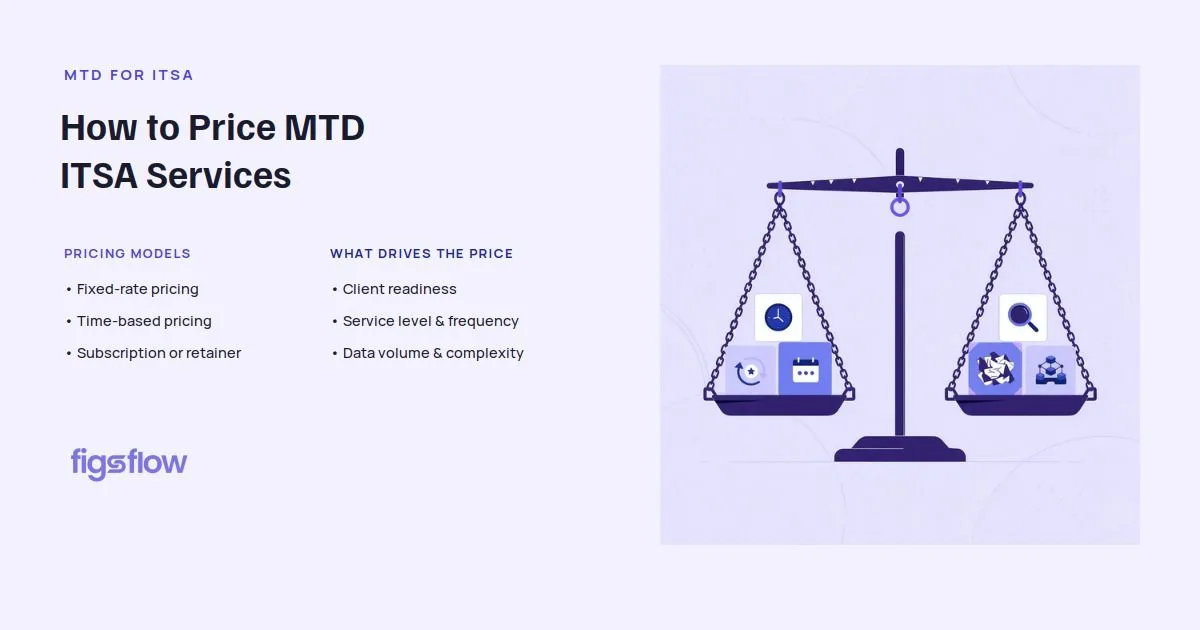
An infographic detailing different pricing models and factors affecting costs for MTD ITSA services.

5/5/2025

How to Price MTD ITSA Services: A Comprehensive Guide for Accountants & Tax Advisers

How to Price MTD ITSA Services: A Comprehensive Guide for Accountants & Tax Advisers How to Price MTD ITSA Services: A Comprehensive Guide for Accountants & Tax Advisers Understanding the Scope of MTD ITSA Services Key Pricing Factors for MTD ITSA Client Readiness & System Integration Pro Tip Service Level & Frequency Pro Tip Volume & Complexity of Client Data Pro Tip Client Segmentation & Customisation Pro Tip Pricing Models for MTD ITSA Fixed-Rate Pricing Time-Based Pricing Subscription or Retainer Model Pro Tip Additional Considerations Further Reading On MTD for ITSA Conclusion The introduction of Making Tax Digital for Income Tax Self-Assessment (MTD ITSA) marks a significant shift in how accountants and tax professionals manage client records and submissions. Individuals and small businesses will need to comply with MTD ITSA regulations, which require quarterly updates and annual declarations to HMRC. This change presents both challenges and opportunities for accountants, particularly when it comes to pricing these new services. To ensure that MTD ITSA services are priced correctly, accounting firms need to evaluate various factors ranging from the level of service required to the complexity of each client's needs. In this article, we will explore the key factors to consider when pricing MTD ITSA services, along with practical tips to create a structured pricing model for your clients. Before diving into pricing, it's important to define what services are included in MTD ITSA compliance: Quarterly Updates – Clients will need to submit income and expense updates to HMRC every three months. Annual Declaration – A final declaration will be required at the end of the tax year, which consolidates the quarterly updates and ensures the information is accurate. Digitisation of Records – Clients not currently using digital tools will need assistance transitioning to MTD-compliant software. Ongoing Support & Advisory – You may offer additional services such as tax planning, business advice, and financial forecasting to help clients optimise their tax situation. These components will form the basis of your service offering and help determine each client's complexity and time commitment. You may find pre-designed MTD ITSA templates helpful when designing engagement letters to showcase what you offer and how you carry out your work. For a full breakdown of how MTD ITSA works, including scope rules, thresholds, quarterly obligations, and agent setup, read our complete guide: MTD for Income Tax, A Complete Guide for Accountants and Agents. In the section below, we will discuss some of the pricing factors that need to be considered to determine the price that needs to be charged to the clients. The current state of the client's records will heavily influence the pricing. There are typically three types of clients: Clients Already Using MTD-Compliant Software – If your clients are already using accounting software that complies with MTD ITSA (e.g., Xero, QuickBooks), the additional cost for them to comply with MTD ITSA will be minimal. Pricing for these clients will primarily cover the administrative tasks associated with submitting quarterly updates and the annual declaration. Clients with Paper-Based or Non-Digital Records – For clients still relying on paper records or outdated digital systems, the transition to MTD ITSA will require significant work. You'll need to help digitise their records, set up MTD-compliant software , and train them on how to maintain accurate digital records. This may involve extra fees for system integration and setup, including: Transitioning to new software Data entry and conversion of paper records Client training and ongoing support Hybrid Clients (Partially Digital but Non-Compliant) – These clients might already have some digital records, but they may not be compliant with MTD ITSA standards. Additional work will be required to bring their systems up to date, which will add to the cost. When evaluating client readiness, it's essential to assess the volume of data and complexity of the client's financial situation. For instance, a business with multiple income streams and numerous transactions will require more time to bring their records into compliance than a client with a simple income structure. MTD ITSA mandates that updates be submitted quarterly, which may require more frequent communication and work from your accountancy firm. In fact, there is a host of requirements accountants and tax advisers need to follow when providing Making Tax Digital services. Pricing needs to account for: Basic Service – This could involve quarterly submission of updates and a simple review of client data. Full-Service Accounting – For more complex clients, you may need to offer a full-service package that includes: Quarterly updates and financial reconciliation Preparation of the final annual declaration, which may require adjustments for non-quarterly income (e.g., pension, dividends, interest) Accountants may also need to consider the frequency of client interaction. If clients need to reach out for assistance frequently, or if you're offering a more proactive service, this will add to your costs. Clients who require higher levels of support (e.g., regular bookkeeping and quarterly consultations) should be priced accordingly. You can offer different tiers of service packages based on how much interaction the client needs. The complexity of a client's financial situation will influence pricing. Consider factors such as: Number of Transactions – A higher volume of transactions or numerous income sources (e.g., rental income, freelance work) will increase the amount of time required for data entry, reconciliation, and quarterly updates. Multiple Bank Feeds – More bank feeds to reconcile means more time spent ensuring the accuracy of financial records. Taxable Deductions & Additional Income Sources – Clients with complex tax situations (e.g., pensions, dividends, interest, and employment income) will require more time to compile, analyse, and report this information in line with MTD ITSA at the time of final submission. Create pricing tiers based on the number of transactions or bank feeds clients have. For example, a flat fee for clients with fewer than 100 transactions per quarter and an additional charge per 50 transactions above that threshold. Every client is different, and tailoring pricing to meet the unique needs of each client is crucial. Consider segmenting your clients into different categories, such as: Simple Clients – These clients may have straightforward financial records, limited transactions, and minimal support needs. They might only require basic quarterly submissions and annual declarations. Complex Clients – Clients with complex financial situations, multiple income sources, or frequent transactions will need a more comprehensive service package, which will justify a higher price. Offer customised pricing models for clients based on their specific needs. For example, you could offer a standard package for clients with simple records and a premium package for more complex businesses. There are several pricing models you can choose (including the famous value-based pricing model ) from to price MTD ITSA services: A fixed-rate pricing structure provides a clear, predictable cost for clients. You can base this rate on factors such as: The service package selected (basic vs full-service) The client's readiness and the complexity of their data The number of quarterly updates and the final declaration For clients with complex needs, time-based pricing (hourly rates) may be more appropriate. This model is best for clients who require more bespoke services, such as extensive bookkeeping or data conversion. A subscription-based or retainer model can provide clients with ongoing support and predictability in costs. Clients pay a monthly or quarterly fee that covers all MTD ITSA services, including quarterly updates, bookkeeping, and annual declarations. Move clients who are currently paying for annual tax returns to a quarterly or monthly billing model to align with the new MTD ITSA requirements. Early Bird Discounts – Consider offering discounts for clients who sign up early for MTD ITSA services or for those transitioning to MTD-compliant software. Value-Added Services – Use MTD ITSA as an opportunity to offer additional services such as tax planning, financial forecasting, or business consultancy, which can help increase your revenue. Ongoing Training – Ensure that your team is continually trained on MTD ITSA requirements, so you can provide the best possible service to clients and stay ahead of HMRC updates. Updating MTD Engagement Letter: 6 Clauses That Must Change How to Onboard MTD Clients Efficiently in 2026 | FigsFlow MTD ITSA Engagement Letter Template | FigsFlow Pricing MTD ITSA services requires careful consideration of various factors, including client readiness, the complexity of data, the level of service required, and the frequency of updates. By understanding these factors and offering flexible pricing models, accountants and tax professionals can ensure that their services are competitive, profitable, and aligned with the needs of their clients. Whether you choose to use a fixed-rate, time-based, or subscription pricing model, the key to success is to clearly communicate the value your services provide. Offering a range of packages and customisation options will allow you to serve clients at every level, from those with straightforward financials to those with complex tax situations, all while ensuring compliance with MTD ITSA. If you're still unsure how to price your MTD services, use FigsFlow , the proposal, pricing and engagement letter software for accountants, which uses automatic pricing models to give you the optimum prices for your service offerings. how-to-price-mtd-itsa-services-a-comprehensive-guide-for-accountants-tax-advisers how to price mtd itsa services a comprehensive guide for accountants tax advisers page Page
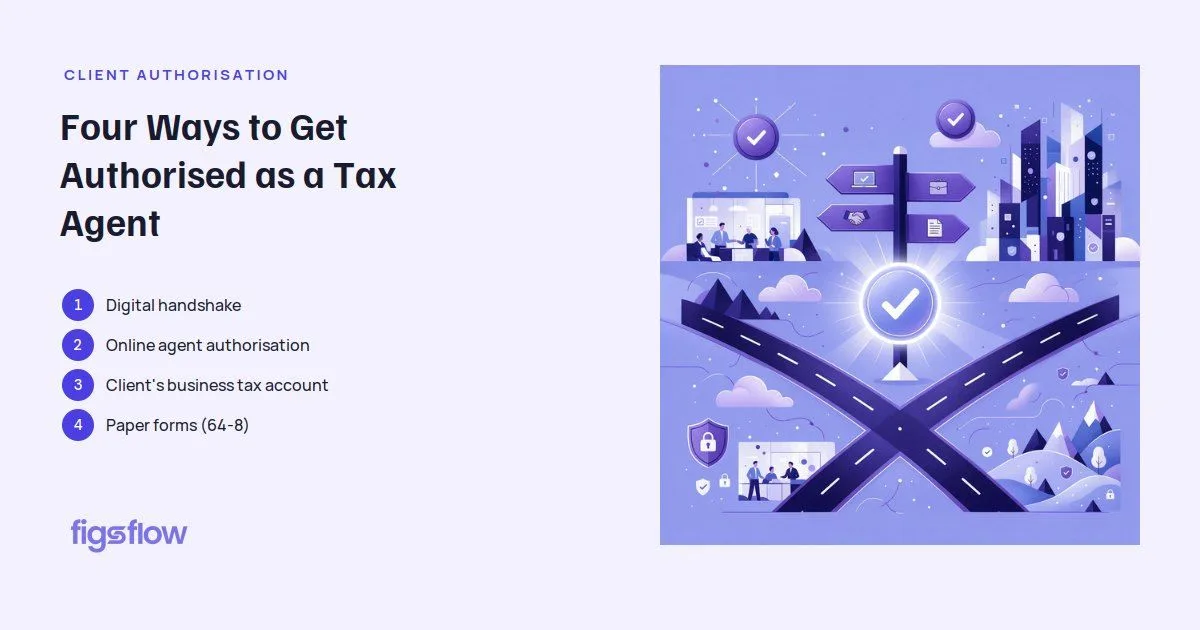
An illustrated guide on how to get authorised as a tax agent.

4/1/2025

How to Get Authorised to Act as a Tax Agent on Behalf of Your Clients

How to Get Authorised to Act as a Tax Agent on Behalf of Your Clients How to Get Authorised to Act as a Tax Agent on Behalf of Your Clients Understanding Client Authorisation Methods of Obtaining Authorisation The Digital Handshake Online Agent Authorisation Authorisation Through the Client's Business Tax Account Paper Forms Choosing the Right Method for Your Clients Step-by-Step Process: A Practical Walkthrough Step 1: Prepare Your Agent Details Step 2: Select the Appropriate Authorisation Method Step 3: Follow Up & Confirm Step 4: Provide Support for Digitally Excluded Clients Benefits of Proper Authorisation Keeping Up with Updates Conclusion In today's digital world, tax agents play a crucial role in ensuring that individuals and businesses remain compliant with HM Revenue & Customs (HMRC) requirements. Before you can manage your clients' tax affairs, you must obtain the necessary authorisation to act on their behalf. This comprehensive guide explains the different ways to secure client authorisation, including using the digital handshake, the Online Agent Authorisation service, obtaining authorisation through your client's business tax account, and using paper forms. The guidance is designed to help tax agents, whether new or experienced, navigate the authorisation process efficiently. Client authorisation is a mandatory step for any tax agent who wishes to transact on behalf of a client with HMRC. It confirms that the client has granted you permission to handle their tax matters, including submitting returns, managing communications, and accessing confidential financial information. Importantly, you must never use your client's Government Gateway user ID or directly access their online tax account. Instead, you need to follow the correct processes to gain your own authorisation credentials. The methods for obtaining authorisation vary depending on the specific tax service you wish to manage. HMRC offers several ways to obtain this permission, ensuring flexibility and accessibility regardless of your client's digital literacy. There are several pathways available for obtaining client authorisation for tax agents. Each method is designed to suit different circumstances and the specific tax services involved: The digital handshake is an innovative, secure method that allows clients to grant authorisation online without the need for physical forms. It is used for various tax services, such as: Annual Tax on Enveloped Dwellings (ATED) Capital Gains Tax on UK property Making Tax Digital for Income Tax Self Assessment Trust Registration Service VAT (previously Making Tax Digital for VAT), and many others How It Works: Initiation – As a tax agent, you begin by initiating the digital handshake process. This can usually be done through HMRC's online platform. Client Interaction – Your client receives a prompt—either via email or through their HMRC online account—to complete the handshake. This process confirms that they wish to authorise you. Confirmation – Once the client completes the digital handshake, HMRC links your agent details with their tax account, enabling you to act on their behalf. Benefits: Speed & Efficiency – The digital handshake significantly reduces processing times compared to traditional methods. Security – It uses robust encryption and authentication processes to ensure that only authorised agents can access client data. Paperless – This method supports HMRC's drive towards digital transformation, reducing the need for paper forms and manual processing. For many tax services, HMRC provides an Online Agent Authorisation service for tax agents managing services like S elf-Assessment , Corporation Tax , and more. This service is integral for agents managing: Corporation Tax Employment Related Securities (ERS) Machine Games Duty Self Assessment VAT Mini One Stop Shop (MOSS), and more Steps to Authorise Online: Registration – First, ensure you are registered as a tax agent on the HMRC online services portal. Accessing Service – Log in to your agent account and select the relevant option to authorise a client. This is typically found under the "Authorise client" menu. Submission – Enter the client's details as required. This may involve confirming their identity, providing your Agent Government Gateway Identifier (which can be found in your agent account), and following on-screen instructions. Validation – HMRC processes the authorisation request and, upon successful validation, links your account with the client's tax profile. Benefits: Convenience – Online authorisation is available 24/7, allowing both agents and clients to complete the process at a time that suits them. Real-Time Processing – The system often provides immediate feedback or confirmation of the authorisation. Integration – Once authorised, you can easily manage multiple tax services for your client without additional paperwork. Another approach involves asking your client to authorise you directly through their own business tax account. This method is particularly useful for services like: Construction Industry Scheme (CIS) Employment Related Securities (ERS) Machine Games Duty PAYE VAT (Legacy), and other business-related tax services Steps for This Method: Communication – Provide your client with your Agent Government Gateway Identifier. This identifier is essential as it ensures HMRC knows who is requesting access. Client Login – Instruct your client to log into their business tax account. Authorisation Request – Within their account, the client selects the option to authorise an agent. They will then need to enter your Agent Identifier and follow the on-screen instructions. Confirmation – Once the process is complete, the authorisation is recorded, and you will be able to access the relevant tax information for your client. Benefits: Direct Involvement – This method gives clients direct control over who accesses their tax information. Clarity & Security – By using their own account, clients can see exactly what permissions are being granted. Flexibility – It is particularly useful for clients who are more comfortable managing their own online accounts. For clients who are either digitally excluded or prefer traditional methods, HMRC still offers the option to use paper forms. This method applies to a variety of tax services, including: Corporation Tax Individual PAYE or National Insurance Self Assessment VAT (Legacy) Tax Credits and Child Benefit How to Use Paper Forms: Obtain the Correct Form – Identify the correct paper form for the tax service you are dealing with. For example, use the 64-8 form for services such as Corporation Tax, PAYE, Self Assessment, and VAT. Complete the Form – Fill in the required details, ensuring accuracy. The form typically asks for both your details and those of your client, as well as the specific permissions you require. Submission – Send the completed form to HMRC via post. Make sure to follow any specific instructions regarding the mailing address or any additional documentation that may be required. Processing – HMRC will process the paper form, and once approved, you will receive confirmation that you are authorised to act on your client's behalf. Benefits: Accessibility – Paper forms provide an option for clients who may not have access to digital services. Familiarity – Some clients may prefer the traditional paper-based process, finding it easier to understand and complete. Legal Documentation – A paper trail can sometimes provide added reassurance and clarity regarding the authorisation process. Selecting the appropriate method for obtaining client authorisation depends on several factors: Client Preference – Some clients are tech-savvy and prefer quick, online methods such as the digital handshake or online authorisation, while others might be more comfortable with paper forms. Type of Tax Service – Certain tax services have specific authorisation requirements. For instance, services like ATED and Making Tax Digital for VAT are designed to work with the digital handshake. Timeliness – Online methods typically offer immediate processing, which is beneficial when urgent authorisation is needed. Paper forms, while reliable, may take longer to process. Digital Exclusion – For clients who are digitally excluded or have limited access to online services, the paper form or telephone support (via HMRC's Extra Support Team) might be the best option. By understanding these factors, you can tailor your approach to ensure that each client is comfortably and securely authorising you to handle their tax matters. Streamline Client Onboarding with Ready Templates Use FigsFlow's 100+ pre-built templates to simplify client authorisation, from engagement letters to proposals, and enhance your onboarding process. Explore Templates? Let us consider a scenario where you need to secure authorisation for a client who wishes to use your services for Corporation Tax, Self Assessment, and PAYE. Here is how you might proceed: Verify Your Registration – Ensure you are fully registered as a tax agent with HMRC. Locate Your Agent Identifier: – Log in to your HMRC online services for agents account and locate your Agent Government Gateway Identifier under the "Authorise client" section. This is crucial for the next steps. For Corporation Tax & Self Assessment: Online Agent Authorisation: Log in to your agent account. Navigate to the "Authorise client" section. Input your client's details along with your Agent Identifier. Follow the prompts to complete the online authorisation. Alternatively, Paper Forms (64-8): If your client prefers a paper-based approach, complete the 64-8 form . Provide all necessary details, sign the form, and send it to HMRC. For PAYE: Authorisation via Client's Business Tax Account: Ask your client to log in to their business tax account. Instruct them to use your Agent Identifier to authorise you. Or, Using Online Agent Authorisation: Follow the same process as for Corporation Tax, entering the details in the online system. Check for Confirmation – Once your client completes the chosen method, HMRC will process the authorisation. You should receive a notification confirming that you are now authorised to act on their behalf. Verify Access – Log in to your agent account and verify that the authorisation is active. You should now be able to view your client's tax details and proceed with any necessary filings or communications. Extra Support Team – If a client is digitally excluded, provide them with the relevant HMRC contact number. The Extra Support Team will assist them over the phone, guiding them through the process of completing any necessary authorisation steps. Securing the correct authorisation is not merely a regulatory requirement, it also brings several important benefits: Enhanced Security – Authorisation confirms that the client has explicitly permitted you to access their sensitive tax information, reducing the risk of unauthorised access. Streamlined Processes – With the appropriate authorisation in place, you can manage multiple tax services seamlessly from your HMRC online services account, whether through digital methods or paper-based approaches. Improved Client Trust – Clients feel more secure knowing that their data is being handled by an authorised professional, fostering stronger relationships and trust. Compliance & Accountability – Maintaining clear records of authorisations ensures that both you and your clients remain compliant with HMRC regulations, which is crucial in the event of audits or disputes. HMRC periodically updates its authorisation processes to reflect changes in technology, policy, and user needs. It is important to stay informed about: New Methods – Additional digital tools or revised paper forms may be introduced, making it easier to secure authorisation. Regulatory Changes – Any amendments in the legal or procedural requirements for client authorisation should be monitored via HMRC's official communications. Training & Resources – HMRC provides user guides, tutorials, and support for tax agents. Regularly reviewing these resources can help you stay ahead of changes and continuously improve your service delivery. Obtaining client authorisation is a foundational step for any tax agent aiming to deliver efficient and compliant tax services. Whether you choose the innovative digital handshake, the convenience of Online Agent Authorisation, the direct method via a client's business tax account, or the traditional paper form, each method is designed to ensure that both you and your client are protected and that HMRC's stringent standards for security and accuracy are met. By following the step-by-step processes outlined in this guide, you can ensure that your authorisation procedures are streamlined, secure, and tailored to each client's needs. In doing so, you not only enhance your own efficiency as a tax professional but also build trust with your clients, knowing that their financial information is handled with the utmost care and professionalism. Ultimately, proper authorisation is not just about compliance, it is about establishing a secure, efficient, and transparent channel for managing tax responsibilities. By doing so, you position yourself as a trusted and capable advisor in an increasingly complex regulatory environment. how-to-get-authorized-to-act-as-a-tax-agent-for-clients how to get authorized to act as a tax agent for clients page Page

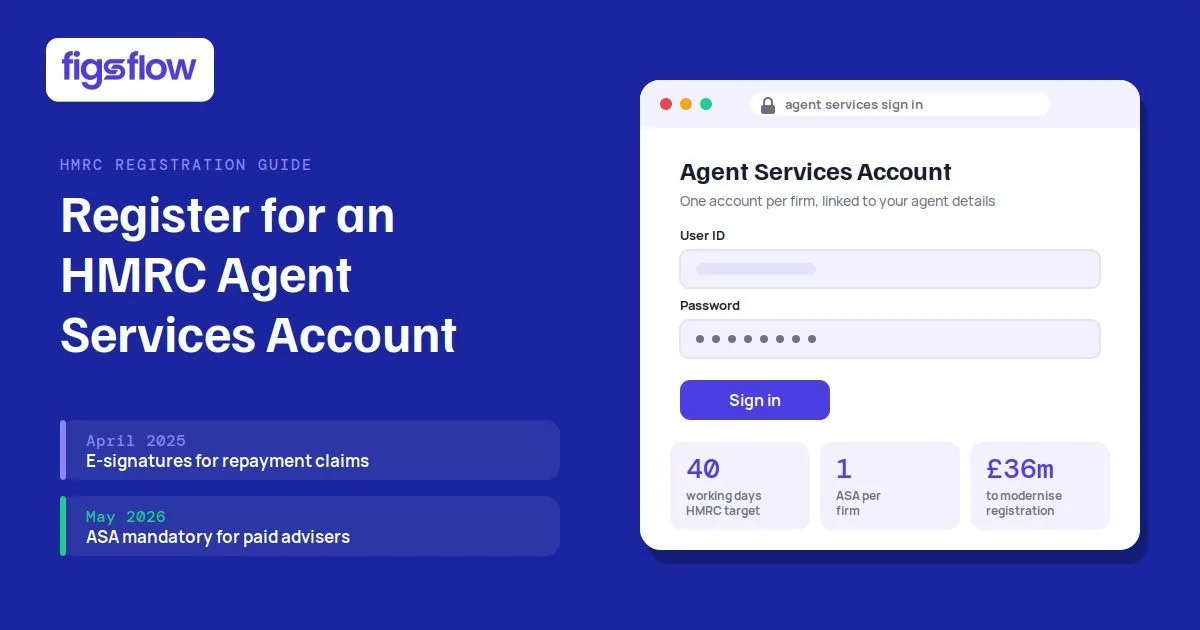
Guide for registering an HMRC Agent Services Account.

3/27/2025

Registering with HMRC for an Agent Services Account: A Step-by-Step Guide

Registering with HMRC for an Agent Services Account: A Step-by-Step Guide Registering with HMRC for an Agent Services Account: A Step-by-Step Guide What Is an HMRC Agent Services Account (ASA)? Understanding the Need for Registration What You'll Need to Register Who Can Create an Agent Services Account? Documents & Information You'll Need Where to Send Your Application by Post What Happens After You Apply What Can You Do With an Agent Services Account? Special Considerations for Non-UK Based Agents Ensuring Ongoing Compliance Common Challenges & How to Fix Them Important HMRC Agent Registration Updates for 2025 and 2026 Conclusion Frequently Asked Questions (FAQs) How do I register for an agent services account? How to get an agent code? Who can create an agent service account? What do you need to create an agent service account? For tax agents, HMRC's Agent Services Account is the key to managing VAT, PAYE, and tax returns online. Here's what you need to register successfully under the latest rules. Creating an agent services account with HM Revenue & Customs (HMRC) is a crucial first step for tax professionals who wish to manage client tax affairs online. This guide provides an in-depth look at how to register with HMRC by post, what information you will need, where to send your documentation, and what to expect once your application has been received. Whether you are an established tax agent or new to the field, understanding these procedures is essential to ensure you can access the range of online services HMRC offers. For tax agents, an agent services account with HMRC serves as the gateway to managing tax returns, PAYE, VAT, and other tax services on behalf of your clients. By registering as a tax agent, you can create an account that gives you secure access to these digital tools. However, if you have not yet registered with HMRC or you do not have an online services account with the requisite authorisations, you must first complete the registration process by post. This guide outlines the registration process in detail, focusing on what is required, the documentation you must provide, and how HMRC assesses your application against their Standard for Agents. With the latest updates from 28 November 2024, this comprehensive resource ensures you have all the information needed to successfully register. Definition of Agent Service Account An agent services account (ASA) is HMRC's updated platform for accessing their digital services for tax agents. Agent Service Account operates alongside the traditional agent portal (HMRC online services for agents) rather than replacing it. Your existing agent portal credentials will still be needed for established services like Self Assessment, PAYE, and Corporation Tax. Each firm can only have one ASA, which is linked to your firm's UTR (Self Assessment UTR for sole traders, partnership UTR for partnerships, or Corporation Tax UTR for limited companies). If your firm currently operates multiple online services accounts across different offices or tax services, you'll need to link these existing Government Gateway agent IDs to your new ASA. Your old accounts and credentials remain active for existing HMRC services. Before you can access HMRC's agent services, you must be registered as a tax agent with HMRC. Registration confirms that you are a recognised professional who meets HMRC's standards for agents. Once registered, you gain access to an agent services account where you can manage client authorisations, file returns, and access other tax-related services. Key Benefits of Registration: Secure Access – Gain a secure, individual login to HMRC's online services. Client Management – Manage authorisations and view client tax details across multiple tax services. Compliance – Ensure you are recognised as a compliant agent who adheres to HMRC's standards. Efficiency – Streamline the process of filing returns and handling client communications through a single, integrated platform. Once registered as a tax agent, you can start using HMRC-approved software solutions for filing tax returns and handling client submissions. Here's a list of MTD-compliant software for accountants to streamline your workflow. Do You Need to Register by Post? (Eligibility Check) There are two paths depending on your situation. Already a tax agent with HMRC? If you already have an HMRC online services account with at least one authorised client — for Self Assessment, Corporation Tax, PAYE, or VAT — you can skip the postal application and create your Agent Services Account online immediately. Brand new to HMRC? If you have never registered as a tax agent before, you must apply by post first. HMRC will process your application within 40 working days. Once approved, you can then create your ASA online. When preparing your application to register with HMRC as a tax agent , it is essential to gather all the necessary information and documentation. Incomplete applications can lead to delays or even rejection, so attention to detail is paramount. Below is a comprehensive list of what you'll need. Personal & Business Information: Full Name – Your legal name as it appears on official documents. Trading Name – If your business operates under a different name, include this detail. Business Address – The address from which your business operates. Note that this cannot be a PO box address. Telephone Number & Email Address – Current contact details for prompt communication. National Insurance Number – Your unique identifier for tax and social security purposes. Tax-Related Identifiers: Self Assessment Unique Taxpayer Reference (UTR) – Required if you are a director, sole trader, or partner. This number is essential for linking your personal tax records. Partnership UTR, LLP UTR, or Company UTR – If applicable, include the relevant UTR for your business. Company Registration Number – If you are registering as a limited company. VAT Registration Number – If your business is VAT-registered. Employer PAYE Reference – If you operate a PAYE scheme for your employees. Information for Multiple Partners or Directors: If your business has several partners or directors, you must provide the following details for each individual: Full Names National Insurance Numbers Self Assessment UTRs Anti-Money Laundering (AML) Supervision Details: Given the heightened focus on compliance and fraud prevention, HMRC requires: Supervisory Authority Information – The name of your anti-money laundering supervisory authority. Documentary Evidence – Evidence as requested by your supervisory authority. It is advisable to check with your supervisor regarding the specific documents needed. AML Supervision Registration Number – If HMRC is your designated supervisory authority. Gathering all these documents and details in advance can save time and ensure that your application is processed without unnecessary delays. Not everyone in your firm can set up the account. Only one of the following can create it: A sole trader using their personal Self-Assessment UTR A partner in a partnership using the partnership UTR A company director using the Corporation Tax UTR Other staff members such as employees or junior accountants cannot register directly. Each firm can only have one ASA, and it is permanently tied to that firm's UTR. With all the necessary information at hand, the next step is to prepare your application for submission. Attention to detail during this phase is crucial because HMRC evaluates your submission against their Standard for Agents. Tips for a Successful Application: Accuracy – Double-check all personal and business information for accuracy. Completeness – Ensure every required document and piece of information is included. Missing details can result in your application being rejected. Documentation – Organise your documents in a clear and logical order. Consider using a checklist to verify that nothing is overlooked. Compliance – Familiarise yourself with HMRC's Standard for Agents. This document outlines the criteria and expectations HMRC has for professional tax agents. Once your application is complete and all the required documentation has been gathered, the next step is to send your application to HMRC by post. The address for submitting your registration is: Agent Compliance Team HM Revenue and Customs United Kingdom BX9 1ZE Postal Submission Guidelines: Secure Packaging – Use a secure envelope or packaging to protect your documents during transit. Tracked Delivery – Consider using a tracked postal service to ensure that your application is delivered and to have proof of submission. Cover Letter – Including a brief cover letter outlining your application details can help HMRC process your registration efficiently. After your application is received by HMRC, the next steps involve processing and confirmation. HMRC will review your submission carefully to ensure it meets all the required standards and contains all necessary documentation. Processing Timeline: Review Period – HMRC aims to register you within 40 working days from the date they receive your application. During this period, your application will be assessed, and any additional information or clarification may be requested. Notification – You will be informed by HMRC whether your registration has been successful. If approved, you will then be able to create your agent services account. Next Steps – Once registered, you can proceed to set up your agent services account. This account will allow you to manage client authorisations, file returns, and access various HMRC online services. Post-Registration Benefits: Agent Services Account Creation – After successful registration, you will be able to create an agent services account. This account serves as your secure portal to HMRC's suite of online services. Access to HMRC Online Tools – With your agent services account, you can easily manage tax returns, update client details, and receive important communications from HMRC. Streamlined Operations – Registering as an agent ensures that you have a single point of access for all HMRC-related functions, which can significantly streamline your operational processes. After registering, you might need to appoint someone to handle HMRC communications for your clients. Learn more about how to delegate HMRC responsibilities in our detailed guide. The agent services account is currently being expanded and supports the following: VAT services (excluding VAT EU Refunds for Northern Ireland businesses, EC Sales List, and Notification of Vehicle Arrivals) Making Tax Digital for Income Tax Trust Registration Service Capital Gains Tax reporting for UK property Income Record Viewer For a complete breakdown of available services and detailed guidance on using each one, visit HMRC's dedicated page for tax agent services at gov.uk . If you are not based in the United Kingdom, the registration process for an agent services account differs slightly. Non-UK agents must follow specific guidelines provided by HMRC to ensure that they comply with international registration requirements. It is advisable to check the latest guidance on HMRC's official website or contact HMRC directly for detailed instructions tailored to your circumstances. Non-UK agents with no UK tax presence, no UK UTR, and no UK-based AML supervisor must follow a different process and need HMRC approval before an ASA can be created. Contact HMRC directly or visit the dedicated overseas agent guidance page on gov.uk. Registering with HMRC is just the first step in maintaining a professional relationship with the agency. It is equally important to ensure that you remain compliant with HMRC's standards and requirements over time. Key Areas for Ongoing Compliance: Regular Updates – Keep your personal and business details updated in your agent services account. Documentation – Retain copies of your registration documents and any correspondence with HMRC for future reference. Continuing Professional Development – Stay informed about changes in tax legislation and HMRC's procedures. This may involve periodic training or reviewing updates published by HMRC. AML & Compliance Checks – Ensure that you adhere to anti-money laundering regulations and other compliance requirements to avoid any potential issues that could affect your registration status. While the registration process is designed to be straightforward, some agents may encounter challenges. Understanding these common issues can help you prepare and avoid potential pitfalls. Challenges: Incomplete Documentation – Missing information or documents can result in delays or rejection of your application. Accuracy Errors – Mistakes in personal or business details can lead to complications during the review process. Postal Delays – Using standard post without tracking might result in delays, making it difficult to confirm receipt of your application. Strategies to Overcome Challenges: Use a Checklist – Create a detailed checklist of all required documents and information to ensure nothing is overlooked. Double Check Details – Review your application carefully before sending it to catch any errors. Choose a Reliable Postal Service – Opt for a tracked and secure postal service to ensure your documents arrive safely and on time. Follow Up – If you do not receive confirmation within the expected 40 working days, contact HMRC to inquire about the status of your application. April 2025 — Electronic signatures now required If you submit income tax repayment claims on behalf of clients using forms P87, R40, or MATCF, you must now obtain an advanced electronic signature from your client before submitting. This replaced the old paper nomination process from April 2025. May 2026 — Registration becomes mandatory for all paid advisers From May 2026, any business that interacts with HMRC on behalf of a paying client will be legally required to register and hold an Agent Services Account. This covers communication by phone, post, email, digital messaging, and submission of returns or claims. If you are paid to deal with HMRC for clients and do not yet have an ASA, you will need one. £36 million invested in modernising agent registration. HMRC has committed significant funding to reduce registration delays, improve ASA security, and simplify how agents access services. Registering with HMRC as a tax agent is a foundational step for accessing the full range of HMRC online services and managing your clients' tax affairs effectively. By preparing all necessary information, following the postal submission guidelines, and understanding what to expect during the review process, you can ensure a smooth registration experience. Once registered, your agent services account will serve as a secure portal through which you can streamline your operations, manage client authorisations, and maintain compliance with HMRC standards. Staying informed about the latest requirements and updates is essential, as HMRC continually refines its processes to meet the evolving needs of tax professionals. This comprehensive guide has outlined the steps you need to take—from gathering your details and documentation to sending your application by post and understanding the post-registration process. With careful preparation and attention to detail, you can confidently register with HMRC and begin enjoying the benefits of a fully operational agent services account. You need to be registered as a tax agent with HMRC first. If you already have an HMRC online services account with at least one authorised client for Self Assessment, Corporation Tax, PAYE, or VAT, you can create your agent services account straight away. You must apply in writing to HMRC for Corporation Tax or Self Assessment agent codes. Each tax service requires a separate application as they're not linked. Your application will be assessed against HMRC's Standard for Agents. Only sole traders, partners, or company directors can create an agent services account. Other staff members within your firm cannot register directly. You'll need your Government Gateway credentials, firm's UTR and postcode, company or VAT registration number (if applicable), National Insurance number and date of birth for identity verification, and anti-money laundering supervisory body details including membership number and renewal date. HMRC Agent Services Account eligibility flowchart showing two paths — register by post for new agents or create ASA online immediately for existing agents with authorised client Checklist of documents required to register for an HMRC Agent Services Account including UTR, National Insurance number, AML supervision details and business address HMRC Agent Compliance Team postal address BX9 1ZE for agent services account registration application Understanding the Need for Registration Four common HMRC Agent Services Account problems and fixes — UTR postcode mismatch, partial client transfer, two Government Gateway IDs, and postal application rejected Timeline of HMRC agent registration changes from November 2024 to May 2026 including electronic signature requirement from April 2025 and mandatory ASA registration from May 2026 register-hmrc-agent-services-account-guide register hmrc agent services account guide page Page

An infographic about GDPR compliance for accountants.

3/17/2025

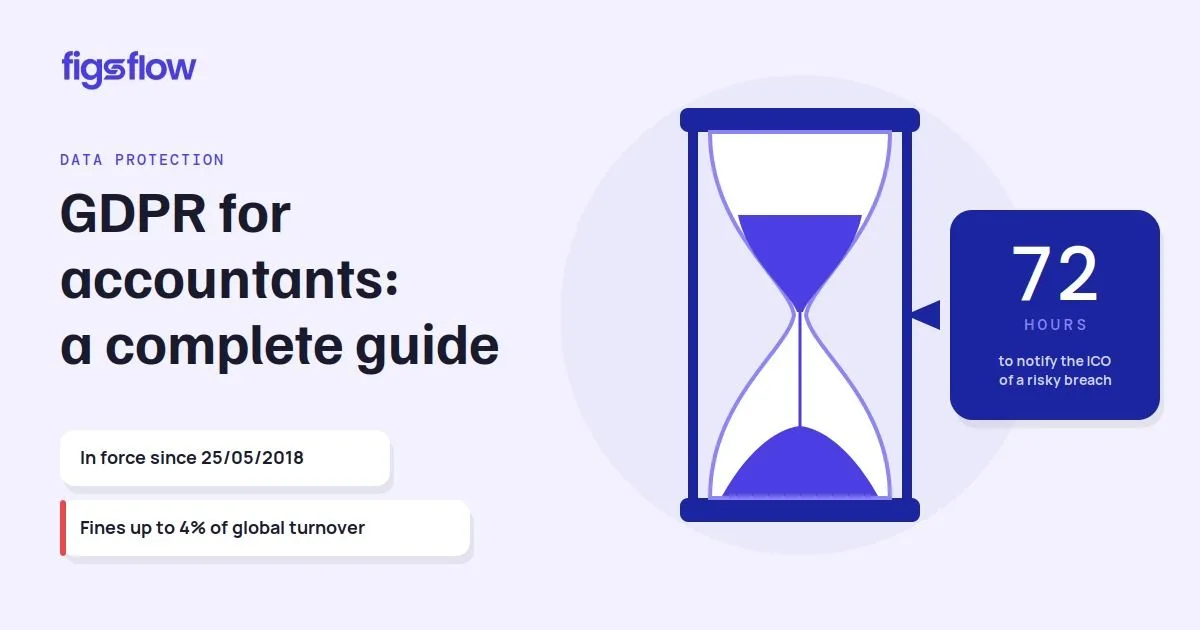
GDPR for Accountants: A Complete Guide

GDPR for Accountants: A Complete Guide GDPR for Accountants: A Complete Guide Understanding GDPR Data Protection Principles & Accountability Data Protection Principles & Accountability Expanded Rights under GDPR & Implications for Accountants Lawful Bases for Data Processing Data Processing, Records Retention & Secure Communication Roles & Responsibilities Understanding GDPR Engagement Letters & Privacy Policies Data Breaches & Enforcement Best Practices & Compliance Steps This guide is designed to help accountancy professionals understand the main features of the GDPR, its impact on day-to-day operations, and the practical steps required to achieve compliance. It is based on technical factsheets and FAQs from leading professional bodies and provides a comprehensive overview of how to implement GDPR requirements within accountancy practice. This guide provides accountants with an overview of the GDPR, explains how it differs from previous data protection laws, and outlines the steps needed for compliance. It emphasises both the legal obligations and the opportunities for enhancing data governance. The content is specifically designed for accountants, audit professionals, tax advisers, and other practitioners who handle both client and firm data. Effective from 25 May 2018, the GDPR impacts any individual or organisation processing the personal data of EU residents. Accountants must understand the new responsibilities, including enhanced accountability and improved data protection practices, to safeguard their data and that of their clients. The General Data Protection Regulation (GDPR) is a comprehensive data protection framework that replaces earlier legislation, such as the Data Protection Act 1998. It governs how personal data is collected, stored, and processed—whether digitally or in paper records. A key change introduced by the GDPR is the accountability principle, which requires firms to actively demonstrate compliance through robust documentation and internal controls. The GDPR builds on earlier data protection principles by enhancing transparency and accountability. It mandates stricter consent requirements where consent must be specific, informed, and given through a positive opt-in mechanism without pre-ticked boxes. Furthermore, the scope of personal data has expanded to include online identifiers, IP addresses, and cookie identifiers, thereby broadening the range of information protected under the law. Under the GDPR, personal data must be processed in a lawful, fair, and transparent manner. Firms are required to ensure that only data necessary for a particular purpose is collected (purpose limitation and data minimisation) and that all information remains accurate, is retained only as long as necessary, and is adequately protected against unauthorised access or accidental loss. The accountability principle compels firms to maintain detailed records of data processing activities, including how and when consent was obtained and how breaches are managed. This involves establishing robust internal controls, appointing a senior data governance lead or Data Protection Officer (where appropriate), and ensuring regular staff training. The Information Commissioner's Office (ICO) recommends that training sessions be conducted at least every two years to keep all staff updated on GDPR requirements. The GDPR grants individuals enhanced rights regarding their personal data. Data subjects have the right to be informed about how their data is processed through clear privacy notices, the right to access and rectify their data, and even the right to have their data erased (commonly known as the "right to be forgotten") under certain conditions. Additionally, individuals can request that processing be restricted, demand data portability, and object to data processing practices such as direct marketing. For accountants, these expanded rights mean that both client data (information received during professional engagements) and firm data (internal records) must be managed with strict adherence to GDPR standards. Firms must develop and implement internal procedures to respond promptly to Subject Access Requests (SARs) and any requests for deletion or restriction within the mandated 30-day period. Before processing personal data, firms must identify a lawful basis. In many engagements, data processing is necessary to fulfil contractual obligations or comply with legal requirements (such as those for audit or tax purposes). Alternatively, processing may be justified by legitimate interests, provided these do not override the rights of individuals. When relying on consent, the GDPR requires that consent is explicit, freely given, revocable, and unbundled from other terms or services. Firms must document in detail when and how consent was obtained and record any subsequent withdrawals to ensure ongoing compliance. Data should be retained only for as long as necessary to fulfil its intended purpose. Firms are advised to establish retention periods that align with both regulatory requirements and professional standards often ranging from 7 to 8 years for audit files, tax records, and client engagement documents. A risk-based approach should guide the secure communication of personal data. This includes using encrypted emails, secure client portals, and avoiding generic cloud storage solutions that lack proper data protection agreements. The chosen communication methods should always reflect the sensitivity of the data being handled. In the context of the GDPR, a data controller determines the purposes and means of processing personal data, while a data processor acts on behalf of the controller. Accountants may find themselves in a dual role—acting as data controllers when managing firm data and as data processors when handling client data. It is important to maintain clarity in these roles to ensure compliance with all regulatory requirements. A Data Protection Officer must be appointed in cases of large-scale or high-risk data processing. Although many accountancy practices may not meet the threshold for "large-scale" processing, it is still advisable to designate a senior person responsible for overseeing GDPR compliance. The DPO's role includes advising on data protection obligations, monitoring compliance, and serving as the primary contact with supervisory authorities. Engagement letters must clearly inform clients about the GDPR's applicability and detail the lawful basis for processing their data. It is essential to separate service terms from consents for additional processing activities such as marketing, ensuring that any consent obtained is freely given and can be easily revoked. Privacy policies should be written in clear, plain language and must include comprehensive details on how personal data is processed, the retention periods, and the rights available to data subjects. Regular reviews and updates to these policies are crucial to ensure ongoing compliance as processing activities evolve. In the event of a data breach, firms must notify the ICO within 72 hours if the breach poses a risk to data subjects' rights. Furthermore, if there is a high risk of adverse effects, data subjects themselves must be informed without undue delay. Developing and regularly testing a breach response plan is essential to ensure that all actions taken are properly documented. Failure to comply with GDPR can result in significant fines up to €20 million or 4% of global turnover, depending on the severity of the breach. By maintaining robust technical and organisational measures, firms can reduce the risk of breaches and avoid the potential for costly sanctions. Conducting a thorough data audit is a critical first step in GDPR compliance. Accountants should identify all data processing activities, document data sources, and review existing records. Keeping detailed records of how consent is obtained, and any subsequent changes is also essential. Regular GDPR training sessions should be scheduled for all staff members, tailored to their specific roles. Additionally, internal policies should be reviewed and updated periodically to reflect any changes in data processing practices or legal requirements. In complex situations or when there is uncertainty about the roles of data controller or processor, seeking specialist legal advice is recommended. Leveraging available resources such as ICO checklists, sample privacy notices, and engagement letter templates can also help streamline the compliance process. GDPR compliance is an ongoing process that requires regular audits, updates to policies, and continuous staff training. By following the steps outlined in this guide, accountants can meet their legal obligations while establishing a robust data governance framework that protects both client and firm data. For further information, professionals are encouraged to visit the ICO website, review updates from the EU Article 29 Working Party, and refer to professional bodies such as ICAEW and ACCA for the latest guidance and resources. By adopting these practices, accountancy professionals can navigate the complexities of the GDPR and enhance their data protection strategies in a rapidly evolving regulatory landscape. gdpr-for-accountants-a-complete-guide gdpr for accountants a complete guide page Page

An overview of HMRC Form 64-8, used for authorising a tax agent.

3/11/2025

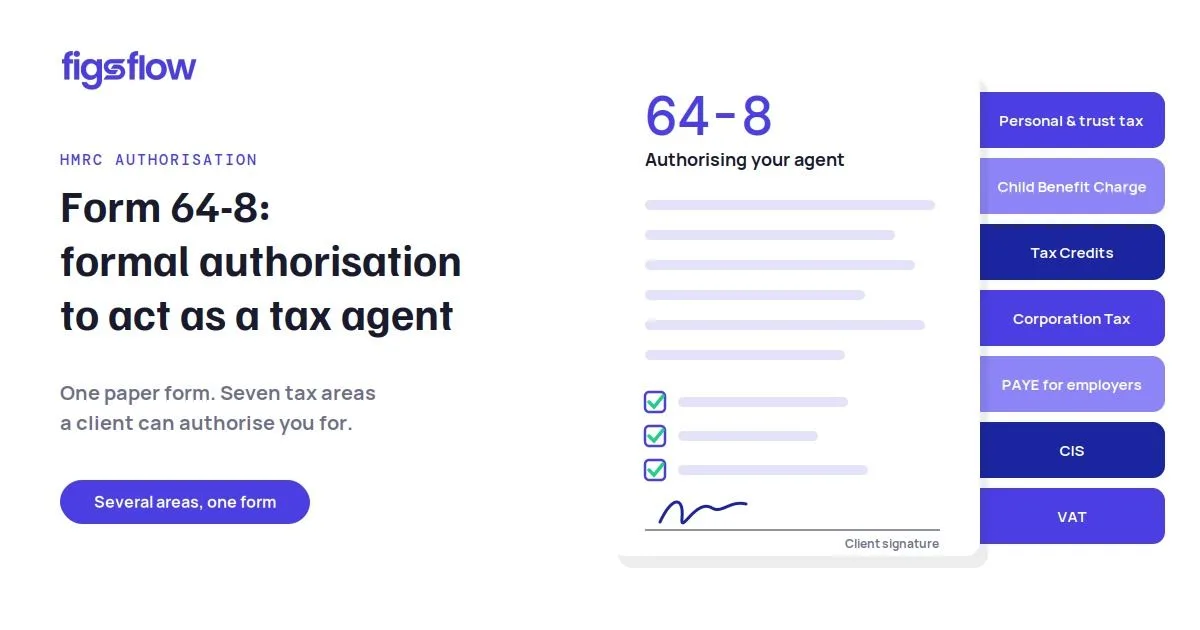
Form 64-8 Formal Authorisation to Act as a Tax Agent: An In-Depth Overview

Form 64-8 Formal Authorisation to Act as a Tax Agent: An In-Depth Overview Form 64-8 Formal Authorisation to Act as a Tax Agent: An In-Depth Overview The Importance of Formal Authorisation Understanding Form 64-8 Tax Areas Covered by Form 64-8 Multiple Authorisations on One Form Completing Form 64-8: Key Instructions & Best Practices Essential Guidelines When Completing the Form Special Considerations for Different Tax Matters Submitting Form 64-8 Maintaining Compliance: What Being Authorised Does & Doesn’t Mean Best Practices for a Smooth Authorisation Process Conclusion If you act as a tax agent or adviser, obtaining formal authorisation from your clients is a mandatory first step before dealing with HM Revenue & Customs (HMRC) on their behalf. This authorisation is a legal requirement that confirms your client’s consent for you to manage their tax affairs ranging from individual self-Assessment returns to more complex matters such as Corporation Tax, PAYE for employers, VAT, and even specific schemes like the Construction Industry Scheme (CIS). While many of HMRC’s authorisation processes can be completed online via HMRC Online Services, some situations require a paper-based approach. One of the most widely used paper methods is completing form 64-8. This comprehensive guide explains what Form 64-8 is, the types of tax matters it covers, and the correct process for completing and submitting it. Before delving into the details of form 64-8, it is important to understand why formal authorisation is necessary: Legal Consent The completed authorisation confirms that your client has explicitly given you permission to act on their behalf. This consent does not transfer any of your client’s legal obligations to you; it merely allows you to transact with HMRC for the client. Data Security & Privacy By following HMRC’s strict protocols, both the client’s and your own sensitive information remain secure. Using the correct form and process ensures that you remain compliant with HMRC’s data handling requirements. Streamlined Communication When authorisation is in place, HMRC can correspond with you directly about your client’s tax matters. This helps in reducing administrative delays and improves the efficiency of managing multiple tax regimes. Form 64-8 is a paper form used by HMRC for client authorisation when digital methods cannot be utilised or when a client prefers a paper-based process. This form is designed to cover a broad range of tax matters, making it a versatile tool in your authorisation toolkit. Your client can use form 64-8 to authorise you for several tax-related areas, including: Individual, Partnership & Trust Tax Affairs – This includes all aspects of individual Self Assessment, partnership accounts, and trust tax submissions. High Income Child Benefit Charge – Authorisations for requests to HMRC for information that helps calculate the High Income Child Benefit Charge can be completed using this form. Tax Credits – Although tax credits client authorisation must be submitted on form 64-8, it is important to note that HMRC continues to correspond directly with your client regarding their claim. Corporation Tax – Clients can grant you authority to handle their Corporation Tax matters. PAYE for Employers – If your client operates a PAYE scheme for their employees, form 64-8 allows you to manage these responsibilities. Construction Industry Scheme (CIS) – For contractors, authorisation to act on their behalf under the CIS must be noted clearly on the form or accompanied by a separate letter. VAT – This form also extends to authorisations concerning VAT matters. Clients have the convenience of authorising you for more than one subject within the same form. However, if your client requires authorisation for a specific area such as CIS, they must make a clear note on the form or attach an additional letter to indicate this. Correctly completing form 64-8 is crucial to avoid delays in processing and to ensure that HMRC accepts your client’s authorisation without issue. Follow these detailed instructions: Use the Correct Version – Ensure you are using the ‘Authorising your agent (64-8)’ version of the form. This is the specific version designed for authorisation purposes. Agent Code or Reference Number – Your client must enter your relevant agent code or reference number in the designated field. For example, in the ‘Agent code (SA)’ box, include the correct six-character code (e.g., 1111XX) for Self Assessment. Similar precise codes apply for other tax regimes, such as PAYE or VAT. Clarity & Accuracy – All information on the form must be typed or written clearly. Do not include additional comments or extraneous information in the form fields stick strictly to the requested data. No Extra Notations – Avoid adding a covering letter unless it contains essential information required to process the form. Any crucial details must be included on the form itself; do not write in the margins or add stray notes. Specific Instructions for CIS – If the authorisation includes the Construction Industry Scheme (CIS) for contractors, your client should clearly note this on the form or attach a separate letter. This ensures that HMRC recognises the additional scope of the authorisation. Tax Credits – For tax credits, your client must complete a form 64-8—there is no option to set up this authorisation online. Additionally, if the claim involves joint tax credits, both claimants must sign the same form. Personal Representatives – When dealing with the estate of a deceased person, personal representatives use form 64-8 to authorise you to manage individual PAYE, Self Assessment, or National Insurance affairs. The person completing the form must include: Their signature, name, and address. The deceased person’s National Insurance number or Unique Taxpayer Reference (UTR) in the appropriate section. Once your client has completed the form, it needs to be sent to the correct HMRC office. The destination depends on the specific tax service being authorised: Central Agent Authorisation Team – In most cases, the completed form should be sent to the Central Agent Authorisation Team at HMRC. Specialised Offices: Corporation Tax – If the authorisation is exclusively for Corporation Tax, send the form to the HMRC office responsible for Corporation Tax. High Net Worth Unit – If HMRC’s High Net Worth Unit deals with your client’s affairs, direct the form to that unit. Charity Matters – For charities, send the completed form to the Charities Correspondence Team. Trusts – For authorisations regarding a trust’s tax affairs, the form should be sent to the Trusts and Estates Team. R40 Form Repayment Claims – If the authorisation accompanies a claim for a R40 form repayment, send the form along with the claim to HMRC. By following these specific submission instructions, you help ensure that HMRC can process the authorisation quickly and accurately. It is important to understand that while being authorised as an agent enables you to act on behalf of your client with HMRC, it does not transfer any of the client’s legal obligations to you. You are still acting as their agent, which means: Client Responsibilities Remain – The ultimate responsibility for the tax affairs lies with your client. Your role is to assist and manage communications, but the legal liabilities remain theirs. Ongoing Communication – Even after authorisation, HMRC will continue to write to your client regarding certain tax matters, such as tax credits. However, you are also empowered to deal with HMRC directly in writing or via telephone. Record Keeping – It is crucial to maintain accurate records of all authorisations and communications. This not only helps in managing your client’s tax affairs but also ensures that you can provide evidence of authorisation if required. To minimise delays and avoid common pitfalls, here are several best practices for managing the authorisation process with form 64-8: Review Before Submission – Encourage your clients to double-check all information on the form before sending it to HMRC. Even minor errors can lead to processing delays. Clear Communication – Provide your clients with clear, step-by-step instructions on how to complete the form. This includes explaining where to enter your agent code and the importance of writing legibly. Timely Submission – Remind clients of the importance of sending the form to the correct HMRC office. If your client is unsure which office to use, consult HMRC’s latest guidance or reach out for clarification. Follow-Up – Once the form has been sent, follow up with HMRC if you do not receive confirmation of authorisation within the expected timeframe. This proactive approach helps ensure that any issues are resolved promptly. Digital Alternatives Where Possible – Although form 64-8 is widely used, if an online authorisation option is available for a particular tax service, consider encouraging your client to use the digital route. This is often faster and more secure. Formal authorisation through form 64-8 is a critical process for tax agents and advisers. It provides the necessary legal framework that allows you to interact with HMRC on your client’s behalf while ensuring that all parties’ rights and responsibilities are clearly defined. Whether dealing with individual tax affairs, Corporation Tax, PAYE, or specialised areas like the Construction Industry Scheme, correctly completing and submitting form 64-8 is essential for maintaining compliance and ensuring efficient communication with HMRC. By adhering to the detailed guidelines provided above—such as entering the correct agent codes, avoiding extraneous information, and sending the completed form to the appropriate HMRC office—you help safeguard both your client’s interests and your own professional standing. Remember, while authorisation enables you to act as an intermediary, the client’s legal obligations remain their responsibility. The Importance of Formal Authorisation Completing Form 64-8: Key Instructions & Best Practices form-64-8-tax-agent-authorization-guide form 64 8 tax agent authorization guide page Page

Diagram explaining different authorization options for dealing with HMRC.

3/3/2025

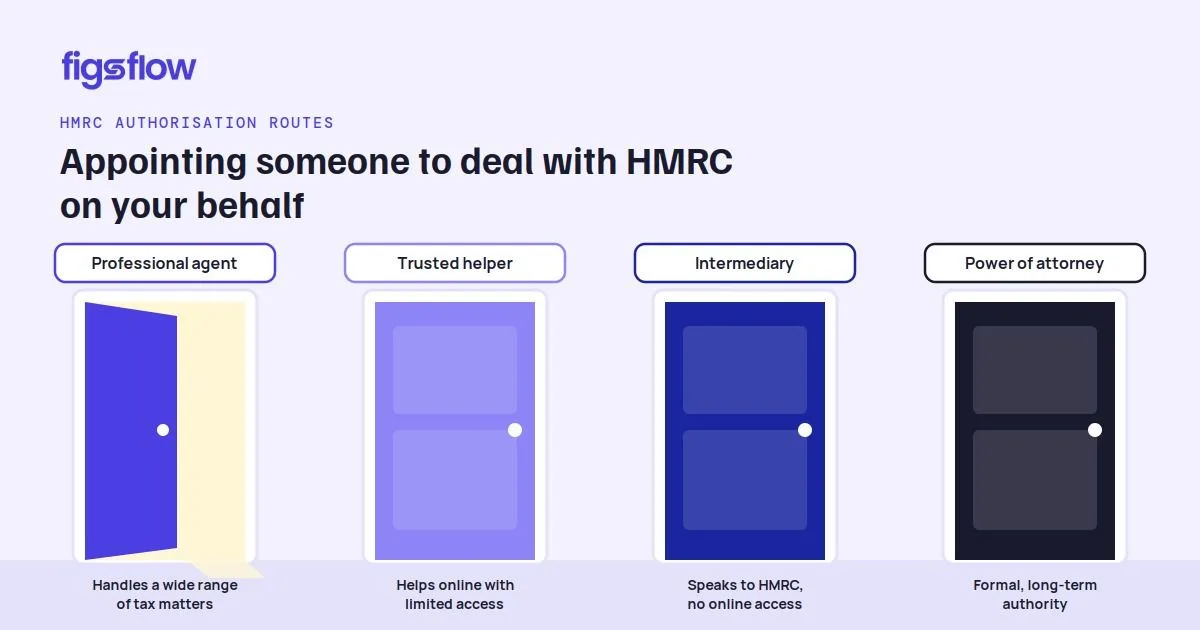
Appointing Someone to Deal with HMRC on Your Behalf: A Complete Guide

Appointing Someone to Deal with HMRC on Your Behalf: A Complete Guide Appointing Someone to Deal with HMRC on Your Behalf: A Complete Guide Authorising an Agent to Handle Your Tax Affairs Why Appoint a Professional Agent? How to Authorise Your Agent Authorising a Trusted Helper for Online Tax Management What Can a Trusted Helper Do? Limitations of a Trusted Helper Setting Up a Trusted Helper Authorising an Intermediary Role & Benefits of an Intermediary How to Authorise an Intermediary Granting Power of Attorney Over Your Tax Affairs Types of Power of Attorney Informing HMRC of the Power of Attorney Key Considerations When Appointing Someone Conclusion Frequently Asked Questions How do I register as an authorised agent with HMRC to act on behalf of clients? What are the differences between Form 64-8 and a professional agent authorisation via the HMRC online system? Can an accountant or tax adviser be granted power of attorney over a client’s tax affairs? Navigating the complexities of the UK tax system can be challenging, and many people choose to appoint someone, whether a professional or a trusted individual, to help manage their tax affairs with HM Revenue & Customs (HMRC). This guide explains the different ways you can authorise someone to act on your behalf. It covers options for appointing a professional agent, a trusted helper, or even setting up the power of attorney, ensuring that your tax matters are handled with the expertise and care you require. When dealing with complicated tax returns or ongoing tax matters, many individuals and businesses opt to appoint a professional agent. This can include accountants, tax advisers, or legal professionals who are experienced in dealing with HMRC. There are several reasons to appoint a professional agent. We have outlined a few major ones worth discussing below. Expertise & Experience Professional agents, such as chartered certified accountants and certified tax advisers, have the expertise to navigate the often-complex tax regulations. They keep up to date with changing tax laws and HMRC guidelines, ensuring that your tax returns are accurate and compliant. Efficiency in Communication A professional agent is authorised to handle communication directly with HMRC. This means that once you have authorised your agent, HMRC will send most correspondence (such as information regarding Self Assessment Tax Return) directly to them. This can reduce confusion and ensure that deadlines are met. Comprehensive Services Agents can deal with a variety of tax matters on your behalf from submitting your Self Assessment Tax Return to addressing issues related to Corporation Tax, VAT, or even more specialised areas such as Inheritance Tax and property transactions. Before you appoint a professional agent to manage your tax affairs, ensure that the individual or firm is registered with HMRC as an authorised agent. This is necessary to access all HMRC services. Learn how to complete the HMRC agent services registration in our detailed guide. To authorise an agent, you must provide explicit permission to HMRC. The process typically involves: Completing the Authorisation Form – Whether you are using an online method or a paper form, you need to complete the necessary documentation, such as a form 64-8 for Self Assessment and other tax services . Meeting HMRC’s Standard for Agents – Professional agents must meet specific standards set by HMRC including compliance with the anti-money laundering supervision details. This ensures that only qualified and reputable professionals are handling your tax affairs. Notification & Confirmation – Once the process is complete, HMRC will update their records so that your chosen agent can act on your behalf. It is important to note that while your agent may handle most communications, HMRC will continue to send certain items such as tax bills or refunds directly to you. Not every tax matter requires a professional agent. Sometimes, you may simply need someone you trust—a friend or relative—to help you manage your online tax account. This arrangement is known as appointing a “trusted helper.” A trusted helper can assist with various online tasks, including: Checking Income Tax – They can verify that you are paying the correct amount of Income Tax. Managing Your Personal Tax Account – They can check or update details within your personal tax account. Monitoring Taxable Benefits – Although their access is limited, they can view or update information related to taxable benefits such as company cars or medical insurance. Reviewing State Pension & National Insurance Records – They can help you keep track of your State Pension details and National Insurance record. It is important to understand that while a trusted helper can assist with many administrative tasks, they cannot submit your Self Assessment Tax Returns (This level of access remains solely your responsibility) and they cannot manage tax credits claims (Trusted helpers do not have the authority to manage your tax credits claims). To set up a trusted helper, your friend or relative must register to manage your tax online using the HMRC system. The system will limit their access to specific sections of your tax account, ensuring you maintain overall control of your tax affairs. But even with a trusted helper, you remain legally responsible for your own tax matters. For those who face additional challenges such as language barriers, disability, or prolonged illness appointing an intermediary can be a practical solution. An intermediary is a person or organisation that can help you interact with HMRC by answering questions and assisting with form completion. Assistance with Communication – An intermediary can speak with HMRC on your behalf and help you understand complex communications. Form Filling & Guidance – They assist in filling out forms correctly, ensuring that all required information is accurately provided. No Direct Access to Online Tax Accounts – Unlike a trusted helper, an intermediary will not have access to your tax online system. Their role is strictly supportive. To authorise an intermediary: Write to HMRC You must send a written letter to HMRC explaining that you wish to authorise an intermediary to deal with your tax matters. Include Essential Information The letter should contain your name, address, tax reference number (such as your Unique Taxpayer Reference or UTR), and the full details (name and address) of the intermediary. Sign the Letter Ensure that you sign the letter. If you are unable to sign, you may need to contact HMRC or arrange for someone else to sign on your behalf. The intermediary’s role is designed to offer extra support while keeping you in control of your sensitive tax information. For a more formal and long-term arrangement, you can grant someone power of attorney over your tax affairs. This legal mechanism gives the appointed person—or attorney—the authority to make decisions and act on your behalf in relation to tax matters. Lasting Power of Attorney (LPA) – An LPA is suitable if you want to allow someone to make decisions about your tax affairs in the event that you become unable to do so yourself. Once registered, the attorney can: Make tax decisions on your behalf. Assist you in making informed tax decisions. Property & Financial Affairs Deputyship – If you have not arranged an LPA and later become incapable of managing your affairs, another person can apply to be your deputy. Once appointed, they can manage your tax matters among other financial responsibilities. Once you have set up a power of attorney, it is essential to inform HMRC so they can update their records: By Phone – If the LPA was registered on or after 1 January 2016 in England or Wales, the appointed attorney can call HMRC. They must sign in to their LPA online account to obtain an access code—this 13-character code (starting with a V, e.g., V-AB12-CD34-EF56) verifies the LPA’s validity. By Post – Alternatively, the attorney can send either an original or a certified copy of the LPA to HMRC. For different tax affairs, there are specific addresses: For tax credits management, send to Tax Credit Office, IAA Team 2, Area E, St Mark’s House, St Mary’s Street, Preston, PR1 4AT . For other tax matters, For UK-based management, send to Pay As You Earn and Self Assessment, HMRC, BX9 1AS, United Kingdom . For agents outside the UK, send to HMRC, Benton Park View, Newcastle Upon Tyne, NE98 1ZZ . Once HMRC has confirmed the power of attorney, the appointed attorney will be able to manage your tax affairs, though you remain legally responsible for your overall tax position. Before you appoint someone to act on your behalf, consider the following key points: Clarity of Role & Authority – Be clear about what authority you are granting. Is it for a one-off situation, a specific task, or ongoing management of your tax affairs? The scope of their role should be well-defined to avoid confusion. Trust & Reliability – Whether appointing a professional agent or a friend, the person must be trustworthy. For agents, this means ensuring they meet HMRC’s standard for agents. For friends or relatives, it means choosing someone who is reliable and understands the sensitivity of your financial information. Legal & Compliance Implications – Remember, even if someone is authorised to act on your behalf, you remain legally responsible for your tax affairs. This is particularly important when granting power of attorney. Communication with HMRC – Maintain clear lines of communication. While authorised representatives can handle many interactions with HMRC, ensure you are kept informed of all significant decisions or correspondence. Alongside appointing a professional agent, it’s essential to use HMRC-approved MTD software for seamless tax submissions. Explore these free MTD-compliant software options that can help you and your appointed agent manage tax returns and other services. Appointing someone to deal with HMRC on your behalf can be a smart move, whether you require professional expertise, need extra support, or face personal challenges in managing your tax affairs. By understanding the various options available, authorising a professional agent, appointing a trusted helper or intermediary, or granting power of attorney, you can choose the solution that best fits your needs. Each method has its benefits and limitations. Professional agents are ideal for complex tax matters and long-term management, while trusted helpers and intermediaries offer more limited support for routine tasks or when facing language or accessibility barriers. For more formal or enduring arrangements, the power of attorney ensures that someone you trust can step in decisively if you are ever unable to manage your own affairs. Whether you opt for a professional agent, a trusted helper, or establish the power of attorney, being proactive about your tax management can provide peace of mind and allow you to maintain full control over your financial affairs. This comprehensive approach not only simplifies the process but also builds a more resilient framework for managing your taxes now and into the future. To register as an authorised agent with HMRC, you need to set up an Agent Services Account (ASA) through HMRC’s online portal. During registration, you will be required to provide details such as your Self Assessment Unique Taxpayer Reference (UTR), VAT registration number (if applicable), and information about your anti-money laundering supervision. Once your ASA is established, you can link existing client authorisations or initiate new ones to manage their tax affairs. Form 64-8 is a paper-based authorisation allowing agents to handle specific tax matters on behalf of clients. In contrast, the online agent authorisation system enables digital authorisation through the Agent Services Account, facilitating quicker access to a broader range of HMRC services, including those under Making Tax Digital (MTD). The online method is generally faster and more efficient, while Form 64-8 serves as an alternative when digital authorisation is not feasible. Yes, an accountant or tax adviser can be granted power of attorney (PoA) over a client’s tax affairs. This involves the client completing a legal document, such as a Lasting Power of Attorney (LPA) for property and financial affairs, and registering it with the Office of the Public Guardian. Once registered, HMRC must be notified to allow the agent to act on the client’s behalf. It is important to note that even with an LPA, the client remains legally responsible for their tax obligations. DEAL WITH THE HMRC appointing-someone-to-deal-with-hmrc-guide appointing someone to deal with hmrc guide page Page

An infographic outlining supplementary AML guidance for tax advisers.

2/28/2025

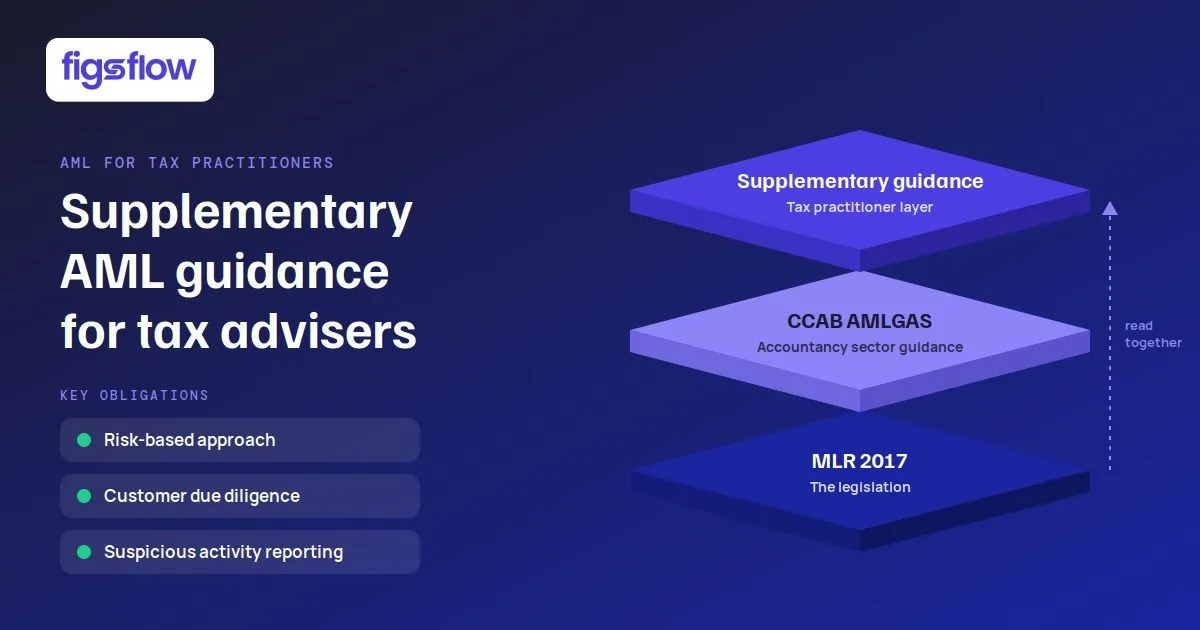
Supplementary Anti Money Laundering Guidance for Tax Advisers

Supplementary Anti Money Laundering Guidance for Tax Advisers Supplementary Anti Money Laundering Guidance for Tax Advisers Introduction & Scope Regulatory Framework & Key Obligations Money Laundering Risks & Anti Money Laundering Checks in the Tax Sector Customer Due Diligence & Reporting Requirements The Privilege Reporting Exemption Tax Offences: Direct & Indirect Guidance on Specific Circumstances Conclusion The Money Laundering, Terrorist Financing and Transfer of Funds (Information on the Payer) Regulations 2017 ( MLR 2017 ) uses the term ‘tax adviser’ and defines a tax adviser as: ‘a firm or sole practitioner who by way of business provides advice about the tax affairs of other persons, when providing such services. The meaning of ‘advice’ is widely interpreted. Tax compliance services, i.e. assisting in the completion and submission of tax returns, are included within the term. The Supplementary Anti Money Laundering Guidance for Tax Practitioners, hereinafter referred to as “guidance” has been prepared to help tax advisers comply with their obligations under UK legislation to prevent, recognise and report money laundering. The provision of the supplementary guidance is not standalone guidance. It must be read in conjunction with the Consultative Committee of Accountancy Bodies (CCAB’s) Anti Money Laundering Guidance for the Accountancy Sector (AMLGAS). The guidance outlines essential regulatory requirements, risk management strategies, and procedural steps to counter money laundering and terrorist financing within the tax services domain. This guidance that discusses money laundering offences and anti money laundering checks is designed for professionals providing tax services covering direct and indirect taxes. It emphasises that even routine tax compliance activities, including preparing and submitting returns, can fall within the regulatory perimeter if they are conducted as part of a business. Notably, the absence of remuneration does not automatically exclude an activity from being subject to AML controls, underscoring the importance of applying consistent due diligence regardless of client type or service nature. Tax advisers must operate in accordance with MLR 2017 and the Proceeds of Crime Act 2002 (POCA). The guidance sets out the following obligations: Risk-Based Approach & Oversight Tax advisers must proactively assess and manage money laundering risks, aligning regulatory mandates and professional ethical guidelines. Customer Due Diligence (CDD) Robust CDD processes are emphasised. This includes verifying client identity, understanding beneficial ownership, and, where necessary, undertaking due diligence on clients referred to by other professional firms. Suspicious Activity Reporting (SAR) SAR is a critical component of the AML regime whereby tax advisers must report any money laundering or tax evasion suspicions to the appropriate authorities, barring circumstances covered by the privilege reporting exemption. These obligations are intended to ensure compliance and prevent tax advisers from inadvertently facilitating criminal activities through their advisory roles. The guidance identifies several risk areas inherent in tax practice, including: Client Misconduct This includes the instances where clients may deliberately under-report income, overstate expenses, or refuse to correct known errors—all actions that might generate proceeds of crime. Complex International Structures Complex International Structures includes cases involving clients with multi-jurisdictional tax affairs or those employing offshore structures, where the opacity of beneficial ownership can mask criminal proceeds. Tax Planning Schemes This includes situations where aggressive tax planning might border on facilitating tax evasion. Tax advisers must exercise careful judgment to differentiate between legitimate tax planning and schemes with criminal elements. This detailed risk assessment framework helps tax advisers to identify, evaluate, and manage potential money laundering vulnerabilities in their client engagements. The document provides comprehensive guidance on the importance of CDD, stressing that tax advisers must establish clear client relationships. Where they advise other professionals, the same level of scrutiny applies to ensure that no steps are overlooked. Moreover, the responsibility to file a Suspicious Activity Report (SAR) is emphasised, especially when there is reasonable suspicion of tax evasion or money laundering—even in cases where the suspected amounts are minimal. The guidance also cautions against “tipping off” clients once a SAR has been made to avoid compromising any ensuing investigations. All this is vital to ensure we are not unintentionally being a part of any money laundering offences. A nuanced aspect of the AML framework addressed in the guidance is the privilege reporting exemption. This exemption applies primarily to scenarios where information is received under privileged circumstances, such as during the provision of legal or tax advice. However, the guidance also describes the limits of this exemption, particularly highlighting that it does not extend to situations where the information is intended to further a criminal purpose (the so-called crime/fraud exception). Clear examples illustrate when exemption applies and when it does not, thereby assisting tax advisers in making informed decisions about their reporting obligations. The guidance details various tax offences that may trigger reporting requirements. These include: Direct Tax Offences Indirect Tax Offences Direct tax offences include fraudulent conduct such as deliberate false returns or the intentional understatement of tax liabilities. Only conduct that involves deliberate or fraudulent activity qualifies for reporting under POCA. Furthermore, where conduct may attract a civil penalty under the tax legislation but may also, on the particular facts, amount to criminal conduct, then the conduct is criminal, and should therefore be reported. Indirect tax offences include errors in areas such as VAT declarations, where even innocent mistakes may carry criminal implications under strict liability provisions. The guidance clarifies that while some mistakes might be resolved through subsequent adjustments, persistent or intentional errors necessitate a SAR. By distinguishing between the types of money laundering offences, the guidance aids tax advisers in assessing whether a client’s actions constitute a reportable criminal offense or a rectifiable error. Tax advisers must adhere to their professional body’s established ethical guidelines such as those outlined in professional conduct in relation to taxation to encourage client compliance with the law. If a client’s intentions remain uncertain, the practitioner should carefully evaluate whether to commence or continue the engagement and determine if there is an obligation to file a Suspicious Activity Report (SAR) or notify their Money Laundering Reporting Officer (MLRO) upon suspecting money laundering. Practical scenarios are presented to help tax advisers navigate common dilemmas, including: Innocent or Negligent Errors Tax advisers need to differentiate between genuine mistakes and intentional understatements. No suspicion is formed if a tax adviser believes the errors resulted from an innocent mistake or oversight. However, if there is reason to suspect that the error or omission was deliberate, a SAR should be filed unless the privilege reporting exemption applies. Client Refusal to Disclose When a client expresses unwillingness or outright refusal to disclose the matter to HMRC to avoid paying the tax due, it indicates that the client has likely formed criminal intent, thereby triggering the reporting obligation unless the privilege reporting exemption applies. Adjustment of Subsequent Returns The legislation covers any activity that launders proceeds from a criminal offence, regardless of the amount involved. However, if the law permits the correction of minor errors through subsequent tax adjustments and if the original error was not due to criminal conduct, then such adjustments do not trigger a reporting requirement, as no crime has been committed. Disclosures under HMRC’s Facilities When a potential or current client requests that a practitioner assist with making a disclosure to HMRC under the applicable procedures, suspicions of tax evasion may often but not invariably arise. Tax practitioners must understand that notifying HMRC does not substitute for reporting to the National Crime Agency (NCA). When there are reasonable grounds to suspect that tax has been deliberately left unpaid when due, a report must be made to the NCA without delay. These specific guidelines are designed to support tax advisers in making consistent, legally compliant decisions in varied and often complex situations. The supplementary guidance provides a vital resource for tax advisers, offering clear and detailed advice on how to comply with AML regulations while managing the inherent risks in tax practice. By integrating robust customer due diligence, clear reporting protocols, and a careful interpretation of privilege and legal exemptions, the guidance equips tax advisers to act ethically and responsibly. Ultimately, it reinforces the importance of balancing client service with regulatory compliance, ensuring that tax professionals do not inadvertently contribute to money laundering or terrorist financing activities. Readers are encouraged to consult the full guidance document for a deeper understanding of the detailed provisions and illustrative examples. Customer Due Diligence & Reporting Requirements supplementary-anti-money-laundering-guidance-for-tax-advisers supplementary anti money laundering guidance for tax advisers page Page

Your privacy choices

We use cookies to improve site performance, remember preferences, and measure marketing effectiveness. You can accept all cookies, reject non-essential ones, or choose categories.