
How to Write a Follow-Up Email After No Response (Free Templates)
Follow-up email templates for UK accountants after no response. Covers proposals, unsigned engagement letters, and hesitant clients - with timing guidance.
You sent the proposal. Or you sent the engagement letter after a call where they seemed genuinely ready to go. Days passed. Nothing.
So you followed up. Still nothing.
Now you're second-guessing everything. Was it the timing? The subject line? Did you come across as too eager, or not eager enough? Is there something every other accountant knows about following up that nobody told you?
This post is your answer to all of it. One complete guide to writing follow-up emails that actually get a response, showing you how to make your messages feel valued and appreciated, with templates written for the three specific situations you're most likely to be in right now.
Sounds good? Let's start.
A follow-up email after no response is a short, purposeful message sent to a prospect or client who has not replied to a previous email. For UK accounting firms, follow-up emails most commonly arise after sending a proposal, an unsigned engagement letter, or a revised service package situations where a response is required before work can begin.
Why Clients Go Quiet (& What It Usually Means)
Clients go quiet for dozens of reasons. You don't need to know all of them. You just need to know the ones that actually affect what you do next.
They Forgot
Your email arrived on a busy afternoon, got buried under twelve others, and never came back up. These clients aren't avoiding you. They just need a warm nudge at the right time. One well-timed follow-up email and you're back in the conversation.
Something Gave Them Pause
Maybe the price landed differently on paper than it did on the call. Maybe they left the discovery call with a doubt they couldn't quite name. These clients aren't gone either, but a generic “just checking in” email won't reach them. What they need is an opening to say the thing they haven't said yet.
They've Moved On
They found another firm, or decided they don't need the service right now, and they're doing what most people do in that situation: saying nothing and hoping the thread dies quietly. You can't win these back with a follow-up email. But you can follow up two or three times, close the loop professionally, and keep them in a nurture sequence. People switch accountants. When they're ready to move again, you want to be the first name that comes to mind.
Knowing which of these three you're dealing with changes everything about how you follow up. That's what the rest of this post is for.
Scenario 1: You Sent a Proposal & Heard Nothing
Most prospects talk to two or three firms before they decide. They’re comparing pricing, service offerings, and how well each firm guides them through the process. That’s the most likely reason your proposal hasn’t come back.
That said, it's just as possible they genuinely forgot, or that one well-timed follow-up email is all it takes to edge ahead. You won't know until you try. That's why you follow up: two to three times, spaced out enough not to feel like pressure, but close enough to keep the conversation alive.
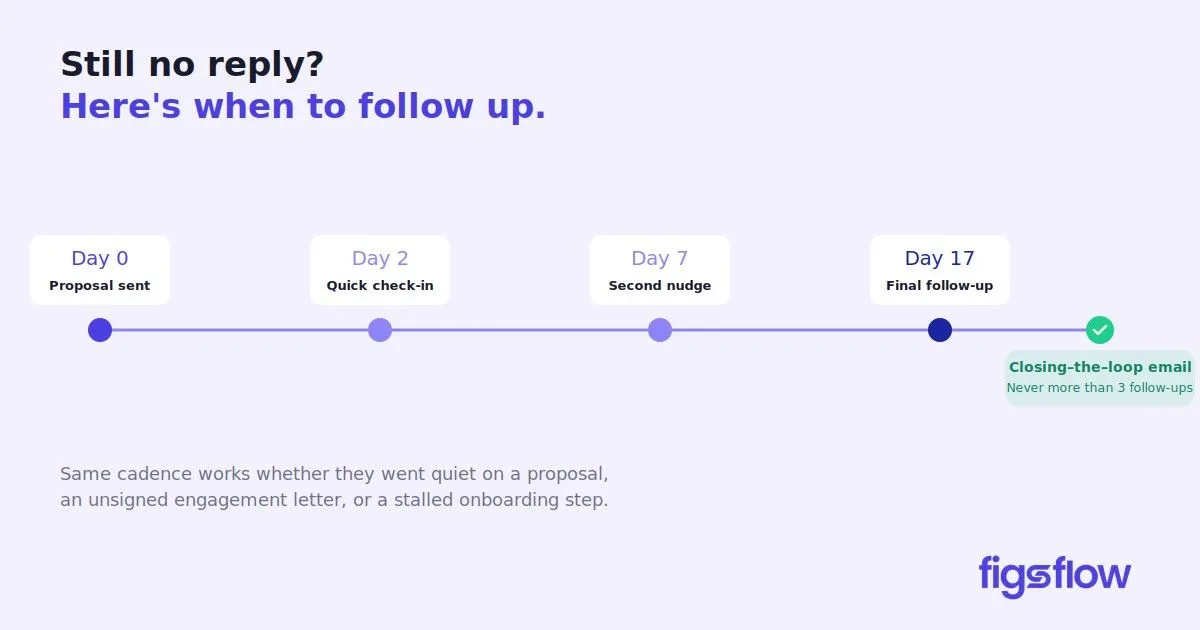
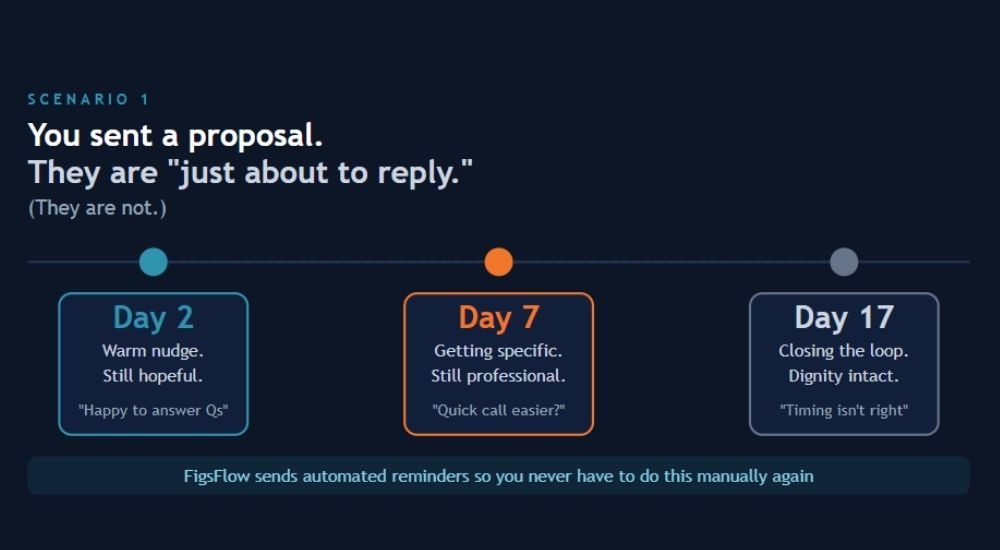
A good default cadence is two days after sending, seven days after that, and seventeen days after that. Adjust based on your service type or any statutory deadline in play.
Here are templates for each of those touchpoints.
Follow-up Email 1: Day 2
Subject: Re: Proposal for [Client Name]
Hi [Name],
Just checking in on the proposal I sent over on [day]. Happy to answer any questions if anything needs clarifying before you make a decision.
If it's easier to talk through the services or pricing on a quick call, just reply and we'll find a time.
[Your name]
Follow-up Email 2: Day 7
Subject: Quick question about the proposal
Hi [Name],
Still happy to help with [specific service] and wanted to check if anything in the proposal raised a question I can answer.
Would a short call be easier than going back and forth on email?
[Your name]
Follow-up Email 3: Day 17
Subject: Following up one last time
Hi [Name],
I haven't heard back since I sent the proposal, so I'll assume the timing isn't right at the moment. No problem at all.
If anything changes, just get in touch. I'll keep your details on file.
[Your name]
Scenario 2: They Agreed on the Call But Haven't Signed the Engagement Letter
There are a few reasons this happens. They forgot, which is the most common. The e-signature process gave them friction and they quietly dropped it. Or they've since decided to go elsewhere and haven't said so yet.
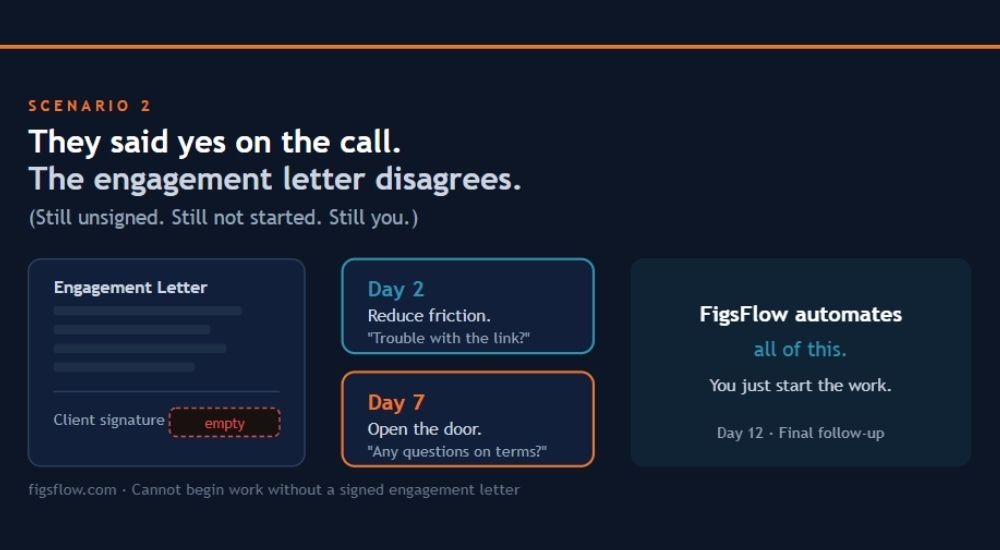
Since they already agreed on the call, your follow-up email has one job: reduce whatever friction is sitting between them and the signature, and do it quickly. The longer you leave it, the colder it gets.
Below are sample templates for each follow-up.
Follow-up Email 1: Day 2
Subject: Engagement letter for [Client Name]
Hi [Name],
Just checking in on the engagement letter I sent on [day]. Once that's signed, I can get everything set up, and we can get started.
If you're having any trouble with the signing process or anything looks unclear, just let me know.
[Your name]
Follow-up Email 2: Day 7
Subject: Any questions on the engagement letter?
Hi [Name],
A quick nudge on the engagement letter. If anything in the terms has raised a question, or the signing link isn't working, just reply, and we'll get it sorted.
[Your name]
Follow-up Email 3: Day 12
Subject: Re: Engagement letter
Hi [Name],
Still haven't heard back on the engagement letter. Can you let me know where things stand? Even a brief reply helps.
[Your name]
Scenario 3: They've Gone Quiet Over Something in the Package
You can usually spot this one before the silence even starts. There was a moment on the discovery call where they hesitated. Maybe the price came up and they went quiet for a beat. Maybe they questioned whether they needed a particular service. You moved past it, they seemed fine by the end of the call, but the hesitation was there.
These clients don't need a nudge. They need an opening. Your follow-up email has to invite them to say the thing they didn't say on the call, directly and without making it awkward.
Below are follow up email templates that does exactly that.
Follow-up Email 1: Day 2
Subject: A quick question about the proposal
Hi [Name],
Just checking in on the proposal I sent over. If anything in there doesn't quite match what you were expecting, whether that's the scope, the price, or something else, it's worth a quick conversation rather than leaving it hanging.
What's on your mind?
[Your name]
Follow-up Email 2: Day 7
Subject: Worth a quick call?
Hi [Name],
I've followed up a couple of times and haven't heard back. I don't want to assume you're not interested when it might just be that something needs a conversation.
Would ten minutes this week help? I'm flexible on timing.
[Your name]
Follow-up Email 2: Day 7
Subject: One last question
Hi [Name],
I've reached out a few times without hearing back. Before I close this off, is there something specific about the proposal I can address?
Even a quick reply helps me understand where things stand.
[Your name]
How Long Should You Wait Before Following Up? (Timing Guide)
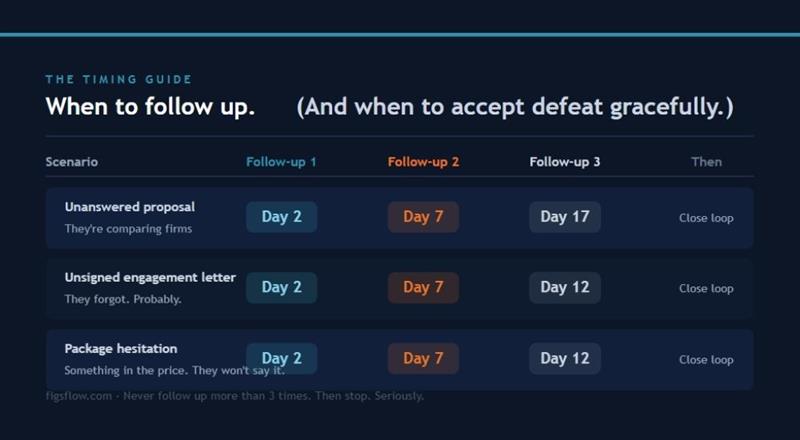
Different situations call for different pacing. Here's a quick reference:
| Scenario | Follow-up 1 | Follow-up 2 | Follow-up 3 |
|---|---|---|---|
| Unanswered Proposal | Day 2 | Day 7 | Day 17 |
| Unsigned Engagement Letter | Day 2 | Day 7 | Day 12 |
| Package Hesitation | Day 2 | Day 7 | Day 12 |
Never follow up more than three times before you move to the closing email. Beyond that, you're not helping the relationship.
The Closing-the-Loop Email
At some point, another follow-up stops helping. If you've sent your follow-up emails across any of the three scenarios and still heard nothing, send one final email. Then stop.
The goal isn't to guilt them into responding. It's to end the thread cleanly, leave a good impression, and make it easy for them to come back if things change.
Closing-the-Loop Email
Subject: Closing the loop
Hi [Name],
I haven't heard back after a few messages, so I'll assume the timing isn't right at the moment. I won't keep following up.
If things change and you'd like to revisit, just get in touch.
If you'd like to stay updated on [service area] or hear from us occasionally, subscribe to our newsletter here: [link].
[Your name]
Conclusion
Different situations call for different follow-up emails. An unanswered proposal needs a structured nudge. An unsigned engagement letter needs a tighter cadence. A client who hesitated on the call needs an opening, not a reminder. Get that right and replies come in. Proposals get signed. Clients move forward.
But the follow-up email is a symptom, not the problem. The real issue is friction – in how the proposal was built, how the engagement letter was sent, and whether signing it required effort the client didn't expect. Fix that friction and the follow-ups become unnecessary.
Built for UK accounting practices
Stop chasing clients. FigsFlow follows up for you.
Proposals, engagement letters and e-signatures in one workflow. The automated reminder system follows up on unsigned documents so nothing slips through.