
Not as Cheap as It Looks: The Hidden Costs of AML Software Pricing
AML software pricing rarely stops at the advertised per-check rate. See how subscriptions, credit minimums and add-ons shape your true annual spend.

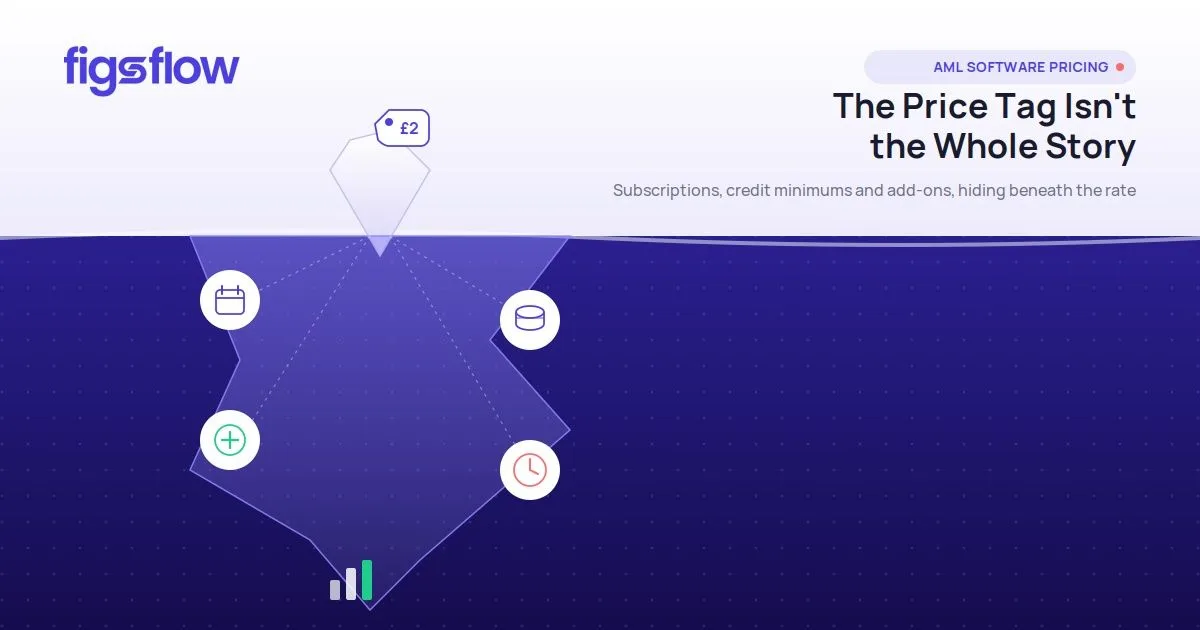
Most AML software platforms advertise a per-check rate. That rate looks reasonable. It is rarely what you pay.
For firms carrying out a modest number of checks each month, the difference between the advertised price and the actual monthly cost can be considerable. Mandatory subscriptions, bulk credit purchases, and per-check add-ons often sit between the headline rate and what you ultimately pay.
Most firms only realise this after they've committed to a platform.
In this guide, we'll break down how AML software pricing really works, explain each cost layer you should factor in, and compare what firms actually pay across different AML providers.
AML Software Pricing: The Per-Check Rate Is Not the Real Price
A platform might advertise £2 per check or £2.63 per ID verification. Those figures are accurate in isolation. They are not the figure that appears on your monthly statement.
The per-check rate tells you the cost of one action within the platform. It does not tell you what you must spend before you can run that action, how many credits you are required to purchase upfront, whether those credits expire, or what additional subscription fee sits underneath the whole structure.
For lower-volume firms, these surrounding costs matter far more than the rate itself. A firm running 25 checks a month at £2.63 per check should expect a checks-only cost of around £65.75. The actual monthly commitment on several platforms is materially higher than that once all layers are counted.
How Bulk Credit Models Work & What They Actually Cost Upfront
Most platforms require you to buy credits in bulk before running a single check, and many add a monthly subscription fee on top. The minimum credit commitment varies widely. Some tools require hundreds of pounds upfront before you can get started. Others set a lower credit minimum but cap how many checks or assessments you can run per month on cheaper tiers, pushing you onto a pricier subscription than you need. Credits on most platforms also expire, so buying more than you use is not a safe option either. The result is that your actual monthly outlay often has two moving parts, the subscription and the credits, neither of which is obvious from the headline per-check rate.
What 30 Checks Per Month Actually Costs Across Four Platforms
The table below uses 30 individual client checks per month, each requiring a standard electronic identity verification with PEP and sanctions screening. No biometric or enhanced due diligence checks are included. Each firm is on the entry or lowest qualifying tier. All figures exclude VAT.
Platform-by-Platform Cost Breakdown
| Platform | Monthly Fee | Minimum Credit Pack | Can You Buy Just 30 Checks? | What You Actually Pay |
|---|---|---|---|---|
| FigsFlow (PAYG) | £0 | £30.00 (10 check min) | Yes | £90.00 |
| FigsFlow (£8 plan) | £8.00 | £21.00 (10 check min) | Yes | £71.00 |
| GoProposal AML Standard | £60.00 | Variable | Yes (up to 50 assessments) | £60.00 min + checks |
| Xama (Core) | £13.00 | £141.90 (30 checks) | Yes | £154.90 |
| BrightManager | Varies | £670.00 (500 check min) | No. 500 minimum. | £670.00 + sub |
Did You Know?
FigsFlow bundles identity validation, PEP screening, sanctions checks, liveness verification, and Companies House verification into a single per-check price. On platforms that charge each of these separately, those same five checks per client can cost between £8 and £15 combined.
How to Calculate Your True Annual AML Spend Before You Commit

Before committing to any AML platform, run the following calculation using your own firm's numbers.
- Step 1- Calculate Annual Onboarding Cost: Take your average monthly new client onboardings and multiply by the full per-client check cost on the platform, including every check type required for standard customer due diligence. Multiply by 12.
- Step 2- Add Annual Platform Subscription: Take the monthly subscription fee and multiply by 12. If the platform charges a per-client monitoring subscription, multiply that rate by your total active client count and add it here.
- Step 3- Add Ongoing Monitoring Costs: On credit-based platforms, multiply your total monitored client count by the annual monitoring credit cost per client. This figure rarely appears on the pricing page. Ask for it before you sign up.
- Step 4- Add Enhanced Due Diligence Charges: Identify your approximate proportion of higher-risk clients. Multiply by the per-event enhanced due diligence charge on that platform.
- Step 5- Total It Up: Add all four figures. That is your true annual AML spend. Compare it across platforms on this basis, not on the advertised per-check rate alone.
How FigsFlow Prices AML Differently
Not every platform requires a large upfront credit commitment to get started. The minimum entry point matters as much as the per-check rate, particularly for firms whose check volume fluctuates month to month.
FigsFlow requires a minimum purchase of 10 credits to run checks. At £3 per check on the basic plan, that is a minimum entry of £30 excluding VAT. There is no monthly subscription on the basic plan. A firm running 10 checks one month and 25 the next pays only for what it uses, with no obligation to purchase beyond the 10 credit minimum.
The basic plan includes client ID verification, Companies House verification, face match and liveness, PEP and sanctions screening, Amberhill checks, and address verification in that single per-check fee. These are not separate events billed individually.
The AML ID Verification and Risk Assessment plan reduces the per-check cost to £2.10 excluding VAT with a fixed monthly fee of £8 plus VAT. This tier adds client due diligence, client risk assessments, enhanced due diligence, and firm-wide risk assessments. At 25 checks per month, the total monthly cost on this plan is £60.50 excluding VAT, with nothing charged on top.
FigsFlow offers a 30-day free trial with no credit card required. You can start at figsflow.com. For a closer look at what a single check actually verifies, see our guide on what AML verification covers, or work out your likely spend with our breakdown of how much an AML check costs in the UK.
Conclusion
AML software pricing is almost never as simple as the per-check rate suggests. Subscriptions, credit minimums, itemised check events, and ongoing monitoring fees all contribute to a monthly total that can be two or three times the advertised figure.
A firm that selects a platform based on the headline rate without modelling the full annual cost will pay more than it budgeted and discover the gap too late to switch without disruption.
Run the full cost calculation before you commit. The platform that looks cheapest on the pricing page is rarely the cheapest in practice.