
Bookkeeping Pricing Made Easy for UK Accountants (2026)
Bookkeeping pricing does not have to make you sweat. FigsFlow calculates accurate fees in seconds based on your client's actual figures.

Bookkeeping pricing presents genuine difficulty. No two clients share identical needs, and their requirements diverge substantially. This reality alone causes experienced practitioners to dread pricing conversations.
During a FigsFlow demonstration, one bookkeeper captured the challenge perfectly: “every time a prospect asked about pricing on a discovery call, it made them sweat.” The article suggests this experience is widespread.
Most bookkeepers possess deep technical expertise, yet pricing discussions remain uniquely uncomfortable. When prospects ask “what would you charge for this?” seasoned professionals struggle to respond confidently.
Why Bookkeeping Pricing Feels So Uncomfortable
Multiple variables interact simultaneously during pricing assessment:
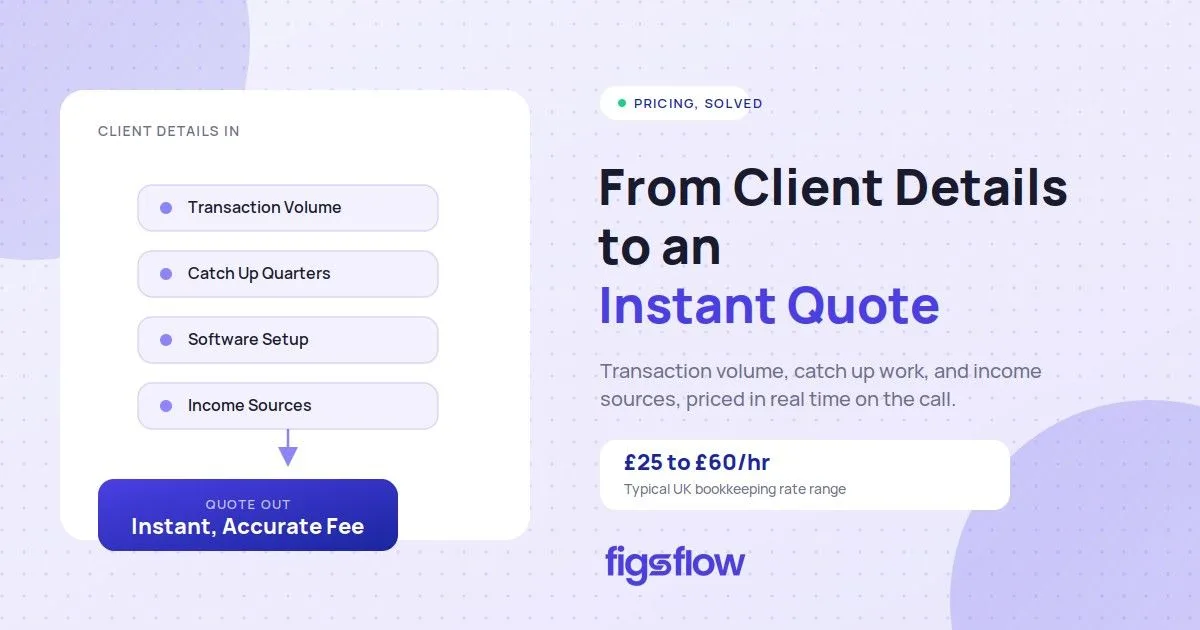
- Transaction volume fundamentally changes the engagement scope
- Catch up work introduces a separate complexity layer entirely
- Software setup represents one-off costs requiring separation from recurring fees
- Multiple income sources compound complexity beyond standard bookkeeping
- Existing record quality alters the entire engagement before work begins
Most bookkeepers handle this through three approaches: quoting ranges to gain time, offering inaccurate ballpark figures, or promising written follow-up (which loses conversational momentum). None projects the confidence that converts prospects into signed clients.
The core problem: “bookkeeping pricing was never designed to be figured out on the spot.” Practitioners understand the work itself thoroughly but lack systematized pricing that delivers accurate figures instantly during conversations.
What Actually Drives the Cost of Bookkeeping Work
Accurate pricing requires understanding every variable feeding into the final number:
Transaction Volume: The obvious starting point but “rarily the whole story.” A client with 200 monthly transactions differs fundamentally from one with 40, despite identical service descriptions on paper.
Beyond transaction volume, several other variables are easy to overlook when quoting on the spot.
Catch Up Work: An entirely separate cost that should never bundle into ongoing monthly fees—though it almost always does, silently absorbed because initial relationship conversations feel awkward. This “should be priced separately, presented clearly, and agreed before anything is signed.” See our guide on how to price catch-up work for new clients for a step-by-step approach.
Multiple Income Sources: Property income, dividends, capital gains—each layer adds complexity the standard fee never covered. These require individual accounting.
Quality of Existing Records: The state of handed-over materials changes engagement scope before work starts. “Clean records and a complete mess are not the same engagement, even if the ongoing service looks the same from the outside.”
A pricing approach omitting these variables constitutes “not really a pricing system. It is a starting point that gets adjusted by feel every single time, differently, by whoever is doing the quoting that day.”
How FigsFlow Prices Bookkeeping Services (and Helps You Send Proposals Faster)
FigsFlow enables building pricing structure once using an advanced pricing calculator. Practitioners define parameters actually driving work costs:
- Transaction volume as numerical input
- Quarters behind as separate numerical input
- Software setup as options selection
- Income sources as additions feeding into the formula automatically
Each parameter connects to a visual formula built once. The calculator produces final fees in real time based on those inputs, every single time thereafter.
Catch-up fees deserve specific mention as “the part of bookkeeping pricing that causes the most friction and the most lost margin.” FigsFlow pre-configures catch-up fees within the service. Indicating catch-up work applies and inputting quarters behind adjusts fees automatically. This appears in proposals as “a clearly labelled, separately calculated figure. Not a surprise on the invoice. Not a conversation you have to have after the work is done.”
Once configured, every bookkeeping proposal the team generates uses identical pricing logic. “The system prices it. You present it.” This is also what lets firms send bookkeeping proposals faster without re-keying figures for every new client.
What Happens on the Discovery Call Now
The discovery call remains the same—prospect asks what you charge—but FigsFlow changes the dynamic.
Practitioners ask:
- Transaction volume
- Any backlog
- Software in use
- Additional income sources
As prospects answer, practitioners input information. The pricing calculator updates in real time. Waiting until call completion becomes unnecessary.
Practitioners can then state: “based on what you have told me, you are looking at somewhere between this and that. Once you send over the exact figures, we will get you a formal proposal with the precise breakdown. And if you are ready to move forward today, we can look at what we can do on the fees.”
This moment transforms the interaction. Practitioners avoid guessing or stalling while giving genuine numbers in real time, keeping prospects engaged with reason to return quickly. Once details confirm, proposals and engagement letters dispatch the same day. Clients sign from phones. No friction, no chasing, no momentum loss.
Consistency Across Your Team
A quieter benefit matters increasingly as practices expand. When pricing lives within individual practitioners’ knowledge, it departs with them.
Standardising bookkeeping pricing protects margins every time proposals go out. A senior bookkeeper pricing by instinct for ten years carries knowledge personally. When they take leave or move on, junior staff guess. Inconsistency emerges. Clients comparing quotes start recognizing discrepancies. Margin disappears through hard-to-trace mechanisms.
FigsFlow “puts the pricing logic in the platform, not in a person. Every team member generates proposals using the same formula. New staff do not need to learn a spreadsheet built by someone who no longer works there.” Pricing remains consistent, documented, and accessible with appropriate permissions.
This represents “not just an operational improvement. It is a risk reduction.”
From Signed Proposal to Recurring Payment
Bookkeeping constitutes recurring service, making post-signature events particularly important.
Once bookkeeping proposals gain acceptance and engagement letters receive signatures, FigsFlow continues the client journey within the same platform. AML checks, KYC verification, and risk assessment follow automatically. Invoicing connects through QuickBooks, Xero, GoCardless, or Adafin. Recurring payment schedules for monthly bookkeeping fees establish without manual intervention.
The pricing wasn’t just a quote—it was “the start of a complete, connected client relationship.” The same logic applies from the very first touchpoint; see our client onboarding checklist for accountants for how to structure that journey.
Conclusion
“Bookkeeping pricing does not have to be the part of the job that makes you uncomfortable.” When variables receive proper capture and formulas perform calculations, proposal numbers become accurate, consistent, and instantly available. If you are still deciding between pricing structures, our guide on the best pricing model for accountancy firms and our accountants quotes tool comparison are useful next reads.
Discovery calls transition from uncertainty moments to deal-closing opportunities. “That bookkeeper who used to sweat every time a prospect asked about pricing? They do not anymore.”