
What Is the Best Pricing Model for Accountancy Firms?
Not sure which pricing model suits your accountancy firm? Compare different pricing models, and find out what the right fit for your firm.

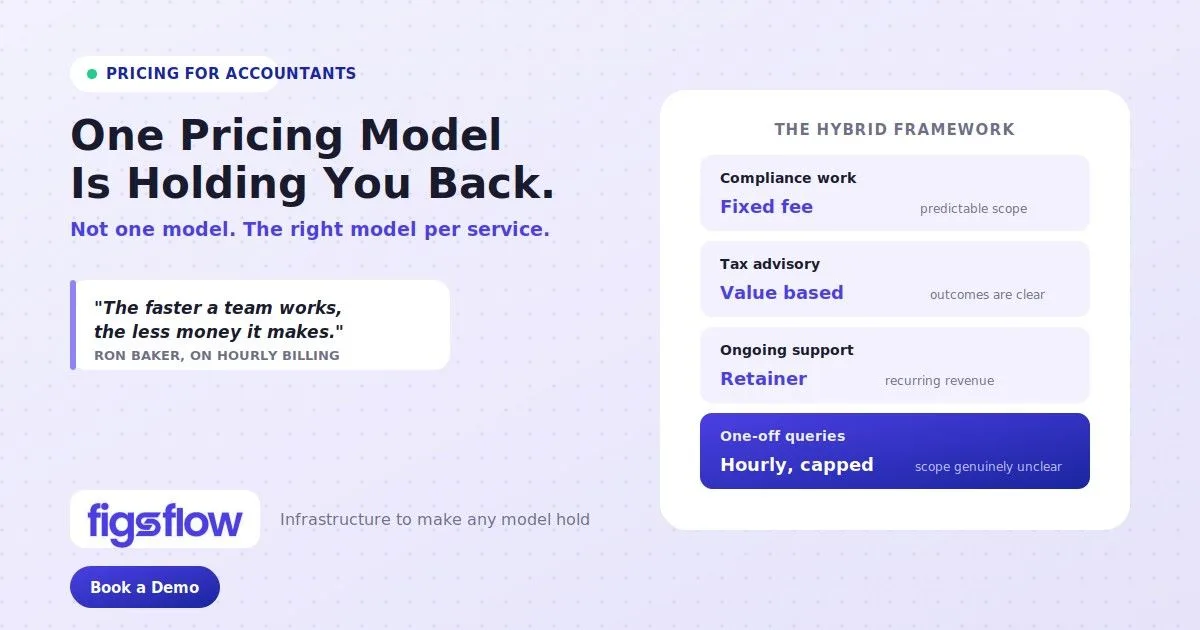
Most accountancy firms are exceptional at managing numbers for their clients. Yet when it comes to pricing and client management, many are winging it. Charging by the hour out of habit, underquoting fixed fees out of caution, and watching profitable work quietly drain into scope creep.
This is not a talent problem. It is a model problem.
This guide breaks down the four main pricing approaches used by accountancy, tax advisory, and bookkeeping firms. When each one works, where each one fails, and what the most profitable firms are actually doing.
By the end, you will have a clear answer to take back to your team.
The 4 Pricing Models Accountancy Firms Use
Most firms do not consciously choose a pricing model. They inherit one. The default tends to be hourly billing, simply because it is what everyone else was doing when the firm was set up. But there are four distinct models available, and each produces very different outcomes for your revenue, your client relationships, and your team.
- Hourly / Time-Based Pricing
- Fixed Fee Pricing
- Value-Based Pricing
- Retainer / Subscription Pricing
Breaking Down Each Pricing Model
There is no single right answer that works for every firm. But understanding how each model actually behaves in practice is the first step to making a deliberate choice. Here is what you need to know about each one.
Hourly / Time-Based Pricing
Hourly billing is the model most firms start with, and for good reason. It is familiar, easy to justify, and straightforward to administer. For genuinely unpredictable work such as a one-off investigation, a complex dispute, or a bespoke transaction, it remains a reasonable choice.
But as a default model for an entire practice, it has a fundamental problem. It ties your revenue to time rather than expertise. As your team gets faster and better, hourly billing actually penalises that efficiency. And from the client’s perspective, the clock ticking in the background creates anxiety around every question and every email.
The faster a team works, the less money it makes.
— Ron Baker
Fixed Fee Pricing
With fixed fee pricing, clients know exactly what they will pay before the work begins. No surprises on the invoice, no anxiety about asking questions. For clients, it feels clean and professional. For firms, it can drive margins up significantly if the work is scoped correctly.
Fixed fee works best when all three of these conditions are true:
- The service is repeatable, such as tax returns, annual accounts, or payroll processing
- The firm has a structured onboarding process and a tight engagement letter
Without those foundations, a fixed fee becomes a trap. Undefined scope leads to extra work that the firm absorbs silently, which is why so many firms try fixed fees, struggle with scope creep, and retreat back to hourly. The model itself is not the issue. The infrastructure behind it usually is.
Value-Based Pricing
Value-based pricing shifts the question entirely. Instead of asking how long something will take, you ask what it is worth to the client. A tax restructure that saves a client £15,000 is worth far more than the six hours it took, and value-based pricing reflects that.
| Hourly Thinking | Value-Based Thinking |
|---|---|
| This took 3 hours | This saved them £8,000 |
| Revenue capped by time | Revenue tied to outcomes |
| Client watches the clock | Client focuses on results |
| Faster work = lower invoice | Better work = higher fee |
Value-based pricing has the highest earning potential of any model. But it demands something most firms have not yet built: a clear understanding of the value they deliver and the confidence to charge for it.
For advisory engagements where outcomes are tangible, it is the right fit. For commodity compliance work, a fixed fee remains the more practical vehicle.
Retainer / Subscription Pricing
A retainer model packages services into a recurring monthly fee. Clients get consistent access to your team. Your firm gets predictable revenue. Done well, it transforms the client relationship from transactional to genuinely advisory.
| Essential — Compliance only | Growth — Compliance & advisory | Advisory — Full strategic support |
|---|---|---|
| Annual accounts, tax returns, and standard filings, packaged at a clear fixed monthly fee. | Everything in Essential, plus tax planning, quarterly reviews, and proactive guidance. | CFO style partnership, cashflow forecasting, KPI monitoring, business structuring advice. |
The retainer model works best when services are tiered clearly, clients understand what each level includes, and the firm has clean systems for onboarding clients into the right tier. Without that structure, retainers are difficult to price, easy to undercharge, and hard to upgrade.
Why Do Most Accountancy Firms Stay Stuck on Hourly Billing?
Hourly billing persists not because firms have not heard of the alternatives. Most have. It persists because it feels safe. There is an intuitive logic to it: the client pays for the time the firm spends, no more, no less. For accountants trained to be precise and transparent, hourly feels like the honest option.
The hidden cost of that comfort is significant. Hourly billing caps practice revenue at the number of chargeable hours in the week. It creates a culture where speed is unconsciously discouraged. It puts clients in a position where every phone call feels like a risk. And it makes services nearly impossible to package, market, or scale, because every engagement is priced from scratch, every time.
So, What Is the Best Pricing Model for Accountancy Firms?
The short answer: value-based pricing is the goal, and a fixed fee or retainer is the vehicle. Most firms will not attempt a full switch overnight, and they should not. But a structured hybrid approach is both achievable and sustainable, and it is what the most profitable practices are already running.
The Hybrid Pricing Framework
| Service Type | Recommended Model | Why It Works |
|---|---|---|
| Compliance work (tax returns, payroll, bookkeeping) | Fixed fee | Scope is predictable; clients value certainty |
| Tax advisory & strategic planning | Value-based | Outcomes can be quantified; you share in the value created |
| Ongoing client support | Retainer / Subscription | Recurring revenue, deeper relationships; easier forecasting |
| One-off queries | Hourly (Limited) | Scope is genuinely unclear; use sparingly with clear caps |
Hourly billing does not disappear entirely in this model. It moves to the margins, reserved for work where scope genuinely cannot be defined in advance. For everything else, fixed fees, retainers, and value-based positioning give your firm cleaner revenue, stronger client relationships, and real room to grow.
The Real Barrier Is Not the Model. It Is the Execution.
Choosing value-based or fixed fee is the easy part. Delivering it consistently across every client, every service, every engagement, every time is where most firms stall.
The most common execution gaps are predictable:
- Proposals written from scratch for each client, with inconsistent scope definitions and no standard pricing structure
- Engagement letters that are vague on deliverables, leaving the firm exposed when clients push for more
- No standardised onboarding process for new service tiers, meaning pricing decisions cannot be replicated or delegated
Solving these gaps is not about willpower. It is about infrastructure. When proposals are templated and professional, when engagement letters are watertight and sent automatically, when AML checks do not require chasing documents by email, that is when a pricing model actually holds. The model becomes something the whole team can deliver, not just the partners who built it.
Helpful Resources
- How to Price Bookkeeping Services Without the Guesswork: Bookkeeping Pricing Made Easy for UK Accountants | FigsFlow
- Price Catch-up Work With Ease: How to Price Catch-Up Work for New Clients | FigsFlow
- How to Talk About Fees Without Losing Clients: Nail Your Price Communication or Keep Losing Clients!
- How to Price MTD for ITSA Services: Charge Your Worth: Guide to Pricing MTD ITSA Services
- Here’s the Missing Piece In Your Pricing Strategy: What Top CPA Firms Know About Pricing (That You Don’t)
Conclusion
The best pricing model for an accountancy firm is a hybrid: fixed fees for compliance work, retainers for ongoing advisory, and value-based thinking threaded through every client conversation.
The firms winning on pricing are not necessarily smarter or more experienced. They are more consistent. They have built systems that hold their pricing even when they are busy, even when clients push back, even when a new team member sends the proposal.
If your pricing model is sound but your execution is still catching up, that is the gap worth closing.
Your Pricing Model Is Only as Good as the Process Behind It
The firms that win on pricing are not just thinking differently. They are operating differently. FigsFlow gives you the infrastructure to turn your pricing decisions into a repeatable, professional client experience.