
Industry-Related AML Risks: A Guide for Compliance Teams with Insights from FigsFlow
Explore industry-related AML risks and learn how accounting firms can effectively manage compliance with insights from FigsFlow's AML solutions

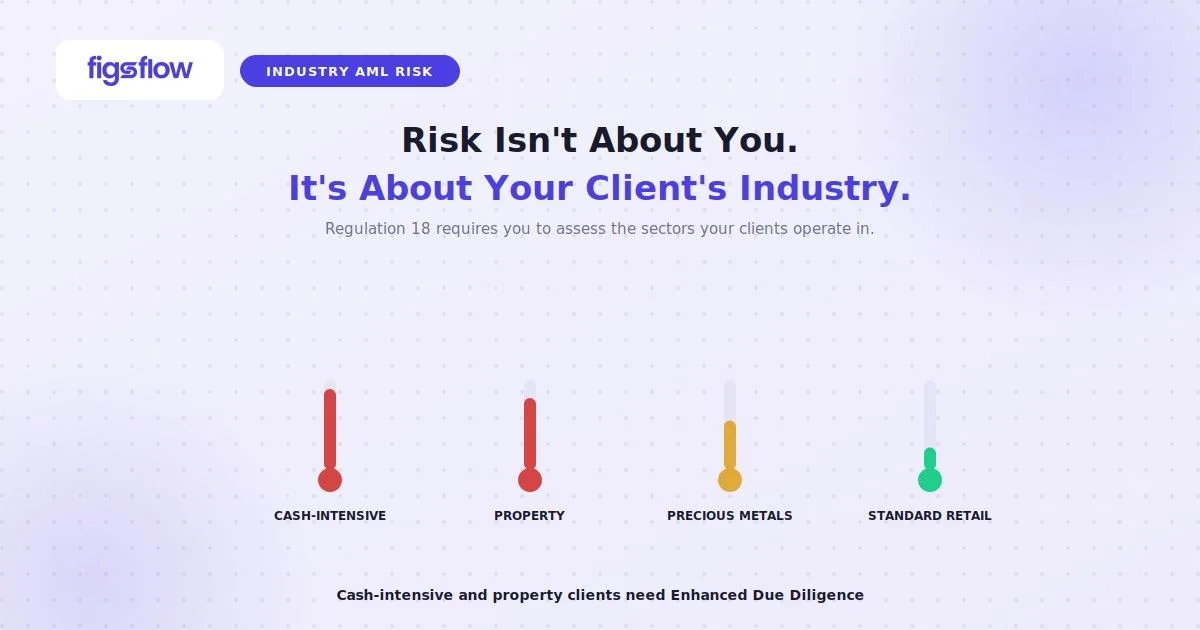
Industry-related AML risks are the money laundering and terrorist financing threats specific to particular business sectors. In accounting and professional services, these risks shape how firms must structure their compliance processes under the Money Laundering, Terrorist Financing and Transfer of Funds (Information on the Payer) Regulations 2017 (MLRs 2017).
For accounting firms, tax advisers, and bookkeeping practitioners, the regulatory framework demands a targeted approach. Firms must assess the risks that arise from the industries their clients operate in, not just their own internal operations.
- HMRC fines for AML breaches across all supervised sectors rose significantly in 2024-25
- Accounting firms are designated as “relevant persons” under the MLRs 2017
- Firms must assess risks from their clients’ industries, not just their own operations
- Enhanced due diligence applies to clients in high-risk sectors
- Technology platforms help manage industry-specific compliance requirements
- The Economic Crime and Corporate Transparency Act adds new verification obligations
The Role of Accounting Firms in AML Compliance
The regulatory authorities in the United Kingdom have designated accounting professionals as gatekeepers in the fight against financial crime. This designation reflects the unique position that accountants, tax advisers, and bookkeepers occupy within the financial system.
The basis for this gatekeeper role stems from the reality that accounting firms routinely handle sensitive financial information, facilitate business transactions, and provide advisory services that could potentially be exploited for laundering purposes.
Under the MLRs 2017, accounting firms are “relevant persons” when providing specified services including external accountancy services, tax advisory, trust or company service provider activities, and insolvency practitioner services. These designations appear in the Proceeds of Crime Act 2002 and the Terrorism Act 2000, creating obligations that carry criminal sanctions for non-compliance.
The breadth of these triggering activities means that many accounting practices fall within scope even where they might not immediately recognise themselves as subject to anti-money laundering requirements. A firm providing basic bookkeeping services is as much a relevant person as a large firm offering complex tax structuring.
Understanding Industry-Related AML Risks Factors
Different sectors present various industry-related AML risks that accounting firms must evaluate as part of their compliance obligations. Regulation 18 of the MLRs 2017 requires all relevant persons to carry out a firm-wide risk assessment that includes the risks associated with the sectors in which their clients operate.
This obligation requires firms to identify and evaluate the specific money laundering and terrorist financing threats presented by their client base, taking into account the nature of the businesses served.
Industry specific risks arise from the characteristics of the sector in which a client operates. Cash-intensive businesses, property transactions involving large sums, online gaming platforms, and precious metals dealers all carry distinct risk profiles that the supervising firm must address in its compliance procedures.
Identifying the Risk Profile of Clients in Accounting Firms
Accounting firms frequently serve clients whose business models or ownership structures present elevated money laundering risk. These include clients with complex corporate structures involving multiple jurisdictions, beneficial owners who are difficult to identify or verify, and businesses with revenue patterns that do not align with their stated activities.
The professional nature of accountancy means that firms often serve clients before any red flags become apparent. Unlike financial institutions, which may see the proceeds of crime passing through accounts, accounting firms may facilitate the creation of structures used for laundering without direct visibility of the underlying transactions.
Additionally, firms should recognise that certain client sectors present elevated risks regardless of the individual client’s apparent legitimacy. Real estate transactions, for example, remain one of the highest-risk areas for money laundering in the UK.
Client risk profiles must consider industry-related AML risks, helping firms determine the appropriate level of due diligence and ongoing monitoring required.
Geographical Factors Affecting AML Risks
Geographical factors influence the industry-related AML risks accounting firms face. The Financial Action Task Force (FATF) maintains lists of jurisdictions with strategic deficiencies in their anti-money laundering regimes, and client connections to these areas trigger enhanced requirements.
The geographical locations where clients operate or where beneficial owners reside create additional layers of compliance obligation. Regulation 33 of the MLRs 2017 specifically requires enhanced due diligence for clients connected to high-risk third countries, defined by reference to the Financial Action Task Force's own high-risk and increased-monitoring lists rather than any EU list.
For accounting firms, clients operating in or connected to high-risk jurisdictions require proportionately more intensive verification, monitoring, and documentation.
AML Risks in Different Service Types and Transactions
Each service type and transaction has its own industry-related AML risks, with varying levels of vulnerability to exploitation for money laundering or terrorist financing purposes.
The services offered by an accounting firm create distinct compliance risks. Firms providing trust and company formation services carry particularly high risk given the potential for these structures to obscure beneficial ownership.
Similarly, firms facilitating transactions concerning real property or business acquisitions must apply heightened scrutiny. These transaction types feature prominently in documented money laundering typologies.
Transactions that are unusually large relative to the client’s stated business profile, that lack apparent economic rationale, or that involve complex arrangements with no clear commercial purpose should prompt additional inquiry.
Recognizing these industry-related AML risks helps firms stay compliant and reduces the chance of facilitating financial crime.
Using Technology to Address Industry-Related AML Risks
Technology plays a vital role in managing industry-related AML risks, providing tools that can automate aspects of due diligence, monitoring, and reporting.
Modern compliance platforms such as Figs Flow address industry-specific risks through automated workflows that standardise the compliance process. Electronic verification tools check identities against government databases and sanctions lists.
By leveraging technology, firms can better mitigate industry-related AML risks and maintain compliance with regulatory requirements.
Client Onboarding and AML Risk Assessment Procedures
Client onboarding processes must account for industry-related AML risks, ensuring that appropriate due diligence is conducted from the outset of each engagement.
The engagement process creates the natural starting point for AML/KYC compliance. Every new client relationship requires identification and verification of the client and any beneficial owners.
Client onboarding functionality should enable firms to gather essential identity documents, verify information electronically, assess risk factors including industry-related considerations, and document the due diligence steps taken.
The platform should guide practitioners through a risk classification process that considers the client’s sector, geographical connections, ownership structure, and the nature of services being provided.
Effective AML risk assessments during onboarding help identify industry-related AML risks early and ensure firms take the right compliance steps.
Ensuring Proper Documentation and Verification for AML Compliance
Proper documentation and verification processes are essential for addressing industry-related AML risks and demonstrating compliance during regulatory inspections.
Effective compliance requires proper documentation of due diligence steps taken. Regulation 28 of the MLRs 2017 sets out the requirements for customer due diligence, including identification, verification, and assessment of the purpose and intended nature of the business relationship.
Technology platforms should facilitate the collection, storage and organisation of compliance documentation. Digital document management creates audit trails that demonstrate regulatory compliance.
The verification process creates a crucial compliance control point. Firms must be able to demonstrate that they have taken reasonable steps to verify client identities and assess risk.
This documentation must reflect industry-related AML risks to ensure firms meet regulatory expectations.
Enhanced Due Diligence for High-Risk Clients and Transactions
Enhanced due diligence (EDD) is crucial for managing industry-related AML risks when dealing with high-risk clients or transactions.
For clients identified as presenting elevated risk, the platform should facilitate enhanced due diligence measures including additional identity verification steps, source of funds and source of wealth checks, and more intensive ongoing monitoring.
The platform should create workflow triggers that identify when enhanced due diligence is required based on the risk assessment outcomes, ensuring nothing falls through the gaps.
By applying EDD procedures, firms can mitigate industry-related AML risks and ensure compliance with regulatory requirements.
Ongoing Monitoring and Transaction Analysis for AML Compliance
Ongoing monitoring of transactions is key to detecting industry-related AML risks over the lifetime of a client relationship.
Compliance extends beyond the initial client onboarding stage. Regulation 28 of the MLRs 2017 requires ongoing monitoring of the business relationship, including scrutiny of transactions undertaken throughout the relationship to ensure they are consistent with the firm’s knowledge of the client.
Technology platforms should enable monitoring workflows that flag transactions or changes in client circumstances that may indicate increased risk.
Regular transaction analysis helps firms address industry-related AML risks and maintain compliance.
Recognizing Red Flags and Suspicious Activities in AML Compliance
Recognizing industry-related AML risks involves spotting red flags and suspicious activities linked to specific sectors.
Effective compliance depends upon staff ability to recognise activities presenting potential money laundering indicators within their clients’ sectors.
Cash-intensive clients presenting unusual patterns of cash handling, particularly where the volumes or patterns are inconsistent with the stated business model, warrant closer examination.
Clients providing incomplete or inconsistent information on the identity of beneficial owners or the source of their wealth may indicate attempts to conceal the true nature of the business relationship.
Critically, Section 333A of the Proceeds of Crime Act 2002 prohibits “tipping off” clients regarding any suspicious activity reports that have been or may be filed.
By identifying industry-related AML risks, firms can act promptly to prevent illicit activities.
Establishing Effective Governance and AML Compliance Structures
Establishing governance structures is crucial for managing industry-related AML risks effectively.
Regulation 19 of the MLRs 2017 requires all regulated entities to implement compliance policies, controls, and procedures to manage and mitigate the risks of money laundering and terrorist financing.
Regulation 21 imposes a specific requirement that firms appoint a Money Laundering Reporting Officer at management board level or equivalent.
The MLRO, working with senior management, bears responsibility for establishing, maintaining, and operating the firm’s compliance framework.
These include:
- A firm-wide risk assessment reflecting the actual risks faced by the practice
- Written policies, controls, and procedures tailored to those risks
- Staff screening procedures for those in relevant positions
- Regular training programmes covering applicable legal obligations
- An independent audit function to assess the adequacy and effectiveness of internal controls
- Record-keeping systems that meet Regulation 40 retention requirements
Strong governance systems help firms effectively address industry-related AML risks by ensuring all compliance activities are properly structured and documented.
Training Staff to Recognize and Respond to AML Risks
Training staff to recognize industry-related AML risks ensures that firms can effectively implement their compliance procedures.
Regulation 24 of the MLRs 2017 mandates that firms ensure relevant employees receive training on the law relating to money laundering and terrorist financing, recognising and dealing with transactions and other activities connected with money laundering.
The training programme must explain the law within the context of the firm’s own procedures and the specific risks identified in the firm-wide risk assessment.
A key consideration is that someone accused of a Failure to Report offence has a statutory defence if they can demonstrate they did not receive adequate training. This makes training not just a compliance exercise but a legal protection for both the individual and the firm.
Beyond formal training, firms should aim to foster a compliance culture where all staff understand the importance of AML procedures and feel comfortable raising concerns.
By educating staff about industry-related AML risks, firms can empower their teams to detect and respond to suspicious activities.
Best Practices for Implementing AML Compliance Frameworks
Implementing best practices in AML compliance involves addressing industry-related AML risks through comprehensive frameworks.
Effective AML compliance depends upon ongoing commitment to maintaining current and effective procedures. The regulatory landscape evolves continuously, and firms must adapt their approach accordingly.
Firms should maintain up to date understanding of regulatory changes and ensure compliance frameworks reflect current requirements.
Clear written procedures should guide staff actions in specified situations. The procedures must address industry-related considerations specific to the firm’s client base.
Firms should address industry-specific requirements applicable within their sector and the sectors served by their clients.
Most fundamentally, firms should foster strong compliance culture where compliance is viewed as an integral part of professional practice rather than an administrative burden.
Following these best practices ensures firms effectively manage industry-related AML risks and maintain regulatory compliance.
- Complete Guide to AML Compliance & Financial Crime for UK Professionals: Read here
- List of AML Regulations & Regulators in the UK: Read here
- How to Verify Client Identity for AML Compliance: Read here
- UK Sanction Screening Guide for Professionals & Businesses: Read here
- Common Identity Verification Mistakes in AML: Read here
- Enhanced Due Diligence on Politically Exposed Persons: Read here
Conclusion: Managing Industry-Related AML Risks with Effective Compliance
To effectively manage industry-related AML risks, accounting firms must implement robust compliance frameworks that address the specific vulnerabilities present within their client base and the sectors they serve.
Industry-specific AML risks require proportionate compliance responses reflecting the particular threats that different sectors present.
Technology platforms including Figs Flow provide important practical tools enabling firms to manage compliance processes more effectively.
Ultimately, effective AML compliance depends upon clear governance structures, well-trained staff, and systematic processes underpinned by appropriate technology.
In conclusion, managing industry-related AML risks with effective compliance frameworks is essential for the ongoing integrity and success of accounting firms.