
Companies House Identity Verification: Complete Guide (2026) | Who, When, How & Personal Code
Who must verify and by when, both verification routes, and where to find your 11-character personal code — including what to do if it never arrived.

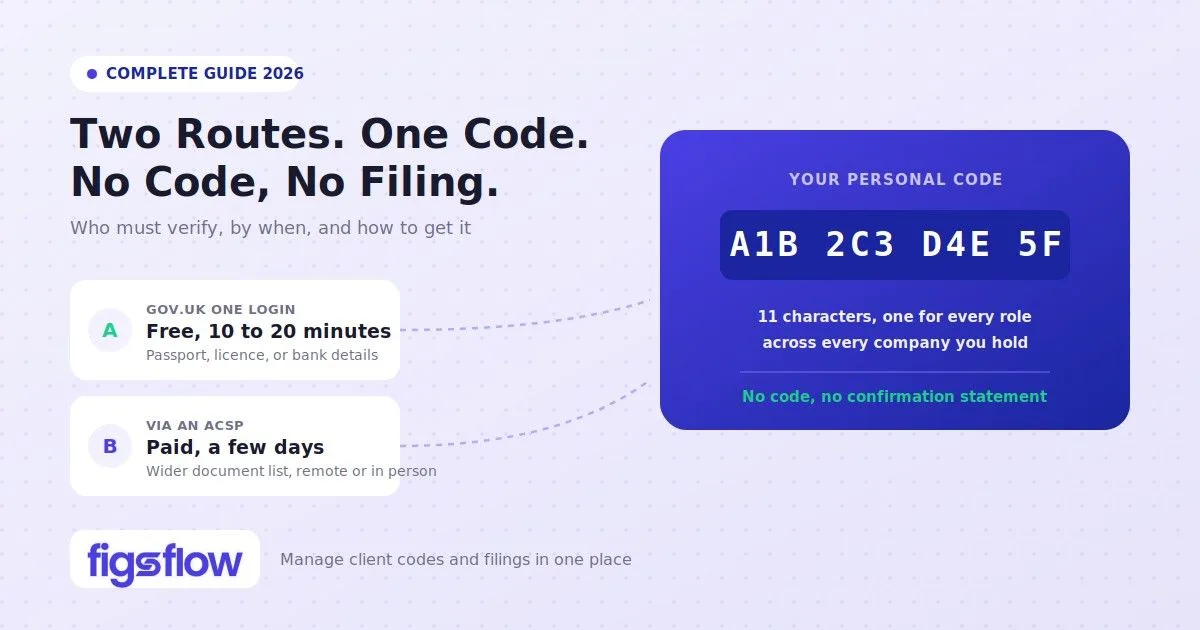
You can’t file your company’s confirmation statement yourself anymore. Not without a Companies House personal code.
Since 18 November 2025, the system simply won’t let you proceed without identity verification. The Economic Crime and Corporate Transparency Act now requires every director, PSC, and equivalent officer to verify before they can file a confirmation statement or take on new appointments, whether that’s registering a new company, recording a director change, or updating company records.
In this guide, you’ll learn who must verify and how to complete the process via GOV.UK One Login or an Authorised Corporate Service Provider, and what to do with your personal code once you have it.
Key Points Summarised for Busy Readers
- Companies House identity verification is a legal requirement under the Economic Crime and Corporate Transparency Act 2023. All directors, PSCs, LLP members, and equivalent officers must verify once and receive a personal code to use when filing or taking on new roles.
- Verification is free via GOV.UK One Login (10 to 20 minutes) or paid through a registered ACSP, such as an accountant or solicitor.
- Existing directors must verify before their next confirmation statement. New directors must verify before appointment. PSCs have a 14-day window to submit their code after verifying.
- Non-compliance is a criminal offence. Your company cannot file; you cannot take on new roles; and Companies House will publicly flag your name.
What is Companies House Identity Verification?
Identity verification is Companies House’s new system for confirming that people running, owning, or controlling UK companies are who they claim to be.

The system addresses a critical weakness in UK company law. Previously, anyone could register a company using false details with minimal checks. This made it easy for criminals to hide behind shell companies and commit fraud.
Under the Economic Crime and Corporate Transparency Act 2023, Companies House now has enhanced powers to verify identities and maintain accurate records. The legislation transforms Companies House from a passive registry into an active gatekeeper against economic crime.
When you verify your identity, you receive a Companies House personal code. It is an 11-character code, personal to you rather than to any company — you verify once, and the same code covers every directorship and PSC role you hold, at every company. You will need it whenever you file, accept an appointment, or are registered as a PSC.
Where to find your Companies House personal code
Where the code lives depends on how you verified, which is why so many people think they never received one.
If you verified through GOV.UK One Login: sign in to Companies House and go to ‘Manage account’ — your code is displayed there. Anyone who verified after 8 July 2026 was also sent the code by email, so check your inbox before assuming it is lost.
If an ACSP verified you — your accountant, solicitor or formation agent — Companies House sent the code to the email address that firm provided for you. If nothing arrived, that is almost always the reason: go back to the ACSP and check which address they gave. It is a common cause of a “missing” code, particularly where a firm used its own email rather than the client’s.
If you think the code has been shared or compromised: contact Companies House and ask for it to be changed. They will issue a new code by email and cancel the previous one. Worth knowing that this is possible — a compromised code is not something you have to live with.
Who you should give your personal code to
Keep the code safe, but do not be precious about it with the people who need it: GOV.UK is clear that you can share it with anyone who files on your behalf, and for most directors that means their accountant. A practice cannot submit a confirmation statement for a company whose directors have not handed over their codes.
What you must not do is give it to someone you do not trust, or let anyone use your identity to set up or run a company on your behalf. Criminals can take out loans and other debt in a director’s name, and the director remains legally responsible for it.
For a practice, the practical implication is that these codes are now client data you hold, request and store. Treat them accordingly — they belong in your client record with the same care as a UTR or a National Insurance number, not in an email thread.
The verification process uses two main routes. You can verify directly through:
- GOV.UK One Login for free, or
- pay an Authorised Corporate Service Provider to handle it for you.
Both methods must meet the same identity assurance standards set by Companies House.
Who Needs to Verify Their Identity with Companies House?
The requirements target specific roles where identity confirmation matters most for preventing economic crime.
- Company Directors – Every director must verify, including executive directors, non-executive directors, and shadow directors. This applies regardless of company size or structure, and whether the company is UK-based or an overseas entity registered in the UK.
- People with Significant Control (PSCs) – Anyone who owns more than 25% of a company’s shares or voting rights, or who can appoint or remove the majority of directors. If you are both a director and a PSC, you only verify once, but you must provide your personal code separately for each role.
- Authorised Corporate Service Providers (ACSPs) – Accountants, solicitors, company formation agents, and other AML-supervised professionals who want to register as a Companies House authorised agent to verify clients’ identities must verify their own identity as part of the registration process. This applies now. Agents who file on behalf of clients but do not offer identity verification are not yet required to register as an ACSP.
Not yet in scope — but coming. This is where a lot of practices have got ahead of themselves. Identity verification has not yet been switched on for members of limited partnerships, or for people who file at Companies House on behalf of a company. GOV.UK is explicit that these will be introduced at a later date, and no date has been published. Designated LLP members sit in the same waiting room.
The practical point for a practice: do not tell an LLP client they are late, and do not build a verification project around roles the regime has not reached yet. Verify the directors and PSCs you actually have deadlines for, and keep the rest on a watch list.
Who Does Not Need to Verify Their Identity with Companies House?
Corporate directors, company secretaries who are not also directors, officers of corporate PSCs, and agents who file on behalf of clients (but are not registering as ACSPs) are not required to verify at this stage. Companies House has confirmed these groups will be brought into scope at a later date.

Companies House Identity Verification Deadlines
Companies House Identity Verification deadline is not the same for everyone. It depends on your role and when you took it on.
Here is how it breaks down.
The 18 November 2025 Start Date Explained
This date marks the point at which identity verification became a legal requirement, not a single deadline for everyone to meet simultaneously. Companies House introduced a 12-month transition period from this date. Your actual deadline depends on when you were appointed and what role you hold.
Timeline for Existing Directors
If you were already a director before 18 November 2025, you must provide your personal code when your company files its next confirmation statement. Every director at that company must be verified before the filing can go through. If any one director has not verified, the entire submission is blocked.
Since confirmation statements are filed annually, most existing directors had several months to complete verification. As of May 2026, if you have not yet verified, your deadline is likely very close or may have already passed. Verify immediately.
Timeline for New Directors
Anyone appointed from 18 November 2025 onwards must verify before or at the point of appointment. You cannot be validly appointed without providing your personal code when filing the appointment. The same applies to new companies: incorporation cannot be completed until all proposed directors have verified.
Timeline for PSCs (The 14-Day Window)
Once you have verified and received your personal code, you have a fixed 14-day window to provide it to Companies House for your PSC role. When that window starts depends on your specific situation.
If you are both a director and a PSC of the same company, your 14-day window begins the day after your company’s confirmation statement date. Note that if the company files its confirmation statement early, your window does not move. It is anchored to the stated confirmation statement date, not the actual filing date.
If you are a PSC but not a director of the same company, your 14-day window falls within the first 14 days of your birth month each year. For example, if your date of birth is 22 January, your window runs from 1 to 14 January.
If you became a PSC after 18 November 2025, you can provide your personal code when you are first added to the Companies House register, or within 14 days of being added.
You submit your code using the dedicated “Provide identity verification details for a PSC” service on GOV.UK. This is a separate step from the initial verification process.
Timeline for ACSPs
If you are registering as a Companies House authorised agent to verify clients’ identities, you must verify your own identity as part of the ACSP registration process. There is no separate deadline. Verification is a prerequisite for registration and you cannot submit your ACSP application without it.
If you are an agent who currently files on behalf of clients but does not offer identity verification services, ACSP registration is not yet required.
What Documents Do You Need for Companies House Identity Verification?
To verify your identity for Companies House, you generally need a valid photo identity document and proof of your current address. The exact documents required depend on which verification route you take.
Via GOV.UK One Login
The documents you need depend on the route. For the app-based route, you can use any of the five accepted photo IDs listed above (a biometric passport from any country, a UK photo driving licence, BRP, BRC or FWP) with a working biometric chip. For the Post Office route, you bring the same original document; photocopies and digital images are not accepted.
For the bank or building society route, no photo ID is needed — the system verifies you using your bank or building society details and National Insurance number.
Via an ACSP
ACSPs work from an approved document list that meets the Companies House verification standard. Accepted documents commonly include a passport, photocard driving licence, national identity card, or biometric residence permit, alongside proof of address. Your ACSP will confirm the exact combination they require before starting. This route is particularly useful for overseas directors or those without UK photo ID, as ACSPs can work with a wider range of international documents.
In all cases, documents must be originals in good condition. Expired or damaged documents will be rejected. For the full current list, refer to the official Companies House identity verification guidance on GOV.UK.
Companies House Identity Verification Process
Companies House offers two verification routes. Both meet the same identity assurance standards, but they differ in cost, convenience, and who performs the checks.

Method 1: Direct Verification via GOV.UK One Login (FREE)
GOV.UK One Login provides free identity verification directly with Companies House. Most people complete the entire process in 10 to 20 minutes from home.
The system asks a few simple questions about your residency, ID documents, and device. Based on your answers, it routes you to the most suitable method.
What ID Can You Use for Companies House Identity Verification?
GOV.UK One Login accepts five types of photo ID for Companies House identity verification:
- A biometric passport from any country
- A UK photo driving licence (full or provisional)
- A UK biometric residence permit (BRP)
- A UK biometric residence card (BRC)
- A UK Frontier Worker permit (FWP)
A biometric passport has a small rectangular symbol on the front cover and can be used at electronic passport gates. All UK passports issued after 2006 are biometric. You will also need your current address, the year you moved in, and a GOV.UK One Login account.
Can You Use Expired ID to Verify Your Identity?
You cannot use an expired passport with the GOV.UK One Login app. You can use an expired UK driving licence if it expired within the last 90 days and was issued by DVLA. You can use an expired BRP, BRC or FWP if it expired within the last 18 months. Expired documents are not accepted for the bank or building society route, or for Post Office verification.
Option A: Using the GOV.UK ID Check App (Recommended)
The app-based route is the fastest option for anyone with a valid UK passport or photocard driving licence and a smartphone. THE GOV.UK ID Check app guides you through three steps:
- photograph your document,
- scan the biometric chip by placing your phone flat on it, and
- then take a selfie for facial recognition.
The whole process typically takes under 15 minutes.
Option B: Bank or Building Society Details
If you do not have suitable photo ID, GOV.UK One Login can verify you using your bank or building society details. You then provide your National Insurance number and answer security questions about your financial history.
This route checks your identity against records held about you and does not accept expired documents. If you are new to the UK or have a limited credit history, this route may not succeed, and the system tells you immediately if it cannot verify you this way.
Option C: Post Office Verification
The Post Office route suits those who struggle with online-only verification. You first enter your photo ID details on GOV.UK One Login, which then emails you a letter containing a unique QR code. Take that letter and your original ID to a participating Post Office. Staff scan the QR code and verify your documents in person. Not all Post Offices offer this service, so check before visiting.
Once verified, you can use your GOV.UK One Login credentials to access over 110 government services, including HMRC, DBS checks, and mortgage deed signing.
If you complete verification at a Post Office, GOV.UK emails you the result, usually within one day. Your personal code is then available in your Companies House account under “Manage account.”
Method 2: Through an Authorised Corporate Service Provider (ACSP)
An ACSP is a professional regulated under UK anti-money laundering supervision, typically an accountant, solicitor, or company formation agent registered with Companies House as an authorised agent.
ACSPs verify your identity on your behalf for a fee. Costs vary by provider, so it is worth checking with your existing accountant or solicitor first, as they may already be registered as an ACSP. You provide them with documents from an approved list, they conduct the necessary checks, and submit your verification to Companies House directly. The process works from anywhere in the world, making it the practical route for overseas directors.
This route suits people without UK photo ID, those who have struggled with GOV.UK One Login, or those who simply prefer professional assistance, and it fits neatly alongside a firm's existing client onboarding checklist.
Which Method Should You Choose?
Try GOV.UK One Login first. It’s free, instant, and available 24/7.
Choose an ACSP if you don’t have UK photo ID, GOV.UK One Login hasn’t worked after multiple attempts, or you prefer to have the process handled for you. Both methods meet the same identity standard. If you’re struggling with GOV.UK One Login, contact an ACSP or Companies House support rather than delaying.
Step-by-Step: Verifying via GOV.UK One Login
Let’s walk through the complete verification process using GOV.UK One Login. This assumes you’re using the recommended app-based route with a UK passport.
What You'll Need Before Starting
Gather your UK passport before beginning. It must be current and valid, with the biometric chip working. Damaged passports often fail the chip scanning stage.
You’ll need access to both a computer or tablet and a smartphone. The process starts on any device but requires a phone for the app-based verification steps.
Have your email address ready. You’ll create a GOV.UK One Login account using this email, and you’ll receive your Companies House personal code at this address. Use an email you check regularly.
Know the year you moved into your current home address. The system asks this as part of confirming your address details against official records. Be as accurate as possible.
The Verification Process in Detail
Follow these steps to verify your identity and receive your Companies House personal code:
- Start the Process – Visit the official GOV.UK guidance page and click “Verify your identity for Companies House.” Confirm you have a valid UK passport or driving licence.
- Create GOV.UK One Login – Enter your email address and verify it with the six-digit code sent to your inbox. Create a strong password and set up two-factor authentication via text message or an authenticator app.
- Answer Screening Questions – Select your ID type (UK passport or driving licence), confirm UK residency, and choose your device. Your answers determine the verification method.
- Download the ID Check App – Scan the QR code on your screen with your smartphone. This downloads the GOV.UK ID Check app links it to your session. Grant camera and location permissions.
- Scan Your Passport – Photograph your passport data page with clear lighting. Then place your phone flat on your closed passport to scan the embedded chip (takes 10-30 seconds).
- Complete Facial Recognition – Take a selfie with good lighting and your face clearly visible. Remove glasses if possible. The system compares your live photo against your passport image.
- Enter Your Address – Switch back to your computer and enter your UK residential address using your postcode. Select your exact address from the dropdown and enter the year you moved there.
- Receive Your Personal Code – Wait 30 seconds for processing. Your Companies House personal code appears on the confirmation screen. Copy it immediately and store it securely.
What Is the Companies House Personal Code?
The Companies House personal code is an 11-character code issued to you once you have verified your identity. It is personal to you as an individual, not to any company you run or work for. If you are a director or PSC of multiple companies, you use the same personal code for every appointment.
When you use your personal code, Companies House may ask you to confirm your date of birth so it can check your details match its records. If the details linked to your code do not match, the code will not connect to your record.
This usually happens because the code was entered incorrectly, the date of birth held by Companies House is wrong, or an ACSP submitted incorrect details. You can check and update the date of birth Companies House holds for you by signing in to WebFiling.
Reverification of Identity
Companies House may question whether your previously submitted information remains accurate or valid. When this happens, they’ll send you a Reverification Notice requiring you to submit fresh or supplementary evidence within 42 days.
Not responding to this notice can lead to your verified status being suspended or removed entirely.
Missing the 42-day deadline results in automatic loss of your verified status. Companies House will notify you that your verification has lapsed, meaning you’ll no longer hold verified status until you go through the entire application process again from scratch.
Special Cases: Harder to Verify Officers
Most people can complete verification through GOV.UK One Login in under 20 minutes. For some individuals, however, the automated process simply does not work. Companies House refers to these cases as “harder to verify” officers.
This typically affects people in the following situations:
People residing outside the UK who hold older, non-biometric passports or identity documents that the GOV.UK ID Check app cannot scan. The app relies on reading a biometric chip, so documents without one will fail at that stage.
People whose nationality or residency status cannot be confirmed through automated checks. This includes nationals of countries whose documents are not supported by the GOV.UK verification system.
People with no UK credit footprint, as the security questions route relies on data held by UK credit reference agencies. Those new to the UK or those who have never held UK financial products will find this route unavailable to them.
What to do if standard verification fails
An ACSP is the practical route for harder to verify officers. ACSPs can conduct manual document checks that meet the Companies House identity verification standard, working with a broader range of international documents and without relying on biometric chip scanning. The verification can be done remotely or in person depending on what the ACSP requires. You provide your original documents, the ACSP satisfies themselves your identity is genuine, and they submit the verification to Companies House on your behalf.
A note for overseas directors
Directors of overseas companies registered in the UK face the same verification requirement as UK-based directors, but with an important difference on timing. Rather than linking verification to a confirmation statement, overseas company directors must confirm that all directors have verified their identity by the anniversary of the UK establishment’s registration. The ACSP route is the most reliable option for this group given the document and accessibility challenges involved.
If you are a harder to verify officer and are unsure how to proceed, contact Companies House directly or find a registered ACSP using the official list on GOV.UK.
Understanding Your Companies House Personal Code
Your personal code is a unique identifier that proves you’ve completed identity verification. It’s personal to you as an individual, not to any specific company. If you’re a director of five companies, you use the same personal code for all five.
Companies House generates your code automatically once verification succeeds. The code never expires unless Companies House explicitly tells you to verify again, which only happens if fraud concerns arise or verification standards change substantially.
How to Get Your Personal Code
Your personal code appears on screen immediately after successful verification. The system also emails it to the address you used for your GOV.UK One Login account.
If you verified via an ACSP, they’ll provide your personal code once Companies House processes your verification. This typically takes a few days rather than being instant like the GOV.UK One Login route.
Store your personal code securely in a password manager or write it down in a safe location. Don’t rely solely on the email.
How to Save an ACSP-Issued Code to Your Companies House Account
If you verified through an ACSP, Companies House recommends saving your personal code to a Companies House account so you can access it whenever you need it. To save it:
- Sign in, or create sign-in details, using the email address your personal code was sent to
- Confirm you have verified your identity
- Enter your personal code
- Enter your date of birth
Where to Find Your Personal Code After Verification
If you’ve lost your personal code, you can retrieve it by signing in to Companies House using your GOV.UK One Login credentials. Navigate to “Manage account,” and your personal code displays clearly on this page.
If you can’t see your code, check you’re using the correct email address. Many people use different email addresses for GOV.UK One Login and their existing Companies House account.
Email enquiries@companieshouse.gov.uk if you cannot locate your code. Include details about when and how you verified your identity.
When & How to Use Your Personal Code
Directors provide their codes when filing confirmation statements. The WebFiling system prompts you to enter codes for all directors. Your company cannot submit the confirmation statement until all directors’ codes are entered correctly.
New directors must provide their code as part of their appointment filing. The appointment cannot be completed without it.
PSCs use a separate service to provide their codes. After verifying, visit the “Provide identity verification details for a PSC” service on GOV.UK. Enter your code within your 14-day window.
If someone files on your behalf, such as an accountant or company secretary, you’ll need to share your code with them. They enter it during the filing process.
What Happens If You Don't Verify Your Identity With Companies House?
Failing to verify is a criminal offence under the Economic Crime and Corporate Transparency Act. Companies House can prosecute through the courts or issue financial penalties directly. If you continue acting as a director after your deadline passes, you commit an ongoing offence. The company itself may also be committing an offence for allowing an unverified director to continue serving.
Filing Restrictions
Your company cannot file its confirmation statement until every director is verified. You also cannot be appointed to new companies, and Companies House will publish a note against your name on the public register.
Impact on Company Operations
The practical consequences extend beyond the legal ones. Banks, suppliers, and investors routinely check the public register during due diligence, which is one reason a thorough Companies House advanced search is worth running before onboarding a new client. A non-compliance note signals a governance problem and can affect banking relationships, credit terms, and investment decisions.
The company also loses the ability to file any changes while verification remains outstanding, whether that is a new director appointment, a registered office update, or a change to share capital.
Common Issues & Troubleshooting
Identity verification sounds straightforward, but many people encounter problems. Here are the most common issues and their solutions.
I Can't Find My Personal Code.
Sign in to Companies House using the exact same email you used for GOV.UK One Login verification. Many people use multiple email addresses and forget which one they used initially.
Check your spam or junk folders. Search your entire mailbox for emails from Companies House or GOV.UK.
If you completed verification but cannot find your code, email enquiries@companieshouse.gov.uk with details about when you verified and which method you used.
Verification Failed - What Next?
Try a different verification route within GOV.UK One Login. If the app method failed, try security questions or the Post Office route.
Use an ACSP if multiple attempts fail. They perform manual document verification and can help people who cannot pass automated checks.
Don’t retry the same method repeatedly. Switch approaches after two or three failures.
Post Office Verification Problems
You cannot walk into a Post Office and verify directly. You must start verification on GOV.UK One Login first, enter your photo ID details online, and complete the initial steps. The system then emails you a letter with the QR code needed for Post Office verification.
Not all Post Offices offer the service. Use the Post Office finder tool on GOV.UK to check your local branch before visiting.
Bring the exact ID documents you entered online. Mismatches cause verification failure
Email & Account Linking Issues
GOV.UK One Login and Companies House WebFiling are separate systems. Use the same email address for both to link them properly.
If you used different emails, create a new GOV.UK One Login account using your WebFiling email address, then verify through this new account.
Contact Companies House support if linking problems persist.
Additional Resources
- Official Companies House Guidance on Identity Verification– Verify your identity for Companies House – GOV.UK
- When You Need to Verify Your Identity for Companies House– When you need to verify your identity for Companies House – GOV.UK
- List of Authorised Corporate Service Providers (ACSPs) – List of Authorised Corporate Service Providers (ACSPs) – GOV.UK
- Three Easy Steps to Complete Client ID Verification– 3 Easy Steps to Client ID Verification | FigsFlow
- Identity Verification through ACSP– Identity Verification Through ACSP Is Now a Business Essential
Conclusion
Identity verification is now mandatory for every UK director and PSC. It enables you to file confirmation statements, appoint directors, update company records, and submit any changes to Companies House. Without identity verification and your personal code, you cannot file anything with Companies House.
Most people complete it for free through the GOV.UK One Login in under 20 minutes. Others may need ACSP support.
We suggest verifying now rather than waiting for your deadline. The process is straightforward, and completing it early gives you peace of mind. If you handle this on behalf of clients, our guide on how FigsFlow supports identity verification covers the practice side of the process.