

A letter from HMRC has landed on your client’s doormat.
It looks official. It mentions deadlines. It uses words like “mandatory”, “digital records”, and “quarterly updates.” Your client has one of two reactions. They panic and call you immediately. Or they put it on the kitchen counter, assume it can wait, and call you in January 2027 when it absolutely cannot.
Either way, it becomes your problem.
This post tells you everything you need to know about the MTD letter, what it means, what your clients are likely to get wrong, and exactly what you need to do about it.
What Is an MTD Letter?
An MTD letter is an official mandation notice from HMRC informing a taxpayer that they are required to join Making Tax Digital for Income Tax (MTD for IT) from 6 April 2026.
HMRC sends these letters to individuals whose gross income from self-employment, property, or both exceeded £50,000 in the 2024-25 tax year. The letter confirms that from April 2026, they must keep digital records and submit quarterly updates of income and expenses through MTD-compatible software.
It is not a request. It is a notice.
And here is the part HMRC buries near the bottom: the letter explicitly tells your client to share it with their accountant or tax adviser. That is your cue.
What Does the MTD Letter Look Like?
Your client will ask if it’s real. Or they won’t ask and will quietly bin it.
Here’s what they’re holding.
It arrives on official HMRC letterhead. HM Revenue & Customs, crown logo, top left. It references their Unique Tax Reference and qualifying income. It tells them their total income was over £50,000 from self-employment and that from 6 April 2028 they will need to use MTD-compatible software to report income and expenses.
Below is the template letter so you know exactly what your clients are holding.
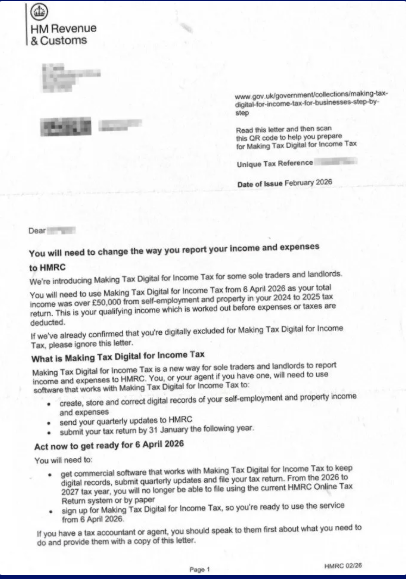
Brief your clients before it arrives. A client who knows what to expect does not call you at 11 pm, convinced they are being defrauded.
Who Is Receiving MTD Letter from HMRC?
HMRC has sent the letters in three batches based on when the taxpayer filed their 2024-25 Self Assessment return.
The first batch went out in November 2025 to taxpayers who filed early, specifically by the end of August 2025. The second batch followed between 2 and 13 February 2026 for those who filed between September and November 2025. The third and final batch is being dispatched between 16 and 27 March 2026 for anyone who filed from December 2025 onwards. Some of those letters will not arrive until early April.
That means right now, today, letters are still landing.
Not every mandated taxpayer will have received one yet. And some will not have opened it. That is not your client’s problem to solve. It is yours.
What Does the MTD Letter Say?
Your clients will forward it to you with a single line: “Do I need to do something about this?”
Here is what the letter tells them.
From 6 April 2026, they must keep digital records of all business and property income and expenses. They must submit quarterly updates to HMRC through MTD-compatible software. They must choose and set up that software before April.
The letter also confirms a soft landing on penalties. No late submission penalties will apply to the first four quarterly updates for 2026 starters. This is welcome news. It is not a reason to delay.
One more thing the letter reminds them: the standard Self Assessment return for 2025-26 must still be filed by 31 January 2027. MTD does not replace it. Both obligations exist.
Taxpayer Responsibilities (Not for Accountants)
If you’re a sole trader or landlord reading this, pay attention.
HMRC sending you a letter is not HMRC doing the work for you. Two things are your responsibility and yours alone:
- Check whether you need to comply with MTD for Income Tax from April 2026
- Sign up before that date arrives
No letter does not mean no problem. If your gross income from self-employment or property cleared £50,000 last tax year, you are in scope. The letter is a courtesy. The deadline is not.
Does My Client Have to Register If They Got an MTD Letter?
This is the question that matters. And the answer is more nuanced than a yes or no.
Receiving a letter does not automatically mean a taxpayer is mandated. Not receiving one does not mean they are exempt. HMRC is sending letters based on the information they hold, but the legal responsibility to check eligibility and register sits with the taxpayer or their agent. That is you.
Here is where clients will get it wrong.
Some will assume their income has dropped below £50,000 this year, and that lets them off. It does not. Mandation is based on 2024-25 gross income figures, not 2025-26. Even if your client has had a quieter year, if they were over £50,000 last year, they are in scope.
Some will assume the letter is a mistake and ignore it. It might not be a mistake.
Some will assume not getting a letter means they are safe. It does not. If their 2024-25 gross income from self-employment or property exceeded £50,000, they are mandated regardless of whether a letter reached them.
Exemptions do exist for those with a confirmed digital exclusion. HMRC has received around 2,200 exemption requests so far. If your client has one confirmed, they can disregard the letter. Everyone else cannot.
If your client is in scope and has not yet registered, they are already behind.
What Should Accountants Do When a Client Receives an MTD Letter?
Do not wait for the forwarded letter. By the time it lands in your inbox with a question mark, you should already know which of your clients are affected.
Here is your action plan.
Step 1. Review Your Entire Client List Now.
Identify every sole trader and landlord whose 2024-25 gross income exceeded £50,000. These are your mandated clients, whether or not they have received a letter. Do not wait for HMRC to tell you who is in scope. You should already know.
Step 2. Contact Them Before They Contact You.
A short, clear note explaining what the MTD letter means, what happens next, and that you are on top of it is worth more than any reactive phone call in late March. Proactive communication is what separates a trusted adviser from someone who just files returns.
Step 3. Check the Gross Income Figure.
Mandation is based on gross turnover from self-employment or property, not what they actually took home. Some clients will assume profit is the number that matters. It is not. Confirm the right figure before drawing any conclusions about whether they are in scope.
Step 4. Get Software in Place Before April.
There is no free HMRC tool. Your clients need MTD-compatible software, and they need it set up before 6 April 2026, not on it. Some may already qualify for a free option through their bank.
Step 5. Explain the Soft Landing Clearly & Completely.
No late submission penalties on the first four quarterly updates. That is the good news. The bad news is that the obligation itself does not soften. Quarterly updates are still required. Clients who hear “no penalties” and interpret it as “no rush” will create a much bigger problem for you later in the year.
Step 6. Make Clear That Self Assessment is Not Going Anywhere.
MTD does not replace the annual return. The 2025-26 Self Assessment return is still due by 31 January 2027. Quarterly updates run alongside it. Clients who assume MTD replaces everything they currently do will be caught off guard. Set the expectation now.
Step 7. Sort Your Own Mandatory Registration.
The new mandatory agent register launches on 18 May 2026. Almost all tax advisers interacting with HMRC for a fee must join. This is firm-level registration, not individual staff. Existing agents have until 18 August 2026, with a hard cut-off of 18 November 2026. Miss it, and your firm faces penalties between £5,000 and £10,000, plus stop notices preventing you from acting for clients at all. This is not a drill.
While You're At It
When you reach out to clients, tell them what a genuine HMRC letter looks like. Scammers know mandation letters are landing. A client who cannot spot a fake is a liability.
A real MTD letter will:
- Include their full name, Unique Taxpayer Reference and National Insurance number
- Direct them to GOV.UK only. No other links, no login pages
- Never ask for bank details, passwords or a PIN
If anything feels off, do not use the contact details on the letter. Go straight to GOV.UK.
Self Assessment helpline: 0300 200 3310 Report scams: phishing@hmrc.gov.uk
The 90% Problem
As of mid-March 2026, 864,000 taxpayers are mandated to join MTD for IT by 6 April 2026.
81,000 have registered.
That means roughly 783,000 people, 90% of everyone who needs to act, have not. Some do not know. Some are waiting. Some are assuming their accountant is handling it. Some are hoping it goes away.
It will not go away.
What this means for your practice is straightforward. A significant wave of last-minute registrations, panicked calls, and rushed software setups is coming. The question is whether you are managing that calmly because you planned for it, or firefighting it because you did not.
The practices that identified their in-scope clients weeks ago are already in control. The ones that have not are about to find out what 90% of unprepared clients looks like in April.
What Else Accountants Need to Know Beyond the MTD Letter
The MTD letter is the immediate problem. It is not the only one.
The Mandatory Agent Register is Coming for You, Too.
From 18 May 2026, almost all tax advisers interacting with HMRC for a fee must join a new mandatory online register. Existing agents have until 18 August 2026, with a hard cut-off of 18 November 2026. Miss it, and your firm faces penalties between £5,000 and £10,000, plus stop notices that prevent you from acting for clients entirely. Financial services firms have a deferral until March 2027, but that exemption is narrower than many assume.
The MTD Threshold Does Not Stop at £50,000.
April 2026 is the first wave. The threshold drops to £30,000 in April 2027 and £20,000 in April 2028. The clients outside the scope today will not stay that way. Here’s what comes next after MTD.
90% of Mandated Taxpayers Have Still Not Registered.
864,000 taxpayers must join MTD by 6 April 2026. Only 81,000 have. The remaining 783,000 are unregistered, largely unaware, and many of them are your clients. The window to act without chaos is closing fast. Here’s the whole story: MTD for Income Tax: 783,000 Taxpayers Yet to Register
Final Thoughts
The MTD letter has arrived.
For most of your clients, it is the first time Making Tax Digital has felt real. Not a government consultation. Not an industry headline. A letter with their name on it and a deadline attached.
Your job now is not to wait for them to forward it. It is to already know who is affected, already have a plan, and already be one step ahead of the panic.
6 April 2026 does not move. The only thing that moves is how prepared you are when it gets here.
MTD Resources Worth Bookmarking
Everything you need to get your clients ready, in one place.
- Get ready for MTD: an agent toolkit – Guidance – GOV.UK: GOV.UK’s official guidance for agents handling the transition.
- Top 9 Totally Free MTD Software for Accountants in 2026: No budget for software? Start here.
- Charge Your Worth: Guide to Pricing MTD ITSA Services: A practical guide to charging for the additional work MTD creates.
- MTD ITSA Engagement Letter Template | FigsFlow: Get the paperwork right before April.
Frequently Asked Questions (FAQs)
The MTD letter is an official mandation notice from HMRC informing a taxpayer that they must join Making Tax Digital for Income Tax from 6 April 2026. It is sent to individuals whose gross income from self-employment or property exceeded £50,000 in the 2024-25 tax year.
It means HMRC believes you are required to keep digital records and submit quarterly income and expense updates through MTD-compatible software. It is not a warning. It is a legal requirement. If you are in scope, you must act.
Yes. The letter itself tells you to. HMRC does not send copies to tax agents, so your accountant will not have seen it unless you share it. Forward it as soon as it arrives. The sooner they know, the sooner they can get you set up.
The mandation date is 6 April 2026. That is when digital record-keeping and quarterly reporting must begin. There is a soft landing on penalties for the first four quarterly updates, but the obligation itself starts on that date, regardless of when the letter arrived.
No. HMRC only sends the letter to the taxpayer. Agents receive no copy and no notification. If your client has not forwarded it, you will not know it has arrived. That is why proactively identifying in-scope clients matters more than waiting for the letter to land in your inbox.