

A potential client asks your accounting firm for a proposal. Your team spends hours preparing the document, explaining the services, calculating the fee, and outlining the scope. The proposal is sent with confidence, but then the waiting begins. Days pass, the prospect does not respond, and eventually the opportunity disappears.
The problem is not always your accounting expertise, experience, or the quality of your service. Often, the issue is the proposal management process behind it. Without a structured way to create, track, follow up, and improve proposals, even strong opportunities can be lost before the client relationship begins.
Effective proposal management helps accounting firms win more work by making every proposal clearer, easier to approve, and simpler to track from first draft to signed engagement. It brings together proposal creation, compliance checks, follow-up, and performance review so firms can convert more enquiries into clients while reducing admin and protecting fees.
Why Proposal Management Matters for Accounting Firms
Many accounting firms focus heavily on delivering excellent client work but spend less time improving how they win new clients. A proposal is not just a document explaining services and pricing. It is the stage where a prospect decides whether they trust your firm, understand your value, and believe you are the right choice.
Poor proposal management creates several problems. Prospects may not understand what is included, fees become harder to justify, and teams spend valuable time chasing proposals that were never properly managed.
Here are the five ways proposal management can help your accounting firm win more clients.
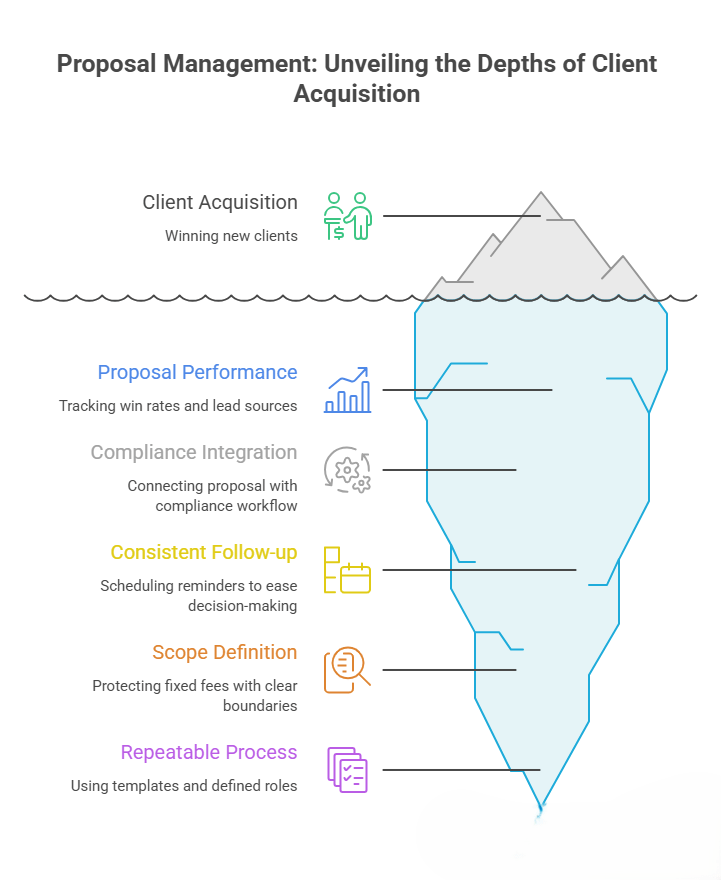
1. Track Your Proposal Management Performance
You cannot improve your proposal management process if you do not know how well your proposals are performing. Many accounting firms know how many clients they have won, but they do not track how many proposals they send, how many convert, or where opportunities are being lost. Tracking your proposal win rate gives you a clear picture of whether your proposal management strategy is working.
The formula is simple:
Proposal win rate = Number of proposals won ÷ Number of proposals sent × 100.
For example, if you send 50 proposals and win 15, your win rate is 30%.
However, good proposal management goes beyond one number. Accounting firms should also review the value of proposals won, the type of services that convert best, and which lead sources produce the strongest opportunities. A firm may have a good overall win rate but still struggle to win larger advisory or tax engagements. That shows the issue may be positioning, pricing, or how the proposal communicates value.
Reviewing proposals by source, such as referrals, website enquiries, existing clients, networking, and outreach, helps firms understand where they should focus their efforts.
2. Build Compliance Into Your Proposal Workflow
Many accounting firms treat proposals, engagement letters, onboarding, and compliance as separate steps. The proposal is prepared first, the client agrees, and only then does the firm start collecting information, completing checks, and preparing documents. This approach creates unnecessary delays and adds friction for both the firm and the client.
A stronger proposal management workflow connects these steps from the beginning. A well-managed accounting proposal should clearly explain the services included, deliverables, fees, timeline, client responsibilities, terms, and next steps.
For UK accounting firms, proposal management should also consider compliance requirements such as identity verification, AML procedures, client risk assessments, and record keeping. When compliance is built into the same workflow as the proposal, clients can move from interested prospect to signed client more efficiently. The easier you make the process, the less chance there is of losing momentum after the client says yes.
Did You Know?
Under the FigsFlow onboarding model, a fully combined proposal, engagement letter, payment mandate, and AML request takes a firm 10 to 15 minutes per client. The same steps handled through a patchwork of separate Word documents and tools took 2 hours 40 minutes.
3. Follow Up Consistently After Sending Proposals
Sending a proposal and waiting for a response is one of the easiest ways to lose opportunities. A lack of response does not always mean the prospect is not interested. Often, clients are busy, comparing options, managing deadlines, or simply forgot to reply. Strong proposal management includes a clear followup process. Instead of sending one reminder and assuming the opportunity is gone, firms should create a consistent communication schedule.
After sending the proposal, confirm the client has received it and let them know you are available if they have questions. A few days later, follow up to see whether they need clarification around the scope, pricing, or next steps. If there is still no response, a final follow-up can remind them without creating pressure.
The purpose of follow-up is not to chase the client. It is to make the decision easier and keep the conversation moving.
4. Protect Fixed Fees with a Clear Scope
Fixed fees are attractive because clients want certainty. They know what they are paying and accounting firms can create predictable revenue. However, fixed fees only work when the scope is clearly defined. Without proper proposal management, unclear scope can lead to scope creep, where additional work slowly gets added without additional fees.
This can happen when a bookkeeping client increases their transaction volume, a tax client introduces new income sources, or a client starts requesting services that were never included in the original agreement. A strong proposal management process makes expectations clear from the beginning. The proposal should explain what is included, what is excluded, and what situations may require a fee review.
For example, instead of simply writing “monthly bookkeeping services included”, a clearer scope would explain the expected transaction volume and what happens if the workload increases.
Clear scope protects the relationship because both the firm and the client understand what has been agreed.
5. Create a Repeatable Proposal Process
The best accounting firms do not depend on one person’s memory to manage proposals. They create a repeatable proposal management process that ensures every prospect receives the same professional experience. This starts with having templates for common services such as bookkeeping, tax returns, payroll, and advisory work. Templates save time while ensuring important details are not missed.
A good process also defines responsibility. Everyone should know who prepares the proposal, who reviews pricing, who sends it, and who manages follow up. Most importantly, firms should review their proposals regularly. Every successful and unsuccessful proposal provides useful information. By analysing which proposals converted, which objections appeared, and why prospects chose another firm, businesses can continuously improve their proposal management approach.
The firms that improve their process over time are the ones that create more consistent results.
How FigsFlow Manages the Whole Proposal Process
Managing proposals manually across emails, spreadsheets, and separate documents can create unnecessary admin and make it difficult to track performance.FigsFlow helps accounting firms manage the entire proposal management process in one workflow, including proposal creation, engagement documents, signatures, onboarding steps, and tracking.
By bringing these activities together, firms can spend less time managing paperwork and more time focusing on winning new clients and delivering valuable services.
Conclusion
Proposal management is not about creating longer documents or sending more proposals. It is about creating a clear and simple journey that helps prospects understand your value and confidently move forward.Accounting firms that measure their results, communicate their services clearly, follow up consistently, protect their scope, and build repeatable systems will be better positioned to convert more opportunities.
The next growth opportunity for your firm may not come from finding more leads. It may come from improving the way you manage the proposals you already send. Start by reviewing your recent proposals and identifying what your successful ones have in common. That is where better proposal management begins.
FAQs
A clear scope, a fee the client understands, and a fixed followup routine. It defines who drafts, reviews, and signs off, sets real deadlines for each stage, and tracks every proposal won or lost so you can keep refining what works.
Most proposals lose not on quality but on confusion or silence. A solid process makes the offer clear, the fee justified, and the followup consistent. That wins more work, protects your margin, and removes hours of admin from every client you take on.
Track your win rate, build the engagement letter and AML into the proposal itself, follow up several times rather than once, and set a scope tight enough to spot drift. Then review what your winners share and reuse it.
A proposal is the commercial document that sets out your services and fees to win the client. An engagement letter is the legal agreement that follows acceptance, defining scope, responsibilities, and terms. The strongest workflow combines both so the client signs once.