
How to Choose the Right Digital Identity Verification Solution
Choose digital identity verification software that integrates with your workflow, automates compliance, and meets MLR 2017 requirements.
Your clients verify their identity for a mortgage in minutes on their phone. Then your firm asks them to email a passport scan and wait.
That gap costs more than goodwill. Every day between client acceptance and a completed check is a day of compliance exposure, and most digital identity verification tools close only part of it.
The harder problem is that vendor demos all look alike. Every platform claims integration, automation and audit readiness.
Building on our complete guide to ID verification in AML, this article gives you ten criteria, a vendor checklist and the questions that separate a real solution from a sales deck.
Key Points for Busy Professionals
Digital identity verification solutions vary dramatically in how they handle integration, automation, and audit trail generation. The wrong choice creates compliance gaps even when you’re technically “doing the checks.”
Here’s what separates effective solutions from checkbox compliance tools:
- Workflow integration means verification starts at client onboarding, not after someone remembers to log into a separate tool
- Electronic verification should check government databases, credit reference agencies and sanctions lists at the same time, not one after another
- Audit trails should timestamp every action automatically because your AML supervisor will expect proof of your compliance journey, not just certificates
- Risk assessment templates should reflect accountancy sector risks rather than generic questionnaires
- Foreign document coverage, client onboarding experience and pricing model matter as much as the compliance features
- The checklist later in this article turns all ten criteria into a side by side vendor comparison
What Should Digital Identity Verification Do?
Digital identity verification gets treated as a compliance checkbox when it should function as the foundation of your entire Customer Due Diligence process, and of every step of an AML check that follows.
What IDV Actually Means
Client identity verification confirms that the person or entity you’re onboarding matches the identity documents they’ve provided. This involves three distinct components working together.
- Document Verification: Checks that passports, driving licences, or identity cards are genuine and haven’t been tampered with. Electronic verification systems read the machine-readable zone on these documents and compare data against authoritative independent sources.
- Database Verification: Confirms identity details against government records, credit reference agencies, and official registries like Companies House for corporate clients. This cross-referencing ensures the person exists in legitimate public records.
- Biometric Verification: Matches the photograph on identity documents to live images or selfies provided by the client. This prevents someone using stolen or borrowed documents by confirming the person presenting the ID is actually the document holder.
A photocopied passport proves you received a document. It does not prove you checked it. MLR 2017 regulation 28(18) requires verification on the basis of documents or information from a reliable source that is independent of the client. Electronic checks are one way to meet that test, not the only one, but they leave a record a visual check cannot. These are among the most common ID verification mistakes in AML.
The machine readable zone (MRZ) on passports and identity cards is what makes electronic document checks possible. The system reads the encoded strip and compares it with the printed details and with independent records.
Most accounting firms only need the first two components. Biometric verification becomes relevant for Enhanced Due Diligence situations involving high-risk clients.
The Compliance Standards You Must Meet
The Money Laundering Regulations 2017 require you to verify client identity before you establish a business relationship (regulation 30(2)). Regulation 30(3) allows verification to finish during onboarding only where this is necessary to avoid interrupting normal business, the money laundering risk is low, and you complete verification as soon as practicable.
MLR 2017 regulation 28 specifies that verification must use documents, data, or information from reliable and independent sources. A passport photocopy satisfies the document requirement but doesn’t prove you verified it against independent sources.
Your verification process must also screen clients against sanctions lists and PEP databases. Politically exposed persons are individuals holding prominent public functions where corruption risks are elevated.
The regulations require you to keep CDD records for five years from the date the business relationship ends, or from completion of an occasional transaction (regulation 40(3)). Those records should show not just what documents you collected but what you verified, when you verified it, and what results you obtained. This is why audit trail automation matters more than most firms realise.
Need the full compliance picture?
Digital identity verification is just one piece of your AML obligations. Our comprehensive guide covers Customer Due Diligence requirements, risk assessment frameworks, and record-keeping rules that accountants must follow in 2026.
Read: 2026 Guide to AML & Identity Verification Rules for Accountants →
Before You Compare Vendors, Audit Your Current Process
A vendor checklist only works if you know which gaps you are trying to close. Map your current process first.
- Timing: Note when ID checks happen relative to client acceptance. MLR 2017 regulation 30(2) requires verification before the business relationship starts, with only a narrow low risk exception.
- Records: List where each piece of evidence lives today, from client data and documents to certificates, risk assessments and approvals.
- Cost: Work out what one check costs you now, including subscriptions, per client fees and any separate charges for PEP, sanctions or Companies House checks.
Each gap you find maps to one of the criteria below.
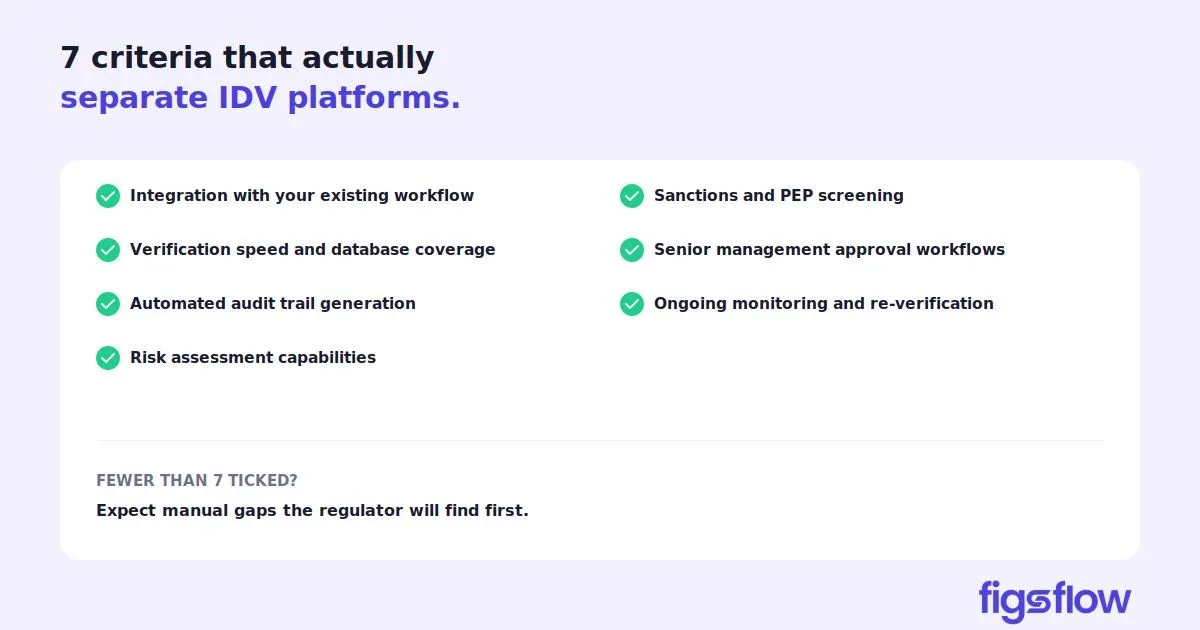
10 Criteria for Choosing the Right Digital Identity Verification Solution
Effective digital identity verification solutions share specific characteristics that separate them from systems that technically work but create operational headaches.
Integration with Your Existing Workflow
Integration determines whether verification happens automatically or requires manual intervention every time you onboard a client.
Standalone verification tools sit outside your practice management system. You win a new client in your CRM, send them an engagement letter, then manually log into a separate verification platform to start compliance checks. This creates a gap where clients begin receiving services before verification completes.
Integrated solutions trigger verification automatically when clients accept engagement letters. The moment they sign, their information flows to the compliance module without anyone needing to remember to initiate checks manually.
Look for platforms that connect directly to your CRM through native integrations. HubSpot integration means won deals import automatically to your compliance dashboard with all client data already populated.
Without integration, one client file ends up in four places: client data in the CRM, documents in email, certificates in the AML tool and risk assessments in a spreadsheet. When your supervisor asks for the full record, someone has to rebuild it by hand.
Database Coverage and Simultaneous Checks
Verification speed affects both client experience and your team’s efficiency. Manual verification means checking documents, searching sanctions lists, and recording results across multiple systems for every client.
Electronic verification should check government databases, credit reference agencies and sanctions lists at the same time, not one after another.
Database coverage matters as much as speed. Your solution should access Companies House for corporate clients, verifying incorporation details and checking the Person with Significant Control (PSC) register automatically. The PSC register identifies persons with significant control, which is essential for beneficial owner verification.
For corporate clients, the PSC register is a starting point, not the end point. MLR 2017 regulation 28(9) states that you do not meet the beneficial owner requirements by relying solely on information delivered to Companies House.
Ask vendors which specific databases their system queries. “Government databases” is too vague. You need to know whether they’re checking DVLA records, passport databases, electoral registers, and credit files.
Non UK Client Coverage
If you act for overseas clients or UK residents with foreign passports, ask whether the system can read and check foreign documents, not just UK ones. A tool built around UK databases alone pushes those clients back into manual checks.
Immigration documents have changed too. The eVisa has replaced the biometric residence permit for most non UK nationals, and a share code from it proves immigration status, not identity. Your solution and your procedures should treat it that way.
Automated Audit Trail Generation
AML supervisor inspections, whether by HMRC or a professional body such as ACCA or ICAEW, focus heavily on your ability to prove compliance, not just demonstrate that you collected documents. A passport copy in your filing cabinet shows you received a passport, but doesn’t prove you verified it against any database.
Manual audit trails fail because they depend on someone remembering to document every action they take. When verification happens across multiple systems, audit trail gaps are inevitable.
Automated audit trail generation timestamps every action without manual logging. Document uploads get timestamped. Verification checks get timestamped. Risk assessments get timestamped. Senior management approvals get timestamped.
The system should generate compliance certificates automatically showing exactly what was verified, which databases were checked, what results were obtained, and when each action occurred. Those records then support the MLR 2017 retention period of five years after the business relationship ends.
A verification certificate proves a check happened on a given date. It does not show how you assessed risk, who approved a high risk relationship or what ongoing monitoring followed. The audit trail needs to connect all of it to the client record.
It also has to outlast the people who created it. Staff leave and systems change, but the records must stay available for five years after the business relationship ends.
Read the complete ICAS review findings
Risk Assessment Capabilities
Generic risk questionnaires don’t reflect the specific risks facing UK accounting practices. You need risk assessment templates aligned with the AML guidance for the accountancy sector that your supervisor applies.
Templates should exist for different client types because property portfolios carry different risks than trading businesses or trust administration. High-net-worth individuals require different risk assessment questions than standard SME clients.
The system should calculate overall risk ratings based on your responses and flag automatically when Enhanced Due Diligence triggers apply. EDD situations include PEPs, a business relationship or transaction with a person established in a FATF call for action country, complex ownership structures, and unusual transaction patterns.
Reusable templates matter more than most firms realise. Client circumstances change over time. When that happens, you complete a fresh risk assessment to determine whether your due diligence level remains appropriate.
Sanctions & PEP Screening
Every client verification should screen against PEP lists and financial sanctions lists. MLR 2017 requires risk management systems to identify PEPs (regulation 35(1)), and UK financial sanctions, made under the Sanctions and Anti-Money Laundering Act 2018, apply to every UK firm. Adverse media screening is not named in the regulations, but it strengthens your client risk assessment.
Sanctions lists update constantly as governments add or remove individuals and entities. Your verification solution should pull current data with every check rather than relying on manually updated databases that might be weeks out of date.
The system should check the UK Sanctions List, which became the only source of UK sanctions designations when the OFSI Consolidated List closed on 28 January 2026. Firms with international clients may also screen UN, EU and OFAC lists. PEP screening should cover both domestic and foreign politically exposed persons.
When the system identifies potential matches, it should alert you for manual review rather than automatically blocking the client. Not every John Smith flagged in sanctions screening is the sanctioned John Smith. Your decision and reasoning should get recorded automatically in the audit trail.
Senior Management Approval Workflows
Senior management approval is mandatory before you establish or continue a relationship with a PEP, or a PEP’s family member or known close associate (regulation 35(5)(a)), and for a business relationship or transaction with a person established in a FATF call for action country (regulation 33(3A)). Many firms extend the same sign off to every high risk client as a matter of policy.
Manual approval processes fail when people forget to escalate or when approval requests sit unanswered in email inboxes. The system should route high-risk cases automatically to designated senior managers when verification results or risk assessments indicate EDD triggers.
Senior managers need a complete context visible in one place. Verification results, risk assessments, submitted documents, and any flags or concerns should all appear in the approval request.
Every approval must be timestamped and recorded with the approving manager’s identity. You need to prove not just that approval occurred but who approved it, when they approved it, and what information they reviewed.
Ongoing Monitoring & Re-verification
Client verification isn’t a one-time event. MLR 2017 regulation 28(11) requires ongoing monitoring of every business relationship, including keeping CDD documents and information up to date, with the depth of monitoring reflecting the risk level you’ve assigned.
Document expiry tracking matters because passports and identity cards expire. Your system should flag when client documents are approaching expiry dates so you can request updated copies before they lapse.
Client circumstances change. Someone might become a PEP after your initial verification. A standard-risk client might expand into high-risk jurisdictions. The system should support re-verification workflows when client circumstances change materially.
Ongoing sanctions screening catches clients who get added to watchlists after your initial checks. Periodic screening frequency depends on client risk level, but your system should make it easy to run fresh checks without starting the entire verification process from scratch.
Client Onboarding Experience
Clients judge your firm on onboarding before they judge your advice. Many already complete digital ID checks for banks and mortgage lenders in minutes, so printing, signing and posting documents feels out of date.
Look for verification the client completes through a secure link or portal on their phone, with document requests matched to the client type. Individuals need photo ID and proof of address. Companies need incorporation documents and beneficial owner details.
The less your team chases, the sooner the check is complete. Good client experience and good compliance pull in the same direction.
Pricing Model and Total Cost
AML pricing models vary more than the features do. Some platforms charge a monthly subscription per client, then bill separately for every ID check, PEP search and sanctions screen. Others charge per check with everything included.
Compare total cost at your real volume. Multiply your monthly new clients by the full cost of one check, add any fixed platform fee, and confirm whether ongoing monitoring and Companies House checks cost extra.
Cut Through the Marketing Noise
Understanding these criteria helps, but comparing actual software against them takes hours of vendor calls and demo requests. Most marketing materials claim every feature regardless of actual capabilities. Use the checklist below to compare solutions systematically or see how FigsFlow implements each criterion in practice.
Read the complete ID verification guide
How to Compare Digital Identity Verification Solutions: A Checklist
Use this comparison framework when evaluating different verification platforms. Put a tick in each box where the solution meets the requirement fully.
| Feature | Solution A | Solution B | Solution C | Solution D |
|---|---|---|---|---|
| Native CRM integration (HubSpot, Salesforce) | ||||
| Automatic verification triggered at engagement acceptance | ||||
| Electronic verification with simultaneous database checks | ||||
| Government database checks included in base price | ||||
| Automated sanctions and PEP screening | ||||
| Timestamped audit trails are generated automatically | ||||
| Risk assessment templates aligned with accountancy sector guidance | ||||
| Automatic senior management approval routing | ||||
| Secure client document collection portal | ||||
| Compliance certificates generated per verification | ||||
| Companies House PSC register verification | ||||
| Document expiry tracking and alerts | ||||
| Foreign passport and ID card verification | ||||
| Client completes checks through a secure link or portal | ||||
| All checks included in one price per verification |
Every unticked box is work your team will handle manually, even when the solution technically completes verifications. You’ll spend time transferring data between systems, manually logging actions, and chasing approvals.
Introducing FigsFlow: An ID Verification Platform That Ticks the Checklist and Beyond
FigsFlow is practice management software built specifically for UK accounting firms with AML compliance integrated throughout the workflow rather than bolted on afterward.
Here’s what FigsFlow offers for digital identity verification:
- Onboarding Link Verification: Verification starts from a secure onboarding link sent to the client, or through the Trust ID integration with NFC chip passport verification.
- Fast Electronic Checks: Connects directly to government databases and credit reference agencies, with results and compliance certificates generated instantly.
- Integrated Sanctions Screening: Runs simultaneous checks against PEP lists, financial sanctions lists, and adverse media databases.
- Companies House Integration: Verifies incorporation details and checks the PSC register automatically for corporate clients.
- Automated Audit Trails: Every verification action, document upload, and approval creates timestamped records without manual logging.
- Sector-Aligned Risk Assessment Templates: Customised templates for property portfolios, trusts, trading businesses, HNWIs, and cross-border clients.
On the AML, IDV and risk assessment plan, each check costs £2.10 + VAT, with a fixed fee of £8 + VAT a month and a minimum purchase of 10 credits. Every check includes identity validation, PEP screening, sanctions, liveness and Companies House verification in a single price, with no separate line items.
FigsFlow doesn’t just verify identities. It transforms how your firm manages compliance from first contact through ongoing client relationships.
FigsFlow Goes Far Beyond Digital Identity Verification
FigsFlow offers everything from client proposals and engagement letters to pricing calculators, document collection portals, team collaboration tools, and payment integrations:
- Generate compliant proposals and engagement letters in 30 seconds
- Collect CDD documents securely through client portals without email back-and-forth
- Integrate seamlessly with Xero, QuickBooks, and Stripe for an end-to-end workflow
- Manage team collaboration with internal notes, task assignments, and approval workflows
Conclusion
Choose the digital identity verification solution that closes your gaps, not the one with the best demo.
Map your current process, score each vendor against the ten criteria, and compare total cost at your real client volume. Firms that do this buy a system that runs compliance inside onboarding. Firms that skip it buy another login.
Before you sign, ask yourself three questions. Does verification start without anyone remembering to start it? Could you hand your supervisor a complete client record today? Do you know what one check really costs?