
Engagement Letter vs Letter of Intent: What’s the Difference & Why It Matters for Accountants
Engagement letter vs letter of intent? Learn the exact difference, legal risks, and precisely when UK accountants must use each to ensure strict compliance.
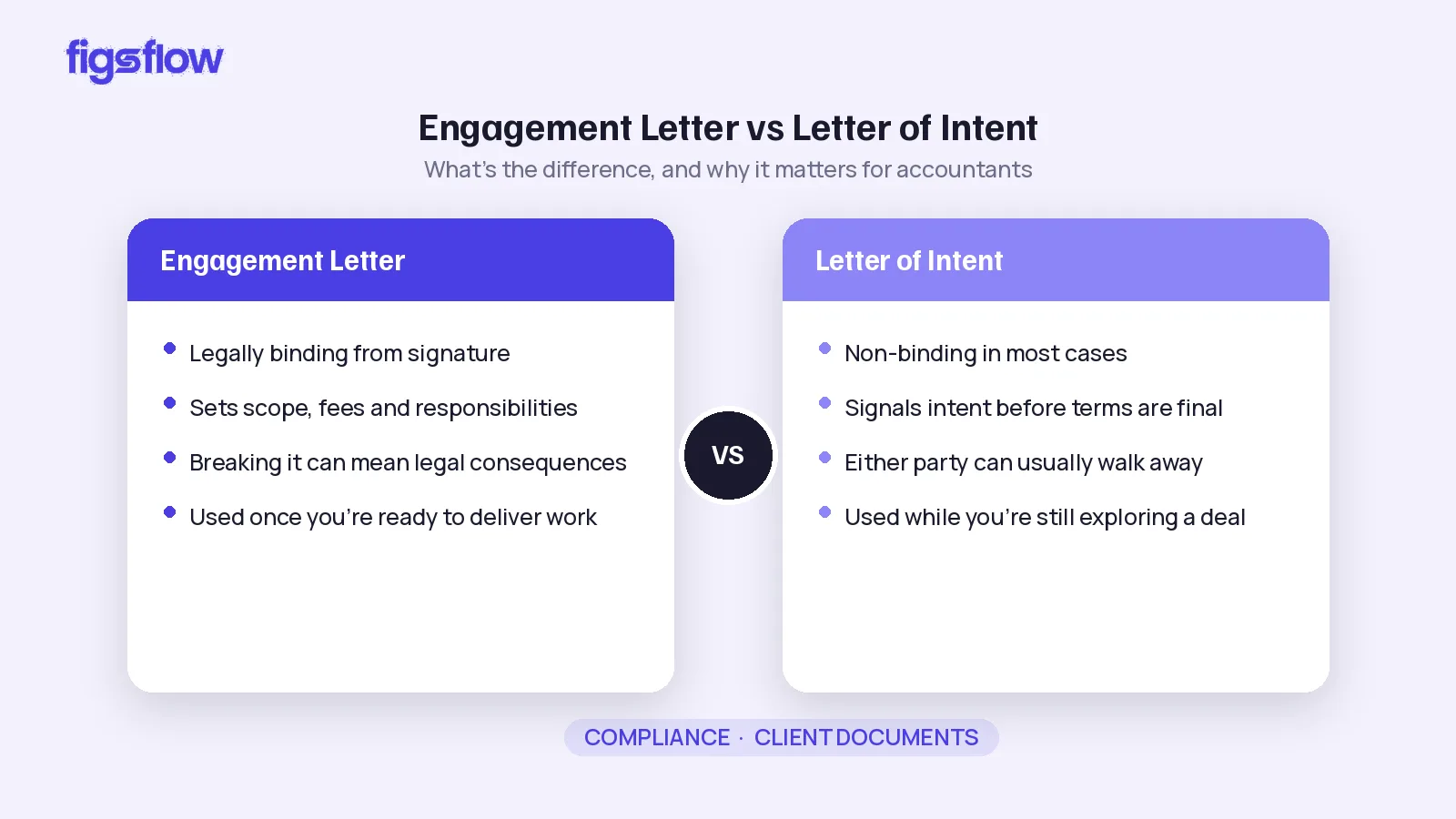
When comparing an engagement letter vs letter of intent, the core distinction is this: an engagement letter (LOE) is a binding written agreement that initiates professional services. A letter of intent (LOI) is a non-binding preliminary document used before formal commitment. For UK accountants, the rule is simple: use an LOE when work is about to begin, and an LOI when you are still exploring whether to proceed. Using the wrong one at the wrong stage creates legal ambiguity that ACCA and ICAEW both cite as a common source of member complaints.
The engagement letter vs letter of intent question comes up every time you onboard a new client. Do you send one or the other?
Get it right and you have legal protection from day one. Get it wrong and you either have unenforceable obligations or no protection at all.
The engagement letter vs letter of intent difference is not complicated. An engagement letter starts the work. A letter of intent explores whether to. But using the wrong one at the wrong moment costs UK accountants more than most realise – from unenforceable fee terms to unintended legal commitments before a deal is even agreed.
Here is exactly how the engagement letter vs letter of intent distinction works in practice, when to use each, and the five mistakes experienced accountants still make.
Key Highlights: Engagement Letter vs Letter of Intent
- In the engagement letter vs letter of intent comparison, engagement letters or Letters of Engagement (LOEs) establish immediate, legally binding agreements.
- Letters of Intent (LOIs) are typically non-binding and used to outline the intent to negotiate a future deal with no formal commitment yet.
- LOEs require specific terms (scope, fees, responsibilities) because they initiate actual work; LOIs remain broad to allow flexibility during ongoing discussions.
- Breaking an Engagement Letter can lead to legal consequences. In contrast, walking away from a Letter of Intent is generally permissible unless specific clauses (e.g. confidentiality or exclusivity) are breached.
What is an Engagement Letter?
An engagement letter is a legally binding agreement between an accounting firm and a client that defines the scope of services, fees, responsibilities, and legal terms before any work begins. Required by ACCA, ICAEW, CIOT, and AAT, it is the primary legal protection for any UK accounting practice if a client dispute, fee argument, or negligence claim arises.
In the engagement letter vs letter of intent framework, think of the LOE as the rulebook for your relationship with your client – the document that locks everything in. As an accountant handling someone’s finances, the engagement letter you send your client makes things official and presents exact details about the scope of work, fees, deadlines and expectations.
The letter typically covers:
- Specific services to be provided
- Payment terms and fee structures
- Project timelines and deliverables
- Confidentiality requirements
- Termination clauses and exit procedures
- What happens if things go wrong or either party wants to end the relationship early
Here’s the crucial part: once signed, the LOE locks you into a working agreement. As an accountant, you’re committed to delivering the services and your client is committed to paying you according to the agreed terms.
Key Characteristics of an Engagement Letter
- Legally binding on both parties from the moment it is signed.
- Defines the specific scope of services to be delivered.
- Sets out fees, payment schedules and billing arrangements.
- Includes project timelines, milestones and deliverables.
- Contains confidentiality requirements and data handling obligations.
- Covers termination clauses and what happens if either party exits early.
- Governs ongoing professional relationships that can last months or years.
What is a Letter of Intent?
A letter of intent is a preliminary, typically non-binding document that signals serious interest in a potential deal or partnership before formal commitment. Unlike an engagement letter, it does not initiate work or create binding service obligations. Certain clauses within an LOI – such as confidentiality and exclusivity – are legally enforceable even if the wider deal falls through.
A letter of intent is a preliminary document that outlines the basic framework for a potential deal or partnership before anyone commits to the real thing. In other words, it’s your way of saying, “we’re seriously interested” without saying, “we are definitely doing this.”
In the engagement letter vs letter of intent context, letters of intent are the testing ground for bigger decisions. Whether you’re looking to acquire another business, enter a joint venture or make a major purchase, the letter of intent lets both parties explore the opportunity without the pressure of a binding contract.
The document typically includes:
- Proposed terms and conditions for the potential deal
- Key deal points and overall structure
- Due diligence requirements and timelines
- Exclusivity periods for negotiations
- Timeline for reaching final agreements
- Confidentiality obligations and basic legal protections during negotiations
Most letters of intent are non-binding, meaning either party can walk away if the deal doesn’t work out during deeper negotiations. However, certain provisions like confidentiality and exclusivity clauses are often legally enforceable even if the main deal falls through.
Key Characteristics of a Letter of Intent
- Generally non-binding, with the exception of specific clauses such as confidentiality and exclusivity.
- Used to signal serious interest in a potential deal before formal commitment.
- Covers broad deal terms and overall structure rather than operational detail.
- Sets out due diligence requirements and timelines for further negotiation.
- Includes exclusivity periods to prevent either party from negotiating with others.
- Temporary by design, typically expiring within 30 to 90 days. Does not initiate any actual delivery of services or work.
What is the key difference between an engagement letter and a letter of intent
The fundamental difference is binding force and timing. An engagement letter creates immediate, enforceable obligations the moment both parties sign – work begins and legal consequences follow. A letter of intent is exploratory. It maps out a potential deal without locking either party into legal obligations, with the exception of specific clauses like confidentiality or exclusivity.
In the engagement letter vs letter of intent comparison, an engagement letter creates immediate, enforceable obligations the moment both parties sign. Work begins, services flow and legal consequences follow if either side fails to deliver. A letter of intent, by contrast, is an exploratory document. It maps out the broad contours of a potential deal without locking anyone into legal obligations, with the notable exception of specific clauses like confidentiality or exclusivity that are typically drafted to be enforceable regardless of whether the deal proceeds.
| Engagement Letter (LOE) | Letter of Intent (LOI) | |
|---|---|---|
| Legally binding | Yes, in full from signing | Partially, specific clauses only |
| Purpose | Formalises an active working relationship | Explores a potential future deal |
| Level of detail | Comprehensive, covers all terms of service | Broad, high-level framework only |
| When it is used | Before work begins | Before formal negotiations begin |
| Duration | Months to years depending on services | 30 to 90 days typically |
| Consequences of exit | Legal liability for breach of contract | Generally no consequences unless binding clauses are violated |
| Initiates work | Yes | No |
For a closer look at how engagement letters compare to other professional documents, the guide on Engagement Letter vs Proposal: Understanding Key Differences covers this well.
When should UK accountants use an engagement letter vs letter of intent?
When thinking about engagement letter vs letter of intent usage, engagement letters are fundamental whenever you are delivering professional accounting services.
They define the scope, responsibilities, fees and terms before work starts, protecting both you and your client. Letters of intent come into play when you are advising on or involved in exploratory or transactional work, where the outcome is not yet fixed and both parties need space to evaluate before committing.
Understanding the engagement letter vs letter of intent question is not just about legal protection. It is about setting the right tone with clients from the start. An engagement letter signals that work is beginning and expectations are locked in. An LOI signals that you are serious but still exploring. Using the wrong one sends the wrong message and can create confusion about what has actually been agreed.
| Scenario | Use an LOE | Use an LOI |
|---|---|---|
| Onboarding a new bookkeeping client | ✓ | |
| Preparing annual statutory accounts | ✓ | |
| Delivering a self assessment tax return | ✓ | |
| Providing ongoing tax planning and advisory services | ✓ | |
| Supporting a client through a business acquisition | ✓ | |
| Conducting financial due diligence ahead of a merger | ✓ | |
| Advising on a joint venture or strategic partnership | ✓ | |
| Reviewing terms for a major financing or supply contract | ✓ | |
| Providing audit or assurance services | ✓ | |
| Negotiating heads of terms on a commercial property deal | ✓ |
For a full walkthrough on putting an engagement letter together correctly, the Complete Guide to Drafting Engagement Letters covers the process step by step.
What are the most common mistakes accountants make with engagement letters and letters of intent?
Even experienced accountants get tripped up by these two documents. The mistakes are rarely about intent. They usually come down to using the wrong document at the wrong time, leaving terms vague or assuming a signature means the same thing in both cases. Here are five mistakes worth avoiding.
Mistake 1: Starting Work Without a Signed Engagement Letter
Beginning client work before the LOE is signed leaves you with no formal protection if the client disputes scope, refuses to pay or walks away mid-project. Work should not start until the letter is signed.
Mistake 2: Treating a Letter of Intent as a Contract
An LOI signals interest, it does not confirm commitment. Assuming it means a deal is agreed can lead to serious problems if you have already allocated time or resources to work that was never formally confirmed.
Mistake 3: Using an Engagement Letter for Exploratory Work
If the scope is not yet defined and neither party has committed to proceeding, an LOI is the right tool. Sending an LOE when you are still in the evaluation phase can create unintended obligations before you are ready.
Mistake 4: Leaving Scope Vague in an Engagement Letter
A poorly scoped LOE creates as many problems as having no letter at all. If services and boundaries are not clearly defined, scope creep becomes almost inevitable and you will have little grounds to push back.
Mistake 5: Ignoring the Binding Clauses in a Letter of Intent
Confidentiality obligations and exclusivity clauses within an LOI are typically enforceable even if the wider deal falls through. Assuming an LOI is entirely non-binding can expose you or your client to unexpected legal risk.
Conclusion
The engagement letter vs letter of intent choice is straightforward once you understand their purpose. Engagement letters formalise immediate professional relationships where services begin right away. Letters of intent explore future possibilities where both parties need time to evaluate before committing.
Using the right document at the right time protects your interests, prevents misunderstandings and keeps deals moving smoothly. The engagement letter vs letter of intent rule is simple: choose an engagement letter when you are ready to work. Choose a letter of intent when you are ready to explore.
Use FigsFlow to draft professional engagement letters in seconds!
Further Reading
- Engagement Letters Explained: 5 Most Common Questions Answered – Got questions about engagement letters? This guide answers the five most common ones accountants and professionals ask, from scope to signatures.
- When to Reissue an Engagement Letter (UK Guide) – Services change, clients evolve and regulations get updated. This guide explains exactly when UK accountants need to reissue an engagement letter and how to do it correctly.
- Disengagement Letter: How to Write One Right – Ending a client relationship professionally matters as much as starting one. This guide walks you through how to write a disengagement letter that is clear, compliant and protects your firm.
- Understanding Engagement Letters: A Guide for Professionals – New to engagement letters or looking to strengthen your understanding? This guide breaks down what they are, why they matter and what every accountant needs to know before sending one.