
Identity Verification through ACSP
Learn how identity verification through ACSP works and why it's crucial for UK company compliance and registration.
Identity verification is now a legal requirement for directors, Persons with Significant Control (PSCs), and anyone filing on behalf of a company. Companies House made this mandatory on 18 November 2025 to reduce fraud and improve the accuracy of the public register.
While verification can be completed through the GOV.UK One Login, many individuals, particularly those based outside the UK or without a UK credit history, choose to verify through an Authorised Corporate Service Provider (ACSP). This guide covers the ACSP route in full: the process, the standards, and the consequences of non-compliance.
What is an ACSP & Why Use One
An Authorised Corporate Service Provider (ACSP) is a professional agent registered with Companies House to verify identities on behalf of clients. ACSPs act as trusted intermediaries, ensuring the verification process meets all regulatory standards.
To qualify, an ACSP must be supervised by a UK Anti-Money Laundering (AML) supervisory body. This includes HMRC, the Financial Conduct Authority, ICAEW, ACCA, and others. The ACSP must also be registered with Companies House.
Before engaging an ACSP, check the Companies House register of ACSPs on GOV.UK. Note that the public list is opt-in, so not every registered ACSP will appear on it. You should also confirm their AML supervisory body registration directly.
The main advantage of the ACSP route is that you do not need a GOV.UK One Login, which removes the requirement for UK financial history checks. This makes it particularly useful for non-UK residents or those without an established UK credit history, as well as anyone who prefers to have the process handled professionally.
Further reading: Companies House Identity Verification: Who, When, How & Personal Code | FigsFlow
Ways of Identity Verification
Companies House offers two ways to verify your identity: through GOV.UK One Login, or through an Authorised Corporate Service Provider (ACSP).

Online Verification Through GOV.UK One Login
This service is free of charge. GOV.UK One Login will ask you a few questions to determine the most suitable verification method for you. Depending on your answers, you will be guided to verify in one of three ways:
- Via an app
- By answering security questions online
- By entering your photo ID details online, then visiting a participating Post Office
Once verified, your Companies House personal code will be available in the "Manage account" section of your Companies House account. From 18 November 2025, this code is required for confirmation statement filings, PSC filings, and director appointments.
Identity Verification through ACSP
ACSP stands for Authorised Corporate Service Provider, also known as a Companies House authorised agent.
Working with an ACSP removes the need to create a GOV.UK One Login account entirely. You provide the required documents and information to your ACSP, and they complete the verification with Companies House on your behalf.
The following sections cover the ACSP process in detail, including the standards ACSPs must meet and the consequences of non-compliance.
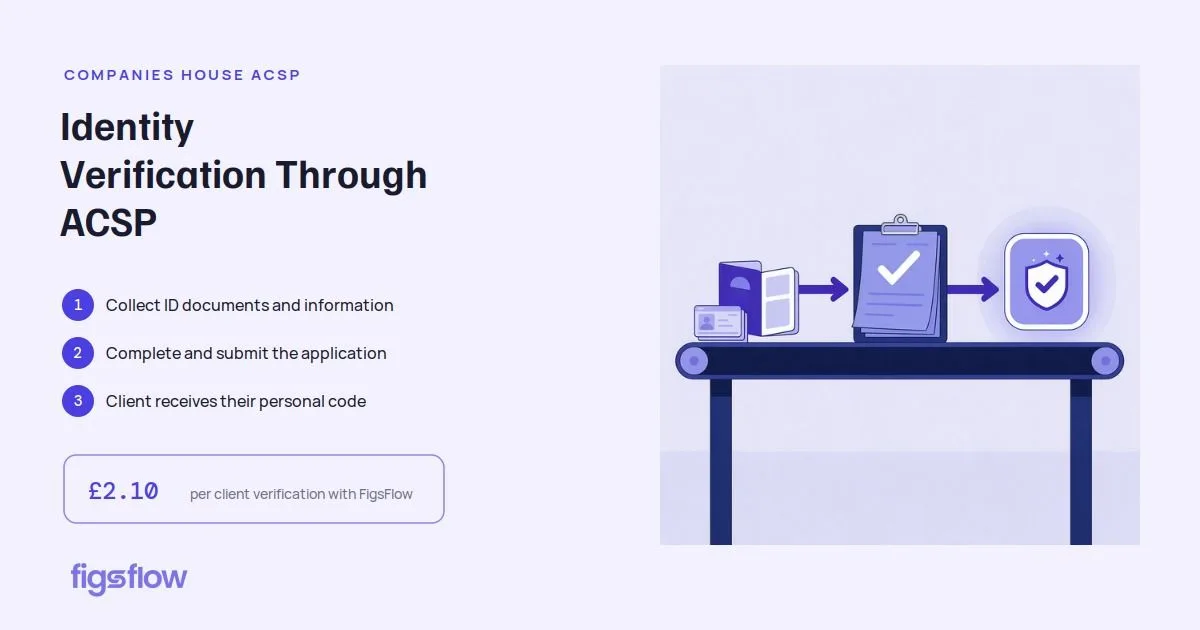
Procedure of Identity Verification through ACSP

ACSPs act as intermediaries between individuals and Companies House, completing the verification process on their clients' behalf. Companies House sets specific standards that every ACSP must follow. Failure to meet these standards can result in suspension or revocation of ACSP status.
Information Collection
Collecting accurate information is the foundation of the process. The ACSP must gather the following from the individual being verified:
- Full name, date of birth, and home address (extracted from identity documents)
- A functional, accessible email address. Companies House uses this to send the personal code
- Identity documents as evidence, stored securely by the ACSP
The specific documents required are covered in the IDV Standards section below. While not explicitly required by Companies House, it is strongly recommended that ACSPs complete their own AML due diligence before initiating the Companies House verification. This is a separate obligation and adds an important layer of protection for the firm.
Completing The Application Form
Once the information is gathered, the ACSP submits the verification using the GOV.UK service: Tell Companies House you have verified someone's identity. This must be accessed using the GOV.UK One Login credentials used when registering as an ACSP.
The form requires:
- Individual's name, email address, date of birth, and home address
- Date the identity checks were completed
- Method used: either IDVT (Identification Document Validation Technology, which validates the cryptographic features of the document) or in-person checks
- List of documents used
- Passport details including number, expiry date, and country of issue
- A declaration confirming compliance with Companies House requirements and the accuracy of all information provided
Before submitting, double-check for typographical errors. If an error is discovered after submission, the individual should contact the ACSP directly. The ACSP can then update the verification details with Companies House. This process is now in place following updates to the personal codes guidance.
Informing the Person About the Personal Code
Once verification is complete, Companies House sends the personal code to the email address provided by the ACSP. The ACSP should inform their client of this and advise them to:
- Check the email address provided was correct
- Store the code securely, treating it with the same confidentiality as a Unique Taxpayer Reference (UTR)
- Save the code to a Companies House account for easy future access. Individuals can do this by signing in with the email address to which the code was sent and confirming their verified status
IDV Standards Set By the Companies House
An ACSP must exercise heightened caution when conducting identity verification checks for third parties. Strict adherence to Companies House standards is essential. Negligence, such as failing to properly validate documents or overlooking signs of fraud, can result in suspension or revocation of ACSP status.
Required Documents
Companies House offers two options for document verification. The option selected determines what documents are acceptable.
Option 1: IDVT (Identification Document Validation Technology)
Option 1 applies only where verification is completed using technology that can validate the cryptographic features of the document. Cryptographic features are security elements embedded in identity documents that confirm the authenticity of the issuing authority.
Acceptable documents under Option 1:
- A biometric or machine-readable passport, or Irish passport card (can be up to six months expired, provided cryptographic features remain valid)
- A UK, Channel Islands, Isle of Man, or EU photocard driving licence (full or provisional)
- An identity card with biometric information from the EU, Norway, Iceland, or Liechtenstein
- A UK Biometric Residence Permit (can be up to 18 months expired)
- A UK Biometric Residence Card
- A UK Frontier Worker permit
Option 2: Manual Checks (Remote or In Person)
Option 2 applies where documents are checked by a person, either remotely or face to face. Two documents in total are required. The individual must provide either two documents from Group A, or one document from Group A and one from Group B.
For non-UK residents, at least one document must be a government-issued document from Group A.
Group A (document reference number, expiry date, and country of issue required):
- A passport or Irish passport card (can be up to 18 months expired)
- An identity card with biometric information from the EU, Norway, Iceland, or Liechtenstein
- A UK Biometric Residence Permit (can be up to 18 months expired)
- A UK Biometric Residence Card
- A UK-accredited PASS (Proof of Age Standards Scheme) card
- A UK or EU driver digital tachograph card
- A UK, Channel Islands, Isle of Man, or EU photocard driving licence (full or provisional)
- A UK HM Forces ID card
- A UK HM Armed Forces Veteran Card
- A UK Frontier Worker permit
- A government-issued photographic work permit
- A government-issued photographic immigration document
- A photographic visa
- A UK, Channel Islands, or Isle of Man firearms licence
- Any other photographic ID listed on PRADO (such as a National Identity Card from Pakistan, a crew member certificate from South Africa, or a US Permanent Resident Card)
Group B (no document reference number, expiry date, or country of issue required):
- Birth certificate or adoption certificate
- Marriage certificate or civil partnership certificate
- Non-photographic immigration document, visa, or work permit
- Bank or building society statement
- UK local authority or social housing rental agreement (must be for the person's current address)
- Mortgage statement (must be for the person's current address)
- UK council tax statement (must be for the person's current address)
- Utility bill (must be for the person's current address)
Records of the Identity Checks
ACSPs must retain all evidence and information used during the verification process for seven years from the date verification is completed. This includes copies of identity documents reviewed, evidence of checks carried out, and records of any unsuccessful verification attempts.
Evidence & Identity Check
Anyone manually checking identity documents must be trained by a specialist provider in accordance with the Home Office's best-practice guidance for detecting fraudulent documents. Documents should be examined for signs of tampering, particularly around areas displaying personal details. Where there is any doubt about a document's authenticity, the ACSP should contact the issuing authority directly. For documents issued outside the UK, concerns should be directed to the relevant embassy.
The ACSP must confirm that documents support the individual's name and date of birth. Where IDVT is used, the cryptographic features must match the data provided. A visual match between the individual and their photograph must be established, particularly during remote verification.
Where there are gaps in address history or a recent name change, additional documents should be requested to reduce the risk of accepting a synthetic identity. Signs of real-life activity should also be considered, such as recent transactions on a bank statement, utility or council tax bills addressed to the individual's home, or evidence that a passport has been actively used over time.
Risks & Consequences for ACSPs
When you take on identity verification work as an ACSP, you are accepting significant responsibility. The consequences of getting it wrong extend well beyond an administrative inconvenience.
Loss of Filing Capability
Companies House has confirmed that in the future, all agents filing on behalf of clients will need to be registered as an ACSP, though no confirmed date has been announced. If your ACSP status is suspended or revoked due to verification errors, you lose filing capability immediately, affecting your ability to serve clients across the board.
Reputational Damage
If an ACSP incorrectly verifies someone's identity, that individual must restart the entire process with a different ACSP. This creates frustration for your client and reflects poorly on your firm, often spreading through referral networks quickly.
Suspension or Revocation of ACSP Status
Under the Registrar (Identity Verification and Authorised Corporate Service Providers) Regulations 2025, Companies House issues a notice of suspension followed by a 28-day period before a formal notice of cessation. During this period, you have the right to object in writing. Errors that put your status at risk include incorrect verification submissions, failure to retain documentation for seven years, and not following prescribed document checking procedures.
Anti-Money Laundering Concerns
Most directors and PSCs with straightforward circumstances verify directly through GOV.UK One Login. When someone specifically seeks out an ACSP, it is worth asking why. Individuals wishing to conceal their true identity may attempt to exploit the ACSP route. Your existing AML due diligence is your first line of defence.
Documentation and Record Keeping Failures
You must retain all evidence and information used during verification for seven years from the date of completion. This includes copies of documents reviewed, evidence of checks carried out, and records of unsuccessful attempts. Failure to produce these records when required puts you in breach of your obligations as an ACSP.
Additional Resources
- Everything You Need to Know About Companies House Identity Verification in 24 Minutes: Companies House Identity Verification: Who, When, How & Personal Code | FigsFlow
- Don't Miss a Single Step with Companies House Identity Verification with Our Comprehensive Companies House Identity Verification Checklist: Companies House Identity Verification Checklist | FigsFlow
- Here's How You Can Choose the Right Identity Verification Solution: Digital Identity Verification Software Guide | FigsFlow
- 2025 Guide to AML & Identity Verification Rules for Accountants: 2025 Anti-Money Laundering ID Check Guide for Accountants in UK – FigsFlow
- Grab the Directors' Identity Verification Engagement Letter Templates for Accountancy Firms Registered As ACSP: Identity Verification Engagement Letter Templates – Accountants
Simplify your verification process.
Explore FigsFlow's AML software for accountants
Conclusion
Identity verification through an ACSP carries real legal and professional weight. ACSPs must apply consistent due diligence when reviewing documents and make a clear, defensible decision on whether to proceed with each verification.
Where there are signs of fraudulent activity or tampered documents, an ACSP has the right to decline the verification. In such cases, the individual must complete the process independently. Importantly, the obligation to retain evidence does not disappear if verification is declined; all related documentation must still be kept for seven years.
Done well, ACSP verification gives individuals and organisations confidence that the process has been handled accurately, securely, and in full compliance with Companies House requirements.
Simplify Client Identity Verification with FigsFlow
Meet Companies House requirements at £2.10 per verification. Automate client invitations, track progress in one dashboard, and stay audit-ready. Purpose-built for regulated UK practices.
Explore Identity Verification →