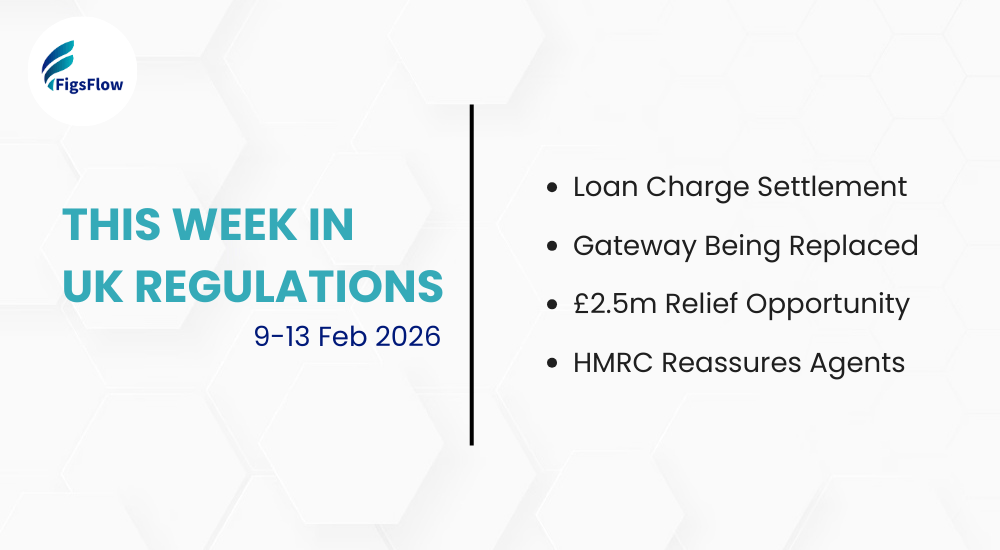

This week brought significant developments for UK tax professionals, from HMRC’s loan charge settlement rollout to major system changes affecting how practitioners access online services.
Here’s what you need to know.
Weekly News & Updates in 30 Seconds
- HMRC Loan Charge Settlement Begins – HMRC is sending letters with named contacts to affected taxpayers. Settlement offers reduced tax calculations, promoter fee deductions, and £5,000 automatic reductions, capped at £70,000 total.
- Government Gateway Phased Out for New Users – New HMRC service users must create GOV.UK One Login accounts. Existing Government Gateway users are unaffected until contacted. Full migration expected by the end of 2027.
- BPR Allowance Increase Opens Planning Opportunities – Business property relief raised to £2.5m from £1m. Splitting shareholdings can maximise relief but creates minority shareholder risks requiring careful governance planning.
- Government Reassures Agents on Registration Rules – Ministers confirm new agent registration targets harmful advisers only. HMRC won’t suspend for minor breaches and will work with advisers acting in good faith.
HMRC Begins Loan Charge Settlement Process with Named Contacts
HMRC started sending letters in January 2026 to taxpayers who used disguised remuneration loan schemes and now face the loan charge. The loan charge is a tax bill on loans received through certain tax avoidance arrangements, calculated based on income from 2019.
Following the McCann Review accepted at Budget 2025, HMRC is now offering reduced settlement terms. Each letter includes a named HMRC contact who explains how the individual’s position is affected.
The settlement scheme offers substantial reductions for those with outstanding loan charge liabilities:
- Tax calculated at the rates from the years when loans were made, not the 2019 rate
- Deduction for historic promoter fees up to £10,000 per year of scheme use
- Automatic £5,000 reduction per taxpayer
- Late payment interest written off, potentially reducing amounts by around 20%
- Maximum total reduction capped at £70,000 per taxpayer
Payment arrangements can be spread over five years without affordability discussions with HMRC. Inheritance tax from covered loan schemes will be written off, and penalties won’t be charged as standard.
However, the Loan Charge Action Group has criticised the settlement as too restrictive, particularly the £70,000 cap and exclusion of those who already settled under previous terms.
Government Gateway Replaced for New HMRC Users
From now on, anyone new to HMRC’s online services must create a GOV.UK One Login account instead of a Government Gateway ID. This marks the start of a gradual transition that won’t be completed until the end of 2027.
Existing Government Gateway users don’t need to take any action yet. They’ll continue using their current credentials and will be contacted when it’s time to switch. HMRC is taking a cautious, monitored approach to the rollout given the scale of change for practitioners and clients.
GOV.UK One Login uses an email and password instead of the familiar 10-12 digit Government Gateway ID. New users must prove their identity through the One Login app using face scans and photo ID.
When fully implemented, GOV.UK One Login will be the single access point for over 200 government services, from Making Tax Digital submissions to passport renewals and Companies House filings.
Inheritance Tax Planning Opportunities After BPR Allowance Increase
The government increased the business property relief allowance from £1m to £2.5m in December 2025, opening new restructuring opportunities for business owners planning inheritance tax mitigation.
Since the allowance applies to both individuals and trustees, there’s renewed interest in splitting shareholdings among multiple holders to maximise the £2.5m relief. However, tax savings must be balanced against business stability.
The key risk lies in minority shareholder rights. Under section 994 of the Companies Act 2006, minority shareholders can claim “unfair prejudice” if they’re treated improperly. Courts commonly order shares be purchased at fair value as a remedy, which could force unexpected liquidity demands on the business.
- Issues that can trigger unfair prejudice claims include:
- Decisions not to declare dividends
- Excessive management remuneration
- Inadequate information sharing with shareholders
- Diversion of business to other group entities
Litigation can be highly disruptive, with proceedings held in public courts requiring disclosure of internal documents and potentially damaging reputation. Legal costs and forced buyout prices could create significant financial strain.
Government Reassures Tax Agents on New Registration Rules
The government provided reassurances to tax professionals about new Finance Bill measures requiring agent registration and expanding sanctioning powers.
Speaking in the House of Commons on 3 February, Exchequer Secretary Dam Tomlinson confirmed agent registration targets “harmful tax advisers who do not meet basic minimum standards” and doesn’t give HMRC new investigative powers.
HMRC will only suspend an agent’s registration after due process, including opportunities to comply and explain circumstances. The powers won’t be used for minor breaches, and HMRC will work with advisers genuinely trying to comply.
On sanctionable conduct, ministers confirmed the measures won’t affect advisers acting in good faith or taking credible views on tax law, including those using HMRC guidance or extra-statutory concessions. The powers don’t target advisers who make genuine mistakes while trying to comply.
ICAEW welcomed these commitments but continues pushing for changes to legislation it considers too broadly drafted.
Plan Ahead
- Now Onwards: New HMRC users must create GOV.UK One Login accounts (existing Government Gateway users can continue for now)
- End of 2027: Full migration from Government Gateway to GOV.UK One Login expected to be complete
- Ongoing: HMRC is sending loan charge settlement letters with named contacts to affected taxpayers
Information compiled from news media, ICAEW and GOV.UK announcements published during the week ending 14 February 2026.