
A new client walks in for a £ 200-a-quarter bookkeeping service. But their books are two quarters behind and an absolute mess. Their previous accountant left things half-finished, and the records are all over the place.
The question every accountant dread at this point is simple. How much do you charge to catch up on all that work before the real engagement even begins?
Most UK accountants either avoid the question completely, bundle the catch-up into the first few months of fees, or pull a number out of thin air. All three approaches cost you money and start the relationship on shaky ground.
But here’s what doesn’t. Pricing catch-up work consistently, with a system that accounts for actual complexity, and presenting it professionally before anyone signs anything. In this guide, that’s exactly what we’ll cover.
What Is Catch-Up Work & Why Is It Always Underpriced?
Catch-up work is everything you need to do to bring a new client’s records up to date before your actual ongoing service can begin. Whatever the specifics, it represents real hours of work that sit entirely outside your standard service scope.
It typically includes:
- Backlog reconciliation from previous periods
- Missed quarterly updates or incomplete filings
- Records left in a mess by a previous adviser
- Clients who simply never kept proper records in the first place
The reason it gets underpriced is straightforward. There is no standard formula, so most accountants estimate. The estimate tends to be cautious because the conversation feels risky at the start of a new relationship. Nobody wants to lead with a number that sends a prospect straight to a competitor. So, the fee gets softened, absorbed, or skipped altogether, and you end up writing off hours that should have been billed from the beginning.
The result is always the same. You do the work, you absorb the cost, and the relationship quietly starts with you already behind.
What Should You Actually Charge for Catch-Up Work?
There is no single flat number that works across the board. It depends on the type of service you are providing and the nature of the catch-up work itself. With that being said, here are a few things to consider before settling on a fee.
Quarters behind.
One missed quarter is a contained piece of work. Three-quarters with overlapping transactions and incomplete documentation is a different engagement entirely. The further behind they are, the higher the catch-up fee should be.
Transaction volume.
A sole trader with forty transactions a quarter is not the same job as a landlord with two hundred. Volume drives time, and time drives cost.
Quality of existing records.
Clean records that need importing are manageable. No categorisation, missing bank statements, and no audit trail are significantly more work. Price what you actually see, not what you hope it will be.
Associated income sources.
Capital gains, dividend income, property income, and partnership income — each one adds complexity. A client with multiple income streams is a more involved engagement than a straightforward single-income self-assessment.
Once you factor all of this in, apply whatever pricing strategy works for your practice, whether that is value-based, hourly, or a hybrid of both. If you are unsure where to start, FigsFlow’s advanced pricing calculator does the heavy lifting automatically based on the inputs you provide.
Why the Proposal Is the Right Place for Catch-Up Fees
The worst time to tell a client what something costs is after you have already done the work. By that point, the fee is a surprise rather than an agreement, and even a reasonable number can land badly if the client was not expecting it.
When catch-up fees are included in the proposal upfront, three things happen naturally:
- The client knows exactly what they are agreeing to before they sign anything
- You have a documented record of what was agreed upon if questions arise later
- The relationship begins with transparency rather than a billing conversation nobody was prepared for
If the catch-up scope is not defined in the engagement letter, you have no protection when the work runs long or the client questions the invoice.
Professional firms include catch-up fees in the proposal as standard. Not because it is legally required, though the documentation does protect you. But it is simply how honest, well-run practices operate.
How FigsFlow Handles Catch-Up Fees in Proposals
Knowing what to charge is one challenge. Building it into a professional proposal quickly and accurately is another. This is where FigsFlow removes the friction entirely.
For every service in FigsFlow, catch-up fees are pre-configured. The factors that drive the work are already built in — transaction volume, quarters behind, complexity of the engagement, and associated income sources. You simply configure the service around your client, indicate that catch-up work applies, and FigsFlow calculates the fee automatically based on those inputs. The pricing panel updates in real time as you go.
By the time you proceed to preview, the proposal and engagement letter are both ready. Everything is accounted for, clearly priced, and presented professionally. No separate documents to prepare, no manual calculations, no mental arithmetic mid-conversation.
You do it all while building the proposal. That is all there is to it.
What the Client Sees
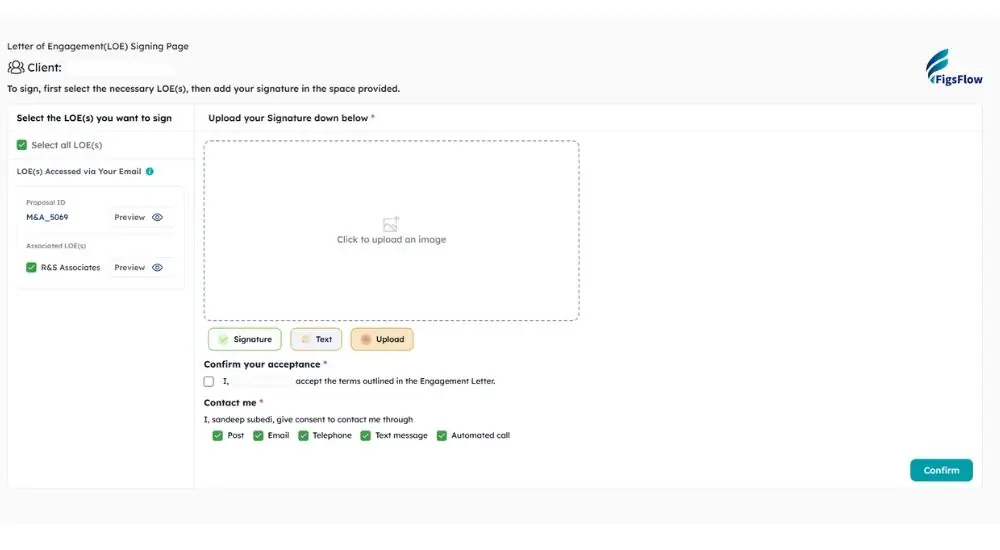
Once you send the proposal, the client receives a clean professional email from your firm. It includes their name, proposal ID, and a clear breakdown of what they are receiving — a proposal and a Letter of Engagement. A single button takes them straight to their documents.
From there, they land on the LOE signing page. They can preview the proposal and the engagement letter before committing to anything. The fee breakdown is laid out clearly inside the document. Every service is named, associated services are listed, and the net total, VAT, and gross total are all visible in plain figures. Nothing is ambiguous.
To sign, they can draw, type, or upload their signature. They confirm acceptance of the terms, select their preferred contact methods, and hit confirm.
No printing. No scanning. No chasing from yours. The catch-up fee is part of the breakdown, not a conversation you need to have later.
Conclusion
Catch-up work is a normal part of the accountancy world. Books get behind, accountants change, records get missed, and something always needs sorting before the real work can begin. As an accountant, you will always have to do it.
The question that matters is how you price it, when you present it, and how you systematise it across every new client. Most practices still treat it as an afterthought. It should not be.
Our advice is simple. Price it upfront, include it in the proposal, and find a system that makes it consistent every single time. FigsFlow does exactly that. Catch-up fees are pre-configured, automatically calculated, and built into your proposal before anything goes out to the client.
Systematising how you price catch-up work is one of the simplest changes you can make for your practice. And that should start today.
See FigsFlow in Action
Frequently Asked Questions (FAQs)
A catch-up fee is a one-time charge for bringing a new client’s records up to date before ongoing services begin. It covers backlog reconciliation, missed filings, incomplete records, and any other work that falls outside your standard service scope.
Including catch-up fees in the proposal ensures the client knows exactly what they are agreeing to before signing. It protects you if questions arise later and starts the relationship on transparent, professional terms.
Catch-up fees depend on how many periods are behind, transaction volume, quality of existing records, and complexity of associated income sources. There is no flat rate. Each client needs to be assessed individually before a fee is agreed.
Yes. Catch-up work sits entirely outside your standard service scope and should always be a separate, clearly named line item in your proposal rather than bundled quietly into the first few months of ongoing fees.
FigsFlow has catch-up fees pre-configured for every service. Based on the inputs you provide during proposal generation, it calculates the catch-up fee automatically and includes it in the proposal and engagement letter before anything goes out to the client.