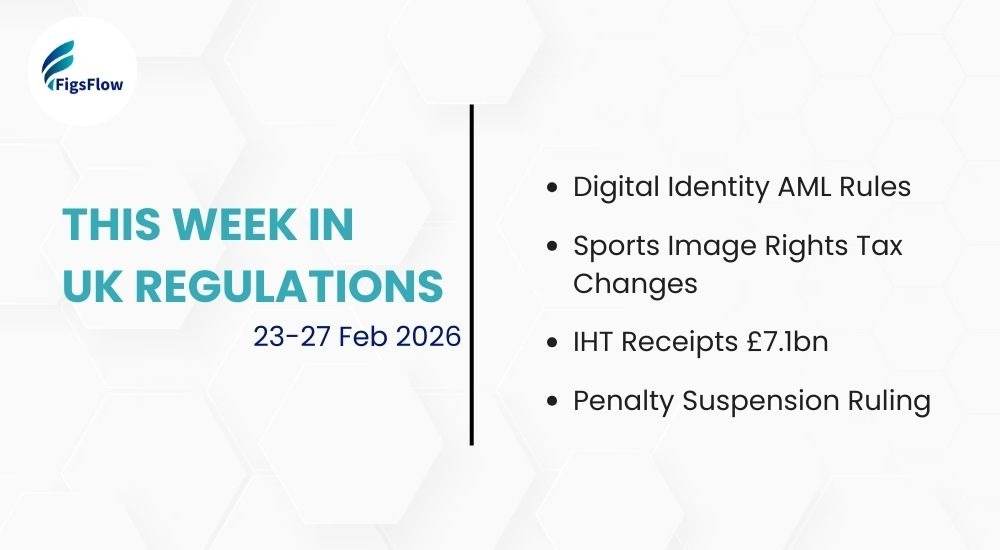

This week covers updated Treasury guidance on digital identity checks for AML compliance, significant changes to the tax treatment of sports image rights, an Upper Tribunal ruling on penalty suspension, and the latest inheritance tax receipt figures with a look at what’s coming.
Digital Identity Checks: Only Certified Providers Count
Treasury has published guidance clarifying which digital identity tools qualify under the Money Laundering Regulations, and the bar is specific. Only providers listed on the DVS register and certified under the UK digital verification services trust framework meet the standard. If your firm is using a digital ID solution that isn’t on that register, it doesn’t satisfy your MLR obligations regardless of how robust the tool appears.
The guidance also draws a clear line on what digital identity actually covers. It handles identification and verification, but it doesn’t fulfil every aspect of customer due diligence. Assessing the purpose and nature of a business relationship, transaction monitoring, and record retention under Regulation 40 of the MLRs remain the firm’s responsibility.
Using a certified DVS provider doesn’t transfer that liability anywhere.
Sports Image Rights: Significant Cost Exposure from April 2027
From 6 April 2027, image rights payments connected to employment will be treated as employment income, subject to income tax and national insurance contributions from both employer and employee. The traditional structure where clubs contract separately with a player’s image rights company, sitting outside PAYE and NIC, will no longer hold where an employment connection exists.
The financial exposure is substantial.
- Clubs will face a 15% employer NIC charge on payments that have until now sat entirely outside that calculation.
- Players will see the same income taxed at 45% plus 2% employee NIC rather than at corporate rates.
A large proportion of existing contracts are structured on a net basis, which means clubs may need to increase the gross payment to maintain the player’s net position. The combined effect on contract costs will be considerable for top-tier clubs.
What remains unresolved is the treatment of genuinely independent commercial arrangements. Sponsorship deals with no employment connection should, in principle, remain outside employment income, but where a club sponsor and a player sponsor overlap, the boundary is unclear. HMRC has not yet provided guidance on how this distinction will be drawn in practice.
Penalty Suspension: One-Off Error Doesn't Guarantee Relief
The Upper Tribunal has upheld HMRC’s decision not to suspend a careless penalty in a case where the error was an isolated one.
In Cox v HMRC, the taxpayers had claimed business asset disposal relief on a share sale but didn’t meet the 5% ordinary share capital condition. HMRC charged a careless error penalty and refused suspension. The First-tier Tribunal sided with HMRC, and the Upper Tribunal has now confirmed that decision.
The central issue was HMRC’s requirement for a SMART suspension condition, meaning something specific, measurable, achievable, realistic, and time-bound that would reduce the risk of future inaccuracies. Where no such condition can be constructed, HMRC can refuse suspension. An otherwise strong compliance record doesn’t in itself provide a basis for suspension if there’s no credible forward-looking condition to attach.
The practical implication for advisers is that suspension needs to be actively argued, with a proposed condition that HMRC can work with. It shouldn’t be treated as a default outcome in straightforward cases.
IHT Receipts: £7.1 Billion and Rising
HMRC collected £7.1 billion in inheritance tax in the first ten months of 2025/26, up £130 million on the same period last year. That puts the full year on course to exceed last year’s total of £8.2 billion and register a fifth consecutive annual record. The OBR has forecast £9.1 billion for the full financial year.
The pattern driving this is consistent: frozen thresholds combined with rising asset values continue to pull more estates into charge.
Two upcoming changes will significantly affect estate planning from here.
- From April 2026, the business and agricultural property relief threshold rises to £2.5 million, with assets above that level taxed at an effective rate of 20%. AIM ISA holdings will also face the 20% rate above that threshold from the same date.
- From April 2027, pensions will form part of an individual’s estate for IHT purposes, which will require a fundamental rethink of how many clients have structured their retirement and succession planning.
The core reliefs still apply in the meantime. Spousal transfers remain exempt, charitable giving reduces the taxable estate, and the seven-year gifting rule continues to offer planning scope. Clients who haven’t reviewed their position in light of the April 2027 pension change, in particular, will benefit from that conversation sooner rather than later.
Looking Ahead
The April 2026 changes to business and agricultural property relief are now weeks away, and the April 2027 pension and image rights changes are moving from “future planning” to “active preparation” territory. If client reviews around IHT exposure and sports contracts aren’t already in progress, now is the time to start.
Next weekly news and updates will cover any further HMRC guidance as it lands. If there are specific topics you want covered in more depth, get in touch.