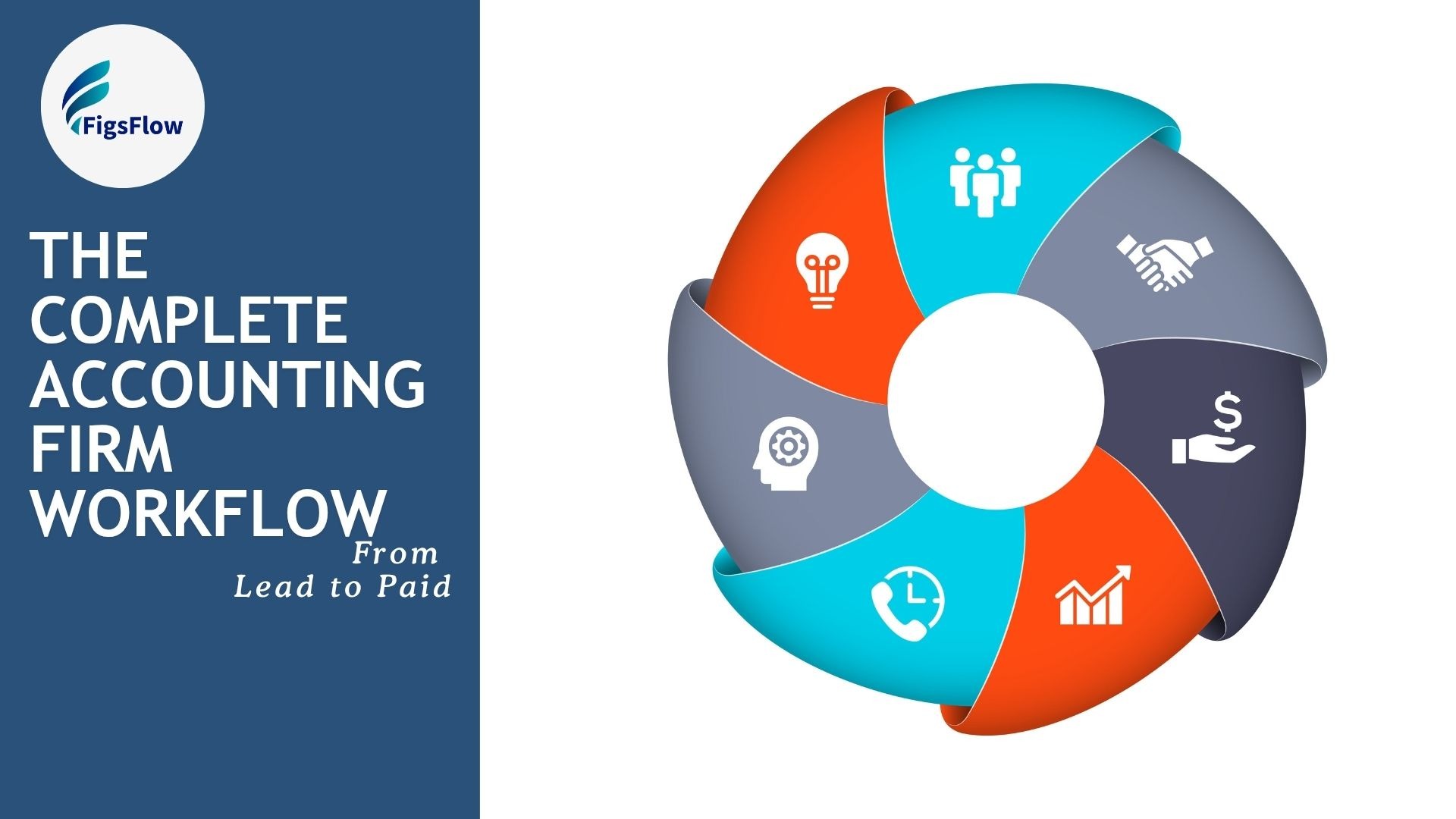

Most accounting firms run their client workflow across five or more separate tools. A spreadsheet for pricing. A Word template for the proposal. An email PDF for the engagement letter. A standalone platform for AML. A separate system for tasks and billing.
Each tool works fine on its own. The problem is the joins.
Every time client data moves from one platform to the next, someone re-enters it. Every re-entry is a delay, and occasionally a mistake. By the time a new client reaches their first invoice, the firm has spent hours on admin that added nothing to the client relationship.
This article maps every stage of the accounting firm workflow, where the friction builds, and what running it in one connected system actually changes.
The Typical Accounting Firm Workflow
Most firms follow the same seven stages client workflow from first contact to paid invoice. The tools vary. The sequence rarely does.
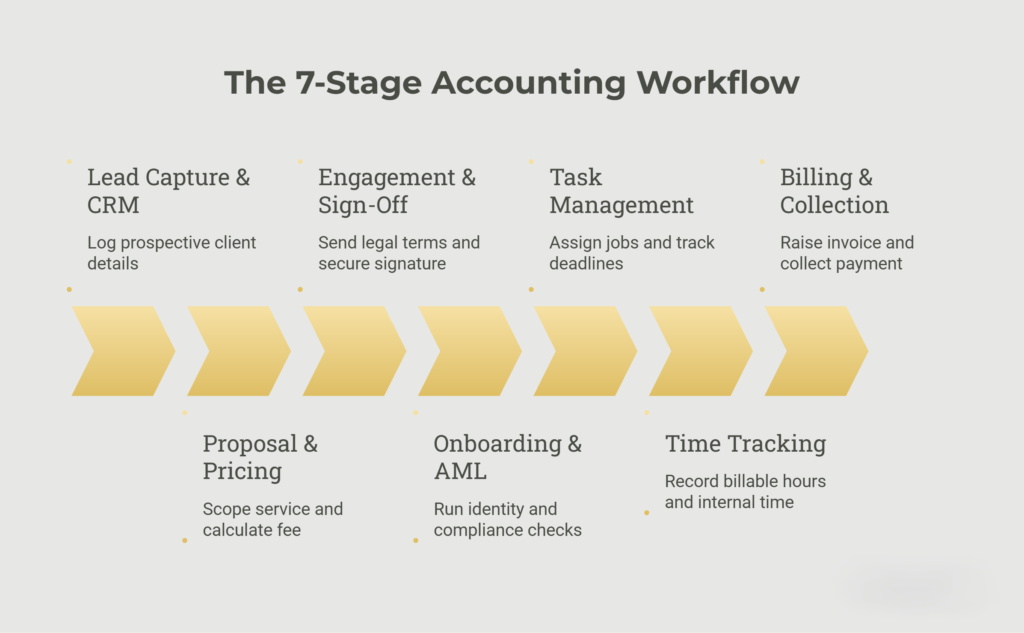
Stage 1: Lead Capture & CRM
A prospective client makes contact through a website form, a referral, or an inbound call. The firm logs the details: name, company, what they need, and where they heard about you. This usually means a Client Relationship Management (CRM) software, a spreadsheet, or a notes file.
The quality of that record determines every subsequent step. A thin record produces a vague proposal. A rich record produces one that lands.
Stage 2: Proposal & Pricing
Once the firm understands the scope, they price the service and send a proposal. For most firms, this means opening a template in Word, adjusting it manually, and calculating the fee separately in a spreadsheet.
Pricing at this stage is often inconsistent. The same service is quoted differently by different team members, or the same team member on different days. There is no pricing engine holding the logic. The fee depends on who does the quote.
Stage 3: Engagement Letter & Sign-Off
The engagement letter sets out the scope, the terms, and the obligations on both sides. It is a legal document. Most firms send it as a PDF by email, chase signatures manually, and have no systematic record of whether the client has actually read it.
Unsigned letters left in inboxes for weeks are normal. So is starting work before the letter is signed, which is both a commercial risk and, in some cases, a compliance one.
Stage 4: Onboarding & AML Compliance
Under the Money Laundering, Terrorist Financing and Transfer of Funds (Information on the Payer) Regulations 2017, firms subject to the regulations must carry out customer due diligence before establishing a business relationship. That means verifying the client’s identity, assessing risk, and completing the required AML checks before substantive work begins.
For most firms, this runs on a separate platform from everything else. The AML record sits in one system, the engagement letter in another, and the client file in a third.
Stage 5: Task & Job Management
Once the client is onboard and compliant, work begins. Jobs are assigned, tasks are tracked, and deadlines are set. This typically lives in a practice management tool or a project management app that the firm has adapted for this purpose.
The problem at this stage is that the task system has no connection to the engagement letter. The scope that was agreed at Stage 3 and the tasks being tracked at Stage 5 are in different places. Scope creep and missed work both become harder to spot.
Stage 6: Timesheets & Time Tracking
Billable time needs to be recorded, reviewed, and approved. For fixed-fee firms, this still matters: it tells you whether the fee is covering the work. For time-billed clients, it drives the invoice.
Most firms use a separate timesheet tool. The data captured there rarely flows automatically into the next stage.
Stage 7: Billing & Invoice Collection
The final stage. An invoice is raised, sent, and chased until paid. For firms using Xero or QuickBooks, invoices are raised manually in their accounting software. Payment is collected by bank transfer, card, or direct debit.
At this stage, the gap between when work is delivered and when cash lands is often measured in weeks. Manual invoicing, slow payment terms, and no automated follow-up all contribute to it.
Did You Know?
FigsFlow’s own data shows that the average onboarding process for a new client takes three hours from first contact to signed engagement when handled across separate tools.
Problems with the Traditional Accounting Firm Workflow
The seven stages above are not the problem. The problem is that each stage lives in a different tool, owned by a different vendor, with no shared data layer between them.
Client details are re-entered at every handoff. Compliance records are scattered. Billing lags because invoices are raised manually from data that lives somewhere else.
| Stage | Typical Tool | Where It Breaks |
|---|---|---|
| Lead Capture | CRM or spreadsheet | No link to proposal tool |
| Proposal and Pricing | Word and Excel | Manual, inconsistent fees |
| Engagement Letter | Email PDF | Signatures chased manually |
| AML and Onboarding | Standalone AML platform | Separate from everything else |
| Task Management | Practice management tool | No link to agreed scope |
| Timesheets | Separate timesheet tool | No automatic flow to invoicing |
| Billing | Xero or QuickBooks | Manual invoice creation |
Each of those tools carries its own subscription. Add an integration layer, such as Zapier, to connect them, and the bill climbs further. A firm running a typical seven-stage stack across separate vendors can expect to pay between £300 and £500 per month before accounting for the staff time spent maintaining the connections between them.
The FigsFlow Approach: One Cycle, Modular by Design
FigsFlow replaces the fragmented stack with a single connected workflow. Every stage runs inside one platform. Client data entered at Stage 1 populates every subsequent stage without re-entry. The engagement letter signed at Stage 3 feeds directly into the AML module and into invoicing.
The accounting firm workflow follows the same seven stages, the difference is how well they work together.
A lead enters the CRM, and the contact record is created once. The proposal is generated from that record using a service library of 150+ pre-built accounting services, each with an advanced pricing calculator that automatically applies the firm’s rules. The engagement letter is auto-populated from the proposal and sent for electronic signature. When the client signs, the AML module is triggered, and the draft invoice is automatically raised in Xero or QuickBooks. The job is created from the agreed scope.
No re-entry. No chasing. No compliance record scattered across three platforms.
Use One Module or All of Them
FigsFlow is built as a modular platform. A firm that already uses Xero for billing and only needs proposals and engagement letters subscribes to those modules. A firm building from scratch takes the full cycle.
The pricing reflects this. Plans start at £8 per month for a single user needing proposals and engagement letters, and scale to £120 per month for larger teams needing the full platform with unlimited proposals, third-party integrations, and multi-workspace capability.
No firm is required to replace its entire stack to use FigsFlow. The modules that solve the biggest pain points first can be adopted without touching everything else.
Conclusion
The seven stages of the accounting firm workflow are not going anywhere. Every firm needs to move a client from lead to paid invoice. The question is how much admin sits between those two points.
A fragmented stack turns each stage into a separate task managed in a separate system. Every join costs time, every handoff risks accuracy, and the cumulative overhead of running six tools instead of one adds up across a full client book.
Start with the stage that costs your firm the most. That is where the workflow changes first.