
Weekly News & Updates for UK Accountants (15-19 June 2026)
The summer VAT cut opens in barely a week, on 25 June, and the boundary rules are where the errors will land. That is the story to act on first. Close behind

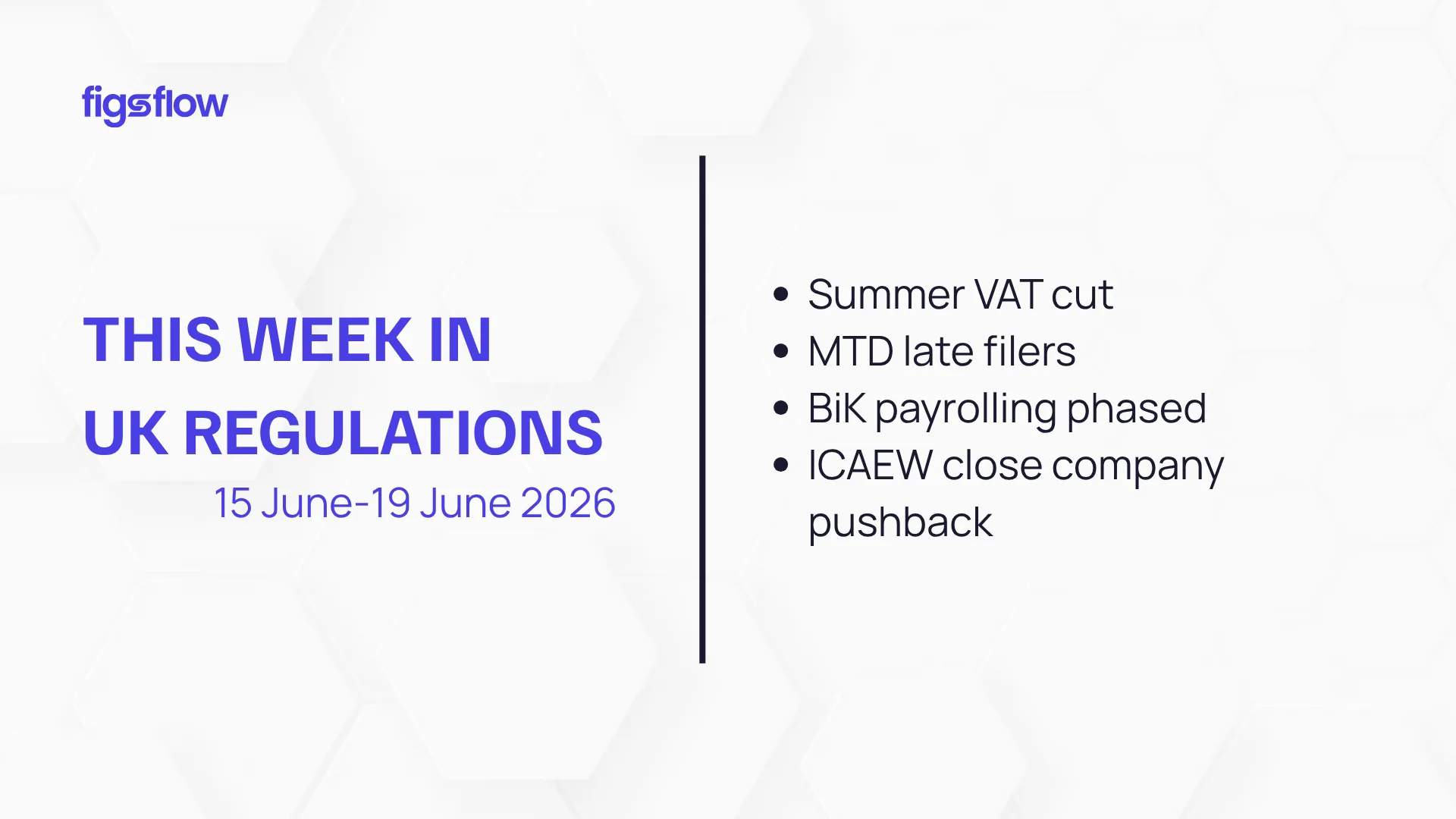
The summer VAT cut opens in barely a week, on 25 June, and the boundary rules are where the errors will land. That is the story to act on first. Close behind it, HMRC’s final MTD for Income Tax letters are pulling late filers into scope ahead of the 7 August deadline, including people who did not expect to be caught.
The other two are about planning rather than panic. Benefits in kind payrolling has been softened into a phased rollout from April 2027, and the ICAEW has formally pushed back on close company transaction reporting, the consultation many practitioners met in April.
Here is the detail.
Summer VAT Cut Opens in Days & the Boundaries Are Where Errors Will Land
A temporary 5% VAT rate runs for 69 days, from 25 June to 1 September 2026, covering children’s meals, cinema and theatre admissions, and a defined set of family attractions. Point-of-sale systems and VAT coding need updating before the opening date, then reverting from 2 September. That is two system changes inside ten weeks.
Qualifying categories:
- Children’s meals consumed on-premises at restaurants, cafes, and hotels
- Admission to cinema screenings, theatrical performances, shows, concerts, and exhibitions
- Admission to zoos, theme parks, water parks, soft play centres, fairs, and museums
The exclusions cause most of the trouble. Whether a meal qualifies turns on how it is marketed and presented, a “kids’ menu” rather than the age of whoever eats it, so a smaller portion of an adult dish does not count. Many family activities fall outside the relief because they are classed as sport: ten-pin bowling generally will not qualify, while trampolining may in certain contexts as an Olympic discipline. That distinction is exactly the kind of thing a client will get wrong at the till.
On pricing, businesses are under no legal obligation to pass the saving to customers, and some may hold prices to offset the cost of two system updates in quick succession. HMRC expects refunds where customers have prepaid for qualifying tickets, but again, there is no legal mandate.
HMRC Targets Late Filers in Final MTD for Income Tax Notifications
HMRC is sending its final wave of mandation letters, and the cohort it targets is the point worth passing on. These letters go to people whose qualifying income, gross income from self-employment and property, exceeded £50,000 once their 2024/25 return was filed after the January deadline or later amended. In other words, a group whose obligation only became visible after the fact, and who may not realise they are now in scope.
The responsibility to sign up does not depend on receiving a letter. A client who is in scope must register regardless, and the first mandatory quarterly update for this group is due by 7 August 2026.
Key facts:
- Letters target those who filed 2024/25 late or amended into qualifying income above £50,000
- Qualifying income means gross income from self-employment and property
- Signing up is mandatory whether or not a letter is received
- First quarterly update due by 7 August 2026
- Sign-up can stall on inconsistent HMRC records, so act early
Check any in-scope client who filed late or amended their 2024/25 return. They may be in the regime without knowing it, and the registration route is not always smooth.
HMRC Phases Mandatory Payrolling of Benefits in Kind & Drops 94 Data Fields
HMRC has eased its approach to mandatory payrolling of benefits in kind, replacing a single universal start date with a phased rollout and stripping a large amount of complexity out of the initial design. For employers bracing for one disruptive switchover, that is a meaningful softening.
The first phase, from 6 April 2027, applies only to a narrow set of benefits: company cars, vans, fuel for both, and employer-provided medical insurance. Most remaining benefits follow in April 2028. Beneficial loans and living accommodation are held back from mandation altogether at this stage because of their valuation complexity, though employers can still report them voluntarily.
In response to stakeholder feedback, HMRC has removed 94 categories and data fields from the initial specification. Draft interim guidance appeared in May 2026, updated technical specifications are expected by July 2026, and final Phase 1 regulations are due at the Autumn Budget.
Key facts:
- Phase 1 from 6 April 2027: company cars, vans, fuel, and medical insurance
- Phase 2 from April 2028: most other benefits
- Beneficial loans and living accommodation excluded initially, available for voluntary reporting
- 94 categories and data fields removed from the initial specification
- Technical specifications expected July 2026, final Phase 1 regulations at the Autumn Budget
Employers providing cars, vans, fuel, or medical insurance should treat April 2027 as the date to plan around. The technical specifications due in July will tell payroll teams what they are actually building towards, so that is the next thing to watch.
ICAEW Pushes Back on Close Company Transaction Reporting as Draconian
The ICAEW has formally objected to the government proposals, consulted on earlier this spring, that would require close companies to report detailed transactions with their participators. Its language is unusually blunt: the institute calls the rules draconian and disproportionate.
The objection rests on three points:
- The reporting would load a heavy administrative burden onto compliant small businesses while doing little to close the tax gap it is meant to address
- HMRC most likely lacks the internal capacity to process or make use of data on that scale
- A better route is targeted, high-risk compliance activity backed by a credible threat of enquiry, rather than mass data collection from every close company
This is the live development on a proposal your owner-managed clients would feel directly, since they are the ones who would carry the reporting load. Keep a watching brief on whether HMRC narrows the scope in response, and use it as a prompt to talk to close company clients about how their participator transactions are currently documented.
Also In The News
- Last week’s round-up covering the stories that shaped the week for UK practitioners.
- Law Firm Accounting Breaches Behind One in Four SRA Closures
- How to Price MTD ITSA Services: Guide for Accountants & Tax Advisers
- How to Onboard MTD Clients Without Doubling Your Admin
- How to Update Your MTD Engagement Letter: The Six Clauses That Must Change
Conclusion
The pattern this week is HMRC giving ground in some places and pressing harder in others. The benefits in kind rollout has been phased rather than imposed in one step, and the VAT relief comes with no obligation to pass the saving on. But the MTD net is still tightening around late filers, and the close company reporting proposal is very much alive despite the ICAEW’s objection.
For most practices the immediate work is narrow: update VAT systems before 25 June, and check any client who filed 2024/25 late against the 7 August MTD deadline. The rest is planning and watching.
We publish these updates every week. Follow us to get next week’s round-up as soon as it lands.