
How Tax Firms Manage Multiple Client Engagements & Seasonal Workload Spikes
Discover how to manage multiple client engagements during peak tax season using capacity planning, prioritisation, and flexible staffing strategies.
 Nirajan PokharelJun 16, 2026Updated Sep 28, 2026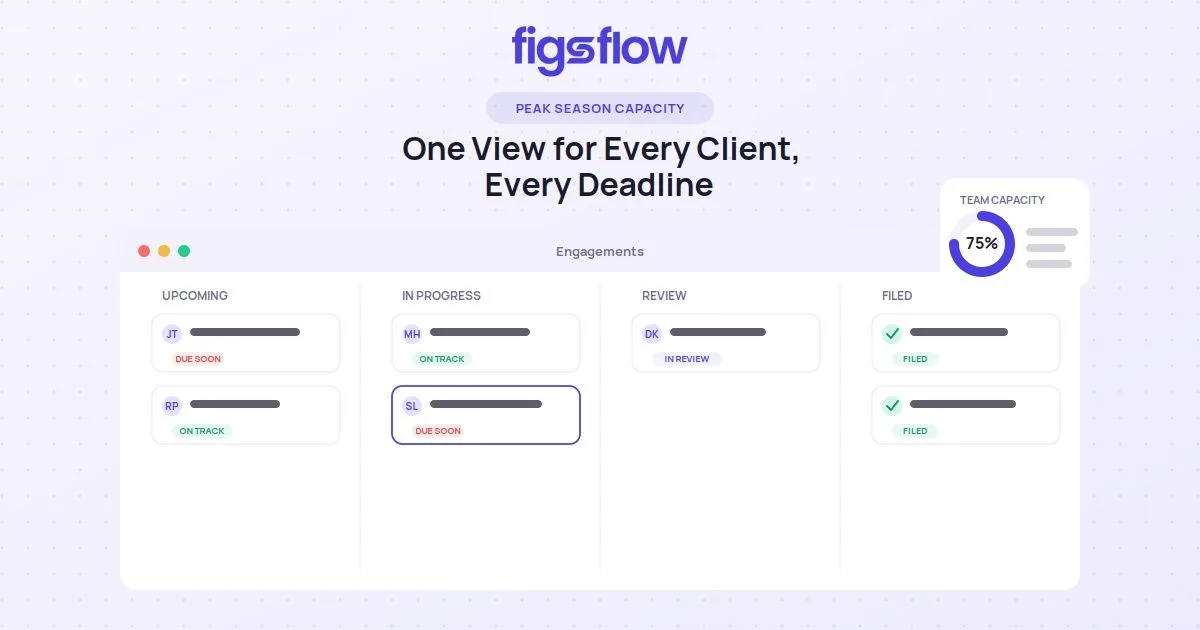
Peak tax season hits and you're drowning in client engagements, impossible deadlines, and 80-hour weeks. Yet some firms stay afloat, with no burnout and no slipped deadlines.
Their secret isn't being smarter or working harder. It comes down to systems. They know their weekly capacity, prioritise by impact, standardise every engagement, protect top talent, and lock in flexible staffing early.
Here's how to put those five strategies to work and manage multiple clients efficiently.
Why Do Most Tax Firms Struggle to Manage Multiple Client During Seasonal Workload Spikes?
Managing a tax firm during peak season means handling 50, 100, or several hundred active client engagements simultaneously. Most firms struggle not because they lack expertise or work ethic. They struggle because they're trying to manage massive complexity with zero internal visibility.
Three structural problems cause this:
Unforgiving, Compounding Deadlines
In most industries, if a team falls behind, project deadlines can be renegotiated. In tax, deadlines are legal mandates. Compounding the issue, a single client rarely requires just one service; they need personal returns, corporate filings, quarterly estimates, and payroll processing, all moving at different speeds simultaneously. When these dates collide, the workload doesn't just increase; it spikes exponentially.
The Illusion of Progress
Without a centralised system, visibility vanishes. Work status lives in scattered emails, spreadsheets, or individual heads. Partners and managers cannot see which returns are stuck, which documents are missing, or who is currently bottlenecked. Because tracking the work takes more effort than doing the work, firms operate entirely reactively.
The "Brute Force" Scaling Model
When the workload triples during peak season, the default human reaction is to throw sheer effort at the problem. Firms mandate 70 and 80-hour workweeks, scramble to hire unvetted seasonal staff, and simply hope for the best. But that brute force does not scale. It leads to exhausted teams, a sharp drop in quality control, and missed deadlines, followed closely by staff burnout and client churn.
The chaos of the busy season is not an inevitable tax of doing business. It is the direct symptom of a firm that has grown its client list faster than its operational infrastructure.
The Price of Poor Client Engagement Management
When engagement management fails, the damage spreads fast across your clients, your legal standing, and your team.
These consequences are real, immediate, and compounding:
- Financial Penalties for Clients – Missing a filing deadline means the tax authority charges immediate penalties and interest piles up on unpaid taxes. Worse, these delays frequently trigger audits, creating years of unnecessary headaches for your clients.
- Serious Liability for Your Firm – If a missed deadline causes a client financial loss, your firm can be held legally responsible. This creates exposure that professional indemnity insurance may not fully cover.
- Overnight Loss of Trust – Clients lose faith the moment a deadline slips. They question your capability, start looking at competitors, and often leave permanently.
- Severe Team Burnout – When work falls behind, staff must work excessive hours to catch up. The constant pressure and gruelling hours burn out your team, leading to high turnover. The remaining staff become exhausted, which naturally causes more mistakes.
The real cost of operational chaos is never just financial. It is a mix of reputational damage, legal risk, and human exhaustion.
5 Essential Ways Tax Firms Manage Multiple Client Engagements
Successful firms do not survive peak season by pushing harder. They take control of their workload, workflow, and staffing long before deadlines arrive.

Know Your Team's Real Capacity
Most tax firms cannot accurately answer a simple question – How many returns can your team actually complete this week? Without this number, you are flying blind.
Real capacity management means knowing exactly what your team can handle right now. For example, it means knowing your review team can process 10 returns weekly, or that your senior accountant has 15 available hours before hitting their threshold. With this visibility, you stop guessing, overloading people, and hoping for the best. Instead, you know precisely when you can take on new clients without breaking your existing team.
Practice management software provides this real-time visibility. Dashboards instantly display team workload, allowing you to catch bottlenecks before deadlines slip.
To build this visibility, implement three steps:
Calculate True Benchmarks
Document exactly how many returns your team can prepare, review, and deliver each week based on real history, not idealistic targets.
Track Work Progression Live
Use your software to monitor which engagements are moving forward and exactly where files are getting stuck.
Enforce Work-in-Progress (WIP) Limits
If your review team can handle 10 returns weekly, cap the review queue at 10. When you hit that limit, clear the backlog before pushing more work into their pipeline.
Prioritise Work That Actually Matters
Most tax firms decide which client gets attention based on who shouts the loudest rather than what matters most. When you treat every engagement with the same level of urgency, important tasks get delayed, deadlines slip, and your team spends peak season reacting to noise.
Successful firms replace this chaos with systematic prioritisation. They evaluate their active workload across three distinct dimensions:
Regulatory Urgency
Statutory tax deadlines are legally binding and unmovable. These form the baseline of your schedule, and all other work fits around them.
Client Value and Relationship Risk
High-value accounts and at-risk client relationships receive immediate operational priority over stable, routine portfolios.
Engagement Complexity
Intricate corporate filings require your most experienced staff. Scheduling these early prevents senior bottlenecks from forming right before a major deadline.
To keep this system accurate, hold a brief weekly alignment meeting with your team leads to review active engagements. Identify which files are approaching deadlines, which are blocked waiting on client documentation, and which require senior intervention. This structural rhythm replaces daily guesswork with deliberate, proactive scheduling.
Stop Reinventing the Wheel Every Day
Inconsistent methods create duplicate effort, drag out document collection, and confuse clients. Operational chaos is inevitable when one accountant collects files via email, another uses a portal, and a third relies on phone calls.
Successful practices eliminate this friction by building clear, repeatable workflows. For example, a personal tax engagement always follows an identical sequence - a fixed list of required documents, a uniform preparation order, mandatory quality checks, and a consistent delivery method.
Shifting to standardised workflows delivers immediate advantages:
Accelerated Onboarding
New hires and seasonal staff integrate faster by following the firm's playbook instead of guessing individual partner preferences.
Consistent Quality Control
Human error drops significantly when every team member works from the exact same procedural checklist.
Predictable Capacity
When a process is repeatable, it becomes measurable. This allows you to accurately forecast how long an engagement takes to better manage overall capacity.
Less Friction
Teams stop losing billable hours to internal questions because the answers are already documented.
Building these systems requires an upfront time investment, but it creates the definitive playbook for your practice. Start by documenting current best practices, mapping out decision trees for common scenarios, and establishing a uniform process for chasing missing client information.
Use Your Best People Where They Matter
Capacity visibility and prioritisation tell you what needs to happen. But they don't tell you who should do it. Strategic resource allocation does.
When the wrong person handles work, expertise gets wasted and bottlenecks form. Successful tax firms match the right person to the right work. Experienced staff focus on complex cases and critical deadlines. Junior staff handle straightforward returns and routine tasks. Firms move people between projects when priorities shift instead of letting work pile up.
Big firms hold weekly resource planning meetings. They review what work is coming, decide who should handle what based on skill and availability, and move people when priorities shift.
When firms allocate strategically:
- Junior staff develop faster because they learn through appropriate challenges
- Complex work gets better results because experienced people handle it
- Firms deliver more with the same team size
Don't Scramble, Plan Six Months Ahead
Every tax firm reaches a point where existing team capacity cannot match seasonal volume. Most practices panic-hire right before peak season with unvetted staff, creating training chaos and errors.
Successful firms avoid this by forecasting capacity and planning flexible staffing six to nine months in advance.
Leading practices use three resource channels:
- Temporary onsite staff for four to six months during peak season
- Outsourced partners to handle routine processing while internal staff focus on complex cases
- Offshore teams to extend working hours and maintain file progression
The defining factor is preparation. Seasonal staff are trained before peak season begins, outsourced partners integrate into workflows before deadlines hit, and offshore teams understand your quality standards ahead of critical dates. Advance preparation ensures scaling actually increases output instead of creating internal friction.
How These Five Elements Work Together
These five operational frameworks do not work in isolation. They form a single interconnected engine.
If you lack prioritisation, capacity visibility is useless. You know you're overloaded but cannot identify what matters. Without standardised workflows, prioritisation fails because task durations become unpredictable. Without strategic resource allocation, talent bottlenecks form immediately. Without flexible staffing, you cannot scale to meet peak demand.

Successful tax firms scale their infrastructure by layering these systems logically:
- The Foundation – Firms start by documenting true capacity and standardising core workflows so they can accurately measure their baseline operations.
- The Visibility – They introduce practice management dashboards to track work progression in real time.
- The Execution – With real-time data available, leadership establishes strict weekly prioritisation rules and trains managers on strategic resource allocation.
- The Scale – Finally, they secure flexible staffing channels six months ahead to absorb the projected workload.
Further Reading
- How to Grow Your Accounting Practice in 2026: The Complete Playbook
- How to Get Bookkeeping Clients: 9 Ways That Actually Work (UK 2026)
- How to Onboard MTD Clients Without Doubling Your Admin
- Stop Losing Clients: FigsFlow Fixes Client Onboarding | FigsFlow
Conclusion
Managing multiple client engagements successfully means one thing: moving from reactive firefighting to proactive systems. Firms that thrive during peak season aren't bigger or more talented. They simply have better systems.
Start with one element. Build capacity tracking first. Add prioritisation next. Progress towards a complete system that fits your firm's size. As you implement these five elements, you'll notice the changes immediately. Less burnout. More predictability. Higher quality. Better client relationships. Better staff retention.
The seasonal roller coaster becomes a sustainable business. That's what these systems create.