
Tax Adviser Registration with HMRC: What Has Changed & What You Need to Do
Changes to tax adviser registration with HMRC, effective from May 2026, have made registration mandatory for agents.

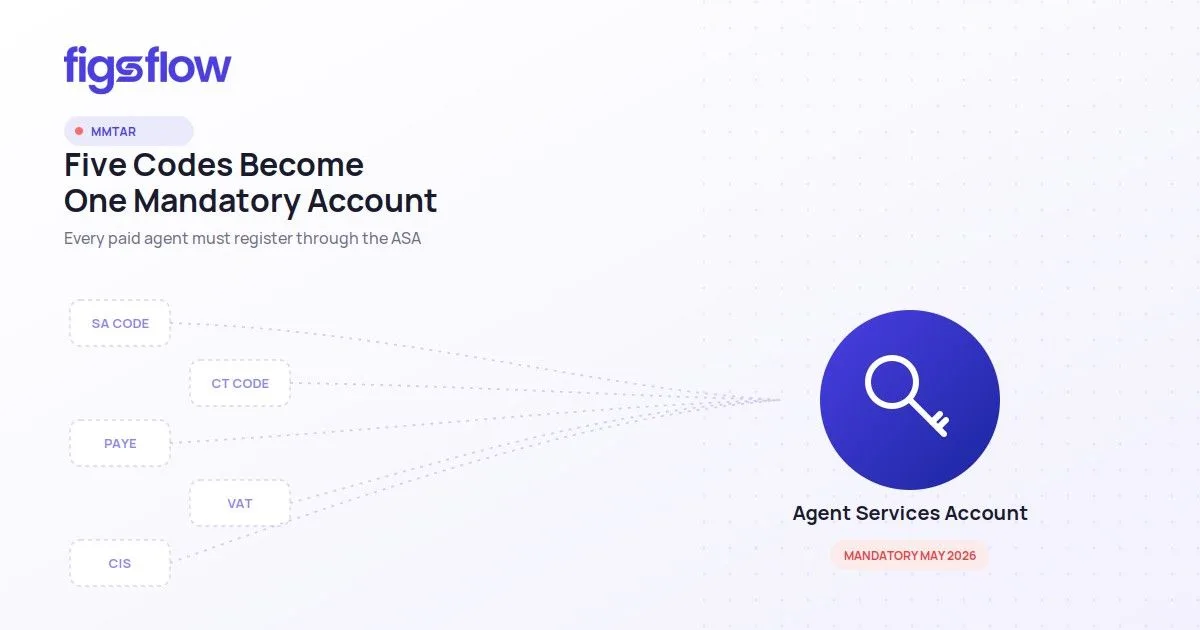
If you are paid to deal with HMRC on behalf of clients, whether as an accountant, bookkeeper, tax agent, or in any other capacity, the way you register has changed. From May 2026, tax adviser registration with HMRC is a legal requirement, backed by sanctions for those who do not comply.
This article explains what the old system looked like, what replaced it, who needs to act and when, and what you actually need to do.
The Old System Was Fragmented
For years, HMRC agent registration was not a single process. It was a collection of separate routes, each tied to a specific tax service. Self Assessment required a written application for an SA agent code, which could take up to 40 working days. Corporation Tax needed a separate code through the same slow process. PAYE, VAT, CIS, and other services each had their own paths, their own timelines, and in many cases their own paper forms.
There was no single account, no unified view, and no legal obligation to register at all.
Firms could interact with HMRC on behalf of clients with minimal checks. Standards were inconsistent, HMRC had no reliable way to verify who was operating, and there was little to stop unscrupulous actors from working largely unchallenged.
The Agent Services Account, introduced for Making Tax Digital, was a step forward. But it sat alongside the old codes rather than replacing them. Many firms ended up running both: old agent codes for legacy services and a separate ASA for MTD. Two systems, neither complete.
What Is MMTAR?
MMTAR stands for Modernising and Mandating Tax Adviser Registration. It is the government’s programme to replace the patchwork of existing registration routes with a single, legally required process.
Announced at Budget 2025 following a public consultation in October 2024, MMTAR introduces a legal obligation for anyone who is paid to interact with HMRC on behalf of clients to register with HMRC. The mechanism for that mandatory tax adviser registration is the Agent Services Account. The ASA, which previously existed as one of several options, is now the universal gateway for all tax agents and advisers.
Who Is a Tax Adviser Under the New Rules?
HMRC’s definition is deliberately broad, and it catches many more firms than the phrase “tax adviser” might suggest.
Under MMTAR, you are a tax adviser if you are paid to interact with HMRC on behalf of clients. That includes providing advice on tax, acting as an agent, helping prepare documents that HMRC will rely on to determine a client’s tax position, filing returns, sending claims, and contacting HMRC by phone, post, email, app, or online portal.
You are required to register with HMRC as a tax adviser even if you do not describe yourself as a tax adviser, even if tax work is incidental to your main services, even if you only act for a single client, and even if your business is based outside the UK. Sole traders must register in their own name. Interactions made through third-party software or API connections count.
Registration is required at firm level. Individual employees do not register separately, though HMRC will carry out checks on certain people within the business, referred to as relevant individuals.
Who Does Not Need to Register?
The exemptions are narrow. You are not required to register for an agent services account if you fall into one of the following categories:
- Your work stays entirely within your own organisation, such as in-house payroll, internal finance functions, or group company tax work
- You provide tax assistance without charge, including charitable or voluntary work
- The law already requires you to interact with HMRC in a specific capacity, for example as an insolvency practitioner or certain pension and investment firms
- You are responding to a direct information request from HMRC
- You build or provide tax, payroll, or accounting software for others but do not yourself contact HMRC on a client’s behalf
- Your HMRC interaction is limited to VAT representation, Northern Ireland tax representation, UK Vaping Duty representation, Import One Stop Shop intermediary work, or court and tribunal representation
If you are uncertain, HMRC has published an online checker on GOV.UK to help you work out whether you need to register.
What Is an Agent Services Account?
An Agent Services Account is HMRC’s online platform for tax agents and advisers to manage client work digitally. It was originally introduced to support newer services, including Making Tax Digital for VAT and Making Tax Digital for Income Tax Self Assessment. Until MMTAR, it sat alongside the older HMRC Online Services Account and various service-specific agent codes as one option among several.
Under the new mandatory tax adviser registration rules, the ASA becomes the single registration route for everyone who interacts with HMRC on behalf of clients. The previous fragmented system is replaced entirely.
If you already have an ASA, you do not need to apply again. HMRC will contact you through your existing account if it needs further information. If you hold an SDLT online filing account but no ASA, you will still need to complete the registration process.
When Do You Need to Register?
The rollout is phased. Your deadline depends on your current situation.
| Your Situation | Register From |
|---|---|
| No ASA and no existing SA or CT agent code | 18 May 2026 |
| Existing SA or CT agent code but no ASA | 18 August 2026 |
| Third-party payroll services only, no other HMRC interaction | 18 November 2026 |
| Financial services organisation | 31 December 2026 |
| Already have an ASA | HMRC will contact you. No action needed yet. |
From your start date, you have three months to submit your agent services account application. You can continue to interact with HMRC on behalf of clients during that window and while HMRC considers your application. Once the three months pass, you must be registered before interacting with HMRC on behalf of any client.
You can complete your tax adviser registration with HMRC early from 18 May 2026 regardless of which group you fall into.
What Do You Need Before You Can Register?
Before you apply, your firm must meet a set of registration conditions.
The first condition is AML supervision. Your firm must be registered for anti-money laundering supervision before you submit your ASA application. HMRC cannot process an application while your AML status is still pending. See our guide on UK money laundering regulation in 2026 if your supervision status needs a refresh.
Your tax affairs must be in order. Outstanding returns or payments will not automatically block your application, but HMRC will take them into account.
You must identify your relevant individuals. These are the people within your firm who manage or make decisions about the tax adviser work. For a sole trader, that is you. For a firm with five or fewer officers, every officer must be named, plus any employees who play a significant role in managing the tax work. HMRC will carry out checks on these individuals and will engage with the firm first if an issue arises.
When you register, you will need:
- Your firm’s Unique Taxpayer Reference and associated postcode
- Company registration number, if applicable
- VAT registration number, if applicable
- Name of your AML supervisory body, membership number, and renewal date
- National Insurance number and date of birth if registering as a sole trader or partnership
What Happens If You Do Not Register?
If you are required to register and do not do so within your three-month window, you will no longer be permitted to interact with HMRC on behalf of clients. That means you cannot file returns, contact HMRC about a client’s affairs, or submit claims on their behalf until you are registered and approved.
If you continue to attempt to interact with HMRC after being told to stop, sanctions apply. These can include financial penalties, temporary suspension from interacting with HMRC, and in more serious cases a permanent ban.
Failing to complete your tax adviser registration with HMRC can also disrupt your clients. Returns go unfiled, deadlines get missed, and the damage to client trust is harder to recover from than the registration itself. Our piece on HMRC agent registration requirements covers the related agent-level obligations.
How to Register with HMRC as a Tax Adviser
Registration is completed online through the Agent Services Account application on GOV.UK. HMRC estimates the process takes no more than an hour once you have your information ready. There is no charge to register, and no charge to remain on the register.
Before you start, make sure your AML supervision is active and your details are to hand. Then:
- Sign in or create a Government Gateway user ID
- Apply for an agent services account via the GOV.UK registration service
- Provide your firm’s UTR, postcode, company registration number and VAT number where applicable
- Confirm your AML supervisory body, membership number and renewal date
- Identify your relevant individuals and confirm the HMRC registration conditions are met
HMRC will review your application and notify you of their decision. You can check the progress of a submitted application online.
Conclusion
HMRC agent registration has moved from a fragmented, service-by-service system with no legal footing to a single, mandatory process built around the Agent Services Account. For most firms, the practical steps are not complicated. Sort your AML supervision first, identify your relevant individuals, and apply through GOV.UK within your registration window. If you also advise on MTD clients, see our MTD for Income Tax guide for accountants and agents.
The deadline for mandatory tax adviser registration with HMRC has already arrived for firms without an ASA. If you have not yet checked whether you need to register, that is the first thing to do today.
Further reading: Tax Adviser Registration Delayed for Financial Sector as HMRC Rewrites the Rules