
UK Tax Advisers Face Mandatory HMRC Registration from May 2026
From May 2026, all tax advisers must comply with mandatory HMRC registration requirement. Find out why and how this change will affect you.

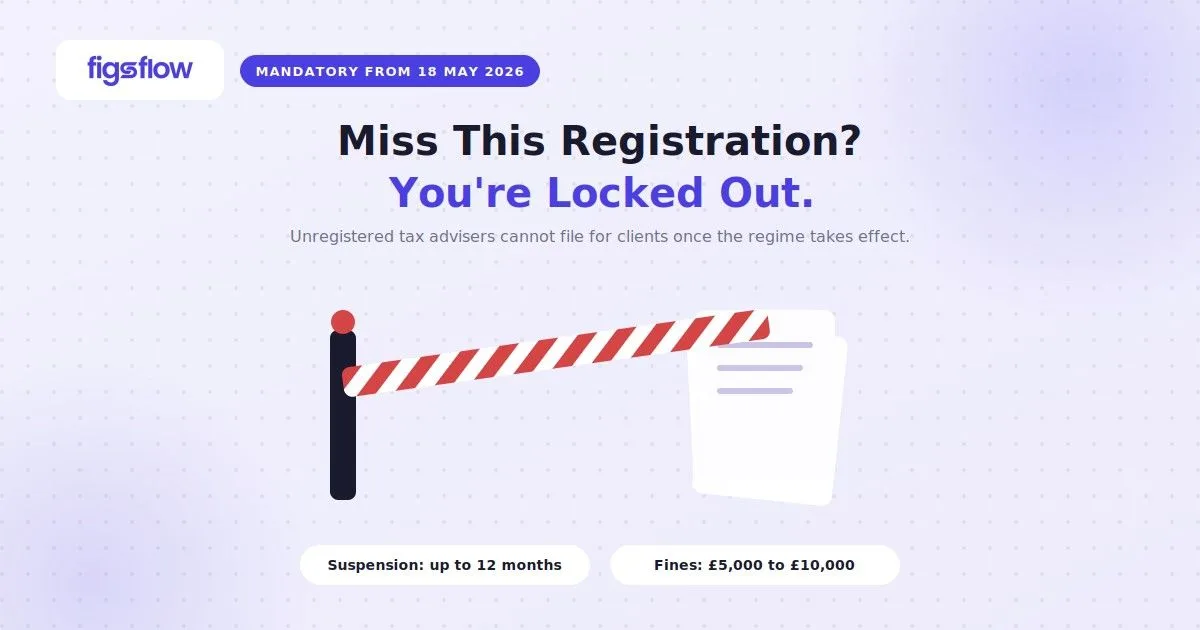
Mandatory registration with HMRC is being phased in from 18 May 2026, and different groups of tax advisers become subject to it on different dates depending on their existing HMRC registration status. It affects anyone who communicates with HMRC about someone else's tax affairs in exchange for payment, and each group is given a three month window in which to register.
This is one of the biggest regulatory changes to hit the profession in years. As of today, the first registration window has already closed and the second window is open. Firms that fail to register on time risk being locked out of HMRC's systems entirely. Here is what accountants and tax advisers need to know, including the correct deadline for each adviser type.
Key Takeaways
- Mandatory registration is phased in across four windows starting 18 May 2026, with each adviser group given a three month deadline based on its existing HMRC registration status.
- Registration applies at the firm or sole practitioner level, with relevant individuals named separately.
- Non-compliance can lead to registration suspension of up to 12 months, preventing advisers from filing returns for clients.
- Financial penalties for non-compliance range from £5,000 to £10,000.
Who Must Register
The registration requirement applies to any individual or firm that interacts with HMRC on behalf of another person in exchange for payment. HMRC's definition of "interact" is broad, covering phone calls, correspondence, email, digital messages, filing returns, and making claims.
If you communicate with HMRC about a client's tax affairs and are paid for that service, you fall within scope, regardless of your job title or how your firm describes the work.
A small number of categories are exempt from the regime. In-house tax and payroll teams advising only their own employer are not caught, and neither are firms whose HMRC interactions are limited to VAT and customs matters, tax software providers, or insolvency practitioners.
HMRC has phased the registration requirement into four groups, each given a three month window to register based on the adviser's existing HMRC registration status.
| Adviser Group | Window Opens | Window Closes |
|---|---|---|
| New tax advisers, or advisers without an Agent Services Account, Self Assessment agent account, or Corporation Tax agent account | 18 May 2026 | 18 August 2026 |
| Advisers with a Self Assessment or Corporation Tax agent account, but without an Agent Services Account | 18 August 2026 | 18 November 2026 |
| Advisers who solely provide payroll services and do not have an Agent Services Account | 18 November 2026 | 18 February 2027 |
| Financial services organisations without an Agent Services Account | 31 December 2026 | 31 March 2027 |
As of today, the first window has closed and the second window, covering advisers with a Self Assessment or Corporation Tax agent account but no Agent Services Account, is open until 18 November 2026.
Eligibility Conditions
To register, firms and individuals must meet a set of baseline conditions set by HMRC.
- A satisfactory record of tax compliance, with no serious or repeated failures to meet personal or business tax obligations.
- No unspent convictions for offences involving dishonesty, such as fraud or tax evasion.
HMRC will carry out checks against these conditions as part of the registration process, and firms should expect a degree of scrutiny that goes beyond a simple sign-up form.
Registration sits at the entity level rather than the individual level. The firm or sole practitioner registers, and must then designate relevant individuals, typically directors or partners, who become subject to HMRC's compliance checks.
Firms that already hold an Agent Services Account may not need to start from scratch, though HMRC has indicated it will make contact directly where additional information is needed to meet the new conditions.
Enforcement & Penalties
HMRC has been given a meaningful set of enforcement powers to back up the new regime, and the consequences of falling short are more significant than a straightforward fine.
The most serious sanction is suspension. HMRC can suspend a firm's registration for up to 12 months where its conduct falls below the required standard. A suspended firm loses the ability to file tax returns on behalf of clients, which for most practices is not a position they can simply work around.
Financial penalties for non-compliance range from £5,000 to £10,000, depending on the nature and severity of the breach.
HMRC also has the power to publish details of advisers who receive financial penalties on GOV.UK, and that published record can remain in place for up to a year.
For firms operating without registration entirely once the regime is in force, HMRC will simply be unable to deal with them on a client's behalf, which in practice makes continuing to trade as a tax adviser unworkable.
Given the scale of these consequences, practices should treat registration as a priority compliance task rather than routine administration.
Additional Resources
- Everything You Need to Know About Tax Adviser Mandatory Registration Requirement with HMRC: Tax Advisers Must Register with HMRC: Deadlines & Penalties
- How the Finance Bill Could Reshape Tax Compliance for Accountants: UK Finance Bill 2025-26 measures affecting tax advisers
- The Full List of UK AML Regulations and Regulators: List of UK AML Regulations for Accountants 2025
- What's Changing Under the UK Money Laundering Regulations in 2026: UK Money Laundering Regulation (MLR) Amendment: What is Changing in 2026?
- Tax Adviser Registration with HMRC: What Has Changed: Tax Adviser Registration with HMRC: What Has Changed & What You Need to Do
Conclusion
The introduction of mandatory tax adviser registration is a fundamental change to how the profession operates in the UK. With registration now phasing in across four separate windows through to March 2027, firms have a limited period, based on their adviser type, to confirm their scope, identify their relevant individuals, and put registration in place.
The penalties for getting this wrong are not trivial. Suspension of registration effectively stops a firm from acting for clients, and published penalty notices carry a reputational cost on top of the financial one.
Practices should treat this as a near-term priority, and where there is uncertainty about scope or eligibility, professional advice should be sought before the firm's applicable registration window closes.