
UK Finance Bill 2025-26 measures affecting tax advisers
From May 2026, UK tax advisers face mandatory registration and stricter sanctions under the UK Finance Bill. Understand the key changes.

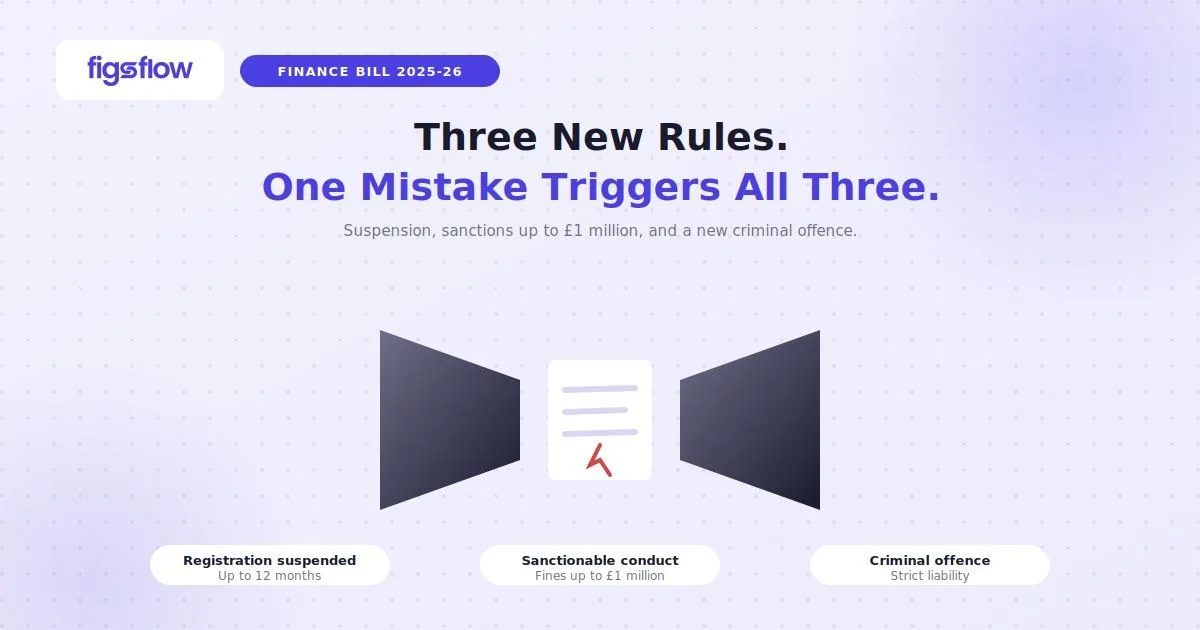
The Finance Act 2026 introduced a package of measures that is significantly reshaping the regulatory landscape for tax advisers. From mandatory registration requirements to expanded grounds for sanctions and a new strict liability criminal offence, these provisions represent a fundamental shift in how HMRC oversees and enforces standards within the profession.
The Institute of Chartered Accountants in England and Wales (ICAEW) has raised substantial concerns about the breadth of these measures and their potential to penalise legitimate professional judgement rather than genuine misconduct. For practitioners, understanding these changes is essential. The consequences of non-compliance range from financial penalties and suspension of practice rights through to criminal prosecution under the Finance Act 2026.
This briefing examines each of the three key measures in turn, sets out the practical implications for advisory firms, and summarises the profession’s response to what many consider the most significant regulatory intervention in a generation concerning the Finance Act 2026.
Overview of the Finance Act 2026
- Registration for UK tax advisers who communicate with HMRC is being phased in across four windows starting 18 May 2026, with up to 12 months suspension possible if an adviser's behaviour falls below expected standards.
- The threshold for sanctions dropped from “dishonest conduct” to “sanctionable conduct” from 1 April 2026, meaning advisers can be penalised simply for intending to reduce tax liability, even in good faith disputes.
- A new strict liability criminal offence, in force since 18 May 2026, prosecutes advisers for promoting arrangements with no realistic prospect of success, regardless of intent or honest belief.
- ICAEW warned these measures could force mainstream advisers out of complex tax work, paradoxically weakening compliance as clients turn to unqualified advisers or proceed without professional guidance.
- A single mistake could trigger all three consequences simultaneously: criminal prosecution, financial penalties up to £1 million, and loss of registration that destroys client relationships and threatens firm survival.
The Three New Regulatory Threats
The Finance Act 2026 introduced three interconnected measures that ICAEW has warned could fundamentally damage the tax advisory profession and harm compliant taxpayers.
Mandatory Agent Registration (May 2026)
With registration now open and phasing in across four separate windows, it is crucial for tax advisers to understand these changes and confirm which window applies to their firm.
Every tax adviser who communicates with HMRC on behalf of clients must register, with registration phased in across four separate windows running from 18 May 2026 to 31 March 2027 depending on the adviser's existing HMRC registration status. To register, advisers must meet strict minimum standards. Their firm and key staff must be up to date with their own tax affairs and cannot have received an anti-avoidance penalty in the past 12 months.
| Adviser Group | Window Opens | Window Closes |
|---|---|---|
| New tax advisers, or advisers without an Agent Services Account, Self Assessment agent account, or Corporation Tax agent account | 18 May 2026 | 18 August 2026 |
| Advisers with a Self Assessment or Corporation Tax agent account, but without an Agent Services Account | 18 August 2026 | 18 November 2026 |
| Advisers who solely provide payroll services and do not have an Agent Services Account | 18 November 2026 | 18 February 2027 |
| Financial services organisations without an Agent Services Account | 31 December 2026 | 31 March 2027 |
The critical problem is what happens next. HMRC can suspend registration for up to 12 months if it believes the adviser’s behaviour “falls below the standards that might reasonably be expected.” For many firms, losing registration is an existential threat. They cannot act for any clients during suspension, which could destroy thousands of client relationships and put firms out of business entirely.
ICAEW’s concerns are specific and serious. First, there is no explicit test requiring HMRC to act proportionately or reasonably before imposing suspension. Second, HMRC officers are not bound by HMRC’s own standards when judging advisers. Third, the regime has retrospective effect. A historic mistake that cannot be fixed could disqualify a firm permanently. For example, if a firm missed a disclosure requirement under the DOTAS regime years ago and received a penalty, that penalty could still prevent registration today, even if the firm has been fully compliant since.
Additionally, ICAEW notes the real wrongdoers will not be caught. Only advisers who interact directly with HMRC must register. Rogue operators who work entirely outside the HMRC system face no registration requirement at all.
The Finance Act 2026 mandates that tax advisers adhere strictly to these registration requirements to maintain compliance.
Lowered Threshold for Sanctionable Conduct (April 2026)
Currently, HMRC can only penalise tax advisers for dishonest conduct. The new law changes “dishonest conduct” to “sanctionable conduct,” defined as acting “with the intention of bringing about a loss of tax revenue.”
This is a dramatic lowering of the bar. The current test requires dishonesty. The new test only requires intention to cause revenue loss. This distinction is crucial.
ICAEW’s objection is forceful and well-founded. The new definition could catch legitimate professional disagreements. Imagine a tax adviser and HMRC both interpret complex legislation differently, both acting in good faith. If HMRC believes the adviser intended (even indirectly) to help the client save tax, sanctions could follow. Every tax return entry and every piece of advice would theoretically need to be assessed against future HMRC challenge risk.
Consider a technical dispute over how anti-avoidance rules apply to a complex transaction. The adviser gives advice based on their interpretation of the law. HMRC disagrees. Under the old law, the adviser would not be penalised unless they acted dishonestly. Under the new law, if HMRC can argue the adviser intended to bring about tax loss, penalties apply. The intention element is broadly interpreted.
Penalties are capped at £1 million for the first breach, calculated by reference to potential lost revenue. This is significant financial exposure.
ICAEW warns this will drive mainstream advisers out of complex or higher-risk work entirely. Paradoxically, this weakens tax compliance rather than strengthens it. When experienced advisers retreat, clients either get no advice, rely on unqualified advisers, or take aggressive positions without professional input.
The implications of the Finance Act 2026 are being felt across the industry, as advisers navigate these new standards.
New Criminal Offence (Two Months After Royal Assent)
With the Finance Act 2026 in place, the landscape of tax advisory work is changing dramatically.
The Act creates a strict liability criminal offence for promoting arrangements with “no realistic prospect” of delivering a tax advantage. Strict liability means intent is irrelevant. You can be prosecuted even if you genuinely believed the arrangement would work.
This is extraordinarily broad. Tax advice is complex and fact sensitive. Mistakes happen routinely from overlooking anti-avoidance provisions, receiving incomplete client information, or misunderstanding developing case law. Currently, these issues are addressed through professional standards, civil penalties and negligence claims. The profession has existing accountability mechanisms.
Criminalising honest mistakes is disproportionate, ICAEW argues. And the criminal penalties compound the registration problem. A criminal conviction (or even prosecution) could trigger loss of registration simultaneously, creating cascading professional destruction.
Why ICAEW Is Alarmed?
The three measures in the Finance Act 2026 work together to create a pincer movement against the profession. Registration suspension threatens business continuity. Sanctionable conduct penalties are almost impossible to avoid in complex cases. Criminal liability makes honest mistakes potentially criminal. A single mistake could trigger all three consequences.
The unspoken concern is that this creates a chilling effect. Advisers become so afraid of crossing undefined lines that they withdraw from legitimate advisory work. Clients either pay more for excessive caution or make tax decisions without proper professional guidance.
The three measures encapsulated in the Finance Act 2026 create a challenging environment for advisers.
ICAEW's Specific Demands
ICAEW’s demands reflected the urgent need for clarity within the framework of the Finance Act 2026.
ICAEW has asked for three things:
- First, limit sanctions to genuinely unethical or unreasonable conduct. Restore a reasonableness requirement.
- Second, ensure criminal offences target actual wrongdoing, not honest mistakes.
- Third, protect legitimate professional judgement from triggering sanctions.
ICAEW had also asked for implementation to be delayed until 2027 at the earliest, with proper consultation and impact assessment. That request was not granted: the measures proceeded on the timetable set out above, with Royal Assent on 18 March 2026.
Historical Context
In July 2025, the government published draft legislation requiring all partners in a firm to register, regardless of whether they worked in tax. ICAEW successfully campaigned against this. The current version requires only relevant individuals (roughly five per firm with six or more partners) to register. This is a partial victory, but the core problems remain.
At the Autumn Budget 2025, the government said it would not regulate advisers. Yet this Act does precisely that. ICAEW’s frustration is understandable.
Historical context surrounding the Finance Act 2026 reveals the evolution of regulatory practices in tax advisory.
Helpful Resources
UK Tax Advisers Face Mandatory HMRC Registration from May 2026: Tax Advisers Face Mandatory HMRC Registration I FigsFlow
List of AML Regulations & Regulators in the UK: List of UK AML Regulations for Accountants 2025 | FigsFlow
Discover the Best AML Tools for Tax Advisers: Anti-Money Laundering Compliance Tools for Tax Advisers | FigsFlow
HMRC is Targeting “Unethical” Tax Advisers: Rogue Tax Advisers Beware: HMRC is coming for you!
Everything You Need to Know About Form-8 Formal Authorisation to Act as a Tax Agent: Form 64-8: Tax Agent Authorisation Guide for Accountants | FigsFlow
Complete AML Guidance for Tax Advisers: Anti-Money Laundering Guidance for Tax Advisers: A Complete Guide
Conclusion
These measures in the Finance Act 2026 are genuinely threatening to the UK tax advisory profession. They shift enforcement toward the profession rather than toward tax avoidance schemes themselves. They create incentives for advisers to over-comply at the expense of legitimate tax planning. They may inadvertently strengthen the market position of unscrupulous operators who operate entirely off HMRC’s radar.
The core problem is that all three measures are broadly drafted with insufficient safeguards for ordinary professional practice. They conflate genuine wrongdoing with technical disagreement. This is why ICAEW has described them as posing existential risk to mainstream firms.