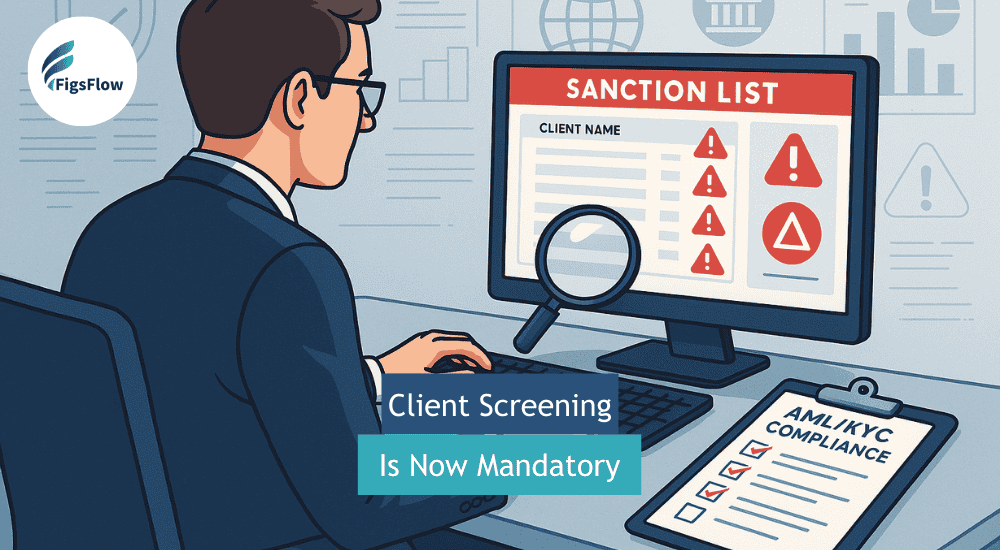

How confident are you that none of your current clients are sanctioned entities?
Your firm handles 200+ clients. You’ve got robust engagement letters, strong internal controls, and excellent technical staff. But what are sanctions? Have you systematically screened every client, beneficial owner, and vendor against OFAC’s Specially Designated Nationals list?
If the answer is “no,” your firm is operating with significant compliance risk. OFAC doesn’t accept “we didn’t know” as a defense. They’ve issued penalties averaging $307,922 per violation, and accounting firms are specifically mentioned in enforcement priorities.
This guide explains sanctions compliance requirements for accountants, identifies your screening obligations, and provides practical implementation steps to protect your practice.
KEY TAKEAWAYS
- Sanctions are federal restrictions targeting countries, entities, and individuals that threaten US national security, sponsor terrorism, or violate human rights
- OFAC maintains the Specially Designated Nationals (SDN) List with approximately 12,000 sanctioned parties that US persons cannot do business with
- Comprehensive sanctions block nearly all transactions with Cuba, Iran, North Korea, Syria, and Russia, while targeted sanctions focus on specific individuals and entities
- Accounting firms face penalties up to $307,922 per violation for processing transactions involving sanctioned parties
- Client screening must occur during onboarding and continue throughout the engagement
- Automated screening tools can check OFAC lists in 30 seconds, creating audit trails that demonstrate compliance
What Are Sanctions?
Definition of Sanctions
Sanctions are punitive measures imposed by the US government to restrict or prohibit financial transactions, trade, and economic activity with specific countries, entities, or individuals.
When the Treasury Department sanctions a party, US persons (citizens, residents, companies, and anyone physically in the US) cannot engage in most transactions with that target. This includes providing accounting services, processing payments, or facilitating any business activity that benefits the sanctioned party.
The US government uses sanctions as a strategic response to five primary threats:
-
National Security Protection
Sanctions target countries developing weapons of mass destruction or engaging in military aggression. North Korea's nuclear program and Russia's Ukraine triggered comprehensive programs.
-
Counterterrorism
Individuals and organizations financing terrorist groups face asset freezes and transaction prohibitions that cut funding networks.
-
Human Rights Enforcement
Governments committing genocide, torture, or political repression face sanctions designed to pressure regime change.
-
Corruption Prevention
Officials misappropriating public assets face targeted sanctions, including asset freezes and travel bans.
-
Non-Proliferation
Sanctions restrict access to materials and technologies for nuclear, chemical, or biological weapons development.
Sanctions vs. Embargoes
Sanctions can be targeted (against specific individuals or entities) or comprehensive (affecting entire countries). What are sanctions in contrast to embargoes? An embargo is a complete ban on trade with a country, but sanctions can be targeted or comprehensive. Cuba and North Korea face US embargoes, while Russia faces targeted sanctions that prohibit specific transactions but don't ban all trade.
Types of Sanctions US Accountants Must Know
If you’re asking yourself, what are sanctions in the context of US law, the US Treasury employs several categories of sanctions, each with different restrictions and compliance requirements.
Comprehensive Sanctions
These prohibit almost all trade, financial transactions, and investment between US persons and the sanctioned jurisdiction. As of 2025, five programs impose comprehensive restrictions: Cuba (sanctions dating to 1962), Iran (targeting nuclear programs and terrorism sponsorship), North Korea (blocking all access to financial systems), Syria (restrictions targeting the regime, though some relaxed in 2025), and Russia (expanded after the 2022 Ukraine invasion). For accounting firms, comprehensive sanctions mean you generally cannot provide services to clients operating in these countries without specific OFAC authorization.
Targeted (Smart) Sanctions
These focus on specific individuals, entities, or economic sectors rather than entire countries. Venezuela provides a clear example: specific government officials and state oil company PDVSA face blocking sanctions, but the country isn’t comprehensively sanctioned. However, financial institutions often avoid all business with targeted sanctions countries because they fear violating complex regulations, making “smart” sanctions function like comprehensive ones in practice.
Primary Sanctions
These prohibit US persons from engaging in specified transactions. If you’re a US accountant, primary sanctions always apply regardless of where your client operates or conducts business.
Secondary Sanctions
These penalize non-US individuals and companies for transacting with primary sanctions targets, even when no US connection exists. A German bank financing Iranian oil could face US sanctions despite being foreign. This works because most international transactions use dollars or clear through US financial institutions.
Financial Sanctions
These specifically target money movement through asset freezes (all property of designated persons within US jurisdiction is blocked and cannot be transferred), transaction prohibitions (US financial institutions cannot process transfers involving sanctioned parties), and market access restrictions (sanctioned entities lose the ability to access US capital markets or obtain US bank financing).
Who Enforces Sanctions? Key Authorities
Economic sanctions enforcement involves multiple federal agencies working together to implement foreign policy objectives. Each authority has distinct responsibilities, but its systems interconnect to create comprehensive oversight.
US Office of Foreign Assets Control (OFAC)
This Treasury Department office administers and enforces economic and trade sanctions programs. OFAC maintains the Specially Designated Nationals and Blocked Persons List (SDN List) with approximately 12,000 names that update constantly, sometimes multiple times daily. The agency manages over 35 active sanctions programs targeting countries, terrorism, narcotics, weapons proliferation, and human rights abuses. OFAC issues licenses for transactions that would otherwise be prohibited (general licenses provide broad authorizations while specific licenses are granted case-by-case) and enforces compliance through civil penalties up to $307,922 per violation and criminal prosecutions with fines up to $1 million and 20 years imprisonment.
Department of Commerce Bureau of Industry & Security (BIS)
This agency controls trade through Export Administration Regulations governing dual-use items, which are goods with both civilian and military applications. BIS maintains the Entity List identifying foreign persons subject to license requirements before receiving certain exports.
State Department
State develops the foreign policy objectives that sanctions support, builds international coalition support for sanctions programs, and maintains the State Sponsors of Terrorism list (Iran, North Korea, Syria, and Cuba as of 2025).
Inter-Agency Coordination
Treasury, State, Commerce, Defense, and Justice coordinate across interconnected systems to implement sanctions. Presidential Executive Orders often initiate programs, while Congress passes legislation granting enforcement authority.
Sanctions Compliance Requirements for US Accountants
US accountants face direct legal obligations under sanctions programs that carry severe financial and professional consequences. Understanding these requirements protects your practice and ensures you don’t inadvertently facilitate prohibited transactions.
Direct Professional Obligations
As a US person, you’re subject to OFAC regulations regardless of your client’s location or where services are performed. Sanctions apply to all accounting functions: bookkeeping, tax preparation, audit, CFO advisory, or consulting. Preparing tax returns for a sanctioned individual constitutes a prohibited transaction just as processing their payments would.
You must conduct reasonable due diligence before accepting clients. “I didn’t know” isn’t a defence if reasonable screening would have revealed the sanctions issue. Screening also isn’t a one-time obligation. OFAC adds names daily, meaning clients who were compliant when you accepted the engagement could become sanctioned during your professional relationship.
Enforcement Penalties
If you fail to recognize what are sanctions and violate OFAC regulations, civil penalties reach up to $307,922 per violation or twice the transaction amount, whichever is greater. Criminal penalties for willful violations carry fines up to $1 million and 20 years imprisonment. Since 2008, OFAC issued $6.5 billion in penalties across 357 violations, with the largest single penalty reaching $1.1 billion against BNP Paribas.
Professional and Reputational Risks
State accounting boards can suspend or revoke licenses for sanctions violations. Professional liability insurance may not cover sanctions-related claims. Client relationships dissolve when firms become associated with compliance failures, creating cascading business damage beyond the immediate penalties.
Automated screening takes 30 seconds per client. The alternative involves discovering issues after months of service, requiring extensive remediation, voluntary self-disclosure to OFAC, and potential practice closure.
Red Flags: Identifying Sanctioned Connections
So, what are sanctions red flags? Recognizing them during client onboarding and ongoing engagement prevents violations before they occur. These warning signs indicate potential sanctions exposure requiring additional verification.
Ownership Structures in High-Risk Jurisdictions
Beneficial owners in Russia, Iran, China, or Venezuela require additional scrutiny beyond standard screening protocols. Multiple shell company layers or ownership through secrecy havens can obscure sanctioned connections that don’t appear in initial screenings.
Business Operations in Sanctioned Sectors
Energy, defense, financial services, and technology companies in high-risk countries face particular sanctions exposure. These sectors attract targeted sanctions more frequently than other industries.
Resistant to Due Diligence
Clients hesitant to provide beneficial ownership information may be hiding sanctions issues or connections to designated persons. Legitimate businesses understand compliance requirements and cooperate with verification requests.
Payments To/From Sanctioned Countries
Wire transfers to or from comprehensively sanctioned jurisdictions should halt immediately pending verification. Even indirect routing through third-party intermediaries without an obvious business purpose indicates potential sanctions evasion schemes.
Invoice Manipulation Requests
Clients asking you to restructure invoices or alter payment destinations may be disguising sanctioned connections. When combined with cryptocurrency usage to obscure payment origins, these requests warrant immediate additional scrutiny.
Engagement Letter Protections
Include client representations that they’re not on sanctions lists and will notify you if their status changes. Reserve your right to terminate immediately upon discovering sanctions issues, clarify that sanctions screening may occur throughout the engagement, and state explicitly that you cannot provide services violating OFAC regulations, regardless of client instructions.
Practical Sanctions Screening for Accountants
To fully understand what sanctions are and how to comply, effective sanctions screening must be implemented. It’s crucial to screen every client before engagement and continue monitoring throughout your relationship.
Ownership Structures in High-Risk Jurisdictions
Screen every new client, beneficial owner, and related party against OFAC’s SDN List and Consolidated Sanctions List before engagement. Cover legal entity names, DBAs, individual beneficial owners (25%+ ownership), and key management. With automated tools, comprehensive screening takes 2-3 minutes per client.
Ongoing Monitoring
Quarterly rescreening represents the minimum standard, though monthly screening provides better protection. Subscribe to OFAC alert notifications for immediate list updates so you’re notified when changes occur. For high-risk clients operating in sanctioned sectors or jurisdictions, implement transaction-level monitoring beyond periodic rescreening.
Documentation & Record-Keeping
Maintain records of all screening decisions proving you took “reasonable steps” to identify sanctions risks. Record who was screened, when, what lists were checked, the results, and how matches were resolved. For potential matches, document your analysis, determining true match versus false positive. Update documentation when client circumstances change.
AI-Driven Screening Logic: The New Standard for Accuracy
Reducing "False Positives" Through Contextual Intelligence
- Biometric & Vital Data: Automatically cross-referencing dates of birth, nationalities, and known aliases.
- Geospatial Analysis: Flagging transactions that originate near sanctioned borders, even if the address provided appears legitimate.
- Behavioral Patterns: Identifying “structuring” or unusual payment frequencies that mimic sanctions-evasion tactics.
The 50 Percent Rule and UBO Mapping
AI is essential for complying with the OFAC 50 Percent Rule. These systems can instantly “crawl” through layers of shell companies to identify Ultimate Beneficial Owners (UBOs). If a sanctioned oligarch owns a combined 50% stake across a complex corporate web, the AI flags the entity as blocked, even if the company name itself does not appear on any list.
The Necessity of "Explainable AI" (XAI)
A critical 2026 compliance trend is Explainability. If your firm is audited, you cannot simply say “the AI cleared the client.” You must use tools that provide a clear “decision trail.” Modern AI-driven logic documents why a match was dismissed or flagged, providing the necessary audit trail to defend your firm during a regulatory inquiry.
Electronic Reporting: Navigating the OFAC Reporting System (ORS)
Mandatory Filing Requirements
- The 10-Day Rule: You must submit an initial report through the ORS within 10 business days of the property being blocked.
- Annual Reporting: All blocked property held as of June 30 must be reported annually via the ORS by September 30.
- Unblocking Licenses: If a client provides evidence that they were wrongly sanctioned, or if you receive an OFAC license to release funds, the “unblocking” must also be documented through the electronic system.
Why Digital Reporting Matters for Accountants
The ORS provides a centralized, secure portal that generates a digital receipt of your filing. For accounting professionals, this receipt is a vital piece of evidence for your compliance audit trail. Failing to use the electronic system or missing the 10-day window can lead to “Failure to Report” penalties, even if the underlying transaction was blocked correctly.
Critical Documentation Requirements
Record the date and method of each screening. Note which lists were checked and who performed the screening. For potential matches, document your analysis, determining whether it's a true match or a false positive. Maintain copies of screening results and supporting documents, updating them whenever client circumstances change. This documentation proves you took "reasonable steps" and provides your defense if OFAC questions your compliance program.
When You Discover a Sanctions Issue
Discovering a client has sanctions exposure triggers immediate legal obligations that supersede your professional relationship. How you respond in the first hours determines whether you face severe penalties or qualify for reduced consequences.
Stop All Transactions Immediately
Halt payment processing, tax preparation, or any services benefiting the sanctioned party the moment you identify the issue. Continuing transactions after discovery converts negligence into willful violation, substantially increasing penalties.
Do Not Warn the Client
Federal law prohibits tipping off the subject before reporting to authorities. Warning clients about sanctions issues or your intention to report constitutes obstruction and creates separate criminal liability.
Secure All Documentation
Preserve all documents, communications, transaction records, and screening results immediately. This documentation proves your compliance timeline and demonstrates you took reasonable steps once the issue was discovered.
Engage Legal Counsel
Consult an attorney experienced in OFAC matters before making disclosures. They’ll guide voluntary self-disclosure timing, help prepare required filings, and protect attorney-client privilege during the process.
File Voluntary Self-Disclosure
Report to OFAC within a reasonable time of discovery. Voluntary disclosure made promptly typically results in substantially reduced penalties compared to violations discovered through OFAC investigation. If activity involves suspected money laundering, file a Suspicious Activity Report with FinCEN.
Understand Legal Protections
Safe harbor provisions reward prompt voluntary disclosure with reduced penalties. Clients cannot successfully sue you for compliance with federal reporting requirements, as the prohibition against retaliation protects firms meeting their legal obligations.
Building an Effective Sanctions Compliance Program
A comprehensive sanctions compliance program protects your practice through systematic policies, training, and technology that make screening automatic rather than optional. These components work together to demonstrate reasonable due diligence if OFAC ever questions your procedures.
Written Policy Framework
Establish written policies defining who is responsible for screening, when screening occurs (initial onboarding, quarterly reviews, transaction monitoring), escalation procedures for potential matches, and client acceptance criteria for high-risk jurisdictions. Written policies demonstrate your firm took compliance seriously and provide clear procedures staff can follow consistently.
Staff Training Requirements
Conduct annual training covering sanctions basics, screening procedures, red flag identification, and reporting requirements. Provide role-specific training so client-facing staff understand their obligations differently from back-office personnel. Document training completion and update content when regulations change significantly.
Automated Technology Solutions
Implement automated screening that checks names against current lists during onboarding, updates automatically when OFAC publishes changes, and generates audit trails proving compliance. Integrate screening into the workflow so it becomes mandatory before engagement approval, preventing staff from bypassing checks during busy periods.
Regular Audit and Testing
Conduct annual internal audits, sampling client files to verify screening occurred as required. Test screening technology using known SDN names to confirm it catches sanctioned parties. Consider third-party compliance consultant reviews for independent verification. Document all testing, findings, and corrective actions taken.
Streamlined Compliance with FigsFlow
FigsFlow handles everything from proposal generation and pricing to engagement letters with e-signatures, payment processing, invoicing software integration, and comprehensive AML/sanctions screening and KYC verification, all in a single platform. Rather than managing multiple systems, you get automated sanctions screening built directly into your client onboarding workflow.
Want to simplify your compliance program? Try FigsFlow for free and see how integrated screening protects your practice.
Additional Resources
- Master Cross-Border Accounting & AML with Our Complete Compliance Guide: Cross-Border Accounting & AML Compliance for US Firms (2026)
- Spot These Money Laundering Risks in Financial Statements Before It’s Too Late: Red Flags in Financial Statements: Money Laundering USA
- Here’s Some of the Best CDD Practices for Accounting Firms Under USA Anti-Money Laundering Regulations: Client Due Diligence for US Accountants: AML Risks & Rules(
- Legal Consequences for Accountants Failing AML Compliance in the US: AML Compliance: Legal Consequences for Accountants in the US
- Excel Adverse Media Screening with Our Complete Guide to Negative News Risk Management & Compliance: Mastering Adverse Media Screening | FigsFlow
- U.S. Department of the Treasury (OFAC): This is the primary authority on sanctions and compliance in the U.S. (OFAC.gov).
Conclusion
Now that you know what sanctions are and the impact they can have, you understand that sanctions aren’t just foreign policy concerns-they’re critical compliance obligations for every US accounting professional.
The stakes include penalties exceeding $300,000 per violation, potential criminal prosecution, and practice-ending reputational damage that destroys client relationships and professional credibility.
Three actions protect your firm: Screen every client against OFAC lists before engagement. Monitor clients quarterly for sanctions list additions. Document screening decisions to demonstrate reasonable due diligence.
Implement these screening procedures today. Your practice depends on it.
Frequently Asked Questions (FAQs)
A sanction is a government-imposed restriction that prohibits or limits economic activity with specific countries, entities, or individuals. In the context of US accounting, sanctions mean you cannot provide services, process payments, or engage in most transactions with sanctioned parties without violating federal law.
The four main types are comprehensive sanctions (prohibiting nearly all transactions with countries like Cuba, Iran, and North Korea), targeted sanctions (focusing on specific individuals or entities), financial sanctions (blocking assets and restricting money movement), and sectoral sanctions (restricting activity in specific industries like energy or defense).
Sanctions on a country are government-mandated restrictions that limit or prohibit trade, financial transactions, and economic activity with that jurisdiction. For US accountants, country sanctions mean you generally cannot provide accounting services to clients operating in comprehensively sanctioned countries without OFAC authorization.
The US Office of Foreign Assets Control (OFAC) within the Treasury Department administers and enforces economic sanctions programs. OFAC maintains the sanctions lists, issues licenses for permitted transactions, and imposes penalties for violations. The State Department and Commerce Department’s Bureau of Industry and Security also play coordination roles.
As of 2025, comprehensive sanctions target Cuba, Iran, North Korea, Syria, and Russia. These programs impose the most restrictive measures, prohibiting nearly all trade and financial transactions between US persons and these jurisdictions without specific OFAC authorization.
Economic sanctions are punitive measures imposed by governments to restrict financial transactions, trade, and investment with targeted countries, entities, or individuals. They function as foreign policy tools designed to pressure sanctioned parties into changing specific behaviors, operating more severely than diplomatic protests but less severely than military intervention.