
ICAEW Engagement Letter Template: What It Is & How to Get It Right
Everything UK accountants need to know about ICAEW engagement letter templates, from what to include to how to automate them.
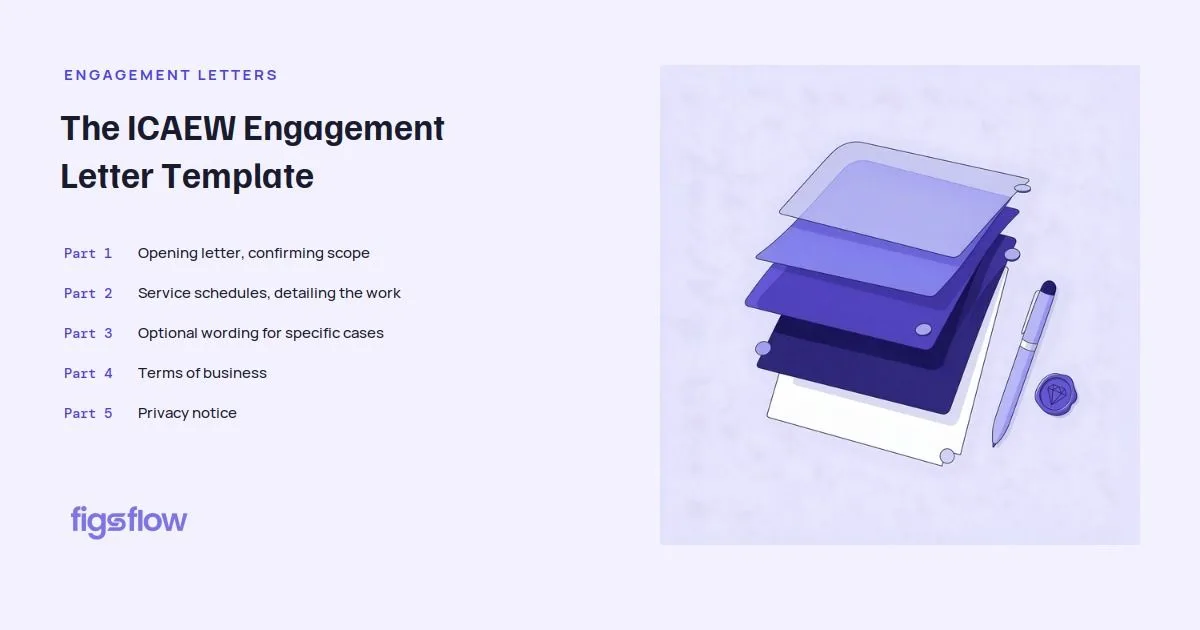
Engagement letters are your first line of defence. Use the ICAEW-approved template to stay compliant and protect your firm.
The ICAEW engagement letter template is a structured set of sample wordings issued by ICAEW's Technical Advisory Service to help members in practice draft compliant engagement letters for their clients. It covers both corporate and non-corporate clients across general practice work and runs across five parts that together form a complete, legally grounded letter.
Most practitioners know the template exists. Fewer know exactly what a compliant letter must contain, when it needs to be issued or updated, or how to apply the wording correctly without introducing errors. That is what this article covers.
What Is an ICAEW Engagement Letter?
An ICAEW engagement letter is a written contract between an accounting firm and its client. It sets out what services the firm will provide, on what terms, at what fee, and what each party is responsible for. It is issued before work begins and signed by both parties.
The letter matters for two reasons. First, it protects the firm. A clearly scoped engagement letter is your primary defence if a fee dispute arises or a client later claims they expected work you never agreed to do. Second, it protects the client. It gives them a clear record of what they are paying for and what falls outside the agreement.
Without one, the terms of the engagement exist only informally. That creates risk on both sides, particularly when services change, fees increase, or the relationship breaks down.
What Makes an ICAEW-Compliant Engagement Letter?
ICAEW has issued an engagement letter helpsheet through its Technical Advisory Service that sets out what a compliant engagement letter should contain.
A complete letter comprises four required parts. The engagement letter (Part 1) identifies both parties and references the service schedules and terms of business. The service schedules (Part 2) define the specific work, client responsibilities, and fee basis, each selected individually for each engagement. The terms of business (Part 4) cover payment, termination, liability, AML obligations, and GDPR. The privacy notice (Part 5) explains how personal data is collected and processed under UK GDPR.
Part 3 provides optional additional wording for specific circumstances and is included only where needed.
When to Issue or Update an ICAEW Engagement Letter
New clients should receive an engagement letter before any work begins, without exception. For existing clients, the letter should be reviewed and reissued whenever services change, fees are restructured, or the terms of business are updated.
It is also worth reviewing letters whenever the ICAEW helpsheet is revised. The helpsheet was updated in March 2026, with changes across multiple service schedules. If your current letters are based on an older version, they may no longer reflect current regulatory expectations, particularly for services such as MTD Income Tax, VAT, and ACSP identity verification, all of which have been updated or newly added in recent revisions.
As a general rule, annual reviews for recurring client engagements are good practice. It takes little time and avoids the much larger effort of unpicking an ambiguous agreement when something goes wrong.
Sample ICAEW Engagement Letter
A complete ICAEW engagement letter in practice looks broadly like this.
The opening letter (Part 1) confirms the client's name and the firm's details, states the date from which the engagement applies, and lists the service schedules attached. It references the terms of business and privacy notice and includes a signature block for both parties.
The attached service schedules (Part 2) then set out the detail. A corporation tax schedule, for example, will define the scope of the return preparation, what records the client must provide, submission deadlines, and how the fee is calculated. A payroll schedule will cover pay run frequency, responsibilities for reporting to HMRC, and the treatment of off-payroll working rules if applicable.
The terms of business (Part 4) follow, covering everything from invoice payment dates to what happens if either party wants to end the relationship.
The privacy notice (Part 5) closes the document, explaining the lawful basis for processing personal data and how the client can exercise their rights.
FigsFlow generates engagement letters in this structure, aligned with ICAEW standards, with each section populated based on the services selected. The image below shows what a completed letter looks like within the platform.
Create Your ICAEW Engagement Letter in Minutes with FigsFlow
Building an engagement letter manually using the ICAEW helpsheet takes time. Selecting the right schedules, removing guidance text, handling optional clauses, and keeping terms of business current across a full client base adds up quickly.
FigsFlow handles this in minutes. Over 100 pre-built templates aligned with ICAEW, ACCA, CIOT, CIMA, ATT, AAT, and other UK standards. Each letter is assembled automatically based on the services you select, customisable per client without touching your master template. Built-in e-signature, automated signature reminders, and group engagement support are all included.
See for yourself with a free 30-minute demo.
Free ICAEW Engagement Letter Templates
FigsFlow's template library includes ready-to-use engagement letters for a wide range of accounting, tax, and bookkeeping services, all built to UK compliance standards. A selection of available templates includes:
Annual accounts and corporation tax return, personal tax return (self assessment), VAT returns, payroll services, MTD for Income Tax, trust accounts and tax return, R&D tax credit, non-resident company tax return, Companies House ACSP identity verification service, and month-end close.
The full library is available at the FigsFlow templates page. Templates can be used as-is or customised to match your firm's scope and pricing.
Conclusion
An engagement letter is not an administrative formality. It is the document that defines the relationship with your client, protects your firm when disputes arise, and demonstrates to regulators that you operate to professional standards. Getting the structure right matters from the first letter you send to the last.
The ICAEW helpsheet gives you the framework. FigsFlow gives you the speed to apply it properly across every client, every year, without the manual effort that framework-only solutions require.
Further Reading: Best Engagement Letter for Accountancy Firms | FigsFlow