
You already know what the problem is.
A new client comes in, things move fast, and somewhere between sending the engagement letter and running AML checks, a step gets missed. Not because you’re careless. Because there’s no system. A client onboarding checklist fixes that, here it is.
Download it, use it on your next client, and never miss a step again.
Download Client Onboarding Checklist for Accountants
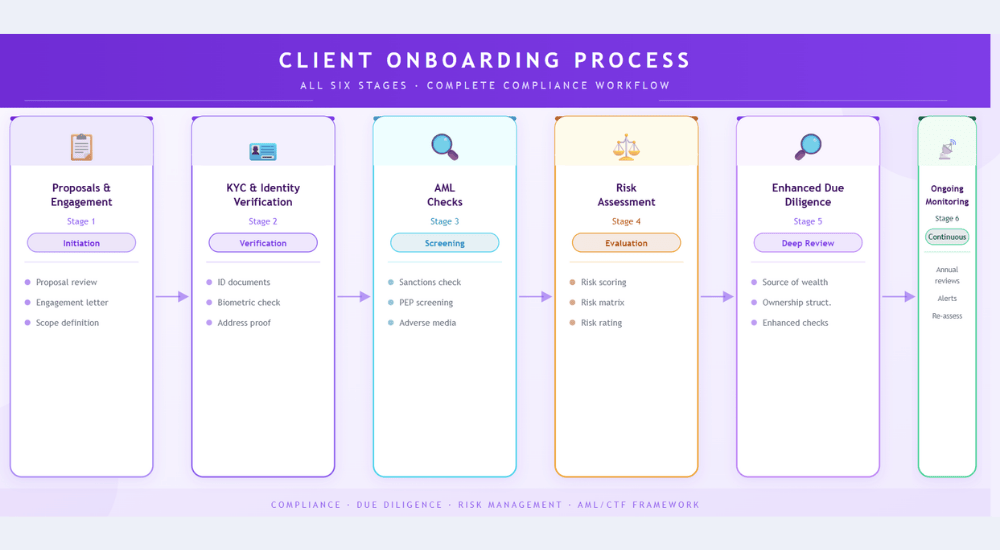
This checklist covers every stage of client onboarding from the initial proposal through to ongoing monitoring. It is built around six stages: proposal and engagement, KYC and identity verification, AML checks, risk assessment, enhanced due diligence, and ongoing monitoring.
It works for any new client regardless of service type, and is ready to use as-is. Print it, save it to your client file, or use it digitally. No setup required.
What Does the Client Onboarding Checklist Cover?
The checklist is organised into six stages, each representing a distinct phase of the onboarding process.
Stage 1: Proposals & Engagement.
Before any work begins, make sure your Client Onboarding Checklist is followed, ensuring all the right paperwork is completed. This means the correct engagement letter has been sent, the schedule of services reflects what was actually discussed, and all required signatories have e-signed.
Stage 2: KYC & Identity.
The Client Onboarding Checklist will guide you in gathering the required KYC and identity documents to ensure compliance. Identity documents, proof of address, UTR verification, and source of funds are all captured here before anything else moves forward.
Stage 3: AML checks.
Follow your Client Onboarding Checklist to complete the AML check, confirming the client’s identity and ensuring regulatory compliance. The result of the check and the rationale for the due diligence level applied are both recorded here.
Stage 4: Risk Assessment.
Based on everything gathered in the previous stages, this is where you make the compliance decision. The risk assessment is completed, reviewed by senior management where required, a Customer Risk Rating is assigned, and a conflict of interest check is completed.
Stage 5: Enhanced Due Diligence.
If the risk assessment flags a high-risk client, EDD is required. This stage confirms whether EDD applies and whether it has been completed using the appropriate template.
Stage 6: Ongoing Monitoring.
Onboarding does not end at sign-off. This final stage ensures a review date or trigger condition has been set for the client so their risk profile is revisited when circumstances change.
How to Use the Client Onboarding Checklist
Here is how you can make the most out of this checklist.
Assign it to a designated person in your firm and make it a rule that no client is marked as fully onboarded until every stage is signed off. No exceptions, regardless of how simple or familiar a client seems. Beyond that:
- Work through it in order. Each stage builds on the previous one, and the sequence is intentional.
- Keep a completed copy of every client file. It confirms everything has been done and nothing has been missed.
- Review it once a year. Your firm evolves, regulations shift, and the checklist should keep pace with both.
This checklist works best when used alongside a practice management system or onboarding system. It has been designed with FigsFlow’s onboarding workflow in mind, but it can be adapted to fit whatever system your firm uses. Adjust the stages, add firm-specific steps, and make it yours.
Common Client Onboarding Mistakes Accountants Make
Even experienced firms make the same onboarding mistakes repeatedly. Most of them are not about knowledge. They are about process. Here are the ones that come up most often.
Generic engagement letter
Sending a standard letter without checking whether it reflects the specific services agreed with the client creates problems later, particularly if a dispute arises over scope.
Skipping the source of funds
It feels like an awkward question, especially with referred or established clients. But it is a regulatory requirement, and its absence is exactly what a compliance review will look for.
Incomplete risk assessment sign-off
Completing the assessment is not enough. Senior management sign-off needs to be recorded with a name and a date, otherwise there is no confirmation of who reviewed and approved it.
No ongoing monitoring in place
Treating onboarding as finished once the client file is set up leaves risk profiles outdated without anyone noticing. A review date needs to be set before onboarding is closed.
Each of these mistakes is avoidable. A consistent checklist, followed without exception, is what prevents them.
Helpful Resources
- How to Onboard MTD Clients Faster: Streamline Your MTD Client Onboarding Journey | FigsFlow
- 7 Client Onboarding Mistakes You Must Avoid: 5 Client Onboarding Mistakes Costing You Clients
- 25+ Engagement Letter Template (It’s Free): 25+ Free Engagement Letter Templates Collection | UK Compliant
- Your Only Guide to Crafting Client-Winning Accounting Proposal: Create Client-Winning Accounting Proposal (Free Template Included) | FigsFlow
- Anti‑money laundering guidance for the accountancy sector: Accountancy sector guidance for money laundering supervision – GOV.UK
Conclusion
Client onboarding does not have to be chaotic.
With the right process in place, every client gets the same consistent, thorough experience from day one. Six stages, every step covered, ready to use today. Put it on the next client that comes through the door and work through it from top to bottom.
A consistent process is the difference between a practice that scales and one that stays stuck in the same onboarding chaos year after year.