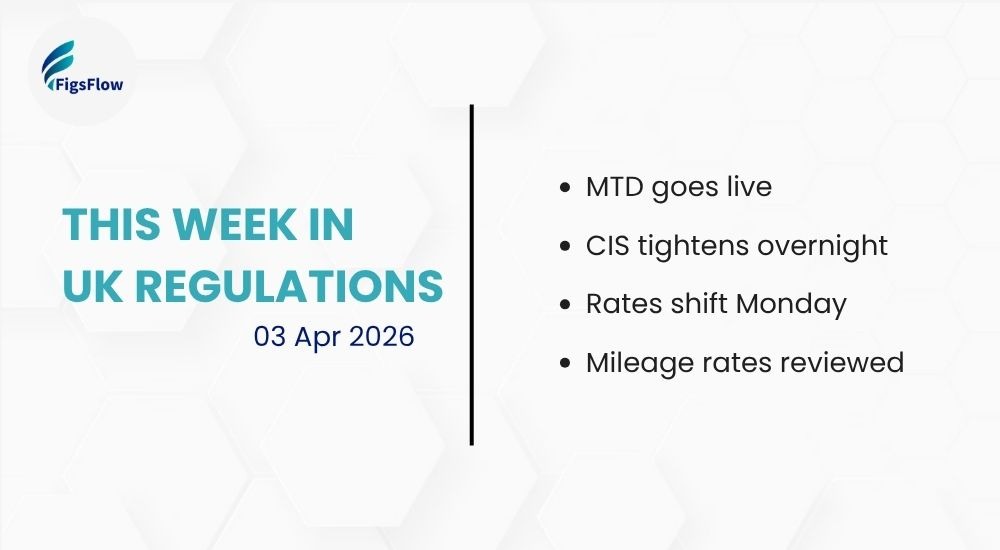

This weekly news and updates for UK accountants lands at the start of a new tax year and three days before MTD for Income Tax becomes law. Alongside that, CIS rules tighten, multiple tax rates shift, and HM Treasury has announced the first review of approved mileage rates in fifteen years.
Four stories. All live from Monday or already in motion.
MTD for Income Tax Starts in Three Days
Your qualifying clients are entering a new compliance regime on Monday, 6 April 2026. The penalty framework that comes with it rewards early action and penalises delay.
Making Tax Digital for Income Tax becomes mandatory on 6 April 2026 for self-employed individuals and landlords with qualifying income above £50,000, based on 2024 to 2025 records. There are no submission penalties for missing quarterly deadlines in this first year (2026-27), but digital record-keeping applies from day one. The first quarterly update deadline is 7 August 2026.
Late payment penalties apply from 6 April 2026, structured in tiers based on how long the tax remains outstanding. Clients struggling to pay should contact HMRC before the deadline. A payment plan agreed in time pauses penalties from the date of contact.
| Payment Timing | 2026 to 2027 | 2027 to 2028 |
|---|---|---|
| Up to 15 days late | No penalty | No penalty |
| 16 to 30 days late | 3% of the outstanding tax as at day 15, waived in the first year of MTD | 4% of the outstanding tax as at day 15, waived in the first year of MTD |
| 31 or more days late | 3% as at day 15, plus 3% as at day 30, plus a daily rate of 10% per year from day 31 until settled or up to 2 years | 4% as at day 15, plus 4% as at day 30, plus a daily rate of 10% per year from day 31 until settled or up to 2 years |
Clients whose qualifying income ceased before 6 April 2026 do not need to register. To exit, notify HMRC by phone or webchat.
CIS Rules Tighten From 6 April
Two changes to the Construction Industry Scheme land this weekend. Both carry penalties that your contractor clients may not yet be aware of.
From 6 April 2026, contractors must submit a monthly CIS return even in months where no subcontractors were paid. Previously, a nil return was optional where no payments had been made. That position has changed. The obligation is now absolute, and contractor clients who have treated quiet months as exempt months are now non-compliant by default unless they act.
The second change carries more serious consequences. HMRC now has the power to cancel Gross Payment Status immediately where fraud is suspected in the supply chain, without the contractor necessarily having been the source of that fraud. A firm that fails to detect fraud within its subcontractor network could lose GPS for five years and face a penalty of 30% on the tax lost. The due diligence requirements on contractor clients have effectively increased overnight.
- Monthly nil returns: mandatory from 6 April 2026, even with no subcontractor payments
- GPS cancellation: can now be immediate on fraud suspicion
- Maximum GPS ban on fraud detection failure: five years
- Penalty on lost tax: 30%
For any client holding Gross Payment Status, now is the time to review subcontractor vetting processes before HMRC reviews them first.
New Tax Year Brings Rate Changes Across the Board
Monday’s new tax year moves multiple rates simultaneously. Clients who have not yet been briefed are already behind.
Dividend tax rates rise by two percentage points from 6 April. The basic rate moves to 10.75% and the higher rate to 35.75%. The section 455 charge on overdue directors’ loans mirrors that increase, also rising to 35.75%. Business Asset Disposal Relief increases to 18%. For clients who were planning disposals in the hope of a lower BADR rate, the window closed on 5 April.
Inheritance tax treatment for business and agricultural property changes substantially. A new £2.5 million allowance covers assets qualifying for 100% relief. Value above that threshold carries an effective 20% IHT charge. VCT income tax relief drops from 30% to 20%, reducing the attraction of that vehicle for higher-rate clients. On the other side, EMI scheme asset limits increase from £30 million to £120 million, opening the scheme to a wider range of companies than were previously eligible.
- Dividend basic rate: 10.75% (up from 8.75%)
- Dividend higher rate: 35.75% (up from 33.75%)
- Section 455 charge: 35.75%
- BADR rate: 18%
- IHT: £2.5m allowance for 100% relief; effective 20% above that threshold
- VCT income tax relief: 20% (down from 30%)
- EMI asset limit: £120m (up from £30m)
Any client review conversations scheduled for after the new year are now conversations about positions already locked in.
Government Announces Mileage Rate Review
Approved mileage rates have not changed since 2011. The government has confirmed a review is coming. For now, there is nothing to implement but much to watch.
HM Treasury announced on 25 March that approved mileage allowance payment rates will be reviewed ahead of a future Budget. The rates, currently 45p per mile for the first 10,000 miles and 25p thereafter, have remained unchanged for fifteen years despite significant shifts in motoring costs. The review is framed around lower-paid workers in roles where car use is essential, and the gap between the allowance and actual costs is most pronounced.
For practitioners, this is not yet actionable. No revised rates have been proposed, and no timeline has been set beyond a future Budget. What it does create is a natural conversation with employer clients about their current mileage reimbursement policies. Employers paying at or below the approved rate carry no benefit-in-kind exposure. Those paying above it do. If rates change, those calculations change with them.
- Current approved rate: 45p per mile for the first 10,000 miles, 25p thereafter
- Rates last updated: 2011
- Review focus: workers who rely on their car to do their job
- No revised rates or implementation date announced
Keep a watching brief. When rates do change, employer payroll and expenses implications will need rapid communication to clients.
Also In The News
- The reason behind 1 in 4 SRA firm closures: Law Firm Accounting Breaches and SRA Closures | FigsFlow
- What counts as sanctionable conduct under HMRC’s new rules: HMRC’s New Sanctionable Conduct Powers Explained
- The security flaw behind the Companies House fraud risk: Companies House WebFiling Flaw Exposed 5 Million Companies
- HMRC rewrites the rules on tax adviser registration: Tax Adviser Registration for Financial Firms Delayed to 2027
- UK accounting news from last week: Weekly News and Updates for UK Accountants (27 March 2026) | FigsFlow
Conclusion
MTD goes live, CIS tightens, and multiple rates shift at once. Taken together, this is one of the more consequential April openings in recent years. Some clients will have prepared thoroughly. Others will be behind without knowing it. If there are clients who have not yet been briefed, this week is the week to reach them.