
You’ve probably used “digital signature” and “electronic signature” as if they mean the same thing. For most of your career, that was fine.
However, the distinction now has a compliance consequence. Get it wrong, and your client’s repayment claim doesn’t get processed. But to understand why, you need to know what actually separates the two – and why digital signature vs electronic signature is no longer just a terminology debate.
An electronic signature is the legal umbrella term for any data in electronic form used to sign a document, from a typed name in an email to a cryptographically verified identity certificate. A digital signature is a specific subset of that. It uses Public Key Infrastructure technology to verify the signer’s identity and lock the document so that any change made after signing immediately invalidates it. In short, every digital signature is an electronic signature. However, not every electronic signature is a digital signature.
This guide draws the digital signature vs electronic signature line clearly – where it sits, which documents fall on which side of it, and what HMRC now requires from agents.
Digital Signature vs Electronic Signature: In Plain Terms
Digital signature vs an electronic signature isn’t just a terminology debate. It’s what happens behind it.
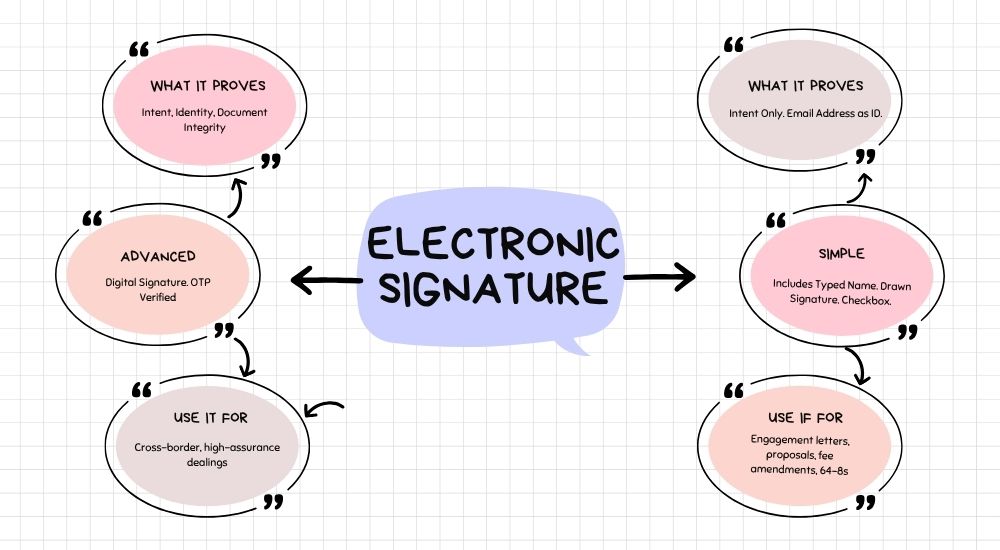
The simplest way to see a digital signature vs an electronic signature is through the same document, signed two different ways.
Your client signs an engagement letter through your platform. They receive a link, open the document on their phone, type their name, and click sign. The platform records their email address, IP address, and the exact time of signing. That’s a simple electronic signature. It’s legally valid for this document. It proves your client intended to sign.
Now the same client signs a P87 repayment nomination as part of an HMRC submission. They receive a link, open the document, and before they can sign, the platform sends a one-time password to their mobile number. They enter it. That OTP is cryptographically linked to the document at the point of signing. If anything in the document changes after that moment, the signature is flagged as invalid. That’s an advanced electronic signature. It’s also a digital signature.
Built for UK accountants
FigsFlow Uses Advanced Electronic Signatures
Not Just a Typed Name
Cryptographically secured, identity-verified, audit-trailed. The professional standard for UK accountants.
What Counts as an Electronic Signature Under UK Law?
Under Article 3 of the UK eIDAS Regulation, an electronic signature is:
data in electronic form, which is attached to or logically associated with other data in electronic form, and which is used by the signatory to sign.
The Electronic Communications Act 2000 makes it admissible as evidence in legal proceedings.
UK eIDAS recognises three tiers of an electronic signature.
Simple Electronic Signature
It includes a typed name, a drawn signature, or a checkbox. The platform records who sent the document, who accessed it, and when it was signed. It’s enough for the majority of documents that accounting firms handle day to day.
Documents like engagement letters, proposals, fee amendments, and standard client contracts all sit here.
Advanced Electronic Signature
It must meet four conditions, as set out under Article 26 of UK eIDAS:
- uniquely linked to the signatory,
- capable of identifying them,
- created using data under their sole control, and
- linked to the signed document in a way that detects any subsequent changes.
In practice, that means a one-time password sent to the signatory’s mobile before they can sign. It doesn’t just record intent. It proves who signed and that the document hasn’t been touched since.
Qualified Electronic Signature
It requires a qualified electronic signature creation device and a qualified certificate issued by a qualified trust service provider, as set out in Annex I of UK eIDAS. Identity verification happens face-to-face or via video with the QTSP (Qualified Trust Service Provider) before the certificate is issued. It’s rarely required for standard English law transactions.
You’ll encounter it in cross-border dealings or situations demanding the strongest possible identity assurance. For everyday accounting work, you won’t need it.
Did You Know?
A signed document without a compliant audit trail leaves you exposed if a client disputes the signature. Here’s what actually makes an e-signature and an e-signature platform valid – Are Electronic Signatures Legally Binding for in the UK?
What Counts as a Digital Signature?
Once you understand the digital signature vs electronic signature distinction, the definition becomes obvious. A digital signature is defined as:
an electronic signature that uses cryptographic technology to verify the signer's identity and seal the document against tampering.
Here’s what that means in plain terms.
At the moment of signing, the platform creates a unique fingerprint of the document. That fingerprint is encrypted and locked to the signer’s identity. If anything in the document changes after signing, the fingerprint no longer matches, and the signature is immediately flagged as invalid.
Advanced and Qualified electronic signatures are both digital signatures. A simple electronic signature is not.
Digital Signature vs Electronic Signature: What Each One Actually Proves
Where digital signature vs electronic signature really matters is not validity – both are legally valid. It is what you can prove when a document is challenged.
| What it proves | Simple Electronic Signature | Advanced / Digital Signature |
|---|---|---|
| The signatory intended to sign | Yes | Yes |
| The signatory is who they claim to be | Partially (email address only) | Yes (identity verified via OTP or certificate) |
| The document has not been altered since signing | No | Yes |
| Admissible audit trail | Basic | Complete |
| HMRC accepted for agent repayment nominations from April 2026 | No | Yes |
For engagement letters, proposals, and standard client contracts, the simple tier is sufficient. The Law Commission confirmed in its 2019 report on electronic execution of documents that what matters is whether an authenticating intention can be demonstrated, not the tier of signature used.
The table matters when you move into HMRC submission territory.
Choosing the Right E-Signature Platform for Your Practice
Which Signature Type Does Each Document Actually Need?
The digital signature vs electronic signature question has a practical answer for every document type your firm handles. Here is where each one lands.
| Document | Minimum signature tier required |
|---|---|
| Engagement letters | Simple electronic signature |
| Client proposals | Simple electronic signature |
| Fee amendments | Simple electronic signature |
| NDAs and service agreements | Simple electronic signature |
| 64-8 agent authorisations | Simple electronic signature (HMRC confirmed, Agent Update 115) |
| P87 / R40 / Marriage Allowance (agent repayment nominations) | Advanced electronic signature (from 6 April 2025) |
| IHT400 / IHT100 | Printed signature accepted where the agent provides written confirmation all LPRs have agreed |
| Lasting powers of attorney | Wet signature required. The Office of the Public Guardian does not accept e-signatures |
| Wills | Wet signature required under the Wills Act 1837 |
| Land Registry registered dispositions | Mercury signing or Conveyancer-Certified Electronic Signature. QES accepted under the pilot scheme from August 2025 per GOV.UK |
Conclusion
Digital signature vs electronic signature – the distinction is technical, but the compliance consequence is not. For most documents accounting firms handle, it doesn’t matter. A simple electronic signature on an engagement letter is legally valid and has been since the Electronic Communications Act 2000.
The distinction starts to matter the moment you move into HMRC submissions territory. Since April 2025, agent repayment nominations on P87, R40, and Marriage Allowance forms require an Advanced Electronic Signature. A simple electronic signature no longer qualifies. And HMRC will ask for evidence that you have an AES solution in place before processing any claims.
Practices that have this right now have one less compliance gap to worry about when HMRC asks.
10 Best E-Signature Software for UK Accountants (2026)
Every tool compared - AML integration, pricing, compliance, and which level your firm actually needs.
More e-signature guides for UK accountants
Frequently Asked Questions (FAQs)
A digital signature is a type of electronic signature, but they are not the same. An electronic signature covers any method of signing electronically, such as typing a name or clicking to agree. A digital signature uses encryption to verify identity and ensure the document has not been altered.
Yes. HMRC now supports digital filing and electronic authentication for many tax processes. From April 2026, companies must use commercial software for Company Tax Returns, and many sole traders and landlords must file through Making Tax Digital software. Some paper forms may still have separate signature requirements.
No. A simple electronic signature is sufficient under UK law. The Law Commission’s 2019 report confirmed that what matters is whether an authenticating intention can be demonstrated. A platform that captures the signatory’s email address, IP address, and timestamp alongside a locked PDF satisfies that requirement.
Digital signatures offer higher security than standard electronic signatures. They use encryption to confirm the signer’s identity, detect any changes made after signing, and create a reliable audit trail. This makes them more suitable for sensitive documents, high-value transactions, or agreements that may need to be defended legally.
DocuSign offers all three tiers — Simple Electronic Signature, Advanced Electronic Signature, and Qualified Electronic Signature. Which tier applies depends on how the document is configured, not the platform itself. A standard DocuSign envelope with email authentication is a Simple Electronic Signature. A DocuSign envelope with OTP verification is an Advanced Electronic Signature — and therefore a digital signature.
For UK accounting firms, FigsFlow is purpose-built where DocuSign is general-purpose. FigsFlow combines Advanced Electronic Signature — the tier HMRC now requires for P87, R40, and Marriage Allowance agent repayment nominations — with engagement letters, proposals, AML checks, and KYC in a single platform. Rather than paying separately for an e-signature tool and a practice management system, FigsFlow handles the entire client onboarding process including compliant e-signatures for under £2.10 per client verification. Built specifically for UK accountants, bookkeepers, and tax advisers.