
Client risk assessment software you can show the workings for
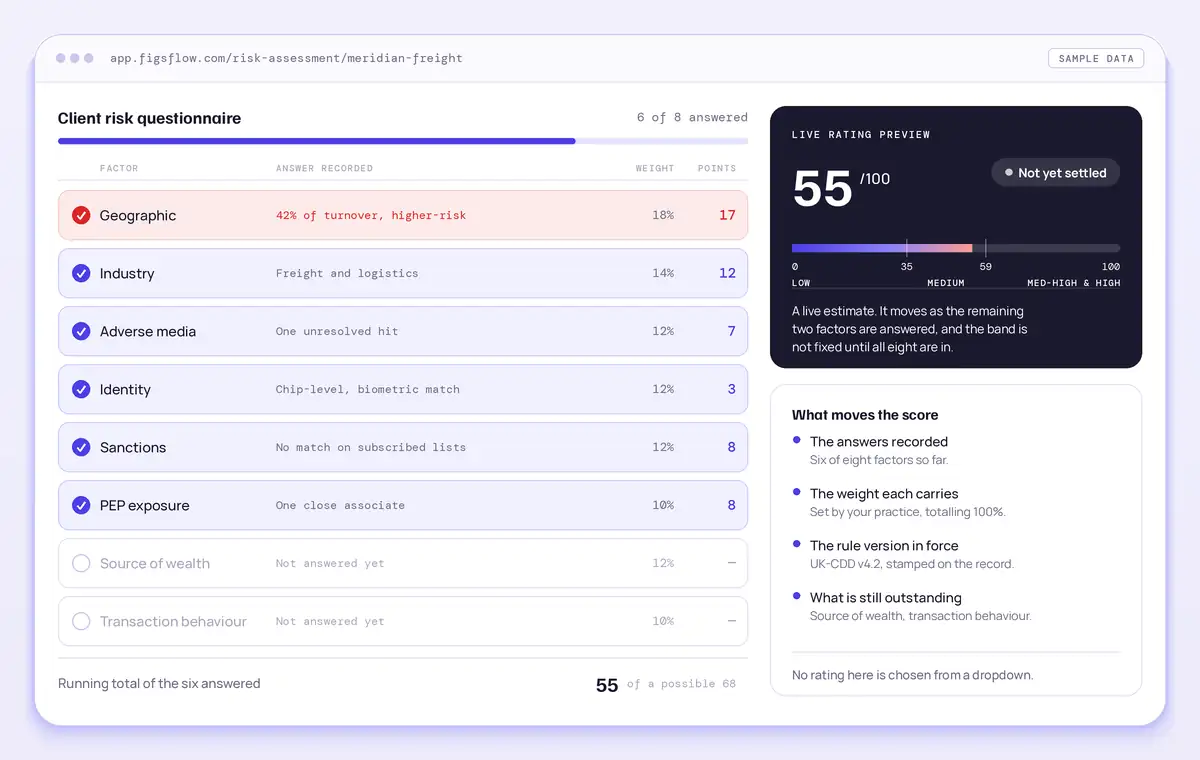
FigsFlow is client risk assessment software for accountants that computes the rating rather than asking someone to pick one. Eight weighted factors, coded rules, a live preview as the questionnaire is completed, and a band that triggers enhanced due diligence on its own. Every score reconstructs to the data and the rule version in force when it was made.
 G2 reviews
 Google reviews
Verified reviews
Trustpilot reviews
Google reviews
Verified reviews
Trustpilot reviews
Trusted by the best





Watch a score build itself
Ninety seconds: open the questionnaire, answer six of eight factors, watch the preview move, hit a high-risk answer, and see the band flip and the EDD trigger fire.
The point is that nothing is decided by a person choosing from a dropdown.
- 0:00Open the questionnaire
- 0:18Answer six of eight factors
- 0:46The preview moves as each answer lands— the moving number is the argument
- 1:04A high-risk answer, and the band flips
- 1:18The EDD trigger fires on its own
Preview clock — no video source set
- ◉Computed, not chosenNo dropdown decides the rating
- ⚖Weights visibleEight factors, each on its own rules
- ⚠Trigger fires itselfThe band drives the diligence
- 🗑Rules versionedReconstructs to the day it was made
The partner asks why this client is medium and not high, and the honest answer is that somebody chose it on a Tuesday.
A score nobody can reconstruct is a score nobody will sign
A rating written into a box is a record that the assessment happened. It is not a record of what the assessment concluded, or why. Six months later the person who chose it has moved on, the client has changed, and the only thing left is a number with nothing behind it.
The question is never whether a judgement was made. It is whether anyone can show the basis for it — which answers were given, what each one was worth, and which version of the rules was in force on the day.

This client is rated medium on the answers given, the evidence filed against them, and the version of the rules in force on 11 September 2026.
View reasoning →What feeds the score, and what it sets off
Client risk assessment software is only useful where it is wired into everything either side of it.
The record supplies the answers; the band decides what has to happen next.
Feeds it
Sets off
What is the score actually made of?
Eight factors, each scored on its own rules and each carrying its own weight. The answers are weighted, the engine is deterministic, and the preview updates as the questionnaire is completed — so the outcome is never a black box.
- 18%Geographic
Counterparties in higher-risk jurisdictions, measured as a share of invoiced turnover rather than a yes or no.
- 14%Industry
Sector risk from your own matrix — cash-intensive trades, freight, property and crypto rated against the rest of the book.
- 12%Adverse media
Screened continuously. A hit raises the score and opens a review task; it never quietly closes itself.
- 12%Source of wealth
Declared wealth weighed against what has actually been evidenced. Unevidenced portions keep the score up.
- 12%Identity
Verification strength across directors and beneficial owners. Chip-level checks with a biometric match pull the score down.
- 12%Sanctions
Screened daily against the lists your practice subscribes to. You hear from FigsFlow when something changes.
- 10%Transaction behaviour
Activity compared with what the engagement said to expect, so drift is caught at the point it happens.
- 10%PEP exposure
Domestic and foreign PEPs, family members and close associates. A confirmed match is recorded with the reason for continuing.
What happens the moment the band lands?
The band is not a label applied after the fact. It decides which diligence path the client goes down, and the system enforces that relationship rather than trusting someone to remember it.
- 0–35Low
Standard due diligence, reviewed on the practice’s longest cycle. Simplified due diligence cannot be selected until the permitting basis is recorded.
- 36–59Medium
Standard due diligence with a shortened review cadence. Any single factor in the top band opens a review task on its own.
- 60–100Medium-high and high
Enhanced due diligence is driven by the band, not requested by a person. The named trigger is recorded alongside the rating, not just the outcome.
What happens when something changes?
The market has moved from an annual review to perpetual monitoring, and a rating that is only correct on the day it was made is not a control. A change in the underlying data re-opens the rating by itself.
- Ownership
A new beneficial owner appears on the register and the ownership factor is rescored.
- Sanctions
A sanctions designation lands overnight and the review task opens before anyone logs in.
- Geographic
A registered-address change at Companies House moves the geographic factor and the score with it.
- Identity
An expired document weakens the identity factor rather than quietly passing as verified.
What does the file look like three years later?
Answered in versions. The rating as at onboarding, the annual review, the re-rating — and the rule version in force at each.
Each decision is snapshot at the point it was made, so a rating reconstructs to the data, the versions and the configuration in force when it was made, not to today’s settings applied backwards.
Seen enough? Bring the client your team argued about.
A template you fill in, or a model that computes
Client risk assessment software is not a questionnaire with a rating box at the bottom. A template records what somebody decided. A model produces the decision, shows the arithmetic, and files the version of the rules that produced it.
Both are a record. Only one of them is a record of the reasoning.
WHO USES IT
What this looks like at your size
Pick the shape of your practice.
A regulator's query is the first thing that will outgrow your own memory, because it can land on any file, at any time — not just the ones you still remember clearly.

PREVIEW CLOCK — INTERACTIVE DEMO
A supervisory visit is the first thing that will outgrow whoever handled the file, because it can ask about any client, on any day — not just while that person is still around.

PREVIEW CLOCK — INTERACTIVE DEMO
A review season is the first thing that will outgrow your current process, because it touches every open file at once, not just the ones somebody happens to remember.

PREVIEW CLOCK — INTERACTIVE DEMO
A regulator's request is the first thing that will outgrow three separate packs, because it expects one answer — not three different ones from three different people.

PREVIEW CLOCK — INTERACTIVE DEMO
The same data, practice-wide
Client risk assessment software earns its place only if the client ratings roll up. The firm-wide risk assessment covers client base, products and services, geography, transactions and delivery channels, each with its summary, assessment and mitigating actions, and a signatory sign-off. What the client model learns feeds what the practice assesses.
Works with what you already run
Built inside a working UK practice
Built inside working practices, not in a lab — by people who had returned their own work with review points on it.
 Placeholder
0:48
Placeholder
0:48
 Placeholder
1:02
Placeholder
1:02
 Placeholder
0:55
Placeholder
0:55
 Placeholder
1:14
Placeholder
1:14
What a risk assessment costs
Risk assessment sits inside the AML and client due diligence module. It is not a second tool with a second invoice. Identity and screening checks are credit-metered per check inside the subscription.
£3.00 from your 100th check, permanently. Electronic identity and address verification, PEP and sanctions screening, the Amberhill check, 24 months of ongoing screening and the inspection-ready record are all inside that one price.
Client and firm-wide risk assessments, enhanced due diligence workflow, policies, controls and MLRO roles, monitoring alerts and the training log. Billed annually; £19 a month on monthly billing.
Checks only, no programme, with everything above still included. Credits never expire, and the programme can be added at any time — free for the first 90 days.
The firm-wide risk assessment is not metered. What is metered is the identity and screening check run against a person; the Compliance Programme is a flat monthly fee per firm, however many clients you hold.
Nothing is sold separately — no data credits, no per-search top-ups, no separate sanctions module. A 250-client re-check on the programme costs about £800 once, and there is nothing per client per month after that. The programme is included from Onboarding Team upwards, and in the Practice Suite.
Everything a rating connects to
A rating does not sit on its own. These four touch it directly; the rest of the platform sits around them on the same client record.
What the rating governs.
See the AML module Engagement lettersWhat the clearance releases.
See the engagement letters module Forms and requestsWhere the answers come from.
See the forms module Audit trailWhere the workings are kept.
See the audit trail module