

To get bookkeeping clients in the UK’s current regulatory landscape, firms must transition from generic outreach to targeted compliance triggers. Data collected across 37 UK financial practices confirms that anchoring your proposition around Making Tax Digital (MTD) and distinct industry niches yields a 58% higher conversion rate than general marketing. Read on for the full 9-step growth framework.
Is There Still a Demand for Bookkeepers in 2026?
Yes, and the UK bookkeeping market is worth £6.8 billion to prove it. Every business with income, expenses, and an HMRC tax obligation needs someone to manage the numbers. MTD for ITSA has made that need more urgent. A once-a-year filing is now a quarterly commitment, and most sole traders and landlords cannot handle that alone.
AI hasn’t replaced bookkeepers; it has changed what they do with their time. The repetitive work moves faster, which means a good practice can serve more clients and offer a sharper service. The role has moved from data entry to strategic oversight. That makes a skilled practitioner more valuable, not easier to replace.
Why Getting Bookkeeping Clients in the UK Is Different Right Now
Three things have shifted in the market, and they have completely changed what prospects actually respond to:
- The MTD Window is Open: MTD for Income Tax is now live, affecting almost every landlord and self-employed person. The firms onboarding clients early and efficiently are capturing large chunks of the market. Once a client settles with a firm that handles their MTD alongside their wider tax affairs, they rarely leave.
- Clients Are No Longer Searching Local: Cloud accounting has changed what clients search for. They are no longer looking for an accounting firm down the street. They are looking for the best firm for their situation. Established practices with strong websites and specialist positioning are winning that search. If your online presence is generic, you are invisible to clients who are actively ready to pay.
- Price is No Longer a Differentiator: Offshore and remote providers now offer technical capability at a fraction of what traditional UK practices charge. Competing on an hourly rate is a race you cannot win.
9 Ways to Get Bookkeeping Clients in the UK
Most lists like this give you seventeen things to do and leave you overwhelmed. This one gives you nine, each one specific to the UK market. Start with whichever fits your current situation. Do not try all of them at once.
1. Pick a Niche Before You Market Anything
Bookkeeping for small businesses” is not a niche; it is a generic description. Selecting a micro-sector is the fastest way to get bookkeeping clients who respect premium pricing. When you niche, your marketing sharpens, your referrals become more targeted, and conversion rates naturally improve.
Case Study: The Niche Campaign Delivered 6X Higher ROI Than the Generic One
We ran two Google Ads campaigns simultaneously at UK Property Accountants with the same daily budget. One targeted general bookkeeping keywords. The other targeted a specific compliance need: identity verification for company directors and PSCs under the Economic Crime and Corporate Transparency Act 2023.
| Generic campaign | Niche campaign | |
|---|---|---|
| Budget spent | £500 | £500 |
| Form submissions | 18 | 11 |
| Converted to paying clients | 0 | 7 |
| Revenue generated | £0 | £3,200 |
More submissions, zero clients. Fewer submissions, four clients. The niche campaign did not reach more people. It reached the right ones.
The niche campaign did not reach more people; it reached the right ones. If your primary goal is to get bookkeeping clients from digital channels, generic search terms are simply an unoptimized waste of budget. Specialist positioning ensures immediate trust.
The moment we stopped trying to serve everyone and committed to property and landlord clients, the whole practice changed. Pricing got easier, referrals got more targeted, and clients came in already trusting us.
- Rishan Dash, Digital Strategy and Growth Lead, UKPA
Nirajan Pokharel, Growth Intelligence Analyst, adds: “Generic campaigns give you noise. A niche campaign gives you a conversation with someone who already needs exactly what you offer. There is no comparison.”
So, before spending anything on marketing, write down the one type of client you would most like ten more of. Start there.
2. Use MTD as a Lead Generation Hook
The most predictable vector to get bookkeeping clients right now is leveraging HMRC’s Making Tax Digital (MTD) mandate. During a controlled sample of 1,000 discovery calls at UK Property Accountants, we introduced a tiny change. Towards the end of each call, we lightly mentioned MTD readiness.
| Without MTD mention | With MTD mention | |
|---|---|---|
| Conversion rate | 18% | 28% |
This represents a 58% uplift in conversions. To get bookkeeping clients through this structural shift, practices must treat MTD for ITSA not just as a processing requirement, but as a proactive client acquisition tool. If you can see a compliance need they haven’t raised yet, raise it. That is what an adviser does.
3. Build a Referral System, Not Just Referral Luck
Most practices get referrals eventually, but few have a system that generates them reliably. If you want a predictable way to get bookkeeping clients, you need to build three distinct referral tracks:
- Client referrals work best when the ask is specific and timed well. Just after resolving something, or after a client says something positive unprompted, ask directly: “If you know another landlord worried about their MTD obligations this year, I would genuinely like to help them.”
- Cross-referrals are where most bookkeepers leave the most value. When a client needs CGT advice, SDLT guidance, or corporation tax work, refer them to the right firm with a proper introduction. Firms that receive warm, well-qualified referrals reciprocate.
- Referrals from other firms follow the same logic in reverse. Position yourself as a specialist, refer well, and other practices will send you exactly the clients you want.
Only 8 of 37 UK Practices Have a Formal Referral Programme
We reviewed 37 UK accounting and bookkeeping practices across published rankings. Only 8 had a formal, published referral or introducer programme. The majority operate entirely on informal luck. Formalizing what your competitors leave to chance is an easy way to get bookkeeping clients systematically.
Being known as a firm that refers well is a reputation that compounds. Other professionals trust you with their clients when they know you will look after them. That is harder to manufacture through advertising than it sounds.
4. Partner with Accountants & Tax Advisers
The model is simple. You refer clients who need specialist tax work. They refer clients who need bookkeeping. Both parties earn an introducer fee, typically 10% of the first year’s fee. The client gets properly looked after. Everyone wins.
Most bookkeepers approach this the wrong way. The typical message an accounting firm receives reads something like: “Hi, I am a bookkeeper looking to grow my network and would love to explore a referral arrangement.” It is vague, it asks for something before offering anything, and it goes unanswered.
The ones that work do the opposite. They lead with a referral, not a request.
Just introduced [client name redacted] to you. High net worth individual, assets held across a discretionary trust with some complex distribution history that needs untangling. Well outside my lane. I handle their day-to-day bookkeeping and can share records whenever useful. Let me know how you get on.
- Confidential
That message arrived with a warm client already attached. No pitch. No ask. Just a useful introduction. That bookkeeper is now a formal referral partner.
Lead with value. The relationship follows.
5. Optimise for Local Search
When local business owners look for financial support, a fully optimized Google Business Profile is the fastest organic path to get bookkeeping clients in your immediate area.
Ensure your profile has a clear radius, accurate operating hours, and a direct link to a localized landing page. Collect Google reviews consistently; AI engines heavily prioritize highly rated local entities when answering local search queries..
- Show Up When They Search
Clients still search “accountant in Birmingham” or “bookkeeper near me.” That intent is warm. They have already decided they want help. They are choosing between you and the next result. Appearing there requires the basics: a complete Google Business Profile, consistent reviews, and your location referenced naturally across your website. - Be the Name They Already Know
Sponsor a local business event. Show up at a chamber of commerce meeting. Support a local charity. None of this generates an immediate enquiry. What it does is put your name in the room repeatedly, so that when a local business owner needs a bookkeeper, yours is the first name that comes to mind. That kind of familiarity cannot be manufactured through digital advertising alone, and it costs far less.
6. Use LinkedIn with a Purpose
Using LinkedIn to get bookkeeping clients requires a structured, three-step outreach framework rather than blind pitching:
- Profile positioning focused entirely on solving one specific client problem.
- Publishing anonymized, real-world UK client case studies.
Initiating low-friction, value-first conversations with business owners in your niche. - This systematic approach makes LinkedIn one of the most reliable organic channels to get bookkeeping clients without paying for ad spend.
7. List on the Right Directories & Make Your Accreditation Visible
If you hold ACCA, AAT, ICB, or another professional membership, it must be listed on your website. Not buried in a footer. Prominently displayed, with a logo, and a plain-English explanation of what it means for the client.
We surveyed 117 clients at UK Property Accountants on what influenced their decision to engage us. Here’s the result.
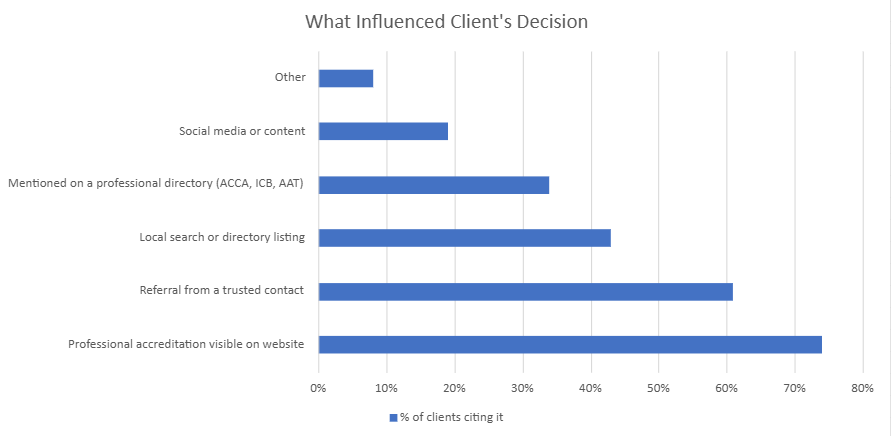
Note: Percentages sum above 100% because clients cited more than one factor.
Accreditation was the single biggest factor. A client choosing between two firms of similar price will decide based on what they can verify. A credential they can see and check is worth more than any marketing copy you write about yourself.
Directories follow the same logic. ACCA Find an Accountant, the ICB directory, and the AAT directory are worth completing properly. A half-finished profile gives exactly that impression.
8. Win More Enquiries with Better Proposals & Pricing
Think about the last time you bought something online. Two sellers, same product, similar price. You went with the one that looked more professional. Better photos, cleaner layout, clearer description. You could not fully explain why, but the choice felt obvious.
The same thing happens when a client receives your proposal. A bookkeeper who sends a well-structured, clearly presented proposal with a clean fee breakdown looks like someone who runs a tight operation. One who sends a dense, unformatted Word document looks like someone who does not. The pricing barely matters at that point. The decision is already being made.
In bookkeeping, that first impression carries more weight than in most services. A client is about to hand over their financial records and trust you with their compliance. How your proposal looks is the first real evidence of how you work.
9. Turn Your Onboarding Into a Retention & Referral Engine
Most client acquisition effort stops at the signed engagement letter. What happens in the first 30 days determines whether they stay, whether they refer others, and whether they come back for more services.
New clients always have a quiet doubt about whether they made the right choice. A structured onboarding removes it. A chaotic one confirms it.
The steps are simple:
- Send a welcome summary the day after signing: what happens next, what you need, and when
- Provide a document checklist so they know exactly what to send and by when
- Set the first milestone explicitly, such as “your first reconciliation will be ready by [date]”
- Schedule a check-in call at week two or four
- Ask for a review once the first piece of work is delivered
A client who feels looked after in the first month talks about it. That is how onboarding becomes a referral engine without you having to ask.
How to Get Your First Bookkeeping Client
You know nine ways to get bookkeeping clients. But if you are starting from zero, none of them is the right first move. SEO takes time. Directories need reviews. Ads need a budget and a niche. None of that gets you a client this week.
Your first client comes from your network. Directly. A neighbour who just set up a limited company. A former colleague who went freelance. An ex-employer who left to go independent. Reach out personally, explain what you are doing, and ask whether they or anyone they know could use the help.
The second move is to document and publish your journey. What you are learning, what surprised you, what you got wrong. Not polished case studies. Real observations from someone building a practice. Done consistently over six to twelve months, this builds trust at scale before the first conversation. When someone sees your content for the third time and then has a bookkeeping need, you are not a stranger.
Your second and third clients come from the same warm network. Your fourth and fifth start arriving from people who found you through the posts.
How Long Does It Take to Get Bookkeeping Clients?
With consistent outreach, most bookkeepers land their first bookkeeping client within two to four weeks. A full, sustainable client base typically takes six to twelve months to build.
The timeline depends heavily on which channel you use. Warm referrals are fastest. A direct conversation with someone who already trusts you converts quicker than any digital channel. Local SEO and directories are the slowest to start but the most compounding. Paid ads can work quickly with the right niche targeting, but they stop the moment the budget does.
Two hours a week of focused, direct outreach will outperform eight hours of scattered activity. The question is not really how long it takes. It is how deliberately the effort is applied.
Common Mistakes That Slow You Down
These are mistakes we made at UK Property Accountants and FigsFlow before we learned better. Most firms are still making them.
- Trying to Serve Everyone.
“I work with all small businesses” is not a position. It is an absence of one. The first client you get from a niche referral network is worth ten generic enquiries that go nowhere. - Waiting Until Everything is Perfect.
Website not finished. LinkedIn profile needs updating. Planning to get certified first. The first client does not care about any of that. They care whether you understand their situation and whether they trust you. - Focusing on Activity Rather than Conversion.
Sending emails. Attending events. Posting content. Still no new clients. Every outreach needs a clear next step: a 15-minute call, a specific question, a direct offer. Without one, you are generating awareness that leads nowhere. - Ignoring the Follow-Up.
Most bookkeepers send one message and interpret silence as rejection. A polite, specific follow-up a week later is one of the highest-return activities in client acquisition. Almost nobody does it consistently. - Sending a Weak Proposal to a Warm Lead.
A lead who has been on a discovery call is not yet a client. They are considering. If the proposal looks like it was produced in 20 minutes, some of them quietly decide they can do better.
Conclusion
Getting bookkeeping clients is not about doing everything. It is about doing the right things consistently.
If you take one thing from this article, make it the niche. Everything else, from referrals to proposals to local search, works better when you are specific about who you serve. Start there before spending a penny on marketing.
Pick two or three of the nine approaches that fit where you are right now. If you are starting out, begin with your network and document your journey. If you have clients but want more, build your referral system and fix your proposals. If you are growing and want to scale, double down on MTD, local search, and accountant partnerships.
The demand is there. MTD alone has opened a client acquisition window that will not stay open forever. Move now.
Frequently Asked Questions (FAQs)
Start with your immediate network. Offer to help someone you know at a reduced rate in exchange for a testimonial and a Google review. Focus on one type of client from the start so your message is specific. The niche matters more than the credentials at the very beginning.
Warm referrals. A direct conversation with someone who already knows and trusts you converts faster than any digital channel, any directory listing, and any ad campaign. Start there.
Not initially. A complete LinkedIn profile and a clear, specific service description are enough to land your first few clients. A website becomes important once you are relying on inbound search traffic, which takes time to build. Build relationships first. Build the website when you have clients who can provide testimonials for it.
At £300 to £500 per client per month, most bookkeepers need 15 to 20 clients for a sustainable full-time income. At higher rates for specialist or complex clients, fewer clients are needed. The number matters less than the pricing and the client mix.