

A bad engagement letter rarely looks like one. For many UK firms, it’s treated as routine, a template gets copied, details updated, sent for signature without much thought.That approach can prove costly. In our experience, a single dispute over scope, fees, or responsibilities can run into thousands of pounds once unpaid work, write-offs, and legal costs are added up.
The issue is rarely the absence of an engagement letter. It’s the quality of the one being used. Outdated templates and missing clauses leave room for misunderstandings, ones that only surface once a problem has already started, when it’s too late to fix them.
When an Engagement Letter Fails in Practice
Signing an engagement letter feels like the job is done. It isn’t. A signature only confirms what’s written on the page. If the wording is vague, the signature doesn’t protect you either way. Most firms only find out their letter has gaps at the worst time, during a dispute, a complaint, or a review by their insurer.
By then it’s too late. Rewriting the clause doesn’t help the client who’s already upset. This usually isn’t down to one bad drafter. It’s what happens when a partner writes one version, a junior team member copies and tweaks it for the next client, and nobody checks whether the important protections are still there. Each copy gets a little weaker than the last.
What Makes an Engagement Letter "Bad"?
A poor engagement letter is not necessarily one that is short or poorly written. More often, it is a document that fails to reflect the actual relationship between the firm and the client.
Common warning signs include:
- Vague wording that describes services in general terms instead of listing exactly what is included
- Missing clauses covering additional work, client responsibilities, liability, termination, GDPR, or payment terms
- Outdated templates that no longer reflect current legislation, professional guidance, or the firm’s services
- One-size-fits-all documents used for every client regardless of the services being provided
- No review process, meaning engagement letters remain unchanged for years while regulations and client needs evolve
Each of these weaknesses increases the likelihood of misunderstandings, unpaid work, and regulatory issues. An engagement letter should be treated as a living document that evolves alongside your practice, not a template that is copied from one client to the next.
The Hidden Costs of a Bad Engagement Letter
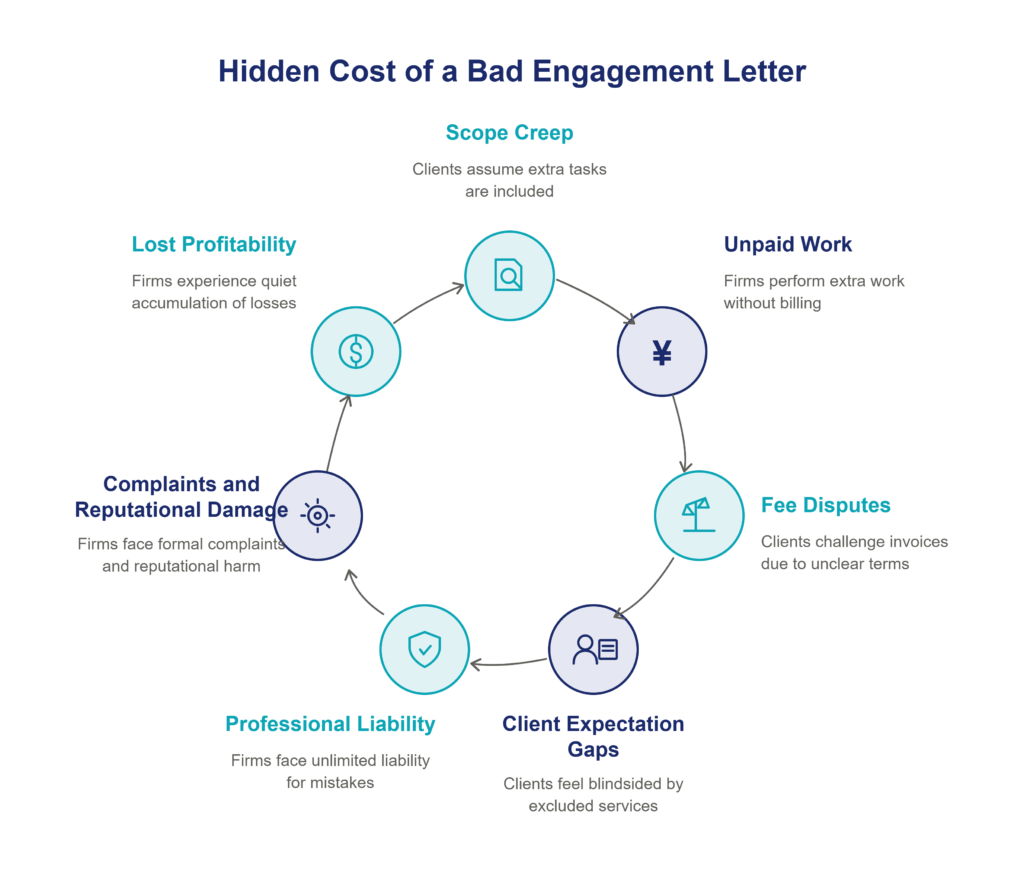
A weak engagement letter rarely causes problems immediately. The costs build gradually through additional work, payment disputes, compliance issues, and damaged client relationships. What begins as a poorly defined agreement can quickly become a drain on both time and profitability.
Scope Creep
Without a clearly defined scope, clients often assume related tasks are included in the agreed fee. A request for Companies House filings may turn into corporation tax advice, bookkeeping queries, or payroll support, all without a discussion about additional charges.
Clearly defining what is and is not included helps prevent these assumptions before they become disputes.
Unpaid Work
This is the direct result of scope creep. The extra work still has to get done, the client still expects it, but the firm can’t send an invoice for it. Why not? Because the letter never said extra work would cost extra. Without that line, asking for payment after the fact looks unfair to the client, even though the firm is in the right. The fix is a clause that says clearly, any request outside the agreed list counts as new work, and new work gets a new quote before it starts.
Fee Disputes
Clients are far more likely to question an invoice if the engagement letter does not explain how fees are calculated, what the agreed fee covers, or when additional charges will apply. If the wording is vague, a client may assume that extra meetings, tax queries, or follow-up work are included in the original price.
A clear pricing clause removes that uncertainty. It should set out the basis of the fee, identify any excluded services, and explain how additional work will be approved and billed. This gives the firm clear evidence that extra work falls outside the original agreement and makes it easier to justify the invoice if the client disputes it.
Client Expectation Gaps
Most clients assume they’re getting a full service unless told otherwise. If the letter doesn’t spell out what’s excluded, the client fills in the gap themselves, usually by assuming everything is included. Then, when the firm says a task isn’t covered, the client feels blindsided, even though the firm never agreed to it. The letter is meant to prevent that gap. When it doesn’t, the firm ends up managing a complaint about something that was never promised.
Professional Liability
Without a limitation of liability clause, a firm can be held responsible for the full cost of a mistake, however large that cost turns out to be. A well written clause limits this. It says the firm is only liable for losses caused by its own negligence, fraud, or serious misconduct, and nothing beyond that. That limit matters because professional indemnity insurance is priced and capped around it. If the letter has no such clause, there’s no ceiling, and a claim can go well past what the insurance was ever meant to cover.
Complaints & Reputational Damage
A complaint that reaches ICAEW or ACCA doesn’t disappear once it’s resolved. It becomes part of a record. A future client doing due diligence, or an insurer setting a premium, can ask about it later. Once a dispute reaches that stage, the firm has already lost some control over how the story gets told. A clear letter reduces the chance a disagreement ever gets that far, because both sides can point to exactly what was agreed.
Lost Profitability
None of the costs above tend to show up as one obvious loss on a firm’s accounts. They build up slowly and quietly, through hours that are never billed and work that’s priced too low from the start.
Consider a practice charging £1,200 annually for a limited company client. During the year, the client requests additional bookkeeping support, several tax queries, and assistance with Companies House filings. Because the engagement letter does not clearly distinguish between included and additional services, the firm spends an extra 12 hours completing work without charging for it.
At an internal recovery rate of £100 per hour, that represents £1,200 of unrecovered time,effectively eliminating the profit from the engagement before accounting for overheads.
Multiply that across just ten similar clients, and the practice loses £12,000 in billable time each year, simply because expectations were never clearly documented.
A well-drafted engagement letter is therefore not just a compliance document,it is an important tool for protecting profitability.
Common Clauses Missing from Poor Engagement Letters
Many engagement letters contain the basics but overlook the clauses that provide real commercial and legal protection. These omissions often remain unnoticed until a dispute arises, by which point it is too late to amend the agreement.
The table below highlights some of the most commonly missing clauses and the risks associated with leaving them out.
| Clause | Why It Matters | Risk If Omitted |
|---|---|---|
| Scope of services | Clearly defines exactly what work is included and excluded. | Scope creep, unpaid work, and disagreements over responsibilities. |
| Additional services | Explains how work outside the agreed scope will be approved and charged. | Clients expect extra work to be included at no additional cost. |
| Fee and payment terms | Sets out fees, payment deadlines, and charging arrangements. | Invoice disputes, delayed payments, and reduced cash flow. |
| Client responsibilities | Confirms what records, information, and approvals the client must provide. | Missed deadlines, inaccurate submissions, and disputes over accountability. |
| Limitation of liability | Defines the extent of the firm's liability where legally appropriate. | Greater exposure to negligence claims and compensation demands. |
| GDPR and data protection | Explains how personal data is collected, processed, and stored. | Increased regulatory and contractual risk relating to data handling. |
| Termination | States how either party can end the engagement and what happens afterwards. | Uncertainty over ongoing obligations and outstanding fees. |
| Changes to services | Explains how variations to the engagement will be agreed. | Informal scope changes that are difficult to recover fees for. |
| Review and update clause | Confirms that the engagement letter will be reviewed when services or regulations change. | Outdated terms that no longer reflect the firm's work or regulatory requirements. |
No engagement letter can eliminate every risk. However, including these clauses creates a clear record of what has been agreed, reduces ambiguity, and gives both the firm and the client greater certainty throughout the engagement.
How a Bad Engagement Letter Gets Fixed
A poor engagement letter cannot be improved by simply adding more legal wording. The solution is to make the document clearer, more specific, and easier for both the firm and the client to understand. Each of the common weaknesses discussed earlier can be addressed with a practical change.
Rewrite Scope in Specific, Not General, Terms
Replace “accounts preparation as required” with the exact deliverable. Say which entity it covers, which period, what format it’s delivered in, and what’s excluded. A well drafted letter states plainly that only the services listed in the Schedule of Services are included, and that any additional work needs a new or amended letter before it starts. That single line is what removes the ambiguity most scope creep depends on.
Tie Every Fee to a Named Deliverable
Clients should be able to see exactly what they are paying for. Each fee should link to a clearly defined service, a named return, a filing, a quarterly update, rather than sitting inside one all inclusive monthly amount with no breakdown.
The engagement letter should also explain how additional work gets approved, priced, and billed. It should say who signs off on extra work before it starts, what rate applies, and when it gets invoiced. That single addition makes it far easier to recover fees when a client asks for something outside the original agreement, because the process was agreed before the work began, not argued about after.
Put the Letter on a Review Cycle, Not a Shelf
An engagement letter should be reviewed whenever the scope of services changes or when there are significant regulatory or operational changes within the practice. Even if nothing has changed, an annual review helps ensure the document remains accurate and compliant.
Treating engagement letters as living documents rather than static templates reduces risk, improves client communication, and ensures the agreement continues to reflect the services your firm actually delivers.
Did You Know?
FigsFlow comes with pre-loaded engagement letter templates covering the full range of accounting, tax, and advisory services. A firm can generate a letter, send it to the client via a secure link, and have it signed electronically, all from the same platform.
How FigsFlow Helps You Prepare an Engagement Letter
Preparing an engagement letter from scratch or adapting an old template takes time and increases the risk of missing important clauses. As your firm grows and services evolve, keeping every engagement letter accurate and consistent becomes even more challenging.
FigsFlow simplifies the process by generating engagement letters tailored to the services you provide. Instead of relying on generic templates, you can build a document that clearly defines the scope of work, fee arrangements, client responsibilities, data protection terms, liability clauses, and any exclusions relevant to the engagement.
The platform also helps maintain consistency across your practice. Whether you’re preparing an engagement letter for bookkeeping, accounts preparation, payroll, VAT, tax compliance, or advisory services, each document follows a structured format while remaining customised to the client’s requirements. This reduces manual drafting, improves accuracy, and helps minimise the risk of disputes later.
Sample Engagement Letter Generated by FigsFlow
Below is an example of how a section of an engagement letter generated by FigsFlow might look.
Further Reading
Conclusion
A poor engagement letter can lead to scope creep, fee disputes, unpaid work, and unnecessary compliance risks. By keeping your engagement letters clear, specific, and regularly updated, you can protect both your firm and your clients.
If your current template no longer reflects the way your practice operates, it may be time for a change. FigsFlow helps you create tailored, professional engagement letters that set clear expectations from the very start.
Ready to update your engagement letters? Try FigsFlow and generate engagement letters with confidence.
FAQs
An engagement letter is a signed document that sets out the scope of work, fees, responsibilities, and terms between an accountant and a client. You need one because it defines exactly what’s included, protects the firm if a dispute arises, and satisfies requirements set by bodies like ICAEW and ACCA
Start with a schedule of services naming the exact work included and excluded. Add fees tied to specific deliverables, client responsibilities, a limitation of liability clause, confidentiality and data protection terms, and a termination clause. Base it on your professional body’s template rather than drafting from scratch.
Yes. Once both parties sign, an engagement letter forms a contract. It sets out enforceable obligations, including what services will be provided, what fees apply, and what happens if either party wants to end the relationship. Courts and professional bodies treat it as the primary record of what was agreed.
The accountant or firm providing the service issues it, not the client. It’s drafted before or at the start of the engagement, addressed to the specific client being acted for, and must be reissued separately for any other party, such as a spouse or associated company.
Yes. Either party can usually end it on notice, as set out in the termination clause. Firms often add a disengagement clause too, covering what happens if a client goes silent for an extended period, so the relationship doesn’t remain open ended indefinitely.