Now Live: Practice Management Launched In FigsFlow On 7 October.Free until 28/02/2027
figsflow logo
Swikriti Thakuri

Swikriti Thakuri

ACCA Content Writer

Published entries

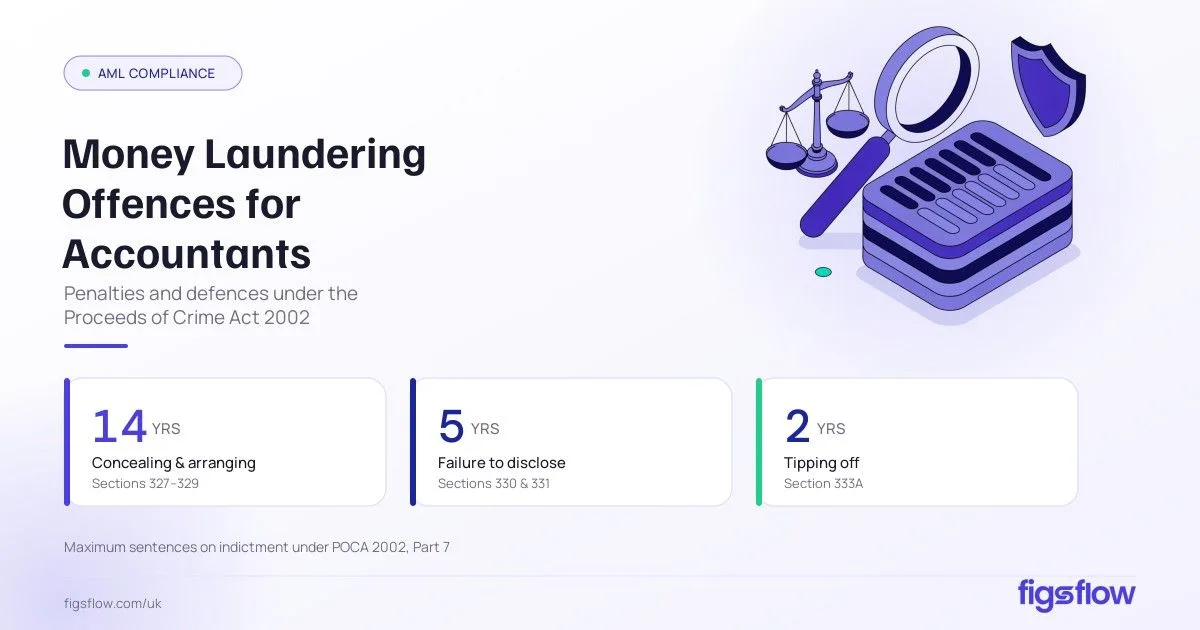
Infographic detailing penalties for money laundering offences under UK law.

10/14/2026

Money Laundering Offences for Accountants: Penalties and Defences Under POCA 2002

Money Laundering Offences for Accountants: Penalties and Defences Under POCA 2002 Money Laundering Offences for Accountants: Penalties and Defences Under POCA 2002 The Offences Accountants Can Commit Section 327: Concealing or Disguising Criminal Property Section 328: Entering an Arrangement Section 329: Acquiring, Using or Possessing Criminal Property Failure to Disclose in the Regulated Sector (Section 330) The Nominated Officer’s Duty (Section 331) Tipping Off (Section 333A) Disclosing That a Report Has Been Made (Section 333A(1)) Disclosing That an Investigation Is Underway (Section 333A(3)) Prejudicing an Investigation (Section 342) Defences Available to Accountants Where Accountants Get This Wrong Conclusion Additional Resources FAQs What is the difference between section 327 and section 330? Do accountants have a role in preventing money laundering? Are UK accounting practices subject to Anti-Money Laundering (AML) regulations? Is there a link to the accounting sector guidance for money laundering supervision? Can an accountant be convicted of a money laundering offence without being involved in laundering the money itself? Concealing a client’s criminal property carries up to 14 years. Failing to report a suspicion carries five. Tipping off a client carries two. The Proceeds of Crime Act 2002 does not treat these as one offence with one penalty, a distinction that is easy to miss. The gap matters because section 330, the provision that actually catches regulated sector professionals, does not require knowledge or suspicion of criminal property the way section 327 does. It requires only a failure to report what a reasonable person in their position would have suspected. This article sets out each money laundering offence an accountant can commit under POCA 2002, the section number, the maximum penalty, and the defence that actually applies to it. Offence Section Maximum penalty Who it applies to Concealing, disguising, converting, transferring or removing criminal property s.327 14 years and a fine on indictment, 6 months and the statutory maximum fine summarily Anyone Entering into or becoming concerned in an arrangement facilitating another person’s use of criminal property s.328 Same as s.327 Anyone Acquiring, using or possessing criminal property s.329 Same as s.327 Anyone Failing to disclose a suspicion, learned in the course of regulated sector business s.330 5 years and a fine on indictment, 6 months and the statutory maximum summarily Accountants, auditors, tax advisers and other regulated sector businesses A nominated officer failing to pass on a disclosure to the NCA s.331 Same as s.330 Money laundering reporting officers (MLROs) in the regulated sector Disclosing that a report has been made, or that an investigation is underway s.333A 2 years and a fine on indictment, 3 months and a level 5 fine summarily Regulated sector businesses Making a disclosure or destroying documents likely to prejudice an investigation s.342 5 years and a fine on indictment, 6 months and the statutory maximum summarily Anyone Accountancy services, tax advice and statutory audit work provided by way of business are named directly in Schedule 9 to the Act as regulated sector business. That is the provision that pulls accountants into sections 330, 331 and 333A, on top of the general sections 327 to 329 and 342 that apply to anyone handling the proceeds of [[money-laundering-definition-process-examples|money laundering]], regardless of sector. Section 327 carries the heaviest penalty in Part 7 of the Act: up to 14 years and an unlimited fine. It prohibits concealing, disguising, converting, transferring or removing criminal property from England and Wales, Scotland or Northern Ireland. An accountant who restructures a client’s accounts, knowing or suspecting the underlying funds come from crime, with the effect of disguising their source, falls directly under this section. This sits separately from the failure to disclose duty under section 330. A firm can breach section 327 even where no report was ever expected of it, simply by acting on what it already knew. Filing a suspicious activity report and obtaining appropriate consent under section 335 before acting is the statutory protection against this offence, provided the authorised disclosure and consent conditions in section 335 are actually met. The notice and moratorium periods that govern when consent is treated as given are set out in the defences section below. The firm’s [[suspicious-activity-report-in-anti-money-laundering|suspicious activity report]] process exists precisely to create that protection. Section 328 carries the same 14-year maximum and covers entering into or becoming concerned in an arrangement that facilitates another person’s acquisition, retention, use or control of criminal property. Accountants have been exposed to this section for structuring a transaction, not for handling the funds directly, where they know or suspect what the arrangement is actually achieving. Property transactions are the clearest example: a client overpays for a property to clean funds, or structures a deposit to obscure its source, and the professionals who help arrange the deal can be caught even without touching the money. Section 329 carries the same penalty band and covers acquiring, using or possessing criminal property. Accepting fees that an accountant knows or suspects derive from crime can fall under this section, independent of any work done on the client’s own transactions. The offence attaches to the accountant’s own conduct in receiving the payment, not to anything the firm advised the client to do. Section 329(2)(c) provides a defence where the property was acquired, used or possessed for adequate consideration. Section 329(3) defines inadequate consideration as consideration significantly less than the value of the property, and expressly excludes goods or services known or suspected to help someone commit criminal conduct from counting as consideration at all. Whether this defence applies depends on the property, the conduct and the consideration actually given in the specific case, so a fee charged at a normal commercial rate for genuine accountancy work is not automatically caught by this section just because the client’s underlying funds are suspect. Did you know? Schedule 9 to POCA 2002 names accountancy services, tax advice and statutory audit work provided by way of business directly as part of the regulated sector. That single paragraph is the reason sections 330, 331 and 333A apply to accounting practices at all. Section 330 carries a lower maximum, 5 years, but it is a key offence risk for accountants specifically, because it requires no intent to launder anything. It requires only a failure to report. The offence has four elements. First, the accountant knows or suspects, or has reasonable grounds to know or suspect, that another person is engaged in money laundering. That third limb, reasonable grounds, is an objective test. It does not require the accountant to have actually suspected anything, only that a reasonable person with their information would have. Second, that knowledge or suspicion came from information received in the course of regulated sector business. Third, under section 330(3A), the accountant can identify the other person or the whereabouts of the laundered property, or believes, or could reasonably be expected to believe, that the information will or may help identify either. Fourth, the accountant fails to disclose it to a nominated officer or an authorised person as soon as practicable. Section 330(14) defines a “relevant professional adviser” as an accountant, auditor or tax adviser belonging to a professional body that tests entry competence and enforces ethical standards, which places most UK practices directly inside this provision. Defences exist. A reasonable excuse for not disclosing is a defence under section 330(6)(a). Information received in privileged circumstances, such as a client’s instructions given for the purpose of seeking legal advice, is protected under section 330(6)(b), subject to section 330(11) removing that protection where the communication furthers a criminal purpose. A lack of required training given by the employer is a separate defence under section 330(7)(b). The court must also consider, under section 330(8), whether the accountant followed Treasury approved guidance current at the time. Section 331 mirrors section 330, but it attaches to the firm’s nominated officer, its MLRO, rather than to the accountant who first raised the concern. The same 5 year maximum applies. The offence arises where the nominated officer receives an internal disclosure under section 330, knows or suspects, or has reasonable grounds for knowing or suspecting, money laundering as a result, can identify the other person or the laundered property, or believes, or could reasonably be expected to believe, that the information will or may help identify either, under section 331(3A), and fails to pass that disclosure on to the National Crime Agency as soon as practicable. The same reasonable excuse defence under section 331(6) applies. Appointing an MLRO does not transfer risk away from the firm. It creates a second point of personal criminal liability inside it, which is why the role needs real authority to act on what it is told, not just a title. Section 333A carries a maximum of 2 years on indictment and 3 months summarily. Several AML guides for accountants still cite a 5 year maximum for tipping off. That figure belongs to the original section 333 offence. The current provision sits in section 333A, and it carries a materially lower sentence. The offence has two limbs, both of which apply only where the information came to the accountant through regulated sector business. That restriction makes this a direct extension of the accountant’s professional duties rather than a general dishonesty offence. Sections 333B to 333D set out permitted disclosure exceptions to both limbs, so not every disclosure linked to a report or investigation is automatically prohibited. The exact scope of those exceptions needs checking against the current text before relying on them in a specific case. Section 333A(1) prohibits disclosing that a report has been made under Part 7 of the Act, where the disclosure is likely to prejudice any resulting investigation. Section 333A(3) prohibits disclosing that an investigation into alleged money laundering is being carried out or contemplated, on the same prejudice test. The practical boundary, what counts as normal client communication against what crosses into tipping off under either limb, is the harder judgment call in this offence than the statute itself. Section 342 carries a 5-year maximum and applies where a person knows or suspects that an appropriate officer is acting, or proposing to act, in connection with a money laundering or related investigation. On that precondition, it covers two separate acts: making a disclosure likely to prejudice the investigation, and falsifying, concealing, destroying or otherwise disposing of relevant documents, or causing or permitting someone else to do so. Unlike section 333A, it is not limited to the regulated sector, and the Act sets out specific exceptions to the disclosure limb beyond the professional legal adviser defence below. A professional legal adviser, meaning a lawyer, has a specific defence under section 342(4) where the disclosure was made to a client in connection with legal advice, or to any person in connection with actual or contemplated legal proceedings. Section 342(5) removes that defence where the disclosure was made with the intention of furthering a criminal purpose. This defence belongs to the professional legal adviser specifically. It does not extend to accountants or tax advisers simply because they count as relevant professional advisers elsewhere in the Act. Five defences recur across these offences, and a firm’s AML file should be built to evidence each one it relies on. Appropriate consent is the defence to sections 327 to 329, and it runs through two different routes depending on who the disclosure is made to. Under section 335, a person who makes an authorised disclosure directly to a constable or customs officer is treated as having consent if no refusal arrives within seven working days, or once a 31-day moratorium period has run its course after a refusal. Under section 336, a nominated officer relaying an internal disclosure to an NCA authorised person follows the same seven-day notice period and 31 day moratorium but commits a separate offence under section 336(5) if they give consent to a prohibited act without one of these conditions actually being met. Reasonable excuse under section 330(6)(a) and section 331(6) is the general defence to both failure to disclose offences, though the Act does not define what counts as reasonable, which is why the basis for relying on it needs to be documented at the time, not reconstructed afterward. Privileged circumstances under section 330(6)(b) and (10) protect information received for the purpose of giving legal advice or in connection with legal proceedings, extended to support staff assisting a relevant professional adviser under section 330(7B). Lack of required training under section 330(7)(b) protects an accountant who did not know or suspect money laundering where the firm failed to provide the training it was required to give. The professional legal adviser defence under section 342(4) applies specifically to prejudicing an investigation, not to tipping off, is limited to lawyers rather than accountants or tax advisers generally and does not survive a criminal purpose under section 342(5). A frequent failure is treating the section 330 standard as subjective. It is not. “Reasonable grounds to suspect” is judged against what a reasonable professional would have concluded from the information available, regardless of what the individual accountant actually believed. A firm that documents its red flag monitoring and training only after a problem surfaces is relying on weaker evidence to support a reasonable excuse defence than if the record had been made at the time. Section 330(7E), a new defence covering information obtained only through an eligibility verification notice under the Social Security Administration Act 1992, was inserted into the Act on 2 February 2026. Firms still working from pre-2026 AML training materials will not know it exists. Technology does not remove the judgment required under section 330, but it can close the documentation gap that undermines a reasonable excuse defence after the fact, building the evidence trail as monitoring happens rather than reconstructing one during an investigation. Money laundering is not the only risk area accountants in the regulated sector have to manage. Firms handling clients exposed to sanctioned states or dual use trade carry separate [[counter-proliferation-financing|counter proliferation financing]] risk assessment and control obligations under the Money Laundering Regulations 2017, alongside the POCA reporting duties covered here. Three bands of offence, three different tests, one regulated sector duty that catches accountants specifically: report what you had reasonable grounds to suspect, as soon as practicable, and document why you acted or didn’t. Get the test wrong and the firm’s exposure sits with the individual who missed it and the MLRO who failed to escalate it, not just the client who caused it. Review your firm’s reasonable excuse and training records against sections 330 and 331 before the next file closes, not after. Proceeds of Crime Act 2002, Part 7 — the full statutory text of the offences covered above. HMRC Economic Crime Supervision Handbook, ECSH23000 — HMRC’s own summary of the Part 7 offences for supervised businesses. [[what-is-anti-money-laundering-in-uk|What Is Anti-Money Laundering in the UK]] — the wider AML framework these offences sit inside. [[aml-acronyms-and-definitions|AML Acronyms and Definitions]] — plain English definitions for MLRO, SAR, DAML and the other terms used throughout this article. [[suspicious-activity-report-in-anti-money-laundering|Suspicious Activity Report in Anti-Money Laundering]] — the disclosure process referred to in sections 330 and 331. [[tipping-off-in-anti-money-laundering-aml|Tipping Off in Anti-Money Laundering]] — where normal client communication ends and a section 333A disclosure begins. Section 327 requires knowledge or suspicion that property is criminal and an act of concealing, disguising, converting, transferring or removing it. Section 330 requires no such act. It is a pure reporting failure, triggered once an accountant in the regulated sector has reasonable grounds to suspect money laundering and does not disclose it. Yes. Accountancy services, tax advice and statutory audit work are named directly in Schedule 9 to POCA 2002 as regulated sector business, which brings firms within the client due diligence duties in the Money Laundering Regulations 2017 and the reporting duties in sections 330 and 331 covered above. The role is not optional. Section 330 makes failing to report a criminal offence in its own right, separate from any involvement in the laundering itself. Yes, where they provide accountancy services, tax advice or statutory audit work by way of business. Practices meeting that description sit inside the regulated sector under both the Money Laundering Regulations 2017 and Schedule 9 to POCA 2002, which means registering for AML supervision, carrying out client due diligence, and reporting suspicions under section 330. The specific obligations and any exemptions depend on the services a firm actually provides, covered in more detail in the wider anti-money laundering framework those regulations set out. Yes. The Consultative Committee of Accountancy Bodies publishes AML guidance for the accountancy sector, approved by HM Treasury under the Money Laundering Regulations 2017. Section 330(8) directs a court to consider whether an accountant followed guidance of this kind when deciding whether a failure to disclose has a reasonable excuse, which is why it is worth checking the current version rather than treating it as background reading. Yes. Section 330 is a standalone offence for failing to disclose a suspicion. It requires no involvement in the underlying criminal property, only reasonable grounds to suspect another person is laundering it, the ability to identify that person or the property, or a reasonable belief the information will help do so, and a failure to report that in time. money-laundering-offences-for-accountants money laundering offences for accountants blog Blogs blogs blogs/money-laundering-offences-for-accountants blogs money-laundering-offences-for-accountants

Overview of UK regulations for the week of October 5-9, 2026.

10/9/2026

Weekly News & Updates for UK Accountants (5-9 October 2026)

Weekly News & Updates for UK Accountants (5-9 October 2026) Weekly News & Updates for UK Accountants (5-9 October 2026) APR & BPR Cap Stalls Farm Investment Ahead of the Budget Conservatives Pledge No IHT on the Family Home MTD for Income Tax Drops to £30,000 With No Soft Landing Most UK Emigrants Skip Form P85 & Miss Tax Refunds Also In The News Conclusion The Autumn Budget lands on 28 October, and new survey data shows what the £2.5 million cap on Agricultural and Business Property Relief is already doing to farm businesses. That is the story to act on first. Close behind it, the Conservatives used their conference to pledge no inheritance tax on the family home, and clients will be asking what it means. The other two stories move more slowly but reach more clients. MTD for Income Tax drops to £30,000 in April 2027 with no penalty grace year, and most people emigrating from the UK are leaving tax refunds behind by skipping Form P85. Here is the detail. Rural family businesses are shrinking themselves to survive the cap on inheritance tax relief. A Country Land and Business Association (CLA) survey of 700 rural family businesses, published on 6 October, found that most now sit above the £2.5 million limit on 100% Agricultural Property Relief and Business Property Relief introduced by former Chancellor Rachel Reeves. For married couples and civil partners the limit is £5 million. The underlying problem is liquidity. Farms hold their value in land and machinery rather than cash, so a future IHT bill has to come from thin operating margins or from selling part of the business. Some owners are suppressing value instead: letting buildings deteriorate, cutting production and putting off spending on machinery and infrastructure. Key figures: 85% exceed the £2.5 million or £5 million relief caps 89% have paused planned investment, with 33% shelving projects above £150,000 Half expect to sell up to a quarter of their land or assets, and one in four expect to sell more than half The CLA has asked Prime Minister Andy Burnham and Chancellor John Healey to scrap the cap at the Budget. For farming and owner-managed business clients, now is the time to model exposure under the current rules and to hold off on irreversible restructuring until 28 October has passed. Kemi Badenoch told the Conservative Party Conference in Birmingham that a future Conservative government would remove inheritance tax from the main residence and let couples pass on a further £1 million tax-free. The party says this would reduce every IHT bill and halve the number of families paying it. Full abolition was ruled out for now and kept as a longer-term aim, to be pursued once it is affordable. The pledge leaves more questions than answers. No funding has been set out. It is unclear whether the £1 million applies per couple or per estate, or how single people and non-family beneficiaries would be treated. Badenoch also called for urgent simplification of a tax code she said now runs past 35,000 pages. Key facts: No IHT on the main home, plus a further £1 million tax-free for couples Restore full APR and BPR for farms and owner-managed businesses Halve employer National Insurance for employees under 25 None of this is law. Clients who raise it should hear that their estate planning has to work under the rules as they stand, not the rules an opposition party hopes to introduce. Taxpayers joining MTD for Income Tax next April will not get the grace year the first cohort had. The soft-landing penalty regime ends on 5 April 2027, so anyone with qualifying income above £30,000 faces penalty points and late filing penalties from their first year. Asked about any concession for this group, HMRC said there was no update. The threshold test is the trap. Eligibility turns on gross income from self-employment and property, before expenses, not on profit. A sole trader with modest profits can still be in scope, and many unrepresented taxpayers will not realise it. Those with both trading and rental income need separate digital records and quarterly updates for each. The threshold is not indexed, so rising incomes will keep pulling people in, and it falls again to £20,000 in April 2028. HMRC is now reaching beyond the profession through bodies such as the British Retail Consortium, OneDance and Yoga Alliance Professionals. Key facts: 1,077,000 taxpayers in scope from 6 April 2027 Around 400,000 (37%) currently file without an agent First quarterly update for this cohort due 7 August 2027 Check every client whose combined gross trading and rental income sits near £30,000, not just those whose profits do. The 400,000 without an agent are also a sizeable pool of prospective clients. Fewer than three in ten British nationals who emigrated last year told HMRC they were leaving. FOI data obtained by UHY Hacker Young shows 69,000 digital Form P85 submissions in 2025/26. ONS figures show 246,000 British nationals emigrated in 2025. Part of the gap is explained by the rules. A P85 is not mandatory, and Self Assessment filers report their departure through the residence pages of their return. The cost falls on everyone else. Someone leaving part-way through the tax year has usually had personal allowances applied on a cumulative PAYE basis, and the P85 is what prompts HMRC to run a final calculation. Without it, any refund goes unclaimed. Key figures: 69,000 digital P85s in 2025/26, up 32% from 52,000 246,000 British nationals emigrated in 2025 Filing rate: 28% For any departing client outside Self Assessment, treat the P85 as standard. They will need their P45 figures, details of any UK home and continuing UK income, and expected UK days for the next three tax years. Advise them to keep a UK bank account open until any refund has been paid. Weekly News & Updates for UK Accountants (28 September - 2 October 2026) - Last week's round-up covering the stories that shaped the week for UK practitioners. How to Onboard MTD Clients Efficiently in 2026 - A practical guide to bringing MTD clients on board without adding to your admin. Last-Minute MTD Resources for Accountants - Resources to help you onboard, price and engage MTD clients quickly. Are E-Signed Engagement Letters Valid in the UK? - What you need to know about the validity of e-signed engagement letters in the UK. The pattern this week is inheritance tax at the centre of the political argument while the compliance net widens with far less noise. The government faces pressure to reverse the relief cap, and the opposition promises to go further. Meanwhile MTD reaches another million taxpayers without a grace year, and HMRC's own data shows how many leavers fall through the gaps. The immediate work is to review farming and owner-managed business clients before 28 October and hold irreversible decisions until after the Budget. Next, check the client list against the £30,000 gross threshold well before April 2027, and make the P85 a standard step for anyone leaving the UK. We publish these updates every week. Follow us to get next week's round-up as soon as it lands. weekly-news-for-accountants-9-oct-2026 weekly news for accountants 9 oct 2026 weekly-news weekly news Weekly News weekly-news/weekly-news-for-accountants-9-oct-2026 weekly-news weekly-news-for-accountants-9-oct-2026

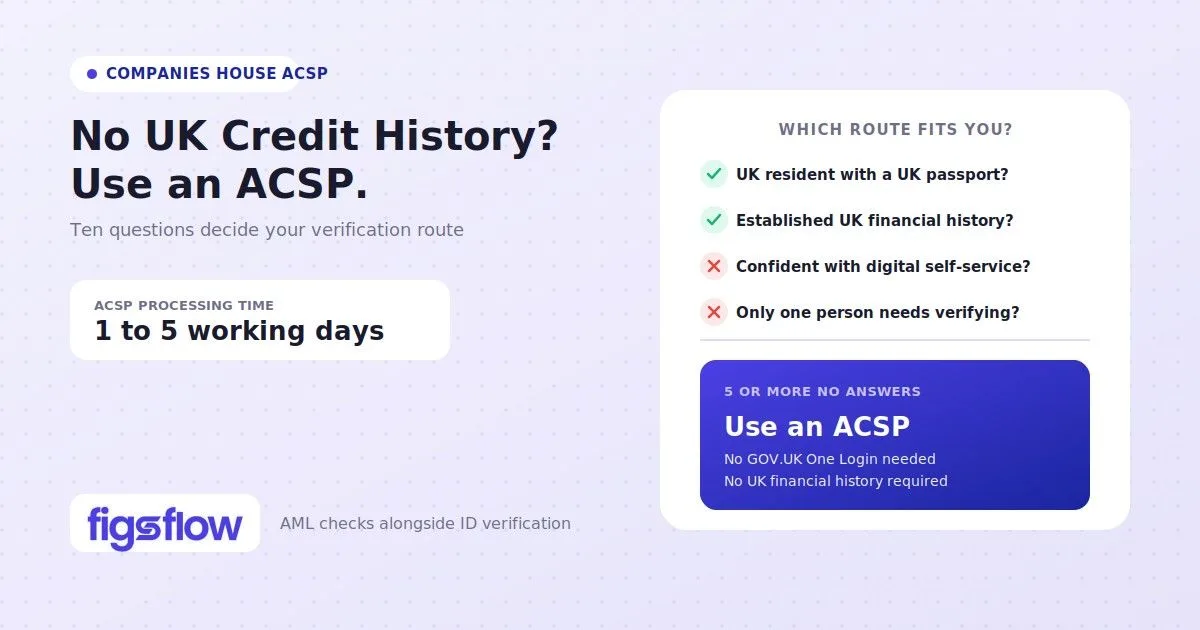
Image: identity verification through acsp figsflow feature

8/27/2026

Identity Verification through ACSP

Identity Verification through ACSP Identity Verification through ACSP Important! ID Verification is Mandatory from 18 November 2025 What is an ACSP & Why Use One Ways of Identity Verification Ways of Identity Verification Online Verification Through GOV.UK One Login Identity Verification through ACSP ACSP vs GOV.UK One Login Verification: Which Route Should You Take? Which Identity Verification Route is Right for You? Key Differences Between Identity Verification through ACSP & GOV.UK One Login Verification Procedure of Identity Verification through ACSP Procedure of Identity Verification through ACSP Information Collection Information Collection Informing the Person About the Personal Code IDV Standards Set By the Companies House Required Documents Records of the Identity Checks Evidence & Identity Check Simplify your verification process. How Much Does Identity Verification through ACSP Cost? Conclusion Frequently Asked Questions What is identity verification? What is the process of identity verification through ACSP? How do I become an ACSP for Companies House? Do company secretaries have to verify their identity? How do I confirm my identity for Companies House? Identity verification through ACSP is a new legal requirement introduced by Companies House to reduce the risk of fraud and enhance transparency, trust, and accuracy of the information held by Companies House. Directors, individuals equivalent to directors, Persons with Significant Control (PSCs), and anyone filing on behalf of a company are required to verify their identity with Companies House. As of 8 April 2025, the above-stated personnel can voluntarily verify their identity to the Companies House. However, this will be a legal requirement in the near future. From 18 November 2025, identity verification is mandatory for most directors and Persons with Significant Control. While Companies House introduced voluntary verification from 8 April 2025, this transition period was designed to allow individuals and businesses adequate time to prepare for the mandatory requirement. Who must verify their identity: Company directors (including those of overseas companies registered in the UK) Persons with Significant Control (PSCs) Individuals equivalent to directors (such as LLP members) Anyone filing on behalf of a company (unless filing through an ACSP) Limited exemptions exist for corporate directors, individuals who have already verified their identity with Companies House, and certain protected persons with legitimate security concerns, though this is subject to specific conditions being met. Once verified, your personal code will be required for: Confirmation statements (from November 2025 onwards) Changes to company officers or PSCs Registered office address changes Most other Companies House filings (phased implementation) Our strong recommendation is to complete your identity verification as soon as possible rather than waiting until the deadline. This approach helps you avoid last-minute complications and ensures you maintain uninterrupted filing capability for your company’s compliance needs. An Authorised Corporate Service Provider (ACSP) is a professional agent registered with Companies House to verify identities on behalf of clients. ACSPs act as trusted intermediaries, ensuring the verification process meets all regulatory standards while providing expert guidance throughout. To qualify as an ACSP, Organisations must be supervised for Anti-Money Laundering compliance by bodies such as HMRC, the Financial Conduct Authority, or professional bodies like ICAEW or ACCA; They must also register with Companies House, and adhere to data protection requirements. Before engaging an ACSP, verify their authorisation by checking the Companies House register of ACSPs on GOV.UK, confirming their AML supervisory body registration , and verifying their business credentials. The primary advantage of using an ACSP is that you won’t need a GOV.UK One Login, which eliminates the requirement for UK financial history checks. This makes the ACSP route particularly valuable for non-UK residents or those without established UK credit history. You’ll also benefit from professional guidance, reduced error risk, and time savings as the ACSP handles the administrative burden. Companies House has come up with the following two ways for identity verification. To verify your identity online through GOV.UK One Login, you must first create an account if you don’t already have one. After signing up, visit Verify your identity for Companies House – GOV.UK. You’ll find a “Verify Your Identity” button to guide you through the verification process. Requirements for Online Identity Verification: Proof of Identity – You will need one of the following documents: Passport, Driving License, UK Biometric Resident Permit, Biometric Residence Card, or Frontier Worker Permit. Home Address Details – You must also provide your home address information, including the year you began residing there. During the process, Companies House will ask you a series of security questions related to your financial situation, such as information about your bank loan, mortgage, mobile phone contract, and your current UK bank account. Once you answer these questions successfully, the identity verification will be complete. After verification, a Companies House personal code will be generated, which you can find in the “Manage account” section of your Companies House account. This code will be required for certain company filings, such as the confirmation statement, starting from April 2025. ACSP stands for Authorised Corporate Service Provider , also known as a Companies House authorised agent. Working with an ACSP simplifies the process and eliminates the hassle of creating a GOV.UK One Login account. By providing them with the requested information, they will verify your identity with Companies House on your behalf, making the process much easier and hassle-free. Let’s now take a closer look at the process for identity verification through ACSP, along with the standards established by Companies House that ACSP is required to adhere to. Choosing the right identity verification route is crucial for meeting Companies House requirements efficiently. While both methods achieve the same outcome providing you with a personal code for company filings, they differ significantly in their processes, requirements, and suitability for different circumstances. Understanding these differences will help you select the most appropriate verification method for your situation. Use the checklist below to determine which route is the best fit for your circumstances. Answer each question with Yes or No. Count your Yes answers and your No answers at the end to find your recommended route. Are you a UK resident? Do you have established UK financial history (bank accounts, loans, mortgages)? Do you have a valid UK passport or UK photocard driving licence? Are you comfortable navigating online government systems independently? Can you answer security questions about your UK financial records? Do you prefer completing verification yourself without professional assistance? Are all your identity documents current and not expired? Do you have lived experience at your current UK address with credit history? Are you tech-savvy and confident with digital self-service processes? Is only one person requiring verification (not multiple directors/PSCs)? Your Results: If you answered Yes to 6 or more questions, GOV.UK One Login verification is the most suitable and cost-effective option for you. If you answered No to 5 or more questions, identity verification through ACSP is your ideal choice and will provide the professional support you need. Feature Identity Verification through ACSP GOV.UK One Login Verification Cost Fee charged by ACSP (varies by provider) Free GOV.UK One Login Required No Yes UK Financial History Required No Yes (bank accounts, loans, mortgages) Suitable for Non-UK Residents Yes No (difficult without UK credit history) Processing Time 1 to 5 working days (depends on ACSP) Immediate (if successful) Professional Guidance Yes No Best For Non-UK residents, those without UK credit history, those preferring expert support UK residents with established financial history who are comfortable with online processes ACSPs are authorised agents and act as intermediaries between individuals and Companies House, enabling identity verification on their behalf. However, there are specific requirements set by Companies House that the ACSP must adhere to. If these standards are not met, Companies House can suspend or revoke the ACSP’s status as an authorised agent. Therefore, ACSPs must exercise extra caution and diligence when performing identity verification to ensure full compliance with Companies House regulations and avoid any potential consequences. For any ACSP, collecting information is a critical and essential part of the identity verification process, and there must be no negligence. Companies House has clearly stated that failure to meet the required standards may result in the suspension of the ACSP’s status. Therefore, it is the responsibility of the ACSP to ensure all information is collected accurately and in compliance with the standards set by Companies House. This step requires basic documents such as passports and proof of identity. Key information such as full name, date of birth, and home address can be extracted from these documents. Additionally, an email address must be requested, and it is the ACSP’s responsibility to inform the directors or the person undergoing the identity checks that the provided email address must be functional and accessible. This is crucial as Companies House uses this email address to send the personal code, which is a vital part of the verification process. The requested documents must serve as evidence and should be stored securely by the ACSP. The required document types are outlined in the “IDV Standard” section below. Although not explicitly stated in the Companies House guidelines, it is highly recommended that the ACSP conduct an Anti-Money Laundering (AML) verification before initiating identity verification checks, in line with the wider UK AML regulatory framework . This adds an extra layer of security and ensures that all checks are performed comprehensively. Once all the necessary information is gathered, the application form for identity verification through ACSP should be completed using the link Tell Companies House you have verified someone’s identity – GOV.UK. This link must be accessed using the GOV.UK One Login credentials that were used when registering the company as an ACSP. The application form itself is straightforward and only requires basic details such as the individual’s name, email address, date of birth, and home address. Additionally, the application must include details such as the date when the identity checks were completed and the method used to complete the checks—either through IDVT (Identification Document Validation Technology) or in person. IDVT is a technology that validates the cryptographic features of the document. The ACSP is also required to list the specific documents used to verify the individual’s identity. Following this, the ACSP must provide a declaration confirming that they have adhered to Companies House requirements and that all the information provided is accurate and true as of the date of the identity verification check. Finally, passport details, including the passport number, expiry date, and country of issue, must also be included in the application. Once the application is completed, it is advisable to briefly double-check it to ensure there are no typographical errors before submission. If any errors are discovered after the application has been submitted, the ACSP can contact Companies House to report the issue and express their wish to rectify it. However, as this is a new service, no formal process for correcting errors is currently in place. We anticipate that Companies House will soon introduce a process to address this situation. Once the application is submitted and identity verification is successfully completed, a personal code is sent to the email address provided in the form. It is the responsibility of the ACSP to inform their clients about the importance of safeguarding this code. Clients should be advised to store the code securely and treat it with the same level of confidentiality and care as they would their Unique Taxpayer Reference (UTR). An ACSP must exercise heightened caution when conducting identity verification checks for third parties, ensuring full compliance with the standards and guidelines established by Companies House. Strict adherence to these requirements is essential, as any form of negligence—such as failing to properly validate documents or overlooking signs of fraud—could result in serious consequences. These may include the suspension of the ACSP’s status or the revocation of their authorisation to act as an authorised agent for identity verification purposes. When an ACSP performs identity verification checks on behalf of someone else, Companies House offers two options that the ACSP can choose from. The type of documents required for the verification process will depend on which option is selected. Each option has specific requirements and determines the acceptable forms of identification and supporting evidence needed to complete the verification in compliance with Companies House standards. Option 1 Option 1 must only be chosen if the identity verification is done through identification document validation technology which can validate the cryptographic features present in the document. Cryptographic features of identity documentation are security elements that help verify the authenticity of the person or organization that issued the document. To meet identity verification requirements, individuals must provide one of the accepted forms of identification. These include a biometric or machine-readable passport, or an Irish passport card, which may be up to six months expired if the cryptographic features can still be validated by identity-checking technology. Other acceptable documents include a UK, Channel Islands, Isle of Man, or EU photocard driving licence (full or provisional); an identity card containing biometric information from the EU, Norway, Iceland, or Liechtenstein; a UK biometric residence permit (which can be up to 18 months expired); a UK biometric residence card; or a UK Frontier Worker permit. Option 2 Option 2 is used when the documents are checked by a person either remotely or in person. If ACSP opts for this option, they require only 2 documents in total to be kept as evidence. The person being verified must provide either two documents from group A or 1 document each from group A and group B. If the person being verified is non-UK resident, ACSP must request the person to provide at least one document issued by the government. Group A documents are listed below which often requires document reference number, expiry date, and country of issue: A passport or Irish passport card (can be up to 18 months expired) An identity card with biometric information from the EU, Norway, Iceland, or Liechtenstein A UK Biometric Residence Permit (BRP) (can be up to 18 months expired) A UK Biometric Residence Card (BRC) A UK-accredited PASS (Proof of Age Standards Scheme) card A UK or EU driver digital tachograph card A UK, Channel Islands, Isle of Man, or EU photocard driving licence (full or provisional) A UK HM Forces ID card A UK HM Armed Forces Veteran Card A UK Frontier Worker permit A government-issued photographic work permit A government-issued photographic immigration document A photographic visa A UK, Channel Islands, or Isle of Man firearms licence Any other type of photographic ID listed on PRADO (such as a National Identity Card from Pakistan, a crew member certificate from South Africa, or a U.S. Permanent Resident Card) Group B documents are listed below, which do not require a document reference number, expiry date, or country of issue: Birth certificate or adoption certificate Marriage certificate or civil partnership certificate Non-photographic immigration document Non-photographic visa Non-photographic work permit Bank or building society statement UK local authority or social housing rental agreement (must be for the person’s current address) Mortgage statement (must be for the person’s current address) UK council tax statement (must be for the person’s current address) Utility bill (must be for the person’s current address) ACSP is required to retain records of all evidence and information used during the identity verification process for a period of seven years from the date the verification is completed. This includes copies of the identity documents that were reviewed, evidence of the identity checks carried out, and records of any unsuccessful verification attempts. Maintaining this information is essential for compliance and audit purposes. To ensure robust identity verification through ACSP, anyone manually checking identity documents must be trained by a specialist provider that follows the Home Office’s best practice guidance for detecting fraudulent documents. During the process, documents should be examined for signs of tampering, particularly in areas displaying personal details. If there are any doubts about a document’s authenticity, ACSP should contact the issuing authority or another reliable source. For documents issued outside the UK, concerns should be directed to the appropriate embassy. In verifying that the identity is genuine and belongs to the individual presenting it, ACSP must confirm that the documents support the person’s name and date of birth, and, if using Identity Document Validation Technology (IDVT), that the cryptographic features match the data provided. A visual match must be established between the person and the photograph on the document, especially during remote verification. To reduce the risk of accepting synthetic identities, additional documents should be requested if there are gaps in address history or a recent name change. ACSP should also look for signs of real-life activity, such as recent transactions on a bank statement, utility or council tax bills sent to the individual’s home, or signs that a passport has been actively used over time. Explore FigsFlow’s AML software for accountants Learn More Identity verification through ACSP typically costs between £99 and £250 per person in the UK. Basic verification for UK residents with valid documentation usually costs £99 to £150, while more complex cases involving overseas directors, expired documents, or manual verification processes may cost £200 to £500 or more. ACSP fees cover: professional document validation, secure record keeping (legally required for seven years), Companies House submission, and expert guidance. This accountability provides significant protection compared to free self-service options. Very low-cost services (below £50) often exclude essential support and may not be professionally regulated, potentially leading to rejected verifications and higher costs later. ACSP fees are usually tax-deductible as allowable business expenses since identity verification is a statutory compliance requirement. When choosing an ACSP, consider not just price but also professional regulation, support quality, and whether the fee covers all necessary directors and PSCs. ACSP must exercise due diligence when reviewing identity documents and must make a clear decision on whether to proceed with the verification . If, at any point, there are signs of fraudulent activity or tampered evidence, ACSP has the right to decline the verification of that individual’s identity. In such cases, the individual will need to complete the identity verification process independently. It is important to note that even if ACSP chooses not to verify the identity, all related evidence and documentation must still be retained for a period of seven years. By conducting identity verification through ACSP, individuals and organisations can have greater confidence that the process is accurate, secure, and carried out by a reliable source. ACSPs follow strict procedures to minimise errors and ensure that the verification is handled in accordance with regulatory standards. Identity verification is the process of confirming an individual’s identity by comparing their documents (such as passport, driving licence, or biometric information) against reliable sources. For Companies House, it ensures that directors and PSCs are who they claim to be, reducing fraud and enhancing the accuracy of company information on the register. The ACSP collects your identity documents, examines them for authenticity, and verifies your details match the documents provided. They then submit an application to Companies House on your behalf via GOV.UK One Login. Once approved, Companies House sends a 9-digit personal code to your email, which you’ll need for future company filings. To register as an ACSP, sign in to GOV.UK One Login and provide your business details (or details as a sole trader). You’ll need to specify which Anti-Money Laundering supervisory body you’re registered with and provide your AML membership number. Finally, pay the £55 registration fee to complete your application. From 18 November 2025, directors and PSCs must verify their identity. Company secretaries are not currently required to verify, but Companies House has confirmed that other key company personnel, including secretaries, will need to verify their identity at a later date to be announced. You can verify your identity in two ways: directly through GOV.UK One Login (free, requires UK financial history) or through an Authorised Corporate Service Provider such as an accountant or solicitor. ACSPs verify your documents and submit the application on your behalf, which is particularly useful for non-UK residents. Image: Ways of Identity Verification Image: Procedure of Identity Verification through ACSP identity-verification-through-acsp identity verification through acsp page Page

figsflow p11d 2026

8/26/2026

P11D Form 2026: Deadline, Benefits in Kind, Class 1A NIC & Submission Checklist

P11D Form 2026: Deadline, Benefits in Kind, Class 1A NIC & Submission Checklist P11D Form 2026: Deadline, Benefits in Kind, Class 1A NIC & Submission Checklist What is a P11D Form? Who Needs to Complete a P11D? When a P11D May Be Needed When a P11D May Not Be Needed Benefits in Kind & Class 1A National Insurance Common Benefits That Go on a P11D P11D(b) & Class 1A National Insurance What is Class 1A National Insurance? P11D vs P11D(b) Common P11D(b) Mistake P11D Deadline 2026 Late Filing Penalties How to Submit a P11D Form Things to Consider Before Submitting Correcting Errors Records to Keep Payrolling Benefits in Kind & P11D Reporting How to Calculate Benefits in Kind for P11D Company Cars Private Medical Insurance Beneficial Loans Living Accommodation P11D checklist for employers, accountants and bookkeepers Common P11D Mistakes to Avoid 1.Missing Directors 2. Forgetting P11D(b) 3. Assuming Payrolled Benefits Remove All Reporting 4. Incorrect Car & Fuel Calculations 5. Treating Benefits As Exempt Without Checking 6. Poor Record Keeping Preparing Clients Before the Deadline for Accountants & Bookkeepers Further Reading Conclusion FAQs Do I pay tax on P11D benefits? Who is responsible for paying P11D tax? Is a P11D a payslip? Can I submit a P11D without a PAYE scheme? Do you get a P11D when you leave a job? The P11D form is used by UK employers to report taxable benefits in kind provided to employees and directors, such as company cars, private medical insurance and beneficial loans. For the 2025 to 2026 tax year, the key deadline is 6 July 2026. By this date, employers must submit P11D forms to HMRC, give employees a copy and report any Class 1A National Insurance due. Class 1A National Insurance must usually be paid by 22 July, or by 19 July if paying by cheque. In short, if you provide non-cash benefits that are not taxed through payroll, you will usually need to complete a P11D and may also need to submit a P11D(b) to report and pay Class 1A National Insurance. A P11D form is used by employers to report taxable expenses and benefits provided to employees or directors during a tax year. These are benefits provided because of employment that are not paid as salary, such as company cars, private medical insurance, beneficial loans or living accommodation. A P11D is usually required if the benefit has not been taxed through payroll. Even if a benefit is payrolled, the employer may still need to report and pay Class 1A National Insurance through a P11D(b). The P11D tells HMRC what benefits have been provided and what their taxable value is. HMRC can then use this information to collect the correct amount of tax from the employee or director, usually by adjusting their tax code or through Self Assessment if relevant. The employer completes the P11D, not the employee. An employer may need to complete a separate P11D for each employee or director who received taxable expenses or benefits during the tax year, where those benefits were not already taxed through payroll. This can apply to companies, partnerships, charities and other employers that provide taxable benefits to staff or directors. A P11D may be needed where: An employee has a company car available for private use An employee receives fuel for private use The employer pays for private medical insurance A director receives a beneficial loan from the company Living accommodation is provided Business assets are made available for personal use Vouchers or credit cards are provided Professional subscriptions are paid by the employer Expenses are reimbursed but are not fully exempt Note Small limited companies should pay particular attention to P11D reporting. Director benefits are often missed, especially where the company pays for medical insurance, provides a car or allows a director to use company assets personally. Even where there are only one or two directors, the company may still have P11D and P11D(b) obligations. A P11D may not be needed where: The benefit has already been correctly payrolled The item is fully exempt The benefit qualifies as a trivial benefit No taxable expenses or benefits were provided The expense is covered by a statutory exemption Employers should check the relevant rules before treating a benefit as exempt, especially for directors of close companies where reporting can be more sensitive. HMRC provides detailed guidance on which expenses and benefits are taxable or exempt at Expenses and benefits: A to Z – GOV.UK Benefits in kind are non-cash benefits provided to an employee or director because of their employment. They have personal value to the individual, even though they are not paid as salary. Two consequences follow from a benefit in kind. The employee or director faces an income tax charge on the value of the benefit. The employer often faces a Class 1A National Insurance charge on the same value. Note Class 1A National Insurance is an employer-only charge on most benefits in kind reported on P11D forms. It appears in P11D reporting because employers must declare and pay this National Insurance on the value of those benefits, separately from Class 1 NIC, which applies to salaries and wages through payroll. Use the table below as a quick reference for the benefits that appear most often, whether Class 1A National Insurance usually applies, and the point to watch on each. Benefit Usually Reportable on P11D? Class 1A NIC Usually Applies? Notes Company car Yes Yes Value set by HMRC car benefit rules, based on list price and CO2 emissions Fuel for private use Yes Yes Separate fuel benefit charge on top of the car benefit Private medical insurance Yes Yes Full employer premium is taxable, including cover for family members Beneficial loan Yes Usually yes Reportable where the total exceeds £10,000 at any point in the year Living accommodation Yes Usually yes Calculations are often complex and depend on the property Assets made available Yes Usually yes Value based on private use and the asset’s worth Trivial benefits Usually no Usually no Exempt only where every condition is met Many reportable benefits carry an employer Class 1A National Insurance cost as well as an employee tax charge. Class 1A National Insurance is the employer’s contribution on many taxable benefits in kind. It is paid by the employer, not by the employee. The employee may pay income tax on the benefit, but Class 1A National Insurance is the employer’s liability. It is reported through the P11D(b), which declares the employer’s total Class 1A National Insurance due on relevant benefits. The two forms do different jobs and are usually prepared as part of the same year end benefits reporting process. Form Purpose Who It Relates To What It Reports P11D Reports taxable benefits and expenses Individual employee or director Benefits in kind and reportable expenses P11D(b) Reports employer Class 1A NIC Employer or PAYE scheme Total Class 1A NIC due across all benefits An employer with non-payrolled taxable benefits will usually need P11Ds for the affected employees or directors and may also need a P11D(b) where Class 1A National Insurance is due. One P11D goes in for each individual who received benefits, and a single P11D(b) summarises the Class 1A National Insurance for the whole scheme. A common mistake is to prepare the P11Ds but forget the P11D(b). Another common mistake is to assume that payrolling benefits removes all year end reporting. If all expenses and benefits are payrolled, employers do not need to report them for each employee at the end of the tax year, but they must still submit P11D(b) for Class 1A National Insurance. Without it, HMRC has no declaration of the Class 1A liability, and the automatic penalty regime attaches to the missing P11D(b). Every 2025/26 deadline sits in the table below. Requirement Deadline Submit P11D forms to HMRC 6 July 2026 Give employees copies of their P11D 6 July 2026 Submit P11D(b) 6 July 2026 Pay Class 1A NIC electronically 22 July 2026 Pay Class 1A NIC by cheque 19 July 2026 Warning The deadline falls three months after the tax year ended on 5 April 2026, so the benefits being reported are already settled. This means employers should not wait until July to start collecting benefit information. Accountants and bookkeepers should ideally request P11D details from clients soon after the end of the tax year, especially where there are company cars, director loans, medical insurance or accommodation benefits. HMRC may charge penalties if the P11D(b) is late. HMRC guidance states that the penalty is £100 per 50 employees for each month or part month the P11D(b) is late. Penalties and interest may also apply if payment to HMRC is late. Expenses and benefits for employers: Deadlines – GOV.UK Filing is online only. HMRC no longer accepts paper P11D or P11D(b) forms. Employers with fewer than 500 employees can submit the forms through HMRC’s PAYE Online service. Employers with more than 500 employees should submit the forms through payroll software. Before submitting, employers should check that: Each employee or director has been reviewed Payrolled and non-payrolled benefits have been separated Benefit values have been calculated correctly Class 1A National Insurance has been considered The P11D(b) figure is complete Employee copies are ready Supporting records have been retained If an error is discovered after submission, it should be corrected. HMRC provides online correction forms for both P11D and P11D(b). Where correcting a P11D(b), the amended form should show the total Class 1A National Insurance that needs to be paid, not just the difference from the previous version. Employers should keep records to support the figures submitted. These may include invoices, payroll records, car details, insurance premiums, loan records, accommodation details and evidence for exemptions. Good records are important because HMRC may ask how a benefit value was calculated or why a particular item was excluded from P11D reporting. Payrolling a benefit means taxing it through PAYE during the year, so the income tax comes out of the employee’s pay each period rather than being reported once on a P11D. Where a benefit has been payrolled, no P11D is needed for that benefit. The tax has already been collected in real time. Class 1A National Insurance is different. Payrolling a benefit may remove the need for a P11D for that benefit, but it does not remove the employer’s Class 1A National Insurance obligation. The P11D(b) is still required to declare the Class 1A due, whether the benefits were payrolled or not. Each benefit has its own valuation rule, and the taxable figure is usually called the cash equivalent. This is the value that goes on the P11D and feeds the Class 1A National Insurance on the P11D(b), so getting it right matters for both the employee’s tax and the employer’s bill. Company cars are the most common and the most detailed. The cash equivalent is the car’s list price multiplied by a percentage set by its CO2 emissions, which is why a fully electric car produces a far smaller benefit than a petrol equivalent. Where the employer also pays for private fuel, a separate fuel benefit charge applies on top, based on a fixed multiplier rather than actual fuel used. Private medical insurance is valued at the premium the employer paid, including any cover for the employee’s family, less anything the employee contributed. Beneficial loans are charged only where the total outstanding across all loans exceeds £10,000 at any point in the year. Below that, the small-loan exemption means there is nothing to report. Above it, the cash equivalent is the interest that would have been due at HMRC’s official rate, less any interest the employee actually paid. The official rate rose to 3.75% from 6 April 2025, up from 2.25%, and HMRC now reviews it quarterly rather than setting it once a year. A rate that can change mid-year means a loan may need to be calculated separately for each period and the results added together, so the reporting date the rate applied on matters. HMRC publishes the current and historic figures in its beneficial loan arrangements guidance on gov.uk. Living accommodation follows its own rules and can be complex, with an additional charge where the property cost more than £75,000. For the underlying method on each benefit, HMRC’s P11D working sheets on gov.uk set out the calculation step by step and are the safest reference where a benefit is anything other than straightforward. Warning Do not estimate a benefit value. Use HMRC’s valuation rules, payroll software or professional advice, and keep the evidence behind every figure. HMRC can ask how a cash equivalent was calculated, and an incorrect return carries a penalty of up to £3,000 per form, separate from any late-filing charge. Before the 6 July 2026 deadline, employers and advisers should complete a structured P11D review. 1. Employee &Director Review Start by identifying every employee and director who received benefits during the tax year. Do not forget directors of small companies, leavers, part-year employees, and employees who received a one-off benefit. 2.Benefit Review Separate benefits into payrolled and non-payrolled categories. Review: Company cars and private fuel Private medical insurance Director loans and beneficial loans Living accommodation Assets made available for private use Vouchers and credit cards Professional subscriptions Reimbursed expenses Exempt benefits Trivial benefits Benefits that were correctly payrolled may not need a P11D, but Class 1A National Insurance may still need to be reported through P11D(b). 3. Calculation &Submission Review Calculate taxable benefit values and Class 1A National Insurance. Check that the P11D(b) agrees with the total Class 1A National Insurance due. Prepare P11Ds for relevant employees and directors. Prepare the P11D(b) for the employer. Give employees their copies by 6 July 2026 and submit the forms to HMRC by the same date. Arrange payment of Class 1A National Insurance by the correct deadline. For electronic payments, the deadline is 22 July 2026. For cheque payments, the deadline is 19 July 2026. Finally, retain records and review whether benefit reporting should be improved for the next tax year. P11D errors are common because benefits reporting often depends on payroll records, director records, expenses data and year end calculations. Directors of small limited companies often receive benefits such as medical insurance, cars or beneficial loans, but these are sometimes overlooked because there are no wider employees. The P11D reports employee level benefits, but the P11D(b) reports the employer’s Class 1A National Insurance. Employers should check whether both are required. Payrolled benefits may remove the need for a P11D for that benefit, but Class 1A National Insurance may still need to be reported through P11D(b). Company car and fuel calculations can be detailed. Employers should check car details carefully and confirm whether private fuel was actually provided. Exemptions can be valuable, but they must be applied correctly. Employers should keep evidence showing why the exemption applies. If HMRC queries the figures, the employer should be able to show how the values were calculated and why any exemptions were applied. The deadline is won or lost on data collection, not filing. A standard approach across the client base removes the June scramble. Send an annual P11D questionnaire to every employer client and collect the benefit evidence early rather than chasing it in the final fortnight. Confirm each client’s PAYE scheme details before filing, since a mismatched or abbreviated business name can cause a submission to fail. Standardise how benefit data comes in, so company car details, medical premiums and loan balances arrive in the same format every year. Reconcile the P11D(b) against payroll records before submitting, which catches the payrolled-benefit and Class 1A gaps before HMRC does. Then look forward. Identify which clients should consider payrolling benefits in future years, and start the conversation now. How Tax Firms Manage Multiple Client Workloads FigsFlow & RentalBux – Save 190+ Hours on MTD Compliance Tax Adviser Registration with HMRC (2026 Guide) | FigsFlow 3 Easy Steps to Client ID Verification | FigsFlow File the 2025 to 2026 P11D and P11D(b) by 6 July 2026, and pay the Class 1A National Insurance by 22 July 2026 if paying electronically. Late filing, incorrect returns and late Class 1A National Insurance payments can lead to penalties and interest. Employers should gather the benefit data early, check every exemption carefully and confirm the Class 1A National Insurance position before filing. Treat this as a transition year for benefits reporting, especially where clients or employers are moving towards payrolling benefits in kind. Yes. The value of a benefit reported on your P11D is treated as additional employment income and taxed at your marginal rate. HMRC usually collects it by adjusting your tax code for the following year, so more tax comes out of your pay, or through your Self Assessment return if you file one. You do not pay National Insurance on the benefit itself, because the employee has no NIC charge on benefits in kind Two parties pay, on two different charges. The employee or director pays the income tax on the benefit, through their tax code or Self Assessment. The employer pays the Class 1A National Insurance on the same benefits, at 15% for 2025/26, declared on the P11D(b). The employer files both forms, but the income tax burden sits with the individual. No. A payslip records the pay and deductions for a single pay period during the year. A P11D is an annual summary of the taxable benefits in kind an employee received across the whole tax year, filed after the year ends. They serve different purposes: the payslip tracks cash pay processed through payroll, while the P11D reports non-cash benefits that were not taxed through payroll. Not directly. If you provide taxable benefits to employees or directors, you should check whether you need to register as an employer and operate a PAYE scheme before reporting P11D benefits. Registering opens the scheme through which the P11D and P11D(b) are filed. The Class 1A National Insurance is still due whether or not a scheme was already in place, so operating without one does not remove the liability. It depends on when you left. If you were employed on 5 April, the last day of the tax year, your employer must send you a P11D by 6 July, even if you left before then. If you left earlier in the year, you are not sent one automatically, but you can request it in writing within three years of the tax year end, and the employer must provide it within 30 days or by the following 6 July, whichever is later. p11d-form-2026 p11d form 2026 page Page

Iceberg graphic: small visible price tag above water, larger hidden costs below. FigsFlow

8/26/2026

Not as Cheap as It Looks: The Hidden Costs of AML Software Pricing

Not as Cheap as It Looks: The Hidden Costs of AML Software Pricing Not as Cheap as It Looks: The Hidden Costs of AML Software Pricing AML Software Pricing: The Per-Check Rate Is Not the Real Price How Bulk Credit Models Work & What They Actually Cost Upfront What 30 Checks Per Month Actually Costs Across Four Platforms Platform-by-Platform Cost Breakdown Did You Know? How to Calculate Your True Annual AML Spend Before You Commit Annual AML Spend Calculation Guide How FigsFlow Prices AML Differently Conclusion Most AML software platforms advertise a per-check rate. That rate looks reasonable. It is rarely what you pay. For firms carrying out a modest number of checks each month, the difference between the advertised price and the actual monthly cost can be considerable. Mandatory subscriptions, bulk credit purchases, and per-check add-ons often sit between the headline rate and what you ultimately pay. Most firms only realise this after they've committed to a platform. In this guide, we'll break down how AML software pricing really works, explain each cost layer you should factor in, and compare what firms actually pay across different AML providers. A platform might advertise £2 per check or £2.63 per ID verification. Those figures are accurate in isolation. They are not the figure that appears on your monthly statement. The per-check rate tells you the cost of one action within the platform. It does not tell you what you must spend before you can run that action, how many credits you are required to purchase upfront, whether those credits expire, or what additional subscription fee sits underneath the whole structure. For lower-volume firms, these surrounding costs matter far more than the rate itself. A firm running 25 checks a month at £2.63 per check should expect a checks-only cost of around £65.75. The actual monthly commitment on several platforms is materially higher than that once all layers are counted. Most platforms require you to buy credits in bulk before running a single check, and many add a monthly subscription fee on top. The minimum credit commitment varies widely. Some tools require hundreds of pounds upfront before you can get started. Others set a lower credit minimum but cap how many checks or assessments you can run per month on cheaper tiers, pushing you onto a pricier subscription than you need. Credits on most platforms also expire, so buying more than you use is not a safe option either. The result is that your actual monthly outlay often has two moving parts, the subscription and the credits, neither of which is obvious from the headline per-check rate. The table below uses 30 individual client checks per month, each requiring a standard electronic identity verification with PEP and sanctions screening. No biometric or enhanced due diligence checks are included. Each firm is on the entry or lowest qualifying tier. All figures exclude VAT. Platform Monthly Fee Minimum Credit Pack Can You Buy Just 30 Checks? What You Actually Pay FigsFlow (PAYG) £0 £30.00 (10 check min) Yes £90.00 FigsFlow (£8 plan) £8.00 £21.00 (10 check min) Yes £71.00 GoProposal AML Standard £60.00 Variable Yes (up to 50 assessments) £60.00 min + checks Xama (Core) £13.00 £141.90 (30 checks) Yes £154.90 BrightManager Varies £670.00 (500 check min) No. 500 minimum. £670.00 + sub FigsFlow bundles identity validation, PEP screening, sanctions checks, liveness verification, and Companies House verification into a single per-check price. On platforms that charge each of these separately, those same five checks per client can cost between £8 and £15 combined. Before committing to any AML platform, run the following calculation using your own firm's numbers. Step 1- Calculate Annual Onboarding Cost: Take your average monthly new client onboardings and multiply by the full per-client check cost on the platform, including every check type required for standard customer due diligence. Multiply by 12. Step 2- Add Annual Platform Subscription: Take the monthly subscription fee and multiply by 12. If the platform charges a per-client monitoring subscription, multiply that rate by your total active client count and add it here. Step 3- Add Ongoing Monitoring Costs: On credit-based platforms, multiply your total monitored client count by the annual monitoring credit cost per client. This figure rarely appears on the pricing page. Ask for it before you sign up. Step 4- Add Enhanced Due Diligence Charges: Identify your approximate proportion of higher-risk clients. Multiply by the per-event enhanced due diligence charge on that platform. Step 5- Total It Up: Add all four figures. That is your true annual AML spend. Compare it across platforms on this basis, not on the advertised per-check rate alone. Not every platform requires a large upfront credit commitment to get started. The minimum entry point matters as much as the per-check rate, particularly for firms whose check volume fluctuates month to month. FigsFlow requires a minimum purchase of 10 credits to run checks. At £3 per check on the basic plan, that is a minimum entry of £30 excluding VAT. There is no monthly subscription on the basic plan. A firm running 10 checks one month and 25 the next pays only for what it uses, with no obligation to purchase beyond the 10 credit minimum. The basic plan includes client ID verification, Companies House verification, face match and liveness, PEP and sanctions screening, Amberhill checks, and address verification in that single per-check fee. These are not separate events billed individually. The AML ID Verification and Risk Assessment plan reduces the per-check cost to £2.10 excluding VAT with a fixed monthly fee of £8 plus VAT. This tier adds client due diligence, client risk assessments, enhanced due diligence, and firm-wide risk assessments. At 25 checks per month, the total monthly cost on this plan is £60.50 excluding VAT, with nothing charged on top. FigsFlow offers a 30-day free trial with no credit card required. You can start at figsflow.com . For a closer look at what a single check actually verifies, see our guide on what AML verification covers , or work out your likely spend with our breakdown of how much an AML check costs in the UK . AML software pricing is almost never as simple as the per-check rate suggests. Subscriptions, credit minimums, itemised check events, and ongoing monitoring fees all contribute to a monthly total that can be two or three times the advertised figure. A firm that selects a platform based on the headline rate without modelling the full annual cost will pay more than it budgeted and discover the gap too late to switch without disruption. Run the full cost calculation before you commit. The platform that looks cheapest on the pricing page is rarely the cheapest in practice. A flowchart outlining the steps to calculate annual AML spending. hidden-aml-software-pricing hidden aml software pricing page Page

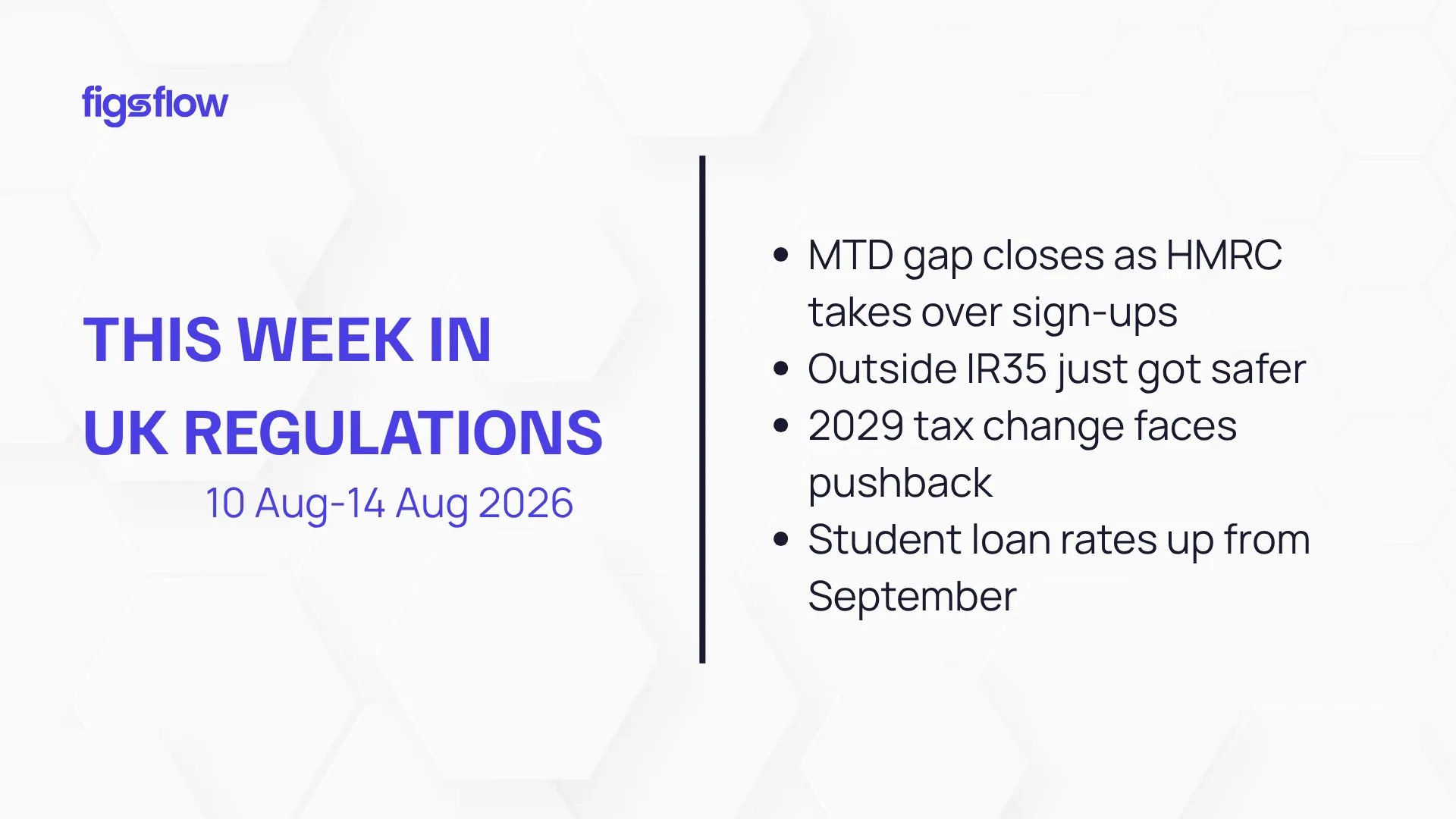
An overview of regulatory updates in the UK from August 10 to August 14, 2026.

8/14/2026

Weekly News & Updates for UK Accountants (10-14 August 2026)

Weekly News & Updates for UK Accountants (10-14 August 2026) Weekly News & Updates for UK Accountants (10-14 August 2026) HMRC Begins Auto-Enrolling MTD Stragglers from September as Filing Gap Widens IR35 is Now the Lower-Risk Route as Umbrella Liability Falls on Agencies & End-Clients Earlier Income Tax Payments via PAYE Draw Sharp ICAEW Criticism on Three Fronts Student Loan Rates Rise from September with a 6% Cap Holding Across Plans 2 & 3 Also In News Conclusion HMRC begins automatically enrolling unregistered MTD taxpayers next month, and any practice still carrying unregistered clients needs to move before September arrives. That is the story to act on first. Close behind it, the April 2026 umbrella legislation has quietly inverted the contractor risk calculus, and the implications for clients running flexible workforces are worth revisiting now that the dust has settled. The other two are about planning rather than panic. The ICAEW has issued a formal objection to the government’s 2029 proposal for in-year income tax payments through PAYE, and student loan interest rates are rising from 1 September with a cap holding across the most-affected plans. Here is the detail. From September 2026, HMRC will automatically enrol sole traders and landlords required to join MTD for Income Tax who have not yet registered. Around 570,000 are currently signed up against a first-wave cohort of 864,000, leaving roughly 294,000 still outside the system. The August filing data adds weight to the urgency: of those registered, over 436,000 filed their first quarterly update by the 7 August deadline, but around 134,000 did not. Auto-enrolment does not pause obligations. A client enrolled by HMRC without software in place and without an adviser alongside them starts from a worse position than one who registered late on their own terms. Key facts: Auto-enrolment of unregistered first-wave taxpayers begins September 2026 294,000 taxpayers remain unregistered; 134,000 registered taxpayers missed the 7 August deadline No penalty points for late quarterly updates in 2026-27; £200 fixed penalty applies from 6 April 2027 once four points are accumulated Any client in scope who has not registered should be contacted this week. Once HMRC acts, the adviser is playing catch-up rather than leading the process. The April 2026 umbrella legislation changed the risk profile for contractor engagements in a way that has not yet filtered through to every client’s workforce policy. Under the new joint and several liability rules, recruitment agencies and end-clients act as guarantors for unpaid PAYE and National Insurance within their supply chains. That liability applies regardless of their own due diligence and regardless of what their contracts say. An agency that vetted its umbrella provider thoroughly, documented the process, and included indemnity clauses is still exposed if that provider fails to account for PAYE and NICs correctly. The risk is no longer bounded by the quality of their own processes. Outside IR35 engagements, by contrast, have become more manageable. Case law has matured, providing clearer grounds for status determinations. The double taxation flaw was corrected in April 2024, meaning firms now pay only the difference in tax (approximately 10% on top of fees) via an offset rather than the full amount. IR35 risk, where it exists, is case-by-case. An umbrella failure is systemic, potentially touching every engagement linked to that provider at once. Key facts: Joint and several liability for unpaid PAYE and NICs applies across the supply chain from April 2026 Outside IR35 double taxation corrected from April 2024; firms now pay approximately 10% on top of fees via an offset IR35 risk is case-by-case; umbrella failure is systemic and can affect all engagements with a single provider simultaneously For clients running contractor or temporary workforces, the question is whether their current supply chain policy reflects the post-April 2026 landscape. A blanket preference for umbrella arrangements made sense under the old risk structure. It is worth testing whether it still does. From April 2029, the government proposes to require Self Assessment taxpayers with PAYE income to pay estimated income tax liabilities in-year through the PAYE system. The mechanism would use coding notices to collect tax on outside income alongside regular employment deductions. The ICAEW has responded formally, raising concerns on three distinct grounds. The first is administrative. HMRC’s systems are already under strain, and layering additional coding notice complexity onto employers and payroll providers adds burden to a part of the infrastructure that is not currently coping well. The second is cash flow. Using stable PAYE income to service fluctuating Self Assessment liabilities could leave taxpayers unable to meet regular financial commitments in months where their outside income has not yet materialised. The third is confidentiality: employers will be able to see, through the coding notice, that an employee has income from outside employment, which carries real risk of workplace bias in smaller businesses. Key facts: Proposal effective date: April 2029 ICAEW supports more timely payments but advocates quarterly rather than monthly collection ICAEW recommends a three-year transitional period and voluntary use of MTD updates for payment purposes For now this remains a proposal, not a confirmed change. Practitioners with clients who have both PAYE and Self Assessment income should note the direction of travel and watch for the government’s response to the consultation. From 1 September 2026, updated student loan interest rates take effect for the 2026-27 academic year. The government has maintained a 6% cap on Plan 2 and Plan 3 loans, limiting the rate borrowers face despite underlying inflation figures that would have pushed rates higher. Without the cap, Plan 2 and Plan 3 borrowers would have faced a maximum rate of 7.1%. Key facts: Plan 1 (pre-2012): rate rises to 4.1%, up from 3.2% Plan 2 (2012-2023) and Plan 3 (Postgraduate): rates range between 4.1% and 6% based on income, capped at 6%; uncapped rate would have been 7.1% Plan 5 (2023 onwards): rate set at 4.1%, up from 3.2% Payroll teams should confirm that deduction calculations reflect the updated rates from September. For any employee asking why their repayments have changed, the cap is the useful context: rates have risen, but the government has held the ceiling at 6% for the most-affected plans. Last week’s round-up covering the stories that shaped the week for UK practioners What’s Next After MTD: Tax Changes for UK Accountants MTD ITSA Guide for Accountants and Tax Agents 2026 HMRC MTD Letter Explained: Who Must Act & What’s Next The pattern this week is HMRC moving from announcement to enforcement. Auto-enrolment from September is the clearest example: the registration window has not closed, but HMRC is no longer waiting for taxpayers to use it. The umbrella liability shift tells a similar story, with risk now falling on whoever is left holding the supply chain. Act this week on MTD registration. Review umbrella supply chains before the next contract renewal. The 2029 payment proposal and the student loan rate changes are both worth filing for the conversations ahead. We publish these updates every week. Follow us to get next week’s round-up as soon as it lands. weekly-news-for-accountants-14-aug-2026 weekly news for accountants 14 aug 2026 page Page

See it run on your own practice.

Screen-shared, using your services, your client mix and your deadlines. You will see where FigsFlow fits, and where it does not.

Design previews, not a shipped build — we will tell you on the call what is live today.

9:41
SignatureEngagement letter
Ready to sign
Engagement letter 20263 signatories · you are firstSign
Audit trailIP, device and timestamp recordedOn
Also waiting
Letter of representationDue 30/09Due
HomeDocsTasksChatProfile
9:41
Tasks3 open
Upload bank statementsVAT Q3 · due todayDue
Sign engagement letterOnboarding · due 05/09Sign
Approve VAT returnQ2 · due 07/09Review
Confirm payroll changesAugust · doneClosed
HomeDocsTasksChatProfile
9:41
Client portalRidgeline Foods Ltd
Upload Sign Pay Ask
Your services
Annual accountsYear end 31/03/2026Live
VAT returnsQuarterly · next 07/10Filed
PayrollMonthly · 14 employeesCurrent
Your team
Amara · ManagerUsually replies within a day
HomeDocsTasksChatProfile
9:41
DocumentsStored in your SharePoint
Recent
Bank statement — AugUploaded by camera · 2 MBSynced
Sales ledger Q3Shared by AmaraNew
Accounts 2025Signed 14/06/2025Final
Add a document
Scan with the cameraEdges cropped automatically
HomeDocsTasksChatProfile
9:41
MessagesAmara · Manager
This job
Re: VAT Q3Amara · 2 hours agoNew
Statement attachedYou · yesterday
Next deadline
VAT Q3 filing07/10/2026 · 15 daysSoon
HomeDocsTasksChatProfile

Your privacy choices

We use cookies to improve site performance, remember preferences, and measure marketing effectiveness. You can accept all cookies, reject non-essential ones, or choose categories.