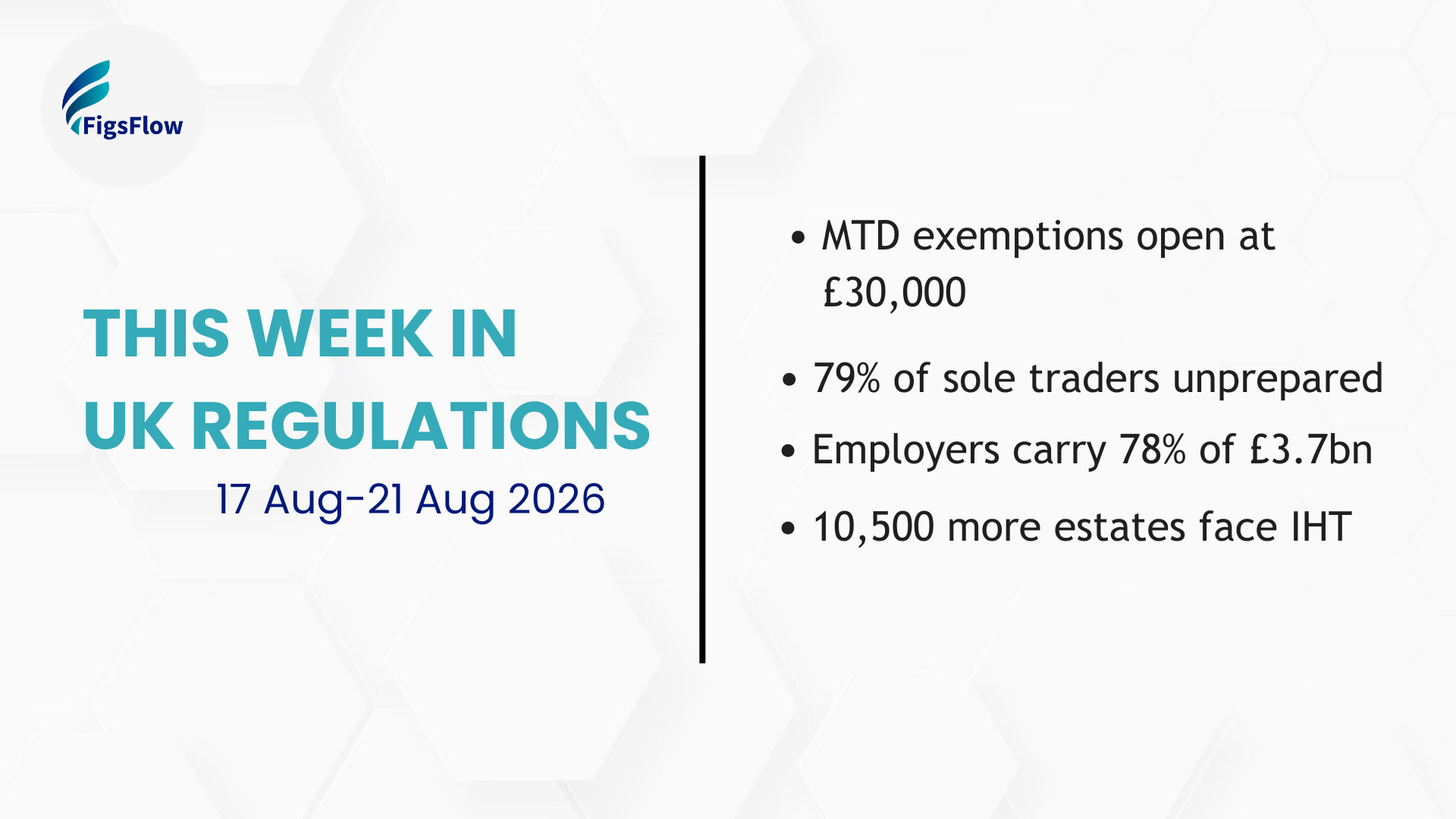

HMRC has opened exemption applications for the £30,000 income band ahead of mandation on 6 April 2027, and four of the arguments clients are most likely to make will be rejected on sight. That is the story to act on first. Behind it, survey data from the building trades puts 79% of sole traders unprepared for MTD, with nearly three in five carrying no accountant at all.
The other two are planning rather than panic. The £2,000 salary sacrifice cap arrives in April 2029 with employers carrying 78% of the bill, and unused pension pots enter the inheritance tax net from April 2027.
Here is the detail.
HMRC Opens MTD Exemption Applications for the £30,000 Income Band
Self-employed individuals and landlords whose qualifying income exceeded £30,000 in the 2025-26 tax year can now apply for exemption from Making Tax Digital for Income Tax, ahead of mandation on 6 April 2027. The test is digital exclusion, and HMRC has drawn it narrowly: age, disability, remote location, or religious belief.
An approved exemption is not an exit from the return. The client still files an annual self-assessment return on paper or via standard online portal. Exemption from MTD for VAT does not carry across either. Those clients have to contact HMRC by phone or in writing with their NI number and VAT registration number and restate their reasons before an income tax exemption is confirmed.
The rejections are where practitioner time gets saved. HMRC will refuse an application built on a history of paper filing, on discomfort with accounting software, on a small volume of records, or on the cost and time of running the software. Since HMRC is providing no free software, that last argument is the one clients will reach for and the one that will fail.
Key dates:
- £50,000 band: already in the regime, first quarterly deadline passed on 7 August 2026
- £30,000 band: mandated from 6 April 2027, applications open now
- £20,000 band: mandated from 6 April 2028, applications not accepted until summer 2027
An application has to be in before mandation, and a client already inside a mandatory window must keep filing while the decision sits with HMRC, which takes several weeks. Check the automatic exemptions first: personal representatives, trusts filing an SA900, Lloyd’s members filing an SA103L, and taxpayers without an NI number are already covered without an application.
79% of Sole Traders in the Trades Are Unprepared for MTD & 58% Have No Accountant
The clearest evidence is the one practitioners saw in their own inboxes. Around the 7 August deadline, firms reported a scramble of self-employed clients above £50,000 who had tried to file their own MTD submissions, found the process harder than expected, and went looking for professional help at the last moment.
The £30,000 band is roughly eight months out and considerably less prepared. The Wickes Mood of the Nation survey found only 21% of sole traders in the building trades describing themselves as fully prepared for quarterly reporting, and one in five not feeling ready at all. Of those with significant concerns, 63% pointed to the administrative burden and 48% to the fear of making mistakes.
The record-keeping position explains why. Half are still working on paper, and most of the rest are on spreadsheets that will not satisfy a quarterly obligation. Suppliers have noticed the gap: Wickes has partnered with Xero to give TradePro members six months of free MTD-compatible software.
Key facts:
- 79% of sole traders in the building trades are unprepared for MTD
- 58% manage their finances with no accountant or tax agent
- 49% rely entirely on paper records, 41% on basic spreadsheets
Nearly three in five of these taxpayers have no adviser, which makes this a pipeline rather than a compliance problem. Firms that reach them through the autumn will be having a transition conversation. Firms that wait until spring 2027 will be competing on price during a scramble.
Salary Sacrifice Cap Hands Employers 78% of a £3.7bn Tax Bill from April 2029
Employers, not employees, carry the weight of the new salary sacrifice cap. Treasury figures released under Freedom of Information and analysed by Bowmore Wealth Group show businesses absorbing 78% of the tax yield once the £2,000 annual cap on salary sacrifice pension contributions takes effect on 6 April 2029. Contributions above that ceiling attract NICs for employer and employee alike.
The detail worth explaining to clients is what happens to corporation tax. Receipts are projected to fall by £177m a year, because the NIC cost reduces the profits that corporation tax is charged on. The measure raises money overall while quietly costing the Exchequer elsewhere.
The scope is wide. Around 3.3 million employees currently contribute through salary sacrifice, across 300,000 companies. For those employers the cap lands on top of the employer NIC rise and the additional overheads introduced by the Employment Rights Act 2025.
Key facts:
- Employers pay 78% of the yield, an extra £2.9bn a year; employees pay 22%, or £800m
- Total expected yield: £3.7bn annually
- Projected fall in corporation tax receipts: £177m a year
Nearly three years is enough time to model this properly. The question for any employer client running a scheme is how many staff currently sacrifice more than £2,000, and what the NIC exposure looks like at that headcount.
Pension Pots Enter the IHT Net in April 2027 & Lifetime Gifting Carries Its Own Traps
HMRC expects 10,500 estates to become liable for inheritance tax in 2027-28 that would not otherwise have been, once unused pension pots fall within the 40% charge. A further 38,500 estates already paying IHT will pay more, by an average of £34,000 each. Gifting conversations are about to become considerably more common.
They are also easy to get wrong. The most frequent error is the client who transfers the family home to their children and carries on living in it. Without full market rent, the gift with reservation of benefit rules keep the property inside the estate, and HMRC reads benefit and control strictly. Refusing to let the new owners redecorate, or insisting your own furniture stays put, has been enough to hold the asset in the estate and undo the entire arrangement.
The second trap shifts the bill onto the recipient. Where the donor dies within seven years, gifts are brought back into the estate in date order, and once the nil-rate band is exhausted the tax on later gifts falls on the beneficiary rather than the estate. Taper relief may soften the rate, but a beneficiary who has already put the money into a house purchase can face a demand with nothing liquid to meet it, and end up borrowing to pay HMRC.
Key facts:
- £3,000 annual gift allowance, leaving the estate immediately, with unused allowance carried forward one year only
- £250 small gifts allowance per recipient per year, unavailable to anyone who has already received part of the £3,000
- Regular gifts from surplus income, where the donor can show a settled pattern and no drop in their normal standard of living
Two client conversations sit behind this, and they are not the same one. Clients who have made a large lump sum gift need the seven-year position mapped. Clients who have transferred a home while still living in it need the arrangement reviewed before April 2027, not after.
Conclusion
The pattern this week is HMRC opening a door and narrowing it at the same time. Exemptions from MTD now exist for the £30,000 band, but the qualifying test is tight, the most common client objections are refused outright, and an exemption still leaves a paper return to file. Meanwhile the population being pulled in behind it is demonstrably not ready, with half of one surveyed group still on paper and most of them unrepresented.
The immediate work is client by client: identify who has a genuine exemption case before 6 April 2027, and start the outreach to unrepresented sole traders now. The 2027 IHT change and the 2029 salary sacrifice cap are modelling and conversation rather than filing.
We publish these updates every week. Follow us to get next week’s round-up as soon as it lands.