
If you’re searching for no photo ID what you can use in the UK, this guide explains every accepted option for banking, employment, voting, and official checks.
A form asks for “photo ID.” You mentally tick through the options:
No passport. Don’t drive. No provisional licence either.
What now? Are you stuck? What actually counts as photo ID in the UK when you don’t have the two documents everyone assumes you own?
Here’s what nobody mentions upfront: roughly 3.5 million UK adults lack passport or driving licence photo ID. You’re not unusual. You’re not stuck. And you have more options than you think.
This guide covers every legitimate alternative when you have no photo ID, from the £15 solution that works almost everywhere to the free options most people don’t know exist.
KEY TAKEAWAYS
No Photo ID? What You Can Use in the UK
- Three main alternatives: Post Office PASS card (£15), provisional driving licence (£34), or free Voter Authority Certificate
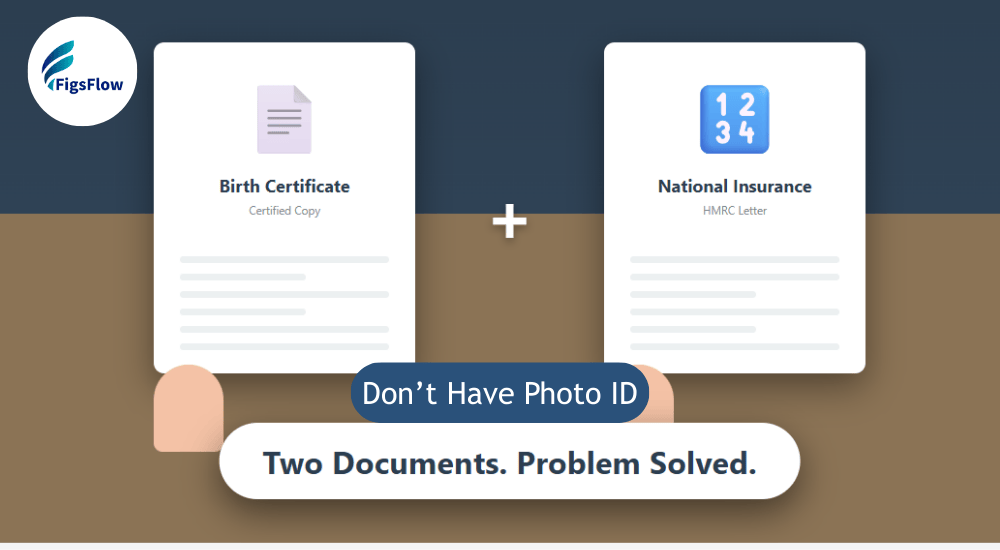
- Two-document strategy: Birth certificate + National Insurance documentation works for banking and employment
- For banking: Basic accounts at Monzo, Nationwide, Barclays, and Co-op accept alternative ID
- For employment: Birth certificate + NI number satisfies right-to-work checks for UK citizens
- For voting: Apply for a free Voter Authority Certificate or use an older person’s bus pass with a photo
- If homeless: Support worker letters and hostel confirmation replace utility bills
- ID1 form: Solicitor-certified identity (£20-£100) works when standard alternatives don’t
If You Have No Photo ID in the UK, You Can Use These Instead
When people ask no photo ID what you can use in the UK, they’re usually dealing with banks, employers, or government forms. The documents below are the most widely accepted alternatives.
- PASS Card (£15–£18) – Widely accepted official proof of age; standard applications cost £15 (via Post Office) or £18 (via CitizenCard).
- Provisional driving licence (£34) – A government-issued photo ID that costs £34 when applied for online.
- Voter Authority Certificate (Free) – Accepted for voting in person; it is free but cannot be used for most other age or identity checks.
- Birth certificate + National Insurance document – Often accepted as a combination for proving the right to work and opening basic bank accounts.
- ID1 form (solicitor-certified) – A formal document used to verify identity for HM Land Registry transactions when standard photo ID is unavailable
Your Three Best Alternatives to Photo ID in the UK
When you need proof of identity without a passport or a driving licence, these three documents solve most situations:
Post Office PASS Card
The PASS card (Proof of Age Standards Scheme) is a government-approved photo ID accepted across the UK for age verification, domestic flights, and identity checks. Banks accept it. Employers accept it. Electoral services accept it.
Apply online or at participating Post Office branches. You’ll need a digital photo, proof of address dated within three months, and someone to verify your identity (family member, friend, or professional who’s known you for two years).
The card includes your photo, name, date of birth, and unique reference number.
Provisional Driving Licence
Even if you never intend to drive, a provisional driving licence is the cheapest government-issued photo ID available. Apply through GOV.UK with your National Insurance number, addresses for the last three years, and a digital photo.
The provisional licence works for everything a full licence does: banking, employment verification, voting, and age-restricted purchases.
Voter Authority Certificate
Apply through your local council for a Voter Authority Certificate specifically designed for people without standard photo ID. Originally created for voting requirements, many organisations now accept it for basic identity verification.
You’ll need to provide a recent digital photo and answer security questions about your electoral register entry. The certificate includes your photo, name, and date of birth.
Each of these documents provides photographic identification when you don’t have a passport or a driving licence. Pick based on urgency and budget.
Can You Open a Bank Account Without Photo ID in the UK?
Banks legally require identity verification, but several UK institutions offer basic bank accounts designed for people who have no photo ID.
Here’s what the banks actually accept:
Birth certificate (original, not photocopy),
- National Insurance number documentation (NI card, P45, P60, or letter from HMRC showing your NI number),
- Benefit award letters from DWP or HMRC,
- Official letters from hostels, support workers, or registered charities confirming your identity and address
If you don’t have proper photo ID, you can implement the two-document strategy. Here’s how it works:
Banks need proof of identity plus proof of address. Your birth certificate handles identity verification. For address verification, you need recent utility bills (gas, electric, water), council tax bills, or bank statements from another institution.
If you don’t have utility bills in your name, you can use tenancy agreements. Letters from educational institutions work if you’re a student. Housing association correspondence is accepted. Official letters from your GP surgery showing your registered address also qualify.
How to Prove Your Identity for Work Without Photo ID
Right-to-work checks require identity verification and proof that you can legally work in the UK. When you have no passport or driving licence, employers must accept specific document combinations.
List A Documents (UK/Irish Citizens Without Photo ID)
Birth certificate issued in the UK, Channel Islands, or Isle of Man showing you were born before 1983, plus an official document showing your National Insurance number (P45, P60, NI card, or letter from HMRC).
Adoption certificate plus National Insurance documentation follows the same pattern.
Here’s what counts as National Insurance proof:
- Your plastic National Insurance card, if you still have it. Most were discontinued, but existing cards remain valid
- P45 from previous employment showing your NI number clearly
- P60 end-of-year certificate from any past employer
- A letter from HMRC or DWP displaying your National Insurance number
- Payslips showing your NI number may be accepted at the employer’s discretion, though they’re not officially listed
The ID1 form alternative
If you’re struggling with standard combinations, ask a solicitor to complete an ID1 form as a certificate of identity. This requires two proofs of residency (utility bills, bank statements, council tax bills dated within three months), a passport-sized photograph, and the solicitor’s verification that they’ve confirmed your identity in person.
Cost varies by solicitor, ranging from £20 to £50. Some Citizens Advice bureaus and local authorities offer this service free or at a reduced cost for people on benefits.
Birth Certificates and Supporting Documents
Birth certificates prove you exist. They don’t prove you’re the person named on the certificate.
That’s why birth certificates alone rarely work as a standalone ID when you have no photo ID; birth certificates function as part of a two-document verification system.
Here’s what birth certificates can do:
Combined with National Insurance documentation, birth certificates satisfy right-to-work checks for UK citizens born before 1983. Alongside utility bills or bank statements, they help open basic bank accounts. With additional proof of address, they support passport applications or provisional driving licence applications.
Below are a few things birth certificates cannot do:
Age verification for purchasing alcohol or entering age-restricted venues (no photo, no proof you’re the person named). International travel (passports required). Sole proof of identity for legal documents requiring witnessed signatures.
The enhanced verification approach:
A birth certificate plus two additional documents creates stronger identity proof. Combine your certificate with your National Insurance number documentation and a recent utility bill. This three-document combination satisfies most employment, banking, and official verification requirements when a photo ID isn’t available.
Medical cards (NHS card showing your NHS number), council tax bills, and official correspondence from government departments strengthen your case. The more recent the supporting documents, the better. Anything dated within the last three months carries the most weight.
The ID1 Form: Solicitor-Certified Identity
What is an ID1 form?
A certificate of identity is completed and signed by a solicitor after verifying your identity in person. The form confirms your name, date of birth, address, and physical description, serving as solicitor-backed proof of identity acceptable to many organisations.
When you’ve exhausted standard alternatives and still need verified identity confirmation without a photo ID, the ID1 form provides professional certification of who you are.
You typically need an ID1 form for property transactions, where you lack a standard ID for AML checks, financial applications requiring certified identity when you have no passports, or official processes demanding professional verification of identity.
To obtain an ID1 form, you’ll need:
- Two forms of proof of residency dated within three months, and
- One passport-sized photograph taken within the last six months
The solicitor will interview you in person, verify the documents you’ve provided, and complete the ID1 form with their official stamp and signature.
What If You're Homeless or Have No Fixed Address
Proving identity without photo ID becomes harder without stable housing, but specific provisions exist for people experiencing homelessness or living in temporary accommodation.
For Bank Accounts
Basic bank accounts designed for homeless individuals accept letters from hostels, night shelters, or temporary accommodation providers confirming your identity. Signed statements from support workers, social workers, or case workers from recognised charities (Shelter, Crisis, The Salvation Army) work. Documentation from day centres or drop-in services where you’re registered also qualifies.
For Employment
Employers must accept letters from hostel managers on official letterhead confirming your residency and identity, documentation from organisations supporting you (probation services, social services, housing charities), or official correspondence from your local council’s homelessness department. Your birth certificate plus National Insurance documentation still works regardless of housing status.
Registration for Voting
You can register to vote using the address where you sleep most nights (hostel, shelter, friend’s sofa), or a declaration of local connection if you have no fixed address. You can apply for a Voter Authority Certificate using these registration details.
Documents That Don’t Count as ID in the UK
Understanding what doesn’t count as a valid ID saves time and frustration when you have no passport or driving licence. Here are the documents that won’t work for official identity verification:
Student ID Cards
University and college ID cards prove you’re enrolled, not your identity, for official purposes. No government verification backs them. They’re easy to fake and only accepted for age verification at student venues, never for employment, banking, or legal identification.
Paper Provisional Driving Licences
Old-style paper provisional licences without photos stopped being valid for ID in 2016. If you have the old paper version, it doesn’t work for modern identity verification. Apply for a photocard provisional licence instead.
Work ID Badges
Employee ID cards from private companies hold no weight for official identification. They lack standardised security features and government backing. These are acceptable only within the issuing company.
Screenshots or Photocopies
Original documents are required for identity verification. Photocopies don’t work. Digital photos of documents don’t work. Screenshots don’t work. Official processes demand physical originals or certified copies prepared by solicitors, notaries, or designated officials.
Expired Documents
Expired photocard driving licences, expired passports, and expired BRPs cannot serve as current proof of identity. Some organisations accept expired photo ID if it has expired recently (within six months) alongside supporting documents, but this isn’t guaranteed.
Mobile Phone Bills
Not accepted as proof of address by most organisations because they’re too easy to fake. Pay-as-you-go bills don’t prove residency. Contract phone bills work only when specifically listed as acceptable proof of address, never as identity proof.
Foreign Documents
Foreign birth certificates, foreign driving licences, and international ID cards work only in specific circumstances, usually with translation and certification. For standard UK identity verification when you have no passport, UK-issued documents carry the most weight.
The pattern is clear: identity verification requires recent, original, government-issued or professionally certified documents. Personal documents, company-issued IDs, and copies don’t meet these standards.
Additional Resources
- Here’s How Company House is Helping Businesses Prepare for Identity Verification: Prepare for Identity Verification: 2026 UK Companies House Rules
- A Complete Accountants Guide to Companies House Identity Verification: Companies House Identity Verification: Who, When, How & Personal Code | FigsFlow
- A Basic Overview of Anti-Money Laundering Regulations Around the World: Anti-Money Laundering Regulations Worldwide | FigsFlow
- List of Acceptable Documents in the UK: List of acceptable ID documents – GOV.UK
- Guidance on Examining Identity Documents 2025: List of acceptable ID documents – GOV.UK
Conclusion
If you don’t have a photo ID in the UK, you’ve got three alternatives that solve most situations.
A PASS card costs £15 and works almost everywhere. A provisional driving licence costs £34 and arrives within a week. The Voter Authority Certificate is completely free.
Or you can use the two-document strategy: birth certificate combined with National Insurance documentation for banking and employment. Birth certificate with utility bills for address verification. ID1 form with proof of residency when organisations demand solicitor certification.
If you’re homeless or in temporary housing, support worker letters replace standard documents. Hostel confirmation letters work for banking. Day centre addresses let you open accounts with Monzo.
Three million UK adults manage without a passport or a driving licence. Pick what fits your timeline and budget. You’re not stuck.
Frequently Asked Questions (FAQs)
You can use a Post Office PASS card (£15), apply for a provisional driving licence (£34), or get a free Voter Authority Certificate from your local council. For banking and employment, combine your birth certificate with National Insurance documentation like a P45, P60, or HMRC letter showing your NI number.
Yes. Banks like Monzo, Nationwide, Barclays, and Co-op offer basic accounts for people without photo ID. You’ll need your birth certificate plus proof of your National Insurance number, or benefit award letters from DWP or HMRC. Bring proof of address, like utility bills or council tax statements, dated within three months.
Use your UK birth certificate (if born before 1983) combined with a document showing your National Insurance number, such as a P45, P60, NI card, or HMRC letter. Alternatively, ask a solicitor to complete an ID1 form as certified proof of identity, which costs between £20 and £100.
Apply for a free Voter Authority Certificate through GOV.UK, which takes up to two weeks to process. Alternatively, you can use an older person’s bus pass, a disabled person’s bus pass, a Blue Badge, or a PASS card with your photo. Register for postal voting to eliminate ID requirements entirely.
Banks accept letters from hostel managers, support workers, or registered charities confirming your identity and residency. Use day centre addresses for banking applications with Monzo or Starling Bank. For employment, letters from housing officers or homelessness services work alongside your birth certificate and National Insurance documentation.