

A prospect emails three bookkeepers on Tuesday morning. By Friday, two have replied and one has not. The work goes to whoever quoted first, not whoever looked best on paper.
With bookkeeping proposals, skill decides the work once it begins. Firms that send bookkeeping proposals quickly are often the firms that win the work. They build a repeatable proposal process that removes unnecessary manual work. Speed decides who gets it at all. Most firms still build each one by hand copying last quarter’s document, retyping fees, hunting for the right engagement letter, then chasing a signature for a fortnight.
The faster route is a reusable template, instant pricing, the engagement letter attached automatically, and one click to sign. That turns an afternoon into minutes.
Why Slow Bookkeeping Proposals Cost You Clients?
A slow proposal costs you in three ways before you have done any work.
- They are Comparing You Now – The prospect asked three firms and is loyal to none. The proposal that lands the same day frames how they judge everyone else. The one that arrives next week turns up after they have nearly decided.
- It Signals Slow Service – A proposal that takes a week tells the prospect your bookkeeping will run just as slow. It is their first read on how you work, before you have started.
- The Chase Loses the Lead – You send it, wait, send a reminder, then another. The longer it sits unsigned, the more likely they go elsewhere.
Warning
A proposal left unsigned for two weeks is not pending. It is a prospect quietly choosing someone faster.
That is how to write a bookkeeping proposals that wins the work. The most efficient firms build these five sections once, then change only what differs from one client to the next.
5 Steps to Faster Bookkeeping Proposals
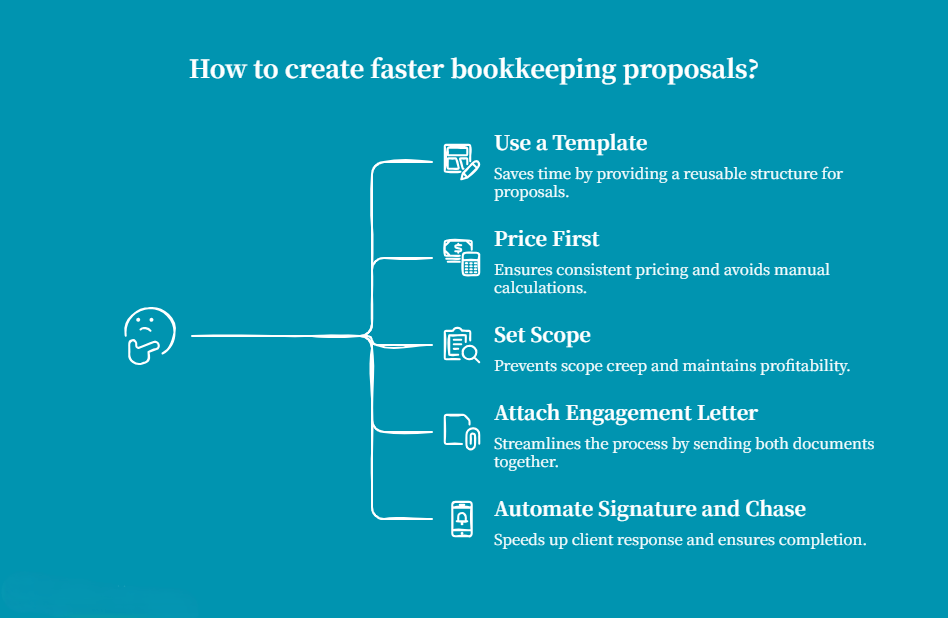
A bookkeeping proposal stalls in five places- the blank page, the pricing, the scope, the engagement letter, and the signature. The real question is not only how to write a bookkeeping proposal and win bookkeeping clients.
Firms that manage it in minutes do not rely on willpower. They run the whole proposal process on dedicated software. The steps below use FigsFlow, a proposal, pricing, and engagement letter platform built by Chartered Certified Accountants for accountants, as the worked example. The principle in each step holds whatever tool you run.
Step 1- Build the Bookkeeping Proposal Template Once
Starting from a blank page, or worse from the last client’s file, is where the afternoon goes. You retype the standard wording, miss a clause, and risk sending one client’s fees to another.
A strong bookkeeping proposal template needs only five sections. Get those right and you have what wins the work. Anything beyond them slows you down without raising your odds.
| Component | What it does |
|---|---|
| Client snapshot | Shows you understood the enquiry, in a line or two |
| Scope of services | Lists the work task by task, and what sits outside it |
| Price and basis | States the fee and how it was reached |
| Engagement terms | Sets the obligations on both sides |
| Acceptance route | Gives the client a quick way to sign |
Build the template once and you never rebuild the structure again. Each new enquiry becomes a handful of edits, not a fresh start.
This is where a template library earns its place. Figsflow gives you more than 100 customisable bookkeeping proposal and engagement letter templates to start from, so each one takes minutes rather than an afternoon.
Step 2 - Price the Engagement Before You Start Typing
The signature is where momentum dies. A signed proposal is revenue. An unsigned one is hope. The gap between them is usually you, chasing by hand.
Send for electronic signature so the client signs from any device, including their phone, without printing or third-party tools. The signing is secure.
On their own, these are five separate jobs. A platform like FigsFlow handles them all, ready templates for every kind of proposal, with pricing, the engagement letter, and signature built into one flow. Pulled together, the change is bigger than a faster afternoon.
Pricing is where most proposals stuck. You open the document, reach the fee line, and start second-guessing the number. Worse, two people in the same firm quote the same job differently.
Decide the fee before you draft a word. Fix the model first.
- Fixed fees for predictable monthly work
- Value pricing where the outcome justifies it
- Monthly retainers for ongoing bookkeeping
- Tiered or volume pricing keyed to transaction count
- Catch-up fees where the client arrives with a backlog
Step 3 - Set the Scope So It Cannot Creep
Vague scope turns a profitable client into a write-off. If the proposal says “bookkeeping,” the client hears “everything,” and you absorb the VAT return, the credit control, and the year-end tidy-up for free.
Spell out the work task by task. State the transaction volume, the reporting frequency, and what sits outside the fee. Name the associated services, bank reconciliation, credit control, payroll, and either price them or exclude them in writing.
Step 4 - Attach the Engagement Letter in the Same Click
A proposal without an engagement letter is half a job and a compliance exposure. Sending the letter separately, days later, is a second delay and a second chance to forget.
Generate both together. With a tool like FigsFlow, the engagement letter builds automatically alongside the proposal, aligned with the standards of ICAEW, ACCA, CIOT, CIMA, ATT, and AAT, with the schedule of services, terms, and privacy notice already populated.
Step 5 - Send for Signature &Automate the Chase
The signature is where momentum dies. A signed proposal is revenue. An unsigned one is hope. The gap between them is usually you, chasing by hand.
Send for electronic signature so the client signs from any device, including their phone, without printing or third-party tools. The signing is secure.
On their own, these are five separate jobs. A platform like FigsFlow handles them all, ready templates for every kind of proposal, with pricing, the engagement letter, and signature built into one flow. Pulled together, the change is bigger than a faster afternoon.
What Changes with Faster Bookkeeping Proposals?
Faster bookkeeping proposals do not just save administrative time. They help firms respond first, convert more enquiries, and win more clients.
Put the five steps together and the whole proposal process drops from an afternoon to minutes. You reply first, while the rest are still drafting. Here is the same job two ways: by hand, and in a connected workflow.
| Stage | Building by hand | In a connected workflow |
|---|---|---|
| Starting point | Copy and clean last client's file | Open a ready bookkeeping proposal template |
| Pricing | Retype fees, hope they match | Calculator sets live totals |
| Scope | Free text, easy to miss items | Schedule of services built in |
| Engagement letter | Find, format, attach separately | Generated with the proposal |
| Signature | Email, wait, chase, repeat | Electronic signature, automated reminders |
| Time to send | An afternoon | Minutes, not hours |
Reply first and you win bookkeeping clients the slower firm never gets to quote on. Price consistently and you protect the margin you would have discounted under pressure. Remove the chase and the cash arrives sooner.The bookkeepers who build the proposal and its engagement letter together, in minutes rather than hours, are not going back. If yours still swallow an afternoon, that is the gap to close.
Conclusion
Five steps stand between a new enquiry and a signed bookkeeping proposal, the template, the price, the scope, the engagement letter, and the signature. Each one either costs you time or saves it.
Build each by hand and a single proposal burns an afternoon while the prospect quietly compares. Run them as one flow and it goes out in minutes, priced right and ready to sign, while the rest are still drafting. Speed is the whole edge. Learning how to write a bookkeeping proposal is important, but building a repeatable bookkeeping proposal template and proposal process is what allows firms to send bookkeeping proposals quickly and win bookkeeping clients consistently.
So look at your last proposal. How many days passed between the enquiry and the signature, and how many of those were spent waiting on you?
FAQs
You need one any time you quote a client for work, before the engagement begins. That covers a new enquiry, adding services for an existing client, or a change in scope or fees. The proposal sets out what is included, the price, and the terms, so both sides agree in writing before any work starts and before the engagement letter is signed.
To win bookkeeping clients quickly, respond fast and make it easy to say yes. Build a reusable bookkeeping proposal template once, so you can send a clear, priced proposal within hours rather than days, then let the client sign electronically so nothing stalls.
Cover five things. Start with a short read of the client’s situation, then the scope of services set out task by task, the price and how it is worked out, the engagement terms, and a quick way to accept. Build these into a reusable bookkeeping proposal template so each new proposal is a few edits rather than a fresh start, and send the proposal and engagement letter together so the client can review and sign in one go.
No. AI is automating the repetitive parts of the job, data entry, categorisation, reconciliations, and first drafts, but it is not replacing the bookkeeper. It moves the role towards review, advice, and client relationships, where judgement matters. Bookkeepers who use AI to clear the routine work and spend the freed time on advisory tend to gain rather than lose.
Keep it short and clear. Name the service in the subject line, thank the client for the conversation in a line, say the proposal and engagement letter are attached or linked, and tell them the one action you want, to review and sign. Close by offering to answer questions, and make the signing link easy to find