
MTD turned one annual job into five
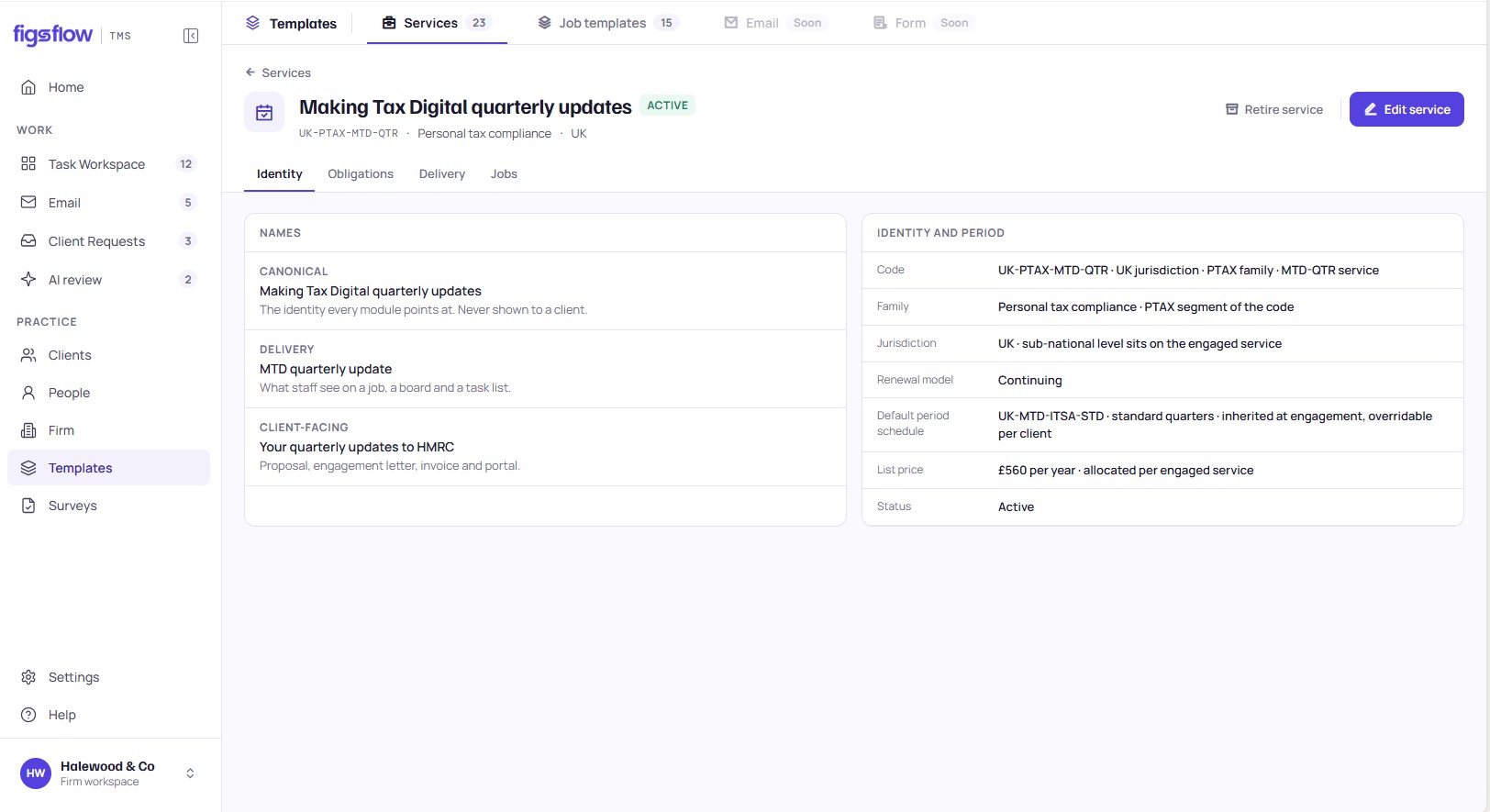
FigsFlow is practice management software for firms taking on MTD Income Tax clients. Scope the quarterly work, price it as a recurring engagement rather than a one-off return, get the letter signed, and have the four updates and the Final Declaration land as jobs on a schedule.
 G2 reviews
 Google reviews
Verified reviews
Trustpilot reviews
Google reviews
Verified reviews
Trustpilot reviews
Trusted by the best


Each service brings its own scope wording and its own recurrence. Add one and the engagement is re-scoped and re-priced from the same approved set.
The mismatch
The fee stayed annual. The work went quarterly
You quoted that client three years ago for a tax return. Now it is four quarterly updates and a final declaration, the records have to arrive five times instead of once, and the chasing happens five times too. The fee has not moved. Multiply that by however many of your clients cross the threshold and you have a capacity problem that looks like a pricing problem, or the other way round.

The split
What FigsFlow does, and what it does not
- Scopes who is in
- Prices the engagement as recurring work
- Generates and evidences the letter
- Runs AML and clearance
- Creates the five jobs, their deadlines and their record requests
- Shows capacity across the book
- Submits the quarterly updates
- Submits the Final Declaration
- Holds HMRC recognition
FigsFlow does not file. Quarterly updates and the Final Declaration are submitted through MTD-compatible software on HMRC's approved list.
- Scope
- Price
- Letter
- AML and clearance
- Five jobs created
- Records requested five times
Scoping
Who is actually in scope?
Qualifying income is gross and it is combined — self-employment and property added together, before expenses. That catches clients who do not feel like MTD clients, and it catches them on the basis of a figure nobody routinely looks at. FigsFlow scopes from the income already on the record rather than from a hunch.
Employment, partnership profit shares, dividends and pensions do not count towards it — which is why a client's total income is the wrong number to scope from.
137 in now · 94 next phase · 181 out
| Qualifying income over | Mandated from | Tested on the return for |
|---|---|---|
| £50,000 | 6 April 2026Now | 2024 to 2025 |
| £30,000 | 6 April 2027 | 2025 to 2026 |
| £20,000 | 6 April 2028 | 2026 to 2027 |
Thresholds and dates checked against HMRC guidance on 15 September 2026 — find out if and when you need to use Making Tax Digital for Income Tax. Re-verify before publishing.
Your MTD book grows twice more without you winning a client.
The work
Five jobs are created, not one
The signed engagement creates the work. Five jobs, five deadlines, five record requests, each on its own schedule, each with an owner. MTD Income Tax practice management is mostly this: making the quarterly reality exist in the system before it exists in your inbox.
The fee
The recurring fee is fixed
Price it as what it is: a recurring engagement with five delivery points, not an annual return that happens to repeat. The fee sits on the letter, the letter drives the jobs, and the jobs carry the time — so at the end of the first year you know whether the number was right rather than suspecting it was not.
Four predictable pinch points, plus January — visible before you sell into them
Capacity
Capacity becomes visible
Five deadlines per client, and they do not move. Across a book of MTD clients that produces four predictable pinch points a year instead of one, which is worse in January and much better in every other month — but only if you can see it coming. The calendar shows the shape of the year before you sell into it.
The difference
An annual job that repeats, or a recurring engagement
The difference is not semantic. One is priced once and delivered once; the other is priced once and delivered five times — and everything downstream follows from which of the two you think you are selling.
| When… | Treated as an annual jobThe tax return, but more often | Bolted onto filing softwareSubmission first, practice second | FigsFlowA recurring engagement |
|---|---|---|---|
| The fee is set | ✕Once, before MTD, and never revisited. | ✕Not its job. | ✓Priced for five delivery points, on the letter. |
| The work is created | ✕One job in the system. | !Submission periods, not jobs with owners. | ✓Five jobs, five dates, five owners. |
| Records are needed | ✕Chased when somebody notices. | ✕Assumed to already be there. | ✓Requested five times, on the job's own schedule. |
| You ask who is in scope | ✕From memory, client by client. | !Only for clients already connected. | ✓Scoped across the book from income on the record. |
| A client leaves scope | ✕Somebody remembers, or does not. | !Connection switched off. | ✓Jobs stop, and the reason is recorded. |
| Capacity is discovered | ✕In the quarter it arrives. | ✕Not modelled. | ✓As the shape of a year, before you sell into it. |
| The submission happens | !Elsewhere. | ✓Here. | !In your MTD-compatible software. Not here, and not claimed. |
FigsFlow runs the engagement. Your MTD-compatible software runs the submission. The two are not in competition.
Who uses it
What this looks like at your size
Pick the shape of your practice.
A handful of clients cross the threshold and suddenly your quietest months have work in them. Pricing it properly once is the difference between a bonus and a burden.

What you’ll see0:00 / 1:56
- 0:00 Twelve clients cross the threshold
- 0:26 That is sixty jobs where there were twelve
- 0:56 Priced as an annual return, it is a burden Priced as recurring, it is a bonus
- 1:28 Same clients, same work, different fee basis
Preview clock — no video source set
The MTD book is the first thing that will outgrow your current process, because it multiplies every client you already have rather than adding new ones.

What you’ll see0:00 / 2:06
- 0:00 Eighty clients you already act for
- 0:32 Thirty of them cross the threshold
- 1:02 That is 150 jobs from clients you already had It multiplies, it does not add
- 1:36 The process gives out before the people do
Preview clock — no video source set
Four quarterly pinch points across four hundred clients. This is the size at which MTD stops being a client question and becomes a resourcing one.

What you’ll see0:00 / 2:20
- 0:00 Four hundred clients, and a third of them in scope
- 0:38 Five deadlines each, none of which move
- 1:10 The year has four pinch points instead of one Predictable is not the same as easy
- 1:48 You can see February before you sell into it
Preview clock — no video source set
Consistency of scoping across offices, and a defensible basis for every client you decided was out of scope.

What you’ll see0:00 / 2:32
- 0:00 Several offices, each scoping its own clients
- 0:42 Different people, different judgement, same threshold
- 1:20 Scoping runs from the income on the record One standard, not several opinions
- 2:02 Every out-of-scope decision carries its reason
Preview clock — no video source set
Your stack
Works with the software that does the filing
FigsFlow runs the engagement. Your MTD-compatible software runs the submission. The two are not in competition.
- Microsoft 365
- Outlook
- SharePoint
- Xero
- QuickBooks Online
FigsFlow is practice management software and is not on HMRC's approved list of MTD-compatible products. Quarterly updates and the Final Declaration are submitted through software that is.
Origin
Built inside a working UK practice
Built by a practice that had to price its own MTD book before anyone had done it twice.
 Coming soon0:54
 Coming soon1:08
 Coming soon1:02
 Coming soon1:15
Named practice references and review-platform ratings are not shown on this page yet. They will be added once the practices concerned have agreed in writing.
What the MTD work costs
The MTD module is included in your plan, not metered. Scoping the engagement, the five delivery points per client, the quarterly jobs and the dates behind them come with the subscription however many MTD clients you take on. The only work FigsFlow charges per unit is the AML check, which every new MTD client goes through once.
£3.00 from your 100th check, permanently. Identity and address verification, PEP and sanctions screening, the Amberhill check and 24 months of ongoing screening are all inside that price.
Checks only, no programme, with everything above still included. Credits never expire and the programme can be added at any time.
Risk assessments, enhanced due diligence, policies and MLRO roles, monitoring alerts and the training log. Billed annually; £19 monthly.
MTD Income Tax is a UK requirement, and this module is available in the UK region only. FigsFlow is practice management software and is not on HMRC's approved list of MTD-compatible products — quarterly updates and the Final Declaration are submitted through software that is.
Related modules
What the MTD engagement connects to
The engagement is the hinge. These four are what it sets in motion; the rest of the platform sits around them on the same shared record.
Pricing and quoting
Where the recurring fee is set, for five delivery points rather than one.
See the pricing moduleEngagement letters
What creates the five jobs — the letter is the trigger, not a filing cabinet.
See the letters moduleHMRC deadlines
Where the five dates live, and why they do not move.
See the deadlines moduleForms and requests
The records, requested five times a year instead of once.
See the requests moduleResources
The MTD cluster, in full
Guides, films and writing on scoping, onboarding, pricing and repapering an MTD book.
 Live
LiveMTD for Income Tax — a guide for accountants and agents
The full picture: thresholds, phases, what agents have to do and when.
Read the guide Live
LiveHow to onboard MTD clients
Scoping, clearance and the conversation that comes before the letter.
Read the guide Live
LiveHow to update your MTD engagement letter
What changes when an annual return becomes a recurring engagement.
Read the guide


Questions