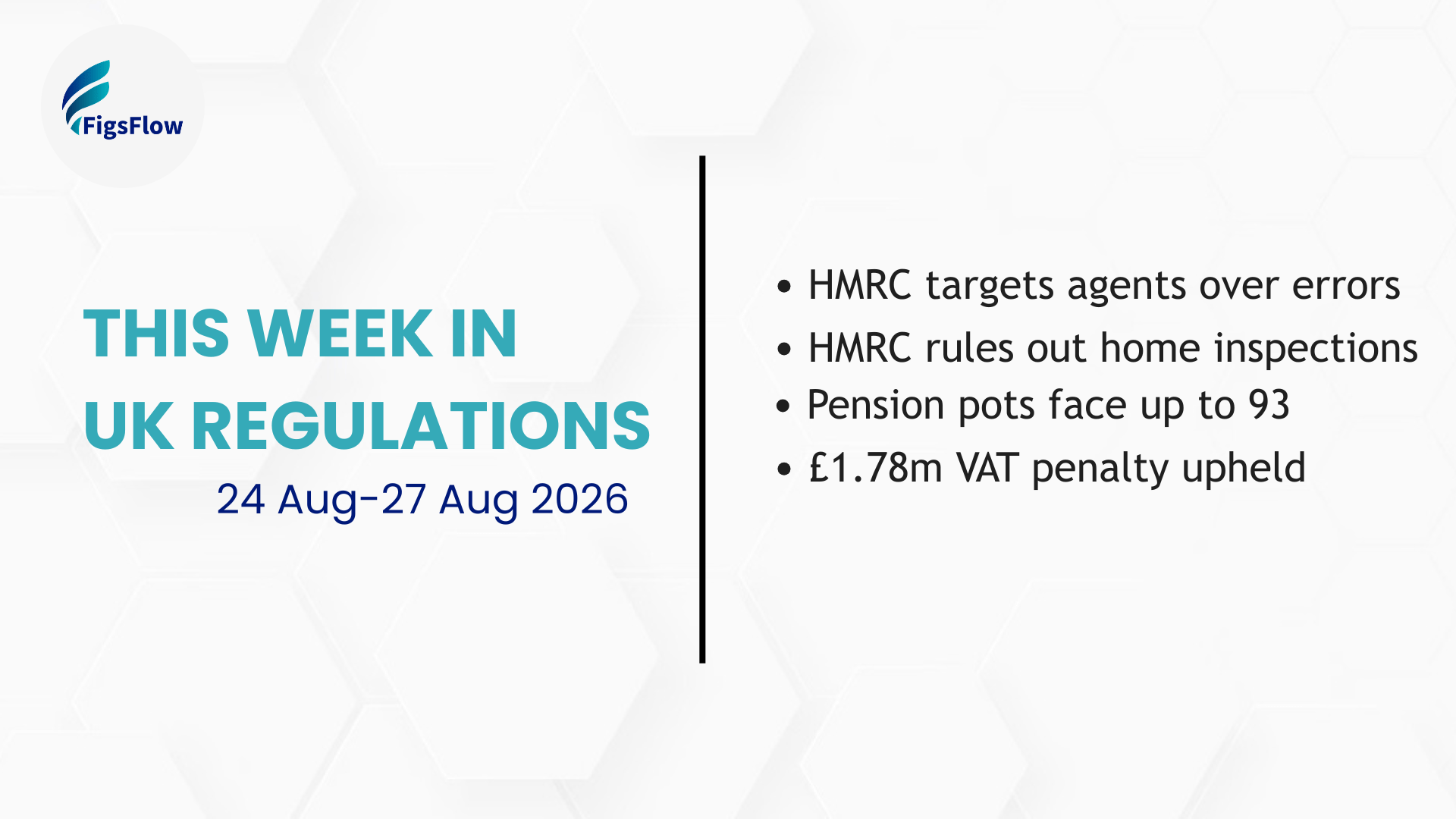

HMRC has begun writing directly to agents, flagging errors on excepted estate reports filed since the January 2022 rules took effect. Any practice with borderline probate cases should check its files now, and that is the story to act on first. Right behind it, HMRC has had to rebut media claims of routine inspections on 165,000 homes worth over £2m under the incoming High Value Council Tax Surcharge, a rumour worth correcting with clients immediately.
The other two are about planning rather than panic. NFU Mutual’s calculations show pension pots entering the inheritance tax net from April 2027 could face effective tax rates as high as 93%, and a tribunal has upheld a £1.78m VAT penalty against a director who tried, unsuccessfully, to blame his accountant.
Here is the detail.
HMRC Targets Agents Over Errors in Post-2022 Excepted Estate Rules
The excepted estate rules introduced in January 2022 let some non-taxpaying estates apply for probate without submitting a full IHT400. HMRC has now launched a “one to many” educational letter campaign aimed at agents, targeting errors on exactly this kind of borderline estate.
Most of the errors HMRC is flagging come down to eligibility, not valuation. The Residence Nil Rate Band, downsizing allowances and transferable nil rate bands cannot be used to bring an estate under the excepted estate threshold. If an estate only qualifies once one of these reliefs is applied, it does not qualify as an excepted estate at all, and a full IHT400 is required instead.
Key facts:
- Excepted estate thresholds range from £325,000 to £1,000,000 (the specific figures are £325,000, £500,000, £650,000, £825,000 and £1,000,000), depending on the estate category
- The Residence Nil Rate Band, downsizing allowance and transferable nil rate band cannot be used to establish excepted estate eligibility
- Any estate that only falls under the threshold because of these allowances must be reported via IHT400, not as an excepted estate
For agents, the safest approach on any borderline estate is to check valuation accuracy first, then confirm whether reaching the excepted estate threshold depends on RNRB, downsizing or transferable allowances. Where it does, submitting IHT400 from the outset is safer than risking a late claim or penalty once HMRC’s letter campaign catches the error.
HMRC Rebuts Mansion Tax Inspection Rumours & Confirms the 2028 Valuation Process
Media reports claimed HMRC intends routine physical inspections of 165,000 homes worth over £2m to enforce the incoming High Value Council Tax Surcharge. HMRC has rebutted this directly: there is no inspection programme planned, and no officer is coming through anyone’s front door.
Valuations will instead be built from sales data, Land Registry records and existing property attributes, the same sources HMRC already holds. Homeowners will have the right to challenge an incorrect valuation band once one is issued.
Key facts:
- The High Value Council Tax Surcharge applies to properties worth over £2m from April 2028, expected to raise around £430m by 2028-29
- London accounted for 67% of £2m+ sales (6,057 transactions) between January 2024 and April 2026, with the Southeast a distant second at 1,585 sales
- HMRC expects an appeal rate of around 20% once valuation bands are issued
Clients who own or are considering high value property, particularly in London and the Southeast, should understand that valuation will be desk based rather than physical, and that an incorrect band can be challenged. Correcting the inspection rumour now heads off a difficult conversation later.
Pension Pots Face a 91% IHT "Triple Blow" as the Net Closes in April 2027
From April 2027, unspent pension pots will be brought into the inheritance tax net for the first time. NFU Mutual’s calculations show the effect is worse than a single tax charge: a pension inherited after the holder’s 75th birthday faces 40% inheritance tax and then the beneficiary’s own marginal income tax rate on top.
The combined effect pushes effective tax rates to around 60% for a higher rate taxpayer, and as high as 85% for an additional rate taxpayer, before any knock-on effect on other allowances is even considered.
There is a third element that makes this worse again. Including a £700,000 pension pot in a £2m estate pushes its value to £2.7m, enough to wipe out the combined £350,000 Residence Nil Rate Band once the estate crosses the tapering threshold. NFU Mutual’s modelling shows this alone takes the estate’s inheritance tax bill from £400,000 to £820,000.
Key facts:
- A £700,000 pension fund inherited after age 75 can face a total tax hit of £639,326, or 91.3%, in England
- In Scotland, where the top income tax rate is 48%, the same pension pot faces a total tax hit of £653,948, or 93.4%
- Losing the £350,000 combined Residence Nil Rate Band through estate tapering can add £420,000 to an inheritance tax bill on its own
For clients approaching 75 with meaningful pension funds, the practical response is to consider tax free lump sums before that birthday, and to use the gifts from normal expenditure exemption where regular giving is affordable. Both are worth raising well ahead of April 2027, not after.
Tribunal Upholds £1.78m VAT Penalty & Exposes the Risk of Blaming Your Agent
The First-tier Tribunal has dismissed an appeal against a Personal Liability Notice issued to Parwinder Singh Gill over under-declared VAT. Gill argued that his accountant, Gary Foster of Dartford, had deliberately suppressed his company PSGCL’s invoices and understated its turnover without his knowledge.
The tribunal had good reason to look closely at that relationship. PSGCL was a substantial business, and the financial ties between the company and its accountant ran well beyond a standard engagement, details that undercut the idea of an arm’s length adviser.
Key facts:
- Personal Liability Notice of £1,781,474.60, covering VAT periods 01/15 to 06/19 (Gill v HMRC, UKFTT 1164 (TC)).
- PSGCL’s turnover was around £30m, and the company had paid for Foster’s office, a computer, Sage software and a deposit on his house.
- The tribunal drew an adverse inference from Gill’s failure to call Foster as a witness, and found the underdeclaration deliberate rather than careless.
What ultimately sank the appeal was what Gill did not do. He never called Foster to give evidence, and the tribunal treated that omission as telling: if Foster’s account would have helped Gill’s case, the obvious step was to produce it. The lesson for practices is straightforward: a Personal Liability Notice does not disappear because a client blames an adviser, and failing to call that adviser as a witness will count against the taxpayer, not for them.
Conclusion
The pattern this week is HMRC tightening scrutiny in some areas while correcting the record in others. The excepted estate letter campaign and the Gill tribunal case both show HMRC pressing hard on compliance and personal liability, while the mansion tax rebuttal shows HMRC pushing back against enforcement claims that overstate its own reach. Sitting alongside both is a pension IHT change that will reshape estate planning conversations regardless of how the compliance picture develops.
For most practices the immediate work is narrow: check any borderline excepted estate files now and be ready to correct client assumptions about mansion tax inspections. The pension IHT change is planning work for the year ahead of April 2027, and the Gill case is a reminder to document adviser relationships carefully rather than something requiring action today.
We publish these updates every week. Follow us to get next week’s round-up as soon as it lands.