
Form 1040: What Tax Practitioners Need to Know Before Filing Season
Form 1040, four new deductions and key threshold changes US tax practitioners need to know before April 15, 2026.

The One Big Beautiful Bill Act introduced four brand-new deductions for the 2025 tax year, and they will significantly change how your clients’ returns look when you file by April 15, 2026.
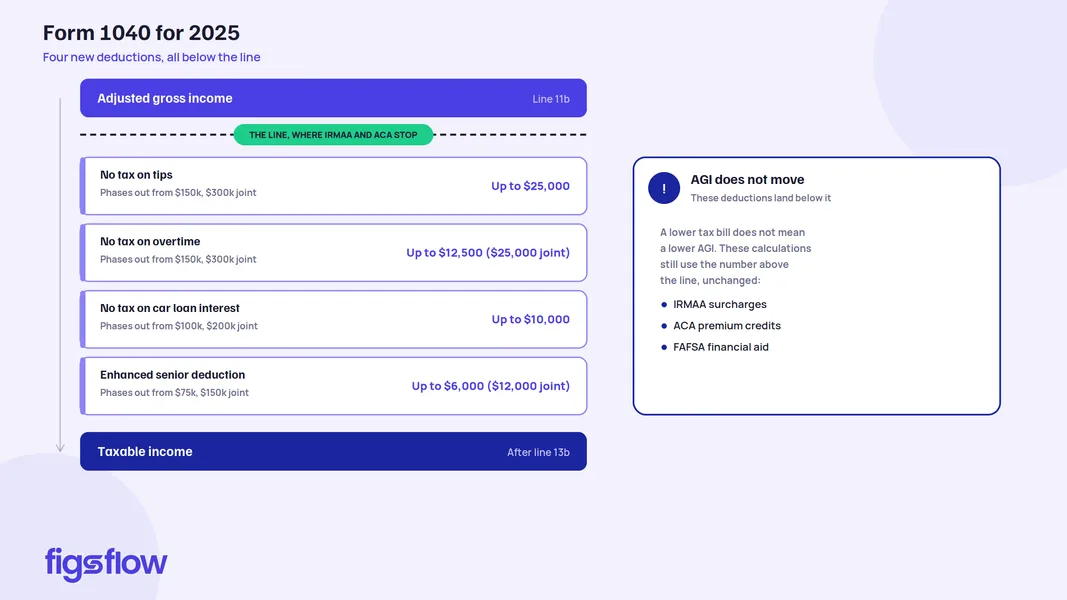
These deductions sit on a redesigned Schedule 1-A, a form that did not exist before 2025. Every qualifying client, whether they take the standard deduction or itemize, can now claim:
- No tax on tips for IRS-designated tipped occupations (up to $25,000)
- No tax on overtime, up to $12,500 ($25,000 joint), on the FLSA premium
- No tax on car loan interest, up to $10,000, on purchased vehicles
- Enhanced deduction for seniors age 65 and older, up to $6,000 per qualifying individual
This guide covers how Form 1040 is structured for 2025, the key changes beyond Schedule 1-A that affect client returns, a breakdown of all four new deductions, including phase-out rules and eligibility conditions, and the deadlines and resources you need for this filing season.
What Form 1040 Is & Who Files It
Form 1040, U.S. Individual Income Tax Return, is the standard federal income tax return filed by US citizens and resident aliens to report annual income, claim deductions and credits, and calculate their federal tax liability. For 2025, a taxpayer generally must file if their gross income meets or exceeds the standard deduction for their filing status, or if they had net self-employment earnings of $400 or more.
A resident alien is a foreign national who meets either the green card test (holds a USCIS-issued Form I-551 at any point during 2025) or the substantial presence test. The substantial presence test requires:
- At least 31 days during 2025
- At least 183 days across the three-year period covering 2025, 2024, and 2023, counting all days present in 2025, one-third of days present in 2024, and one-sixth of days present in 2023
Resident aliens file Form 1040 and report worldwide income, the same as US citizens. Non-resident aliens file Form 1040-NR instead.
Taxpayers born before January 2, 1961, may file Form 1040-SR, which uses the same schedules and instructions as Form 1040 but includes a standard deduction chart printed directly on the form.
Not Every Day Counts
Certain individuals are exempt from the substantial presence day count entirely, including foreign government employees on A or G visas, teachers and trainees on J or Q visas, students on F, J, M, or Q visas, and professional athletes present solely to compete in charitable sports events. Regular commuting days from Canada or Mexico and transit days under 24 hours also do not count toward the 183-day threshold.
How the Form Is Structured
Form 1040 runs two pages. Page 1 captures filing status, dependent information, and all income lines from wages through capital gains and additional income from Schedule 1. Page 2 calculates tax, applies credits, accounts for payments, and produces the final refund or balance due. Most of the complexity for a given client sits in the schedules that attach to the form, not on the form itself.
The Four Numbered Schedules and Where They Land
| Schedule | When It Is Required | Feeds Into Form 1040 Line |
|---|---|---|
| Schedule 1 | Additional income or above-the-line adjustments | Line 8 (income) and Line 10 (adjustments) |
| Schedule 1-A | Qualified tips, overtime, car loan interest, or senior deduction | Line 13b |
| Schedule 2 | Additional taxes, including self-employment tax, AMT, and NIIT | Line 17 and Line 23 |
| Schedule 3 | Additional credits and payments, including foreign tax credit and education credits | Line 20 and Line 31 |
Lettered schedules (A, B, C, D, E, F, and others) attach separately based on each client’s specific income sources, deductions, and credits.
What Changed in 2025
The 2025 Form 1040 carries several updates that go beyond routine inflation adjustments. Some are structural, like the addition of a brand-new schedule. Others are threshold changes that shift how you approach deductions for certain clients. And a few are reporting changes that will generate client questions if practitioners are not ahead of them.
Here is what matters most.
New Schedule 1-A & the Four New Deductions
The most significant structural addition to the 2025 Form 1040 is Schedule 1-A, Additional Deductions. Created by the One Big Beautiful Bill Act, it consolidates four new below-the-line deductions onto a single form:
- no tax on tips,
- no tax on overtime,
- no tax on car loan interest, and
- an enhanced deduction for seniors
The next section covers all four in full detail.
Standard Deduction Increases
Standard deductions increased across all filing statuses for 2025. The increases are inflation adjustments and may push clients who were borderline itemizers in 2024 toward the standard deduction this year.
| Filing Status | 2024 Amount | 2025 Amount |
|---|---|---|
| Single | $14,600 | $15,750 |
| Married Filing Jointly | $29,200 | $31,500 |
| Married Filing Separately | $14,600 | $15,750 |
| Head of Household | $21,900 | $23,625 |
| Qualifying Surviving Spouse | $29,200 | $31,500 |
SALT Cap, Digital Assets & the 1099-K Reset
The state and local tax deduction cap increased to $40,000 for 2025, up from the long-standing $10,000 limit. For clients in high-tax states who were previously constrained by the cap, itemizing may now be worth revisiting. However, this is not a universal increase. For high-income clients whose MAGI exceeds $500,000 ($250,000 for married filing separately), the cap phases back down, eventually returning to the original $10,000 limit. Practitioners with higher-income clients in high-tax states should verify where their client lands before assuming the full $40,000 cap applies.
The digital assets question on Form 1040 now asks whether the taxpayer at any time during 2025 received, sold, exchanged, or otherwise disposed of a digital asset or a financial interest in a digital asset. Clients who used a broker to sell digital assets in 2025 should receive a Form 1099-DA reporting the transaction. Brokers may optionally report cost basis on the 1099-DA, but are not required to do so for 2025, which means basis verification remains a preparer responsibility.
The 1099-K reporting threshold reverted to $20,000 in payments and 200 transactions under the One Big Beautiful Bill Act. Platforms such as Venmo and eBay will only issue a 1099-K to clients who cross both thresholds. However, all taxable income remains reportable regardless of whether a form is received, and preparers should make this clear to clients who assume no form means no reporting obligation.
Schedule 1-A: Where Practitioners Will Get the Most Questions
All four Schedule 1-A deductions are below-the-line, meaning they reduce taxable income after AGI (Adjusted Gross Income) is calculated. They are available whether the client takes the standard deduction or itemizes on Schedule A.
All four are subject to MAGI-based phase-outs, and all four expire after 2028.
MAGI (Modified Adjusted Gross Income) is AGI adjusted for certain exclusions, such as foreign earned income. As a client’s MAGI crosses the threshold for a given deduction, the deductible amount reduces incrementally until it reaches zero.
No Tax on Tips
Clients who receive tips in an occupation the IRS has designated as customarily and regularly tipped may deduct up to $25,000 of qualified tips. To qualify, the tips must be:
- Voluntary and not negotiated
- Reported on a Form W-2, Form 1099-NEC, Form 1099-MISC, or Form 1099-K
- Received in an IRS-designated tipped occupation
Two gatekeeper rules apply before any other calculation: the person receiving the tips must have a valid Social security number, and married clients must file a joint return to claim this deduction. Without either, the deduction is disallowed regardless of occupation or income level.
The MAGI phase-out begins at $150,000 for single filers and $300,000 for married filing jointly.
No Tax on Overtime
Only the FLSA (Fair Labor Standards Act) overtime premium portion of overtime pay qualifies, not the base wage. The premium is the amount above the regular rate of pay that the employer is required to pay for hours worked beyond the standard threshold.
If a client’s W-2 does not separately identify the premium portion, the IRS allows the one-third method as transition relief for 2025: the client may treat one-third of total overtime pay as the deductible premium.
Key limits to know:
- Cap is $12,500 for individuals and $25,000 for married couples filing jointly
- MAGI phase-out begins at $150,000 ($300,000 for married filing jointly)
Note that public sector employees covered by compensatory time arrangements rather than cash overtime must compute their deductible amount differently under the rules applicable to their specific overtime provision.
No Tax on Car Loan Interest
Clients who paid interest on a loan used to purchase a new passenger vehicle for personal use in 2025 may deduct up to $10,000 of that interest. To qualify, the loan and vehicle must meet all of the following conditions:
- The loan must have originated after December 31, 2024
- The loan must be secured by a first lien on the vehicle
- The vehicle must be new and primarily for personal use, meaning the client expects to use it for personal purposes more than 50% of the time. Clients who occasionally use their vehicle for gig work such as ridesharing may still qualify if personal use exceeds that threshold
- The vehicle must have undergone final assembly in the United States
- The VIN (Vehicle Identification Number) must be reported on Schedule 1-A to substantiate US assembly
Lease payments do not qualify. Interest on refinanced loans may still be eligible, provided the original loan met the qualification requirements and the new loan remains secured by a first lien on the same vehicle.
The MAGI phase-out begins at $100,000 for single filers and $200,000 for married filing jointly. Unlike the tips and overtime phase-outs which round down, the car loan interest phase-out rounds up, which can reduce the deduction more quickly at the margin.
Enhanced Deduction for Seniors
Taxpayers born before January 2, 1961 may claim an additional deduction of up to $6,000. If both spouses qualify and file jointly, the maximum is $12,000. Both the taxpayer and any qualifying spouse must have a valid Social security number, and married taxpayers must file jointly to claim this deduction.
The MAGI phase-out begins at $75,000 for single filers and $150,000 for married filing jointly, with a 6% reduction for every $1,000 of MAGI above the threshold.
There is a specific rule for clients whose spouse died during 2025. A person is considered to reach age 65 on the day before their 65th birthday. For example, if a spouse was born on February 14, 1960 and died on February 13, 2025, they are considered age 65 at the time of death and qualify. If that same spouse died on February 12, 2025, they are not considered age 65 and do not qualify.
Where Schedule 1-A Lands on Form 1040 & Why It Matters
The total from Schedule 1-A line 38 flows to Form 1040 line 13b, which sits below line 11b, the adjusted gross income line. This placement is not just a filing mechanic. It has real planning consequences.
Because Schedule 1-A deductions do not reduce AGI, they do not affect any calculation that uses AGI as its base. That includes:
- IRMAA surcharges for Medicare Part B and Part D premiums
- ACA (Affordable Care Act) premium tax credit eligibility and reconciliation
- Phase-outs on other credits that reference AGI
- FAFSA-based financial aid calculations
Practitioner Note
A client who sees a meaningfully lower tax bill from Schedule 1-A deductions may still face unchanged IRMAA surcharges or ACA credit adjustments. Getting ahead of that conversation before filing is the difference between a compliance engagement and a planning one.
2025 Tax Computation: Table vs. Worksheet
Taxable income below $100,000 is computed using the 2025 Tax Table in Publication 1040. Taxable income of $100,000 and above requires the Tax Computation Worksheet from the same publication. Preparers who use tax software will have this handled automatically, but it is worth knowing the threshold for manual review situations.
| Rate | Single | Married Filing Jointly | Married Filing Separately |
|---|---|---|---|
| 10% | Up to $11,925 | Up to $23,850 | Up to $11,925 |
| 12% | $11,926 to $48,475 | $23,851 to $96,950 | $11,926 to $48,475 |
| 22% | $48,476 to $103,350 | $96,951 to $206,700 | $48,476 to $103,350 |
| 24% | $103,351 to $197,300 | $206,701 to $394,600 | $103,351 to $197,300 |
| 32% | $197,301 to $250,525 | $394,601 to $501,050 | $197,301 to $250,525 |
| 35% | $250,526 to $626,350 | $501,051 to $751,600 | $250,526 to $375,800 |
| 37% | Over $626,350 | Over $751,600 | Over $375,800 |
However, these tables do not apply to every client. In the following situations, a separate worksheet or form is required:
- Clients with qualified dividends or net capital gains must use the Qualified Dividends and Capital Gain Tax Worksheet or the Schedule D Tax Worksheet
- Children with unearned income over $2,700 must generally use Form 8615
- Taxpayers filing Form 2555 for foreign earned income must use the Foreign Earned Income Tax Worksheet
- Clients receiving certain lump-sum distributions may need Form 4972
Tax software handles these exceptions automatically, but knowing when the standard table does not apply is essential for manual review and catching errors on complex returns.
Key Deadlines for 2025 Returns
Missing a deadline costs clients money in penalties and interest. Here are the key dates practitioners need to have on their radar for 2025 returns.
| Deadline | Who It Applies To |
|---|---|
| April 15, 2026 | Standard filing deadline for most taxpayers |
| April 15, 2026 | Deadline to file Form 4868 for an automatic 6-month extension (extension is for filing only, not payment) |
| June 15, 2026 | Taxpayers living and working outside the US |
Helpful Resources for Tax Practitioners
The IRS has consolidated the primary reference materials for 2025 returns in a few key locations. Bookmark these before filing season begins.
- Form 1040 and Instructions: The official 2025 Form 1040, full filing instructions, and all numbered schedules, including the new Schedule 1-A. The starting point for every individual returns this season.
- IRS Tipped Occupations List: The definitive IRS list of occupations that qualify for the no tax on tips deduction under Schedule 1-A. Essential for verifying client eligibility before claiming the deduction.
- Publication 1040: 2025 Tax and Earned Income Credit Tables contains the full 2025 Tax Table for taxable income under $100,000, the Tax Computation Worksheet for income above $100,000, and the complete Earned Income Credit tables by filing status and number of qualifying children.
Conclusion
The 2025 Form 1040 is structurally familiar, but Schedule 1-A changes what practitioners need to verify for a meaningful portion of clients. Four new deductions, each with its own:
- Eligibility conditions
- MAGI-based phase-out thresholds
- Documentation requirements
The below-the-line placement of Schedule 1-A deductions will catch some clients off guard. A lower tax bill does not mean a lower AGI, and that distinction matters for IRMAA, ACA credits, and financial aid calculations.
Review your client list before filing season. Identify who may qualify and reach out proactively. That conversation is where compliance ends, and planning begins.
Frequently Asked Questions (FAQs)
Related Articles
- The 10-Return E-File Threshold & What It Means for Form 1096 Filers
- Bookkeeping Engagement Letter: Free Template, Key Clauses & Client Protection Guide
- CPA Engagement Letters: The Clauses, Samples & Risk Protection Every Firm Needs
- Form 1099 Explained: Types, Who Sends It & When
- Form 941 Filing Requirements: What Employers Must Know in 2026
- The Future of Accounting: What the Next Decade Holds
- Is Accounting a Dying Field? What the Data Really Says
- Tax Preparation Engagement Letter: Free Template, Key Clauses & Filing-Season Checklist