
Form 941 Filing Requirements: What Employers Must Know in 2026 | FigsFlow
Learn Form 941 requirements for 2026, from quarterly deadlines to wage reporting and corrections.

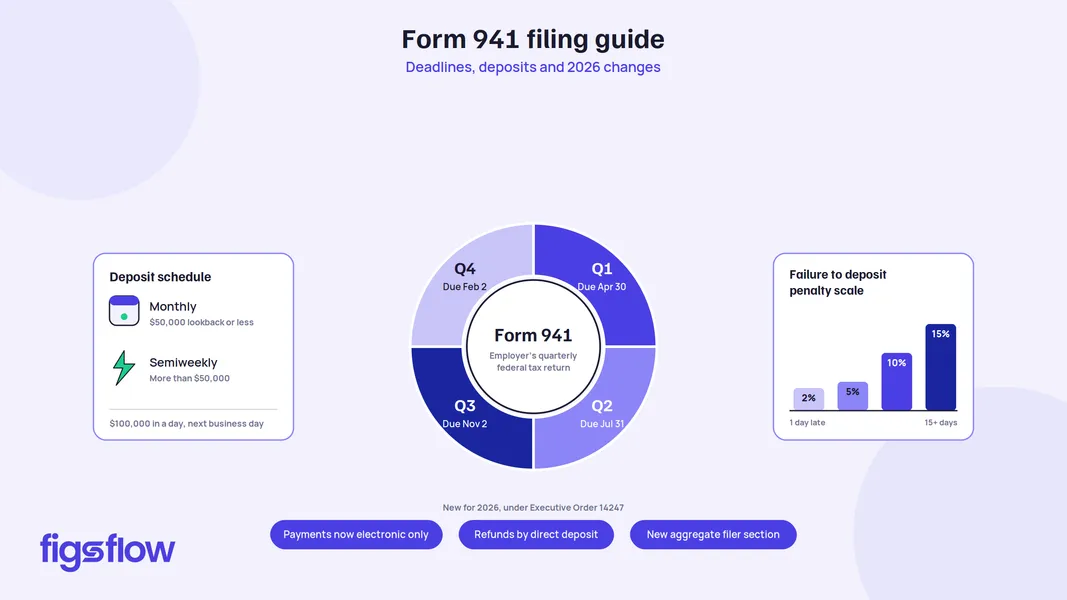
Three changes took effect for Form 941 in 2026:
- Executive Order 14247 now requires all balance-due payments to be made electronically
- Refunds from overpayments are issued as direct deposits rather than paper checks
- A new Aggregate Return Filers Only section requires aggregate filers to identify their filer type on the form for the first time
The IRS expects the March 2026 revision to be used for all four quarters of the year. Here is everything you need to know about filing Form 941 this year.
What Is Form 941? (A Quick Refresher)
Form 941 is the Employer’s Quarterly Federal Tax Return. Employers use it to report federal income tax withheld from employees’ wages, as well as the employer and employee shares of Social Security and Medicare taxes. It is filed four times a year and is separate from the deposits employers make throughout the quarter.
For Example, take Sarah, who runs a design agency and pays Marcus a salary of $75,000 a year. Every time she pays Marcus, she withholds federal income tax and his share of Social Security and Medicare taxes from his paycheck. She also owes her own employer share of those taxes on top of that.
At the end of each quarter, she files Form 941 to report all of it to the IRS and confirm her deposits were made correctly.
Who Must File Form 941?
Any employer who pays wages subject to federal income tax withholding, Social Security tax, or Medicare tax must file Form 941 each quarter. Once you file the first return, the quarterly obligation continues even in quarters where no wages were paid.
Four categories of employers follow different rules:
- Form 944 filers file once a year instead of quarterly. The switch requires written notification to the IRS and cannot be made unilaterally
- Household employers report wages for domestic workers on Schedule H of Form 1040
- Farm employers report agricultural labour wages on Form 943
- Seasonal employers may skip quarters in which no wages were paid, but must check the seasonal employer box on line 18 of every return they do file
What Does Form 941 Report?
Form 941 captures three categories of tax each quarter:
| Tax | Employee Rate | Employer Rate | Wage Cap |
|---|---|---|---|
| Federal Income Tax | Varies (per W-4) | None | None |
| Social Security | 6.2% | 6.2% | $184,500 |
| Medicare | 1.45% | 1.45% | None |
Federal income tax withheld depends on each employee’s Form W-4 and the applicable withholding tables. Once an employee’s wages reach $184,500 for the year, Social Security withholding stops. An aditional 0.9% Medicare tax applies to wages above $200,000 and is withheld from the employee only, with no employer match.
When Is Form 941 Due?
Form 941 is due by the last day of the month following the end of each quarter.
| Quarter | Months Covered | Due Date |
|---|---|---|
| Q1 | January, February, March | April 30 |
| Q2 | April, May, June | July 31 |
| Q3 | July, August, September | October 31 |
| Q4 | October, November, December | January 31 |
Employers who made all required deposits in full and on time for the quarter have an additional 10 days to file.
Under that rule, Q1 extends to May 10, Q2 to August 12, Q3 to November 12, and Q4 to February 10. In 2026, October 31 falls on a Saturday, moving the standard Q3 deadline to November 2, and January 31 falls on a Saturday, moving the standard Q4 deadline to February 2.
What Is the Deposit Schedule for Form 941?
The IRS assigns each employer to either a monthly or semiweekly deposit schedule based on the total tax liability reported during the lookback period. For 2026, the lookback period runs from July 1, 2024 through June 30, 2025.
| Schedule | Lookback Period Liability | When to Deposit |
|---|---|---|
| Monthly | $50,000 or less | By the 15th of the following month |
| Semiweekly | More than $50,000 | Within 3 days of payday (Wed/Thu/Fri paydays: by following Wednesday; all other paydays: by following Friday) |
Two additional rules apply regardless of the schedule. First, if an employer accumulates $100,000 or more in tax liability on any single day, the deposit is due the next business day. This also reclassifies the employer as a semiweekly depositor for the rest of that calendar year and all of the following year.
Second, employers whose total taxes for either the current or prior quarter are below $2,500 may pay the full amount with a timely filed return, provided they did not incur a $100,000 next-day deposit obligation during the current quarter.
In all cases, all deposits must be made electronically through the Electronic Federal Tax Payment System (EFTPS), IRS Direct Pay, or an IRS business tax account.
How Do Form 941 & Form W-3 Reconcile?
At year-end, the IRS matches the amounts reported across all four quarterly Form 941 returns against the totals on Form W-3 (Transmittal of Wage and Tax Statements), which summarises all W-2s filed for the year. Four figures are reconciled:
- federal income tax withheld
- Social Security wages
- Social Security tips
- Medicare wages and tips
Any mismatch will result in contact from the IRS or the Social Security Administration. Running this reconciliation before filing the Q4 return gives practitioners the opportunity to catch and correct errors before they trigger a notice.
What Penalties Apply If You Miss Form 941 Requirements?
Failure-to-deposit penalties scale with how late the deposit is made:
| Days Late | Penalty |
|---|---|
| 1 to 5 days | 2% |
| 6 to 15 days | 5% |
| 16 or more days, but before 10 days after the first IRS notice | 10% |
| Paid directly with the return instead of deposited | 10% |
| Still unpaid 10 days after the first IRS notice | 15% |
The failure-to-file penalty is 5% of the unpaid tax for each month or part of a month the return is late, up to a maximum of 25%.
Further Reading
- Publication 15 (Circular E), Employer’s Tax Guide — covers the deposit schedule rules, lookback period, failure-to-deposit penalties, and trust fund recovery penalty in full detail. The 941 instructions reference it throughout.
- Instructions for Form 941 (March 2026) — the primary source document for all filing requirements, line-by-line guidance, and the 2026 changes.
- How to Order IRS Forms by Mail in 2026 — covers how to request Form 941 and related payroll forms through the IRS ordering portals, including quantity limits and delivery timelines.
Conclusion
Form 941 compliance runs throughout the quarter, not just at filing time. The deposit schedule, the correct filer classification, and the W-3 reconciliation all require attention before the return is due.
For clients whose payroll has grown, check the deposit schedule classification at the start of each year. A client who crosses the $50,000 lookback threshold moves from monthly to semiweekly, and failing to reclassify is one of the more common sources of failure-to-deposit penalties.