
IRS Form 8949: How to Report Capital Gains & Losses in 2026
Sold stocks, crypto, or real estate? You'll likely need to fill Form 8949 and Schedule D. Here's a plain-English walkthrough of how to do it.

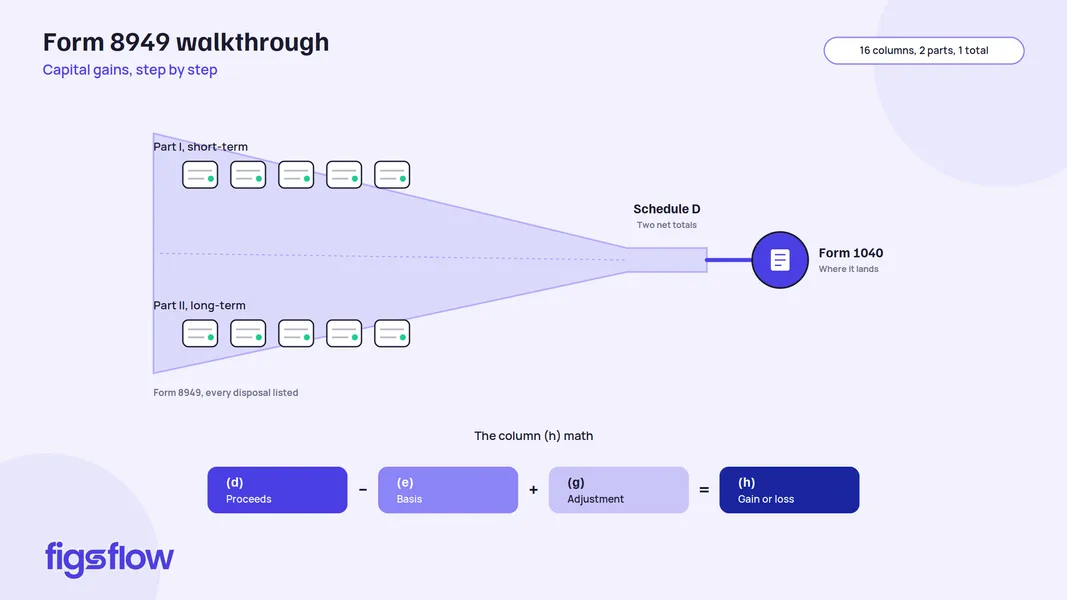
Form 8949 is a two-page form. You list every capital asset your client sold in the year, sort them by holding period into Part I (short-term) or Part II (long-term), check the right box, fill in eight columns, and carry the totals to Schedule D of the Form 1040. That is the whole job.
Easier said than done, right?
The 2025 version of Form 8949 introduces six new boxes tied to digital assets, a new information return from brokers, and updated rules on where cryptocurrency transactions belong. Miss any of it and the totals land on the wrong Schedule D line.
That is what this guide is for. Whether you have filed Form 8949 a hundred times or are looking at it for the first time, by the end, you will know exactly which box to check, which column to fill, and how the whole thing connects back to the return.
What Form 8949 Is & How It Fits into Form 1040
Form 8949 is the transaction-level detail sheet that supports Schedule D (capital gains & losses summary on the Form 1040).
Here Is What the Form Looks Like
Each sale, exchange, or disposal of a capital asset (any property held for investment or personal use, such as stocks, bonds, real estate, or cryptocurrency) is reported on Form 8949. The summary of that activity, one net number for short-term and one for long-term, goes into Schedule D, which then feeds Form 1040.
In simple terms: Form 8949 is the working paper, Schedule D is the headline, and Form 1040 is where those numbers ultimately land.
Who Needs to File Form 8949
Anyone who disposed of a capital asset during the tax year needs Form 8949. That covers individuals filing Form 1040, corporations and partnerships filing their respective returns, and estates and trusts.
The form itself is identical regardless of entity type. What differs is which Schedule D it attaches to:
- Individuals use Schedule D of Form 1040
- Partnerships use Schedule D of Form 1065
- Corporations attach it to Schedule D of their relevant 1120 variant
For joint filers, transactions can be listed on separate Forms 8949 or combined on a single form. Either approach works as long as the totals from all Forms 8949 for both spouses are included on the Schedule D.
What to Collect Before You Start
Three categories of documents drive Form 8949. Knowing which you have, and which are missing, determines the box you check and how much manual work is ahead of you.
Form 1099-B
It is issued by the broker for traditional securities such as stocks, bonds, and mutual funds. It shows proceeds and, for covered securities (securities where the broker is required by law to track and report the cost basis to the IRS), it also shows what your client originally paid for the asset. It will indicate whether that basis was reported to the IRS, which determines whether you check Box A, B, or C.
Form 1099-DA
It is issued by digital asset brokers from 2025 onward. It functions identically to Form 1099-B but applies to cryptocurrency, NFTs, and similar assets. It determines whether you check Box G, H, or I for short-term transactions or Box J, K, or L for long-term ones.
Client records apply where no information return was issued. Private sales, peer-to-peer transactions, and assets sold without a broker all fall under this category. The client’s own purchase records, wallet transaction logs, or settlement statements become the source of the cost basis. These transactions go in Box C (or I for short-term) or Box F (or L for long-term).
Cross-Account Wash Sales
Brokers track wash sales within a single account. If a client sold at a loss in one account and repurchased the same or a substantially identical security in another account, or in a spouse’s account, within 30 days before or after the sale, the broker’s 1099-B will not flag the disallowed loss.
This is one of the most common compliance gaps in high-volume capital gains returns and has to be caught manually.
Short-Term or Long-Term: Sorting Transactions Before You Touch the Form
Every transaction goes into either Part I (short-term) or Part II (long-term) before a single figure is entered. Getting this wrong sends the totals to the wrong Schedule D line.
The holding period starts the day after the client acquired the asset and includes the day of disposal. One year or less is short-term. More than one year is long-term. For stocks and bonds traded on an exchange, use the trade date for both acquisition and disposal.
Some transactions have fixed treatment regardless of actual holding period:
| Transaction Type | How It Is Treated |
|---|---|
| Standard sale, held 1 year or less | Short-term. Part I. |
| Standard sale, held more than 1 year | Long-term. Part II. |
| Inherited property | Always long-term, regardless of actual holding period. Enter INHERITED in column (b). |
| Nonbusiness bad debt | Always short-term capital loss. Part I. |
| Partnership interest held in connection with services (carried interest) | Gains on assets held 3 years or less are recharacterized as short-term under Section 1061. |
Section 1061 & Carried Interests
Section 1061 applies to partnership interests transferred to or held by a taxpayer in connection with the performance of substantial services in an investment-type business (one that raises capital and invests in securities, real estate, commodities, or similar assets). If the underlying assets were held three years or less, the gains are short-term regardless of how long the partner held the interest itself. Interests held by corporations are excluded. So are capital interests where the partner contributed capital commensurate with the interest received.
How to Choose the Right Box on Form 8949?
Form 8949 has two parts. Part I is for short-term transactions (assets held one year or less). Part II is for long-term transactions (assets held more than one year). Each part requires exactly one box to be checked before you enter a single figure.
The box is determined by two questions:
- Which information return did the broker issue?
- Did that return show the cost basis as reported to the IRS?
The broker’s 1099-B or 1099-DA will usually answer both. Look for the field near the top of those forms labeled “Applicable checkbox on Form 8949.” It points you directly to the right box.
Part I boxes (short-term transactions):
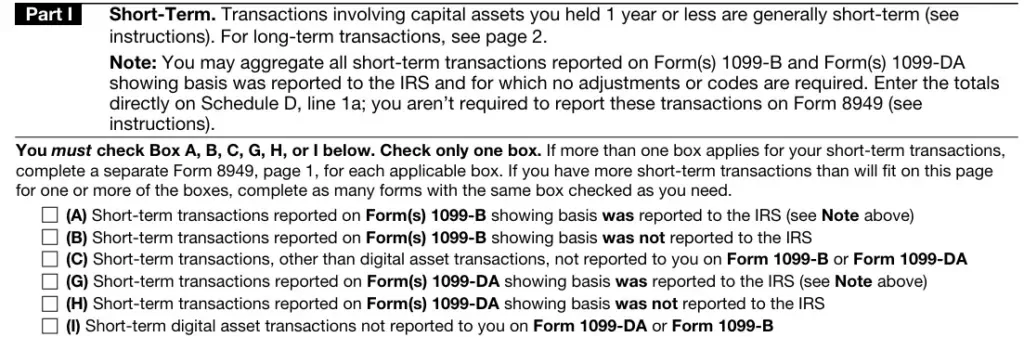
| Box | Information Return | Basis Reported to IRS |
|---|---|---|
| A | 1099-B received | Yes, basis shown and reported to IRS |
| B | 1099-B received | No, basis not shown or not reported to IRS |
| C | No 1099-B or 1099-DA received | Non-digital asset transactions only |
| G | 1099-DA received | Yes, basis shown and reported to IRS |
| H | 1099-DA received | No, basis not shown or not reported to IRS |
| I | No 1099-DA or 1099-B received | Digital asset transactions only |
Part II boxes (long-term transactions):
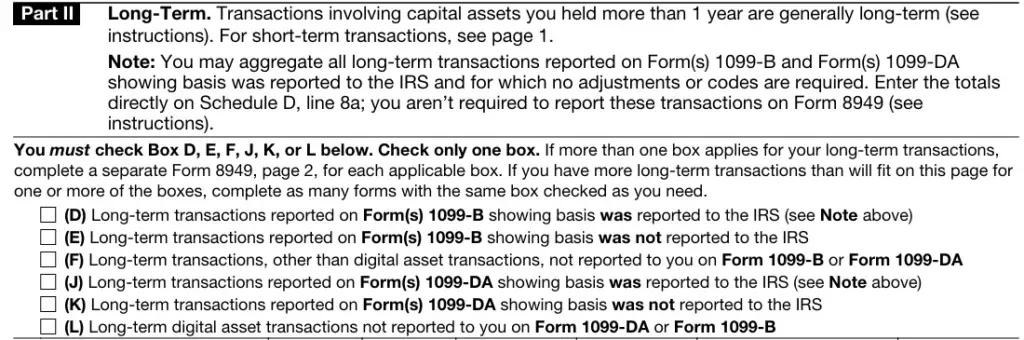
| Box | Information Return | Basis Reported to IRS |
|---|---|---|
| D | 1099-B received | Yes, basis shown and reported to IRS |
| E | 1099-B received | No, basis not shown or not reported to IRS |
| F | No 1099-B or 1099-DA received | Non-digital asset transactions only |
| J | 1099-DA received | Yes, basis shown and reported to IRS |
| K | 1099-DA received | No, basis not shown or not reported to IRS |
| L | No 1099-DA or 1099-B received | Digital asset transactions only |
Before 2025, digital asset transactions defaulted to Box C (short-term) or Box F (long-term) because no dedicated option existed. From 2025 onward, Boxes C and F are reserved for non-digital transactions only. Reporting crypto in Box C or F is now incorrect and will produce a mismatch if the broker has issued a 1099-DA.
One Box Per Client, One Category Per Form
Part I or Part II for each. A client with stocks reported on a 1099-B with basis shown, plus cryptocurrency with no 1099-DA issued, needs two separate Parts, each with one box checked. The column (h) totals from line 2 of each Part are what carry to Schedule D. All totals, across however many Parts and Forms 8949 are needed, attach to the same Schedule D.
How to Fill Each Column on Form 8949
Form 8949 has eight columns. On a clean transaction with no adjustments needed, six of them are straightforward data entry and two stay blank. The complexity sits in columns (f) and (g), covered in the next section.
Technically, the form has 16 columns in total: eight in Part I for short-term transactions and eight in Part II for long-term transactions. The columns are identical across both parts. The only difference is where the transactions go: short-term sales in Part I, long-term in Part II.
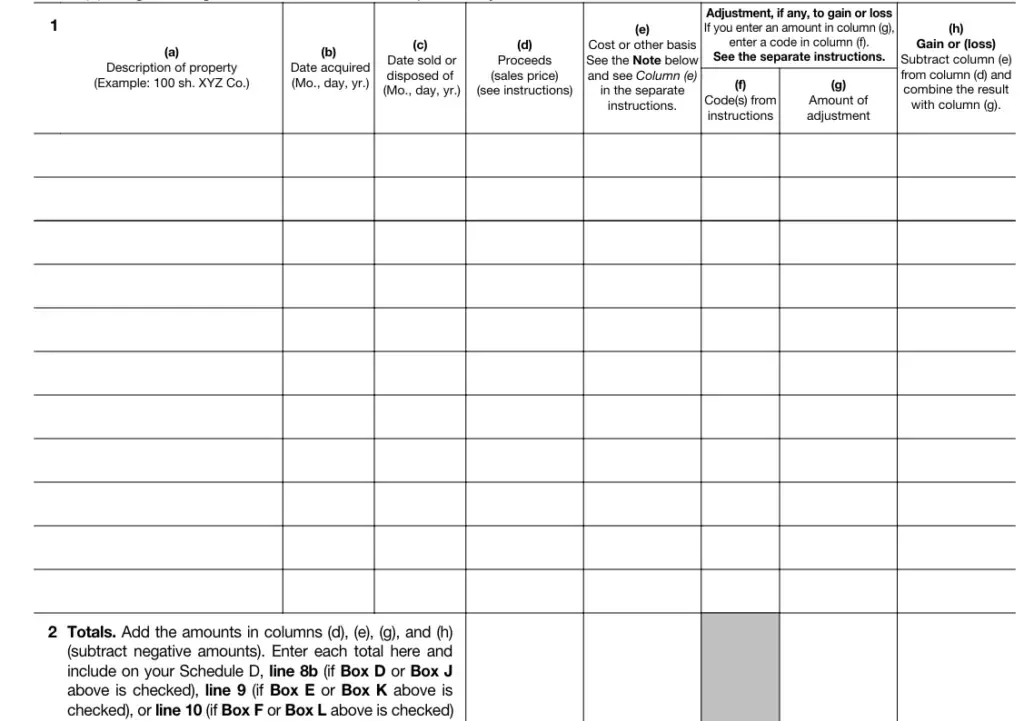
Columns (a), (b) & (c): Description, Date Acquired, Date Sold
Column (a) is the description of the property. For stocks, include the number of shares and the ticker symbol. For digital assets, include the full name or symbol, the exact number of units sold, and the transaction ID if available.
Column (b) is the acquisition date. For stocks and bonds traded on an exchange, use the trade date. Enter VARIOUS if a block of shares or digital assets was acquired across multiple purchase dates. Enter INHERITED for inherited property.
Column (c) is the disposal date. For exchange-traded securities (assets bought and sold on a stock exchange), use the trade date. For short sales, use the date the property was delivered to the broker to close the position.
Columns (d) & (e): Proceeds & Basis
Column (d) is the proceeds, meaning the sales price. If a 1099-B, 1099-DA, or 1099-S was received, enter the figure shown on that form exactly as reported, even if it is incorrect. Corrections go in column (g), not here. If no information return was received, enter net proceeds: gross proceeds minus selling expenses such as commissions and transfer taxes.
Column (e) is cost or other basis. For covered securities where the 1099-B or 1099-DA shows basis reported to the IRS, enter the basis from that form. If the basis shown is wrong, still enter it as reported and correct it via column (g) with code B. For non-covered securities, enter the correct basis directly. For inherited property, the basis is generally the fair market value at the date of death. For gifted property, the basis is generally the donor’s basis.
Digital asset basis includes the original purchase price plus transaction fees, transfer taxes, and other acquisition costs. If the asset was received as payment for services, basis is the fair market value at the time of receipt, which is also the amount reported as income.
Key Terms
- Form 1099-B – Issued by brokers for sales of traditional securities. Reports proceeds and, for covered securities, cost basis.
- Form 1099-DA – Issued by digital asset brokers from 2025 onward. Functions identically to Form 1099-B but applies to cryptocurrency and similar assets.
- Form 1099-S – Issued for real estate transactions. Reports gross proceeds from the sale.
- Covered Securities – Securities where the broker is required by law to report the cost basis to the IRS. Includes stocks acquired after 2010, certain debt instruments acquired after 2013, and digital assets acquired after 2025. If a security is covered, a basis appears on the 1099-B or 1099-DA.
- Non-Covered Securities – Securities where the broker has no obligation to report basis to the IRS. Older holdings, certain debt instruments, and assets acquired before the covered security rules applied. The basis must be determined from the client’s own records.
Columns (f) & (g): Adjustment Codes & Amounts
Most transactions leave these blank. An entry is required only when something deviates from a straight sale: the basis or proceeds shown on the information return are incorrect, a gain is being excluded or deferred, a loss is disallowed, or a special situation applies.
For example, if a client sold their main home at a gain and qualifies for the Section 121 exclusion (up to $250,000 for single filers, $500,000 for married filing jointly), the full proceeds still go in column (d) and the full basis in column (e). The excluded gain then goes in column (g) as a negative number, with code H (more on this in the next section) in column (f). Without columns (f) and (g), the return would show a taxable gain that is not actually owed.
Column (h): Gain or Loss
Subtract column (e) from column (d), then apply any adjustment from column (g). The result is the gain or loss for the transaction. Enter losses in parentheses.
Example: Proceeds in column (d) are $9,000, cost in column (e) is $5,000, and the adjustment in column (g) is ($500). Column (h) is $3,500 ($9,000 minus $5,000 minus $500).
When an Adjustment Code Is Required
An adjustment code is required when something deviates from a straight, clean sale: the basis or proceeds on the information return are incorrect; a gain is being excluded or deferred; a loss is disallowed, or a special situation, such as a wash sale or home sale exclusion, applies.
When that happens, enter the relevant code in column (f) and the dollar adjustment in column (g). When more than one code applies, enter all of them in alphabetical order with no spaces between them, and net all the adjustments into a single figure in column (g).
Below is each code, when it applies, what goes in column (g), and a note where relevant.
| Code | When It Applies | What Goes in Column (g) | Note |
|---|---|---|---|
| B | Basis shown on 1099-B or 1099-DA is incorrect | The difference between reported basis and correct basis (positive or negative) | For Box A/D/G/J: enter reported basis in col (e) and adjust here. For Box B/E/H/K: enter correct basis in col (e) and enter zero here. |
| W | Wash sale: loss is disallowed | The nondeductible loss amount as a positive number | Brokers flag this in box 1g on 1099-B. Verify across all accounts. |
| H | Main home sale with full or partial gain exclusion | The excluded gain as a negative number in parentheses | Report the full sale first, then offset. Up to $250k single / $500k MFJ (Married Filing Jointly) |
| E | Selling expenses or digital asset transaction costs not reflected on the information return | Unreflected costs as a negative number in parentheses | Common when broker reports gross proceeds but the client paid commissions separately. |
| L | Nondeductible loss (other than wash sale) | The nondeductible loss as a positive number | Used for losses on personal property sales reported via 1099-K. |
| Z | Electing to defer gain by investing in a QOF (Qualified Opportunity Fund) | The deferred gain as a negative number in parentheses | A separate row is required for the deferral. Form 8997 also required. |
| Y | Recognizing a gain previously deferred in a QOF | The previously deferred gain as a positive number | Used in the year the QOF investment is sold or the deferral period ends. |
QOF Deferral: What Else Is Required
Code Z defers the original gain, but it does not complete the filing obligation. Form 8997 (Initial and Annual Statement of Qualified Opportunity Fund Investments) is required for every year the client holds the QOF investment and for the year of disposal.
For investments made before December 31, 2026 (OZ 1.0): all deferred gains are recognized on December 31, 2026 at the latest, whether the investment has been sold or not.
For investments made on or after January 1, 2027 (OZ 2.0), the gains are deferred until the fifth anniversary of the investment date rather than a fixed deadline, and a 10% basis step-up applies after five years of holding.
How to Report 100s of Transactions on Form 8949
For a client with hundreds of standard brokerage trades and no complications, listing every transaction individually is neither required nor practical. Two exceptions exist specifically for this situation, and for most high-volume individual returns, at least one of them applies.
Exception 1: Skip Form 8949 Entirely
If every transaction in a given category meets all four of the following conditions, those transactions do not need to appear on Form 8949 at all. They go directly to Schedule D line 1a (short-term) or line 8a (long-term).
- The 1099-B or 1099-DA shows basis was reported to the IRS
- The Ordinary box in box 2 on Form 1099-B or box 6 on Form 1099-DA is not checked
- No adjustments to basis or gain or loss type are needed
- The client is not electing to defer gain into a QOF and is not terminating a prior QOF deferral
For a client with hundreds of standard stock sales through a single broker, no wash sales, and no complications, this exception typically covers the entire account. The broker’s consolidated 1099-B carries the totals and they go straight to Schedule D.
Key Terms
- Form 1099-B – It is issued by brokers for sales of traditional securities such as stocks, bonds, and mutual funds. Shows proceeds and, for covered securities, cost basis.
- Form 1099-DA – It is issued by digital asset brokers from 2025 onward for sales of cryptocurrency, NFTs, and similar assets. Functions identically to Form 1099-B.
Exception 2: Attach the Broker Statement
When Form 8949 is required but listing each trade individually would be impractical, attach the broker’s own consolidated statement instead of transcribing every row. On Form 8949, enter the broker’s name followed by see attached statement in column (a), leave columns (b) and (c) blank, enter code M in column (f), and enter the totals in columns (d), (e), (g), and (h). If statements come from more than one broker, report each broker’s totals on a separate row.
Exception 2 is not available for QOF deferral elections. Those must be reported transaction by transaction, with a separate row for each QOF investment.
Where Do Form 8949 Totals Go on Schedule D?
The line 2 totals from Form 8949 carry to specific lines on Schedule D depending on which box was checked. The column (h) total on Form 8949 line 2 must reconcile with the combined columns (d), (e), and (g) on the corresponding Schedule D line.
| Box Checked on Form 8949 | Carries to Schedule D Line |
|---|---|
| A or G (short-term, basis reported) | Line 1b |
| B or H (short-term, basis not reported) | Line 2 |
| C or I (short-term, no information return) | Line 3 |
| D or J (long-term, basis reported) | Line 8b |
| E or K (long-term, basis not reported) | Line 9 |
| F or L (long-term, no information return) | Line 10 |
Further Reading
- Free Fillable IRS Forms: What They Are and Where to Find Them in 2026 – Where to access every IRS form at no cost, which are available as interactive PDFs, and how the Free File Fillable Forms program works.
- How to Order IRS Forms by Mail in 2026 – Step-by-step guide to requesting physical forms and publications, including ordering limits and delivery timelines.
- Form 1040: What Tax Practitioners Need to Know Before Filing Season – How Schedule D and Form 8949 connect to the return, and what to watch for before filing season starts.
- IRS W-9 Form: What It Is and How to Fill It Out Correctly (2026) – When to request a W-9, what it collects, and how to handle backup withholding situations.
- 2025 Form 8949 – The official IRS form for reporting sales and dispositions of capital assets, as released by the Department of the Treasury.
- Instructions for Form 8949 (2025) – The official IRS instructions covering every box, column, adjustment code, and exception on the 2025 form.
Conclusion
As heavy as Form 8949 looks, filling it is relatively straightforward once the logic clicks.
The form requires details of every capital asset your client disposed of during the year, short-term and long-term. The only exception is transactions that meet all three of the following:
- The broker reported the basis to the IRS
- No adjustments are needed
- No QOF election is involved
Those bypass the form entirely and go straight to Schedule D.
For everything else, there are eight columns: description, dates, proceeds, basis, any adjustment codes and amounts, and the resulting gain or loss. You fill them in for every transaction, or if volume makes that impractical, you attach the broker statement and enter the totals.
Get the box right, get the columns right, and the totals carry cleanly to Schedule D. That is the whole job.