
AI & RegTech: How Technology Is Transforming AML Compliance in 2026
Discover how AI and RegTech are reshaping AML compliance in 2026. Learn how you can use FigsFlow to improve due diligence.
Your competitor down the street just onboarded three clients during their morning coffee.
They verified IDs in seconds, screened sanctions lists in real time, and completed their identity and screening checks before the discovery call ended. Meanwhile, you’re still chasing passport copies via email and manually checking sanction databases with CTRL+F.
You’re not just slower. You’re at risk.
Manual compliance creates audit trail gaps, delays client onboarding, and makes growth impossible. Every hour you spend on compliance paperwork is an hour your RegTech-equipped competitor spends on billable work.
This Guide explains what RegTech is, how AI-powered platforms are transforming AML compliance for UK accountants, and how you can leapfrog competitors still trapped in manual processes. It forms part of our wider AML compliance guide for professional services, which sets out the full MLR 2017 framework.
Key Points Summarised
- RegTech uses artificial intelligence and machine learning to automate regulatory compliance processes that traditionally required manual intervention
- Manual AML compliance can create significant administrative overhead and gaps in the audit trail; the worked example below illustrates how the cost might add up for a firm onboarding 40 clients a year
- The MLR 2017 requires firms to verify identity using reliable, independent sources. Firms may use suitable electronic verification or appropriate documentary checks, depending on risk, and remain responsible for their customer due diligence
- Effective RegTech solutions integrate client onboarding, identity verification, PEP screening, risk assessment, and audit trails in unified workflows
- Cost structures have evolved from enterprise-only pricing to accessible models from £24 a month (billed annually) for small and medium accounting practices, with AML checks from £3.50 each
- Implementation time varies by platform and firm: cloud-based tools can often be activated quickly, while firms moving from fully manual processes may need a few weeks to set up and migrate
- Audit trail automation helps close the gap between holding documents and being able to evidence how and when you verified them
What Is RegTech?
Regulatory Technology, known as RegTech, represents the convergence of compliance requirements and automation capabilities. It uses cloud computing, big data analytics, and machine learning algorithms to help regulated businesses meet their legal obligations efficiently.
The term “RegTech” emerged after the 2008 financial crisis when regulatory requirements expanded dramatically across the financial services sector. Traditional compliance approaches couldn’t scale to handle the volume and complexity of new obligations.
For UK accountants, RegTech specifically addresses Money Laundering Regulations 2017 obligations:
- Customer Due Diligence
- beneficial ownership identification
- PEP screening
- sanctions checking
- ongoing monitoring
The Technology has evolved from simple database lookups to sophisticated AI systems. Modern platforms analyse unstructured data like company incorporation documents, cross-reference multiple databases simultaneously, and generate timestamped audit trails automatically. For a closer look at the checks involved, see What Is an AML Check? and Top 7 KYC Trends That Will Shape Compliance in 2026.
CDD vs EDD: What’s the Difference?
Learn what Customer Due Diligence and Enhanced Due Diligence actually mean for UK bookkeepers.
The Real Cost of Manual AML Compliance
You think manual AML compliance might cost you around 6 hours weekly (an illustrative estimate). Maybe £6,500 annually in staff time if you’re tracking it properly.
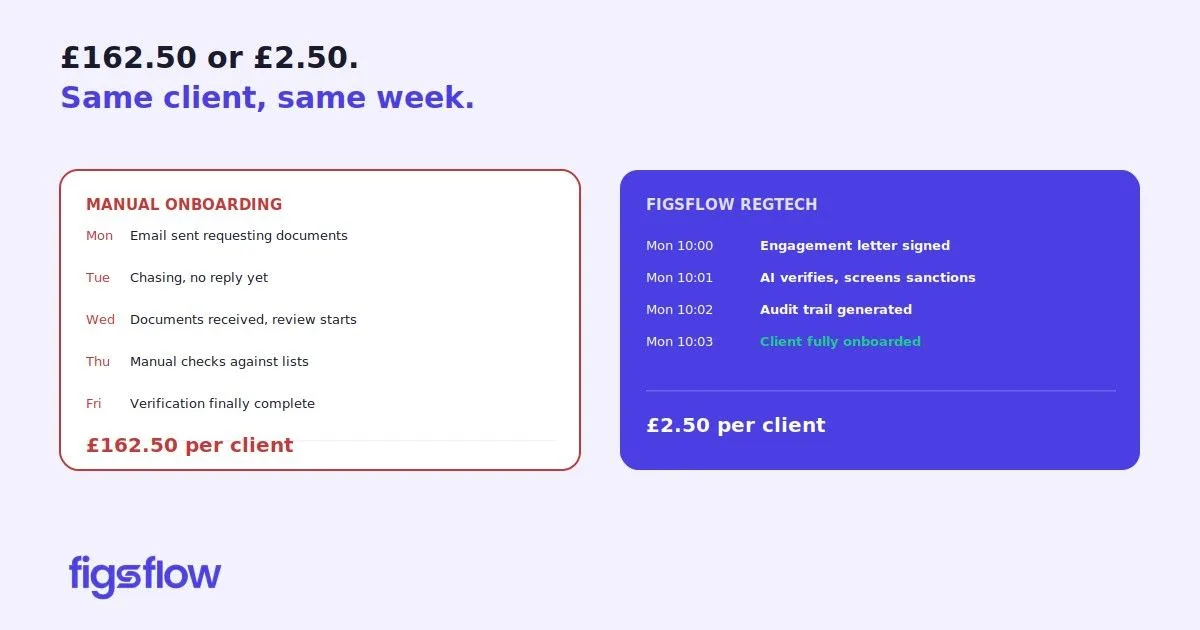
That’s what shows up on your timesheets. Here’s what might happen when a new client signs your engagement letter. This is an illustrative scenario rather than survey data, and actual time and cost will vary by firm, client risk and the checks required:
The Real Timeline of Manual Onboarding
- Monday 10:15 AM – You email requesting passport, proof of address, and company documents.
[Staff time: 15 minutes | Cost: £12.50] - Tuesday 2:30 PM – Client replies. The passport photo is blurry. You email back asking for a clearer copy.
[Staff time: 10 minutes | Cost: £8.33] - Wednesday – Nothing. You send a follow-up.
[Staff time: 5 minutes | Cost: £4.17] - Thursday, 11 AM – New documents arrive. You download them, check the passport number manually on a government website, search three different PEP databases, and fill out your risk assessment spreadsheet.
[Staff time: 90 minutes | Cost: £75] - Thursday, 3 PM – You realise this is a property development company. Enhanced Due Diligence required. You need partner approval, but she’s in client meetings all afternoon.
[Staff time: 20 minutes preparing approval request | Cost: £16.67] - Friday morning – Partner reviews your documentation and approves. You file everything in the shared drive folder labelled “2025 Clients New.”
[Partner time: 15 minutes (£37.50) | Your time: 10 minutes filing (£8.33)]
Total direct Cost per client: £162.50
Time elapsed: Five days
Revenue delay: One week minimum
Meanwhile, your competitor is using RegTech.
Client signed on Monday at 10 AM. AI verified documents, screened databases, generated risk assessment, flagged Enhanced Due Diligence, and created an audit trail by 10:03 AM. Partner approved via mobile notification.
Platform cost: £3.50 | Staff time: 3 minutes | Revenue delay: Zero
That’s not efficiency. That’s a different business model entirely.
Multiply £162.50 by 40 new clients annually. You’re spending £6,500 on compliance administration that your RegTech competitor handles for £320 a year (40 checks at £3.50, plus the £15-a-month Compliance Programme).
The Compliance Failure Nobody Sees Coming
Six months later, HMRC requests your CDD records for that client. You know you did the checks. You remember doing them. But now you need to prove it.
- Where’s the evidence that you verified the passport electronically?
- The timestamp shows you checked sanctions lists before providing services?
- The documentation of why you classified this as high-risk?
It exists. Somewhere. Across seventeen email threads, three folders, and that spreadsheet someone renamed last month.
Reconstructing records for HMRC: 3 hours per client, £150
Discovering you can’t prove the verification sequence: Potential regulatory breach
Manual compliance doesn’t just waste time. It creates evidence gaps that look like compliance failures during supervision visits.
How AI & RegTech Solve the Core Problems
Manual compliance fails because humans can’t scale systematic processes across dozens of clients simultaneously. We forget steps. We apply criteria inconsistently. We can’t monitor changing circumstances in real-time. We create evidence gaps without realising it.
AI-powered RegTech doesn’t just digitise manual processes. It eliminates the fundamental limitations that make manual compliance unreliable at scale.
| Compliance Task | Manual Process | AI/RegTech Solution | Actual Impact |
|---|---|---|---|
| Identity Verification | Visual inspection of documents (30-45 minutes per client) | Automated verification against government databases | Documents verified in 30 seconds with tamper detection and an audit trail |
| PEP Screening | Manually searching outdated lists, missing name variations | Real-time API screening across updated global databases | Can surface matches that manual searches miss and updates as lists change |
| Sanctions Checking | CTRL+F through database websites, one at a time | Simultaneous cross-referencing of multiple sanction lists | Complete screening in seconds with timestamped evidence |
| Risk Assessment | Spreadsheet-based, applied inconsistently | Algorithmic scoring using predefined criteria | Every client is scored against the same predefined criteria, with the firm reviewing and deciding the final risk assessment |
| Source of Funds Verification | Email explanations that clients don't understand | Structured workflows with context-specific prompts | Clients provide correct documentation the first time |
| Enhanced Due Diligence Triggers | Someone remembers to apply them (sometimes) | Automatic flagging of potential EDD triggers based on configured risk indicators | Reduces the risk of missing EDD triggers, although the firm still decides when EDD applies |
| Ongoing Monitoring | Doesn't happen after onboarding | Automated ongoing screening and monitoring of existing clients | Can alert you when client circumstances change |
| Audit Trails | Reconstructed from fragments during HMRC visits | Auto-generated timestamps for every action | A timestamped record of what was checked, when, and by whom |
The Technology doesn’t replace professional judgment. It handles repeatable verification tasks so you can focus on what actually requires expertise: interpreting results, assessing unusual circumstances, and making risk-based decisions about client relationships.
What to Look for in a RegTech Solution
Not all RegTech platforms are created equal. Some were built for US regulations and poorly adapted for UK requirements. Others are just cloud storage with a compliance label.
The difference between effective RegTech and expensive paperwork comes down to what the platform actually does versus what it claims to do. Use this checklist to compare solutions. It combines AML functionality, operational convenience and security considerations. These are software-selection criteria, not a list of requirements imposed in full by the MLR 2017:
RegTech Platform Comparison Checklist
| Essential Capability | Software A: _______________ | Software B: _______________ |
|---|---|---|
| Built specifically for MLR 2017 (not adapted from US regulations) | ☐ Yes ☐ No | ☐ Yes ☐ No |
| Automated KYC verification against government databases | ☐ Yes ☐ No | ☐ Yes ☐ No |
| Real-time PEP and sanctions screening | ☐ Yes ☐ No | ☐ Yes ☐ No |
| Automated risk assessment with EDD triggers | ☐ Yes ☐ No | ☐ Yes ☐ No |
| Ongoing monitoring (not just one-time checks) | ☐ Yes ☐ No | ☐ Yes ☐ No |
| Engagement letter and e-signature capability | ☐ Yes ☐ No | ☐ Yes ☐ No |
| Integration with accounting software (Xero/QuickBooks/Sage) | ☐ Yes ☐ No | ☐ Yes ☐ No |
| Auto-generated audit trails with timestamps | ☐ Yes ☐ No | ☐ Yes ☐ No |
| Complete compliance documentation retrievable in under 5 minutes | ☐ Yes ☐ No | ☐ Yes ☐ No |
| GDPR-compliant data handling, with clear information on where data is stored | ☐ Yes ☐ No | ☐ Yes ☐ No |
| SOC 2 certified or equivalent security | ☐ Yes ☐ No | ☐ Yes ☐ No |
| Transparent pricing with no hidden fees | ☐ Yes ☐ No | ☐ Yes ☐ No |
| Total "Yes" boxes: | ______ / 12 | ______ / 12 |
No platform checks every box perfectly. But if you’re evaluating solutions that score below 9 out of 12 (our own rule of thumb, not a regulatory threshold), you’re looking at digitised paperwork, not genuine RegTech. Go for the one that checks most boxes and solves your biggest compliance pain points first.
Introducing FigsFlow: RegTech That Checks 12 Boxes
FigsFlow was built by accountants frustrated with compliance software designed for banks and awkwardly adapted for accounting practices. It’s purpose-built for UK accountants who need MLR 2017 compliance without enterprise complexity or enterprise pricing.
What FigsFlow Actually Does:
- Complete Workflow Integration – Proposals, engagement letters, e-signatures, AML verification, and ongoing monitoring in one platform (no switching between systems)
- 30-second Identity Verification – Electronic verification against government databases, not 45-minute manual checks
- Automatic Compliance Triggers – Client signs engagement letter, CDD workflows start automatically
- Real-Time Screening – PEP lists, sanctions databases, and Companies House data through unified APIs
- Sector-Specific Risk Templates – Property portfolios, trusts, high-net-worth clients following HMRC guidance
- Auto-Generated Audit Trails – Every check is timestamped and documented permanently
- Accessible Pricing – Onboarding from £24 a month (billed annually); AML checks from £3.50 each on the £15-a-month Compliance Programme (£3.00 from your 100th check). Prices exclude VAT
FigsFlow doesn’t just check boxes on the evaluation list. It solves the fundamental problems that make manual compliance unreliable: scattered documentation, inconsistent processes, evidence gaps, and time you can’t afford to waste.
Getting Started: Your First Steps
The first step isn’t implementing new software. It’s seeing what manual compliance is actually costing you.
Book a demo with a leading RegTech solution. Watch 30-second identity verification versus your 45-minute manual checks. Compare automated PEP screening to CTRL+F searches. See auto-generated audit trails versus reconstructing records from email fragments.
During the demo, calculate your real costs: staff time chasing documents, qualified accountant hours on admin work, and revenue delays from slow onboarding. The comparison makes the decision obvious.
Ready to Take Your First Step?
Book a FigsFlow demo. See complete client onboarding from proposal to completed AML checks before your coffee ends.
Additional Resources
- Economic Crime Supervision Handbook: Economic Crime Supervision Handbook – HMRC internal manual – GOV.UK
- Verify Client Identity for AML Compliance: Verify Client Identity in AML: Step‑by‑Step Guide | FigsFlow
- Complete Guide to ID Verification in FigsFlow: ID Verification & AML: 2025 Guide | FigsFlow
- 2025 Guide to AML & ID Verification Rules for Accountants: 2025 Anti-Money Laundering ID Check Guide for Accountants in the UK – FigsFlow
- AML Compliance: A Comprehensive Guide for Professional Services: Complete Guide to AML Compliance for Professional Services
- What Is Money Laundering? What Is Money Laundering? Definition, Process & Examples
- Counter Proliferation Financing: What Is Counter Proliferation Financing & What Do UK Accountants Need to Know?
- Money Laundering Offences: Money Laundering Offences for Accountants: Penalties and Defences Under POCA 2002
Conclusion
Manual compliance breaks down at scale. What works for 20 clients fails at 100.
The question isn’t whether to adopt RegTech, but when. Every month you delay wastes accountant time on tasks that Technology handles better. HMRC supervision keeps tightening. Penalties for poor audit trails dwarf software costs.
Your competitors are already faster. Lead the transition or scramble to catch up later. To see how technology fits into the wider risk picture, read our guide to counter proliferation financing for UK accountants.
Start Your Free Trial Today
Test FigsFlow for 30 days. No payment details. No obligation.
Verify 30-second verification. Test real scenarios. See actual time savings.